
Sabitlenmiş Tweet

Fusion (by IPOR)
4.9K posts

@ipor_io
Onchain vault infrastructure for institutional-grade yield. Build, white-label, and earn. Explore existing strategies in the Fusion App.

Earning ETH Yield with ARM, Liquid Staking, and Upcoming Origin Vaults ft. @ipor_io x.com/i/broadcasts/1…


Compliant vault infrastructure is not a positioning statement. It is an architecture decision. @DarrenCamas has been building in crypto since 2011 and with @Ipor_io Fusion, he's become one of the people actual solving it. He joins Vault Summit NYC. June 5, NYC · vaultsummit.xyz
Credit markets across the onchain economy are stabilizing. Borrow rates returning to normal ranges, exit queues clearing, leverage strategies coming back to positive territory. All Fusion-powered vaults remained fully accessible to users throughout the volatility.



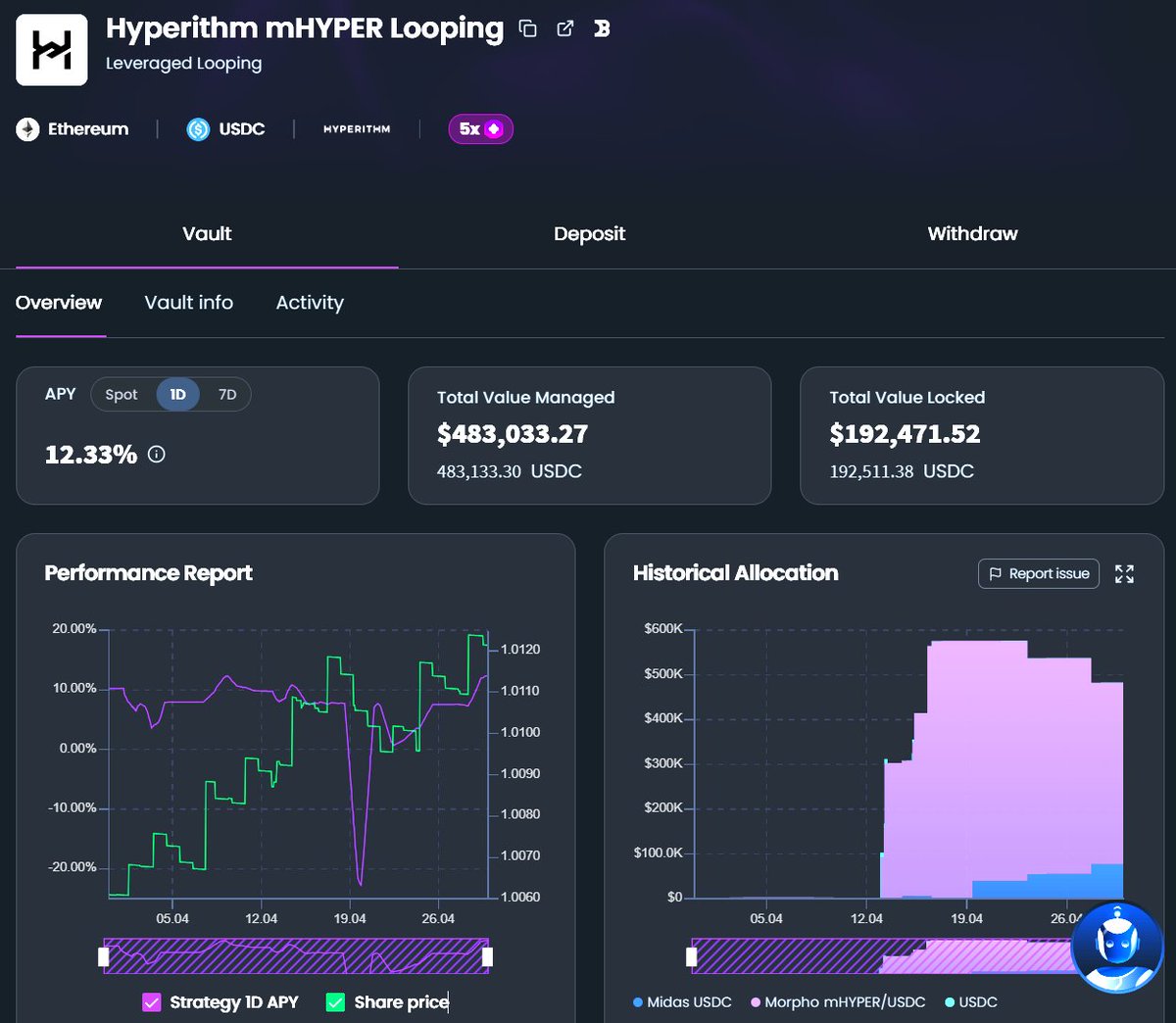
Looped Exposure Accounting: same question at a different layer. Fusion addressed it at the vault level. Total Value Locked (deposits) and Total Value Managed (with leverage) are separate metrics, making looped exposure directly measurable. Walking through the approach below ↓
Tokenized RWAs are under $1T today, but projected to reach $16T this decade. Join this RWA Megaspace on 24th April to upack: 🔹 Where tokenization stands today 🔸 How leading teams are building toward scale 40 speakers. 10 panels. One Space! RSVP 👇 x.com/i/spaces/1DxLd…


Unwinding AavEthena Loops during a storm tl;dr • No TAU vaults had exposure to rsETH • No user funds were at risk at any time • Increase in the USDe borrow rate turned looping APY negative • We adjusted entry and exit fees to account for the higher slippage for sUSDe swaps • Requested withdrawals were all processed with minimal impact on withdrawers and no impact on the vault Full story TAU Labs curates two AavEthena vaults, one on Mainnet and one on Plasma. These vaults run a leveraged yield strategy on USDe and sUSDe using Aave on Ethereum. The strategy’s collateral consists of 45% USDe and 55% sUSDe to borrow USDT and leverage up collateral positions to 9.5x (89.5% LTV) The rsETH incident cascaded through Aave, causing borrow rates for USDe to spike violently. For automated looping strategies, this created a critical inflection point where borrow rates of 15% turned yield deeply negative during a protocol-wide liquidity crunch In this situation, loopers have two options: • Immediate Deleveraging: Exiting the position immediately, which requires eating significant slippage to "unwind" the loop in a thin market • Maintaining the position and hoping for rate stabilization, while incurring a daily negative carry that could eventually exceed the cost of an immediate exit if it persists for longer than expected (uncertainty) In this case, TAU decided to let users make the choice themselves while creating the best possible environment within bad market conditions. Since saturday night, we have worked with withdrawers to allow them to exit the vault with the least possible slippage while protecting the vault from any potential losses ("fair exit system"). To do so, we had to increase the onboarding and offboarding fees to match the new liquidity conditions for sUSDe which showed higher slippage during times of distress. We calculated the real-time cost of deleveraging and applied it directly to the withdrawing capital. Withdrawers were able to exit the Mainnet vault with a 1.25% - 2.3% haircut. Withdrawals from the Plasma vault ate ~3% haircut due to the more limited liquidity conditions on the chain. If we would have kept the original entry and exit fees, any slippage exceeding these fees would have socialized losses across remaining depositors 1. Early withdrawers exit at an artificially low cost. 2. The remaining users effectively "subsidize" those exits. 3. The vault's NAV (Net Asset Value) drops for those who stay This would have ultimately resulted in a PVP environment and potential bank run where the last user left eats the most losses. Especially, smaller-capital positions would've taken on the slippage created by large withdrawals. We intentionally delayed broad communication until the mechanism was fully validated and withdrawal processing was underway. This prevented an "exit panic" while we were refining the calculations, ensuring that no user could front-run the queue or exploit the vault’s liquidity before the new fee structures were live. shoutout to the @ipor_io team for the help along the way

You can’t tell how much TVL in a protocol is due to looping just by looking at the deposits and debts. An account with $100 deposits $80 debts Could be zero loops or ten loops. Leverage can only be understood if you reconstruct an account’s entire history. But leverage doesn’t just exist within a single protocol. Borrowing on Aave and depositing the borrowed assets on Morpho to borrow again is also leverage. Neither Aave nor Morpho numbers reflect the leverage. Many of the largest projects in DeFi do a form of cross protocol looping. The real TVL in DeFi is a fraction of what the headline numbers show. DeFi Llama tries to help with these but it’s an almost impossible task to do it with 100% accuracy.