IT Revolution

12.4K posts

IT Revolution banner
IT Revolution

IT Revolution

@ITRevBooks

Helping technology leaders succeed through books (The Phoenix Project, Team Topologies), events (@ITRevSummit), research, podcasts (#TheIdealcast), and more.

Portland, OR Katılım Temmuz 2017
661 Takip Edilen6.6K Takipçiler
Sabitlenmiş Tweet
IT Revolution
IT Revolution@ITRevBooks·
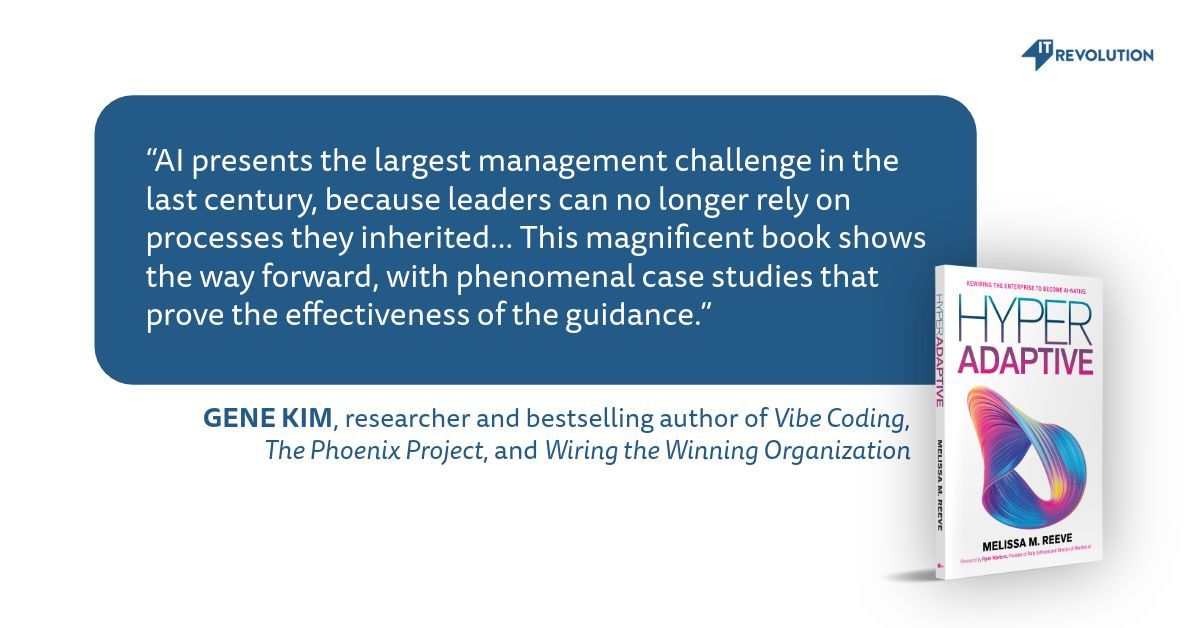
We’re excited to unveil the cover (and final title) for the groundbreaking new book from industry titans @RealGeneKim and @Steve_Yegge, releasing this fall! Vibe Coding: Building Production-Grade Software With GenAI, Chat, Agents, and Beyond isn’t just another tech book—it’s the essential guide that merges decades of hard-won wisdom with today’s most revolutionary advances in AI-assisted development. This is the playbook you’ve been waiting for: discover how to harness GenAI to elevate your code quality, supercharge your productivity, and reignite that spark of joy in programming that first drew you to the keyboard. And just look at that cover! Preorder now: buff.ly/rlbA12i Your dev team will thank you for getting ahead of the curve. #VibeCoding #ITRevolution #FutureOfCoding #GenAI
IT Revolution tweet media
English
5
7
41
20.6K
IT Revolution
IT Revolution@ITRevBooks·
Most AI initiatives stall in the messy middle — where people, roles, incentives, and culture collide with new technology. In her episode of GAEA Talks, Melissa M. Reeve explains why that's where the real transformation work happens. Drawing on her background in the Toyota Production System, agile scaling, and enterprise change, she outlines the structural and cultural shifts organizations must make to move from isolated AI experiments to becoming truly adaptive, learning enterprises. It is a candid look at what AI adoption at scale actually requires from leadership. Watch the full episode here. itrev.io/4tpr0ea
IT Revolution tweet media
English
0
0
0
26
IT Revolution
IT Revolution@ITRevBooks·
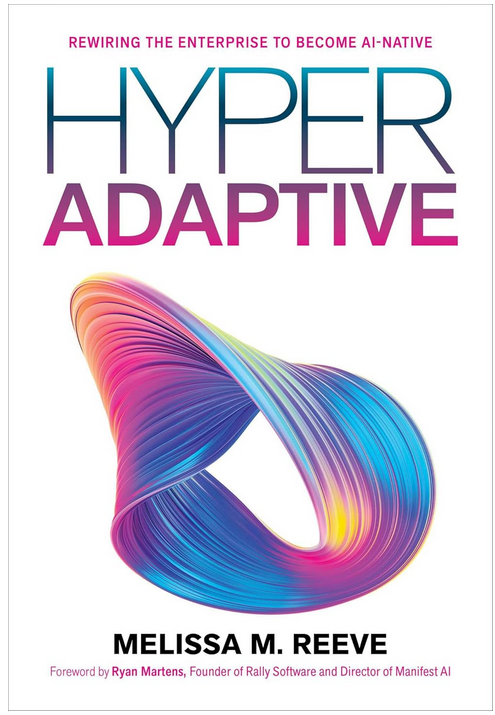
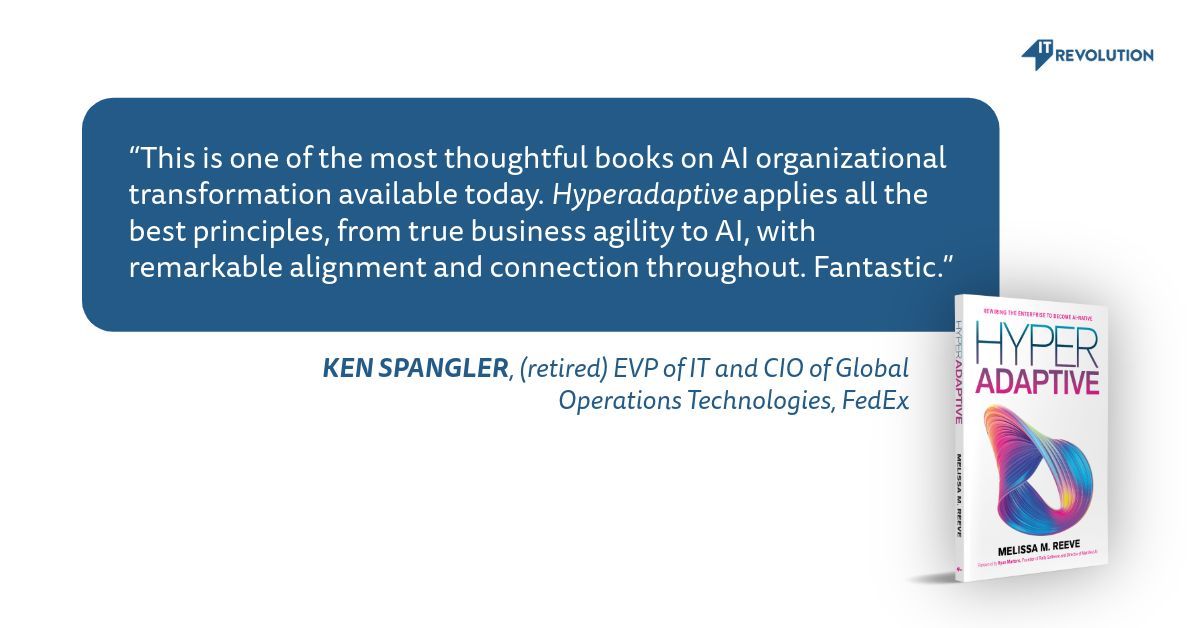
AI transformation at organizational scale requires a different kind of support—and a different preorder package. The Enterprise package for Melissa M. Reeve's Hyperadaptive includes a private 60-minute Executive Briefing, the complete suite of tools from every lower tier, and paid Substack community access. Estimated value: $5,775. For organizations moving beyond pilots toward a true AI-native operating model, this is where the real work begins. Contact Melissa for enterprise access: itrev.io/3Mho16S
IT Revolution tweet media
English
0
0
0
57
IT Revolution
IT Revolution@ITRevBooks·
"But by early 2024, I had started to worry that I could no longer make good decisions as a technology leader unless I deeply understood the radical technology change that was transpiring. I was leading, but without coding, I was leading from the sidelines." —Vibe Coding by Gene Kim and Steve Yegge
IT Revolution tweet media
English
0
0
1
52
IT Revolution
IT Revolution@ITRevBooks·
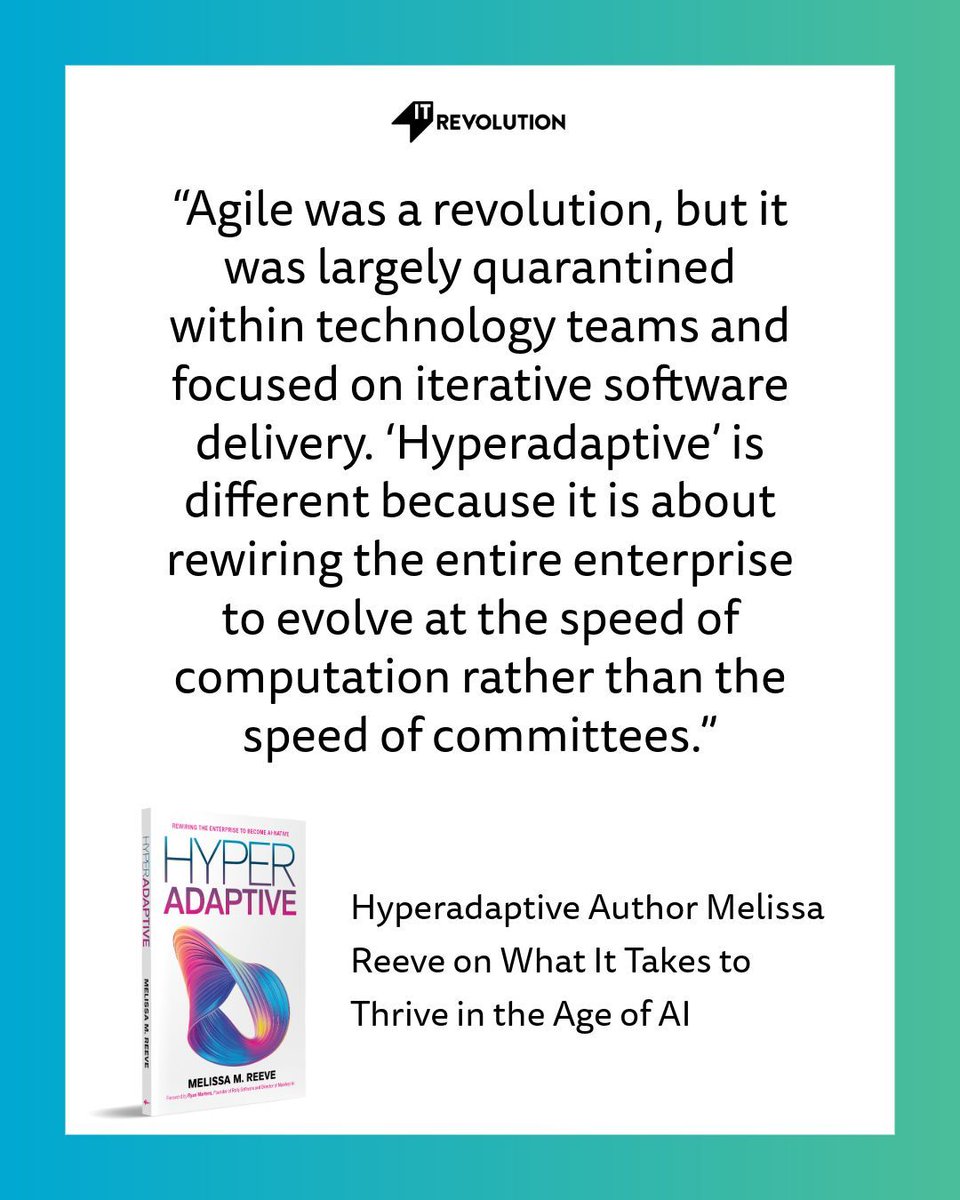
AI transformation isn't about the technology. It's about building the organizational operating system that allows the technology to work. itrev.io/4utyAoI
IT Revolution tweet media
English
0
1
1
61
IT Revolution retweetledi
Gene Kim
Gene Kim@RealGeneKim·
"AI cannot hear. It cannot suffer. It cannot create." That was part of the best argument against AI I've heard in years — from a 17-year-old bass guitarist at a high school speech tournament. He gave a riveting 7-minute talk—and perfectly captured why I think so many smart people are resisting AI and why that resistance won't save them. He was arguing in favor of Sweden banning AI-generated songs from its official top music charts — think Sweden's equivalent of the Billboard Hot 100 — to protect real musicians from being displaced by machines. As a trained bass guitarist, he argued that AI can't hear the music it just wrote. It can't want, can't be afraid, can't be lonely. And therefore, AI can't participate in the lived experience of music. He also argued that AI jeopardized the careers of session musicians — the hired guns who aren't in the band but shape the sound in the studio. He pointed to Larnell Lewis, a Grammy-winning drummer who started as a session player before joining Snarky Puppy, as proof that session work can be a pipeline for greatness. I understood his perspective completely, even though I disagreed. His argument was beautiful and principled. But I'm certain his idealistic worldview will be completely steamrolled by the same economic forces that replaced horses with automobiles and telephone operators with automated switches. The horses didn't get a vote. I texted Brendan Hopper and Steve Yegge, because they're both musicians. Brendan's reaction was visceral: "This makes me so angry." Brendan is someone who loves music but understands economics. Yesterday, I shared this story with Doug Finke. His reaction: Steam-powered looms replaced weavers. IBM's MICR check-sorting machines replaced thousands of bank clerks. Drum machines replaced the majority of studio drummers. He said what makes AI automation so different is speed. Unlike previous technology revolutions, this isn't a 20-year transition. It's the "supersonic tsunami." We dismiss something around AI as "just a toy," and 3-6 months later, it's disrupting entire industries. By the time you see the wave, it's already too late to outrun it. Small AI-augmented teams can do what once required entire departments. Among others, Block recently announced that they're reducing headcount by 40%, increasing profitability, with the hopes of going even faster. Leaders can't force a mindset change. But they have an obligation to make the wave impossible to ignore — to show their people what's coming, while there's still time to learn to surf. What are you doing to help the people around you see the wave coming? And fortunately for all of us, this is one of the major themes at the upcoming Enterprise AI Summit, how leaders help people adapt without denial or panic. You'll hear leaders present on these topics from OpenAI, Amazon, Disney, Block, Netflix and more. Full program below — see you there!
English
2
2
19
2.8K
IT Revolution
IT Revolution@ITRevBooks·
AI telemetry engines, value stream teams, strategic specialists—Stage 4 transformation looks very different from where most orgs are today. A 5-stage framework can show the path. itrev.io/4utyAoI
IT Revolution tweet media
English
0
0
0
74
IT Revolution retweetledi
Gene Kim
Gene Kim@RealGeneKim·
I was awed and amazed while pair-programming with Hal Evans. He's a developer trained as a mechanical engineer — no CS degree, never heard of Clojure or Rich Hickey — who quickly grasped a principle that took me twenty years to learn. The result: he reduced a 4.5-hour database operation to 12 minutes using Claude Code — a 22x speedup. Hal and Sam Sutton support an application used by major grocery retailers to model costs for prepackaged meals — raw materials, processing, labor, packaging, waste — so purchasing teams can make better decisions. We were trying to solve performance problems — users reported extremely slow operations, with many queries hitting 30-second timeouts. But developers couldn't reproduce the issue because they lacked realistic production-like data. Database seeding was painfully slow: 4.5 hours. So developers rarely ran it — and the data looked like test data (e.g., "concrete pizza"). I immediately thought of the legendary performance maven Casey Muratori. His principle: before you optimize, calculate the theoretical minimum. Hal and I did the math. If we created all entities in memory and saved them in one batch, the floor was about 3 seconds. The actual time? 4.5 hours. We were orders of magnitude away. The root cause: it was impossible to separate entity creation from database insertion. Every single entity was built and immediately saved to the database, one at a time, on a single thread, on a 16-core machine. This is what Rich Hickey (the creator of Clojure) calls "complecting" — braiding together things that should be separate. The fix: we used Claude Code to separate "pure" construction from the "side-effect" of persistence. Claude created a hierarchy of entities based on foreign key dependencies: - Level 0: Entities with no foreign keys (currencies, exchange rates) - Level 1 :(suppliers, base categories) - Level 2: (products, ingredients) - Levels 3–11: Progressively more complex aggregates Once separated, we could build everything in memory (~3 seconds), then flush to the database level by level, respecting foreign key dependencies. Full seed: 10 minutes → 60 seconds (10x). Load seed: 4.5 hours → 12 minutes (22x). What's exciting: we are creating a new generation of developers who will be able to apply concepts such as pure functions vs. side effects, level-based dependencies, and decoupling construction from persistence — using AI models as architectural advisors, not just code generators. I'm so thrilled that Ben Grinnell FBCS (Board Member, Capabilities and AI) and Tom Kilcommons (AI Innovation Lead) from Newton Consulting will be presenting about this and more at EAIS San Jose. If you want to see how they're operationalizing this kind of performance engineering with AI, you need to see their talk. If you're wrestling with problems like this, you'll see concrete patterns from leaders at OpenAI, Amazon, Disney, and Netflix. Full program below — see you there!
English
5
6
52
6.9K
IT Revolution
IT Revolution@ITRevBooks·
Automating processes you haven't examined yet isn't a shortcut—it's a liability. The organizations winning with AI optimize first, then automate. itrev.io/4utyAoI
IT Revolution tweet media
English
0
1
1
61
IT Revolution
IT Revolution@ITRevBooks·
Overly restrictive AI governance blocks experimentation. Data quality issues kill pilots. Leaders who talk AI but don't sponsor it stall progress. If this sounds familiar, the foundation needs work. itrev.io/4utyAoI
IT Revolution tweet media
English
0
0
0
66
IT Revolution
IT Revolution@ITRevBooks·
Marketing at Stage 3. Operations at Stage 1. Both are normal—but only if leadership knows the difference. Does yours? itrev.io/4utyAoI
IT Revolution tweet media
English
0
0
1
59
IT Revolution
IT Revolution@ITRevBooks·
The goal of AI transformation isn't Stage 5. It's continuous, honest progression through the capabilities that actually matter for your organization right now. itrev.io/4utyAoI
IT Revolution tweet media
English
0
0
1
56
IT Revolution
IT Revolution@ITRevBooks·
"We genuinely believe that if you wait until the technology stabilizes, you are at risk of being left behind. By learning these techniques now, you’ll be positioned to adapt as the tools evolve, rather than scrambling to catch up when your competitors have already mastered them." —Vibe Coding by Gene Kim and Steve Yegge
IT Revolution tweet media
English
0
1
1
57
IT Revolution retweetledi
Gene Kim
Gene Kim@RealGeneKim·
In 6 hours, I helped my friend Yaz build what an external firm quoted as ~20 FTE days of Azure Batch infrastructure work — and we spent at least half that time waiting (permissions, quotas, RBAC). She built a complete end-to-end Azure Batch pipeline: SimPy containers built and deployed, batch pools provisioned, blob storage for input and output, and a way to create and monitor jobs. Lesson: the bottleneck wasn't writing code. It was getting permissions, quotas, resources, and meeting governance standards. The final boss? Azure role-based access controls. A sampling of the challenges. - UK South: out of vCPUs, no batch pools - Sweden Central: vCPUs available, but batch pool quota set to zero - Lack of subscription owner permissions - Have permissions, but elevated roles had already expired Yaz was helping a major retailer run supply-chain simulations that were taking hours or days on a laptop. She wanted to fire dozens of jobs into the cloud so the team could iterate on "what if" questions fast enough to actually matter. Some sessions were amazing, building out infrastructure at lightning speed. Yaz said that it felt like "breaking through an invisible barrier." In contrast, our third session was nothing but barriers (ha!), mostly beyond our control. Thankfully, the person in charge of security was on-call and joined our session, and could see the problems we were having. He was opening support tickets to Microsoft and responding to their questions in real-time. The idea of having security on-call during pairing sessions came from Ben Grinnell (Board Member, Capabilities and AI) at Newton Consulting. What a fantastic idea—if you know you'll get stuck on RBAC/quotas, make sure you unblock it in real time. A group CTO from a private equity firm said problems like these will pose the greatest leadership challenge of the last 100 years. That's a bold claim. But in 15 minutes, he convinced me. His argument: every two-day delay used to be tolerable because it was just one of a hundred things that each delayed us two days. Now that coding is instantaneous, those delays are all that's left. It's literally all wait time. I'm so delighted that Ben Grinnell (Board Member, Capabilities and AI) and Tom Kilcommons (AI Innovation Lead) from Newton Consulting will present on their novel AI practices to accelerate creating client value at ETLS San Jose, April 9–10. If you're wrestling with problems like this, you'll see concrete patterns from leaders at OpenAI, Amazon, Disney, and Netflix. Full program below — see you there!
English
1
3
20
3K
IT Revolution
IT Revolution@ITRevBooks·
Attempting Stage 4 AI initiatives while failing Stage 1 diagnostics? That's the pattern the 2025 DORA research exposed. The good news: now you know where to start. itrev.io/4utyAoI
IT Revolution tweet media
English
0
0
1
36
IT Revolution
IT Revolution@ITRevBooks·
Information Technology and Operational Technology remain locked in a cold war that costs industries billions. And somewhere between these two worlds, digital transformation dies a slow, expensive death. Coming this fall, The IT/OT Handbook by David Ariens and Willem van Lammeren is a practical guide written by practitioners who’ve actually bridged this divide—through midnight plant crises, million-dollar-per-day downtimes, and systems built where metal meets code. You can preorder the print version now, and the ebook and audiobook versions are also in production. Preorder from Amazon: itrev.io/4sNb8kM Preorder from Barnes & Noble: itrev.io/47uODZq Preorder from Bookshop.org: itrev.io/47xgVT7
IT Revolution tweet media
English
0
0
0
73
IT Revolution
IT Revolution@ITRevBooks·
True hyperadaptivity isn't about having the most advanced AI. It's about having the operating system that lets AI amplify excellence. Most orgs won't reach Stage 5 for years—and that's okay. itrev.io/4utyAoI
IT Revolution tweet media
English
0
0
0
65
IT Revolution
IT Revolution@ITRevBooks·
Learn to see through the illusions that plague every software organization with Signals & Levers, a new book by Elisabeth Hendrickson and Joel Tosi, coming this fall! Using tools from statistical process control, systems thinking, and economic theory, they'll show you how to identify real problems and find the levers that create lasting change. You can preorder the print version now, and the ebook and audiobook versions are also in production. Preorder from Amazon: itrev.io/4lzbjgQ Preorder from Barnes & Noble: itrev.io/4lwlOSa Preorder from Bookshop.org: itrev.io/4lHTlZW
IT Revolution tweet media
English
0
0
1
74
IT Revolution
IT Revolution@ITRevBooks·
Scaling AI without redesigning decision hierarchies and incentives is a setup for instability. Stage 4 asks hard questions about whether your org structure is actually ready for what comes next. itrev.io/4utyAoI
IT Revolution tweet media
English
0
1
1
60
IT Revolution
IT Revolution@ITRevBooks·
Job redesign conversations need to happen before automations go live—not after. Stage 3 is where proactive organizations separate from reactive ones. itrev.io/4utyAoI
IT Revolution tweet media
English
0
0
0
44
IT Revolution
IT Revolution@ITRevBooks·
Bolting AI onto broken processes isn't transformation—it's acceleration of the wrong things. Stage 2 is about optimization first, AI second. Is your org doing it in the right order? itrev.io/4utyAoI
IT Revolution tweet media
English
0
0
1
68