Matthew Watkins

8.8K posts

Matthew Watkins banner
Matthew Watkins

Matthew Watkins

@ITalkOfChrist

Child of God. Child of the Covenant. Disciple of Christ. Author (https://t.co/iT3UtPSYHu). Podcaster (https://t.co/PHZVjf86EQ). I #ThinkCelestial.

Katılım Şubat 2017
906 Takip Edilen5.2K Takipçiler
Matthew Watkins
Matthew Watkins@ITalkOfChrist·
I was so confused why people thought X was negative and filled with p*** bots. I figured for some reason the algorithm was just smiling on me. Then I realized it was because all the content I interacted with or created was Gospel content. The algo sees that and shapes your experience accordingly.
English
0
2
17
192
Matthew Watkins
Matthew Watkins@ITalkOfChrist·
Our "canon" is the scriptures-- the Bible, Book of Mormon, the Doctrine and Covenants, the Pearl of Great Price, and official proclamations and declarations from the First Presidency and Quorum of the Twelve. Basically, if it's text under the "Scriptures" section, it's canon: churchofjesuschrist.org/study/scriptur… "Doctrine" is a related but overloaded term whose colloquial meaning has changed over time. When church leaders first started using it in the 19th Century, they adopted the dictionary definition meaning merely "a teaching." In recent decades, Church leaders have seen a need to more clearly delineate between one-off teachings and core eternal truths, and have reused the word "doctrine" or "core doctrine" for that. The bar for what is "doctrine" is pretty high. Generally Church leaders will only use that word for a principle that is: 1. Timeless: for example, not like the Law of Moses which had an expiration date 2. A principle not a practice: for example, the Lord's Supper is a practice that manifests the principle of the Lord's Propitiation or our sins. 3. Salvific: for example, even if it was codified that God lived as a mortal man before being deified before time began, that's not relevant to our salvation, it's trivia. 4. Consistently taught across dispensations: It meets the consensus of scriptural and prophetic teachings. If there is disagreement among top Church leaders as they speculate, it's not doctrine. There are a few places that enumerate many of the official doctrines we believe (the Articles of Faith, for example). But I like to point people to something with a little more meat on the bones. This is the Gospel Principles manual-- this was the manual we used to give to new members back when we had specific classes for them. Even though it's very basic, this book captures all the doctrines and beyond into the principles and practices and branch subjects. It's a great one-stop primer on Latter-day Saint core beliefs: churchofjesuschrist.org/study/manual/g… So, rule of thumb: If it's in there and it fits the four requirements listed above, it's doctrine. If it's not in there, it's not doctrine.
English
0
0
0
8
spacedog
spacedog@JtheFree·
@ATrueMillennial @QiwiGames * On the topic of The Great Apostasy: If it were true that the Church that Christ built had fallen into apostasy that would mean two things: 1) that Jesus is a liar & 2) if Jesus is a liar and his prophecy failed this means he is not God. Even if he was mortal and just a messenger of God, this would mean his message did not come from God.    What I am referring to is Matthew 16:18 "And I say also unto thee, that thou art Peter, and upon this rock I will build My church; and the gates of hell shall not prevail against it."   You deal with the issue of, if God says the Church will not fall to Hades then why did the Church need to be reformed in the 1830s after centuries of corruption? At what time did the corruption manifest and take hold?    This doesn't mean that corrupt forces cant infiltrate the church, but it does mean it will never fall down into total corruption. It will never teach doctrines contrary to God. If the great apostasy happened like the Mormon church claims, then how can you trust Christ? How can you trust your church? I do not believe the Church ever fell. Anytime there was heresy infesting Christendom the Church would convene at an ecumenical council to stamp out there heresy, this does not mean new teachings were established or new beliefs put in place but rather what has already been revealed is firmly reiterated as dogma for the Church. Many protestants believe the assumption of Mary is a new belief that started by Pope Pius XII in 1950, but this is rather just making a belief that had already existed since the first century firmly set as doctrine to ensure believers can take faith in the truth. I would agree that people can use religion with the intent of evil and harming others. We see this even in the Bible itself. We see this daily in our world in any branch of faith or religion. However the great apostasy needs to be focused to a specific time. Or at least even a time period within a few decades, and this hasn't been shown at least not in my findings so far.    I'm in complete agreement with the Mormon church that God's church does require an apostolic priesthood with authority bestowed by God and that the protestant reformation lead and will continue to lead many astray. Sadly though I must say the Mormon Church does not meet this requirement of a true apostolic priesthood either. I would be severely immoral if I were to ignore this and not warn you that even if unintentionally, you are being lead astray. If you can not trace a priestly lineage back to the time of the apostles, and can not prove that Jesus instituted a new divine priesthood, then there should be questions raised on the authority of the Mormon church. In my view simply stating that Jesus appeared before Joseph Smith and gave him authority and set up a priesthood is not in itself evidence. In my view, believers of all faiths have a duty to be skeptical and not easily swayed by statements, this is how the Devil can deceive us. If we just simply believe the first bit of information that we either believes holds authority and or makes us feel comfortable we do a disservice to God and to ourselves, we must be analytical and search for evidence. God teaches us to test the spirits and to look at what fruit something bears. I understand why you might be questioning me on my Catholic faith right now and you should. I will address this in comparison a bit later.
English
7
0
2
7.3K
Matthew Watkins
Matthew Watkins@ITalkOfChrist·
Elder @StevensonGaryE reminds us that you should always, when possible, only use carry-ons, don't check luggage. And if you have to check luggage, use an Air Tag.
English
0
0
41
1.9K
Matthew Watkins
Matthew Watkins@ITalkOfChrist·
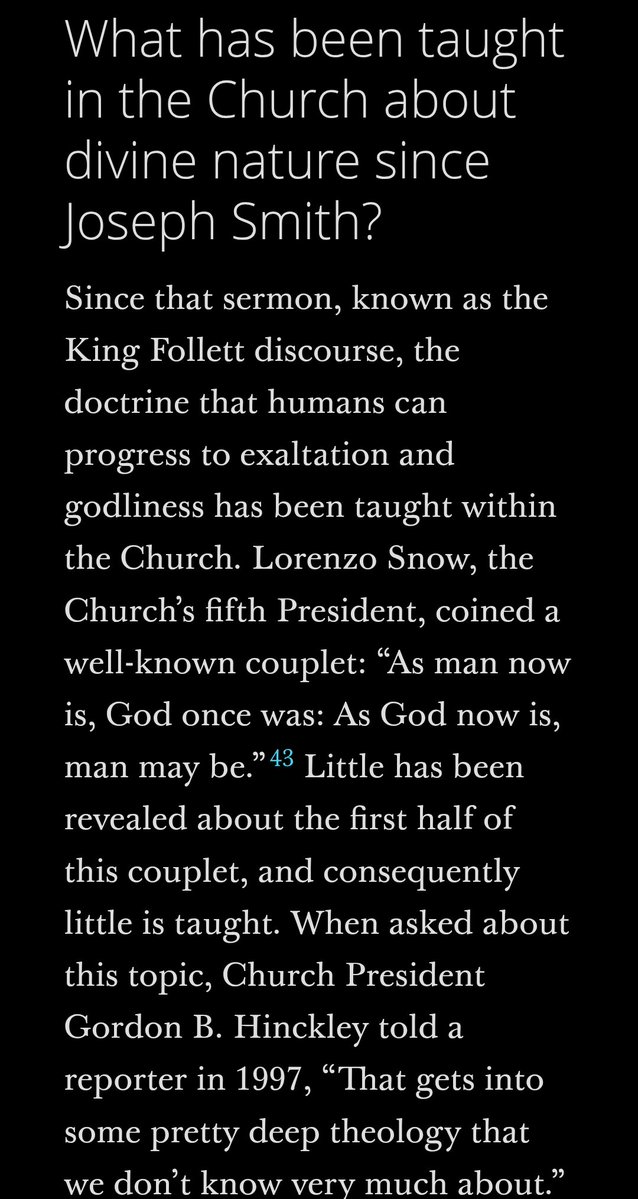
Hold up a sec. Careful with that line "directly from your church." Joseph Smith certainly believed God was once, in a previous iteration of the universe, a mortal man, and taught that idea in a funeral sermon. You can find references to that sermon in the Church-published anthology of Joseph Smith's teachings, and it has been quoted numerous times by some of his successors. But just because someone in our Church-- leader or member-- says something, that doesn't make it canon for the Church. At this point with no codified revelation on the subject, it's still in the realm of conjecture and though I'm inclined to believe it personally, I've heard good arguments on both sides. If you want the full article from the Church on that aspect of our theology, this is really good: churchofjesuschrist.org/study/manual/g…
Matthew Watkins tweet media
English
1
0
2
16
Matthew Watkins
Matthew Watkins@ITalkOfChrist·
Elder Becerra's talk on tithing is going to be echoed in Spanish branches across the country for a long time. Beautiful. #GeneralConference
English
0
0
19
710
Matthew Watkins retweetledi
Ryker
Ryker@RykerJackson97·
“Helping others requires you to stay in your covenants.” - Elder Clark G. Gilbert
Ryker tweet media
English
3
52
642
4.3K
Matthew Watkins
Matthew Watkins@ITalkOfChrist·
Yes, some cultural practices are incompatible with "Gospel culture." Abandon any practice or political position that conflicts with your covenants. #GeneralConference
English
0
2
29
1.6K
Matthew Watkins
Matthew Watkins@ITalkOfChrist·
"My initial reaction was: ' Assistant ward clerk? That's not for me.'" Yet even as a brand new member, Elder @PatrickKearon accepted the calling. Follow the example of Elder Kearon. Don't turn down callings because it doesn't make sense, doesn't feel right, or "doesn't work for you." #GeneralConference
English
4
7
159
2.9K
Matthew Watkins
Matthew Watkins@ITalkOfChrist·
Keister Stendahl has been my example for interfaith dialogue since 2010. If you aren't following his framework, you're not a person worth talking to.
Clint Teeples@TeeplesCY

Krister Stendahl was the Lutheran Bishop of Stockholm and former dean of Harvard Divinity School. He proposed rules for understanding other faiths that prioritize integrity over tribalism: ask adherents about their faith instead of its enemies, and never compare your best to their worst. He also urged us to leave room for "holy envy," appreciating something beautiful in another tradition that you wish your own had. Stendahl lived these rules when he defended the opening of a Latter-day Saint temple in Stockholm in 1985. He argued that in the eyes of God, we are all minorities. He even published scholarship affirming that the Latter-day Saint practice of baptism for the dead has a legitimate basis in the New Testament. He noted that the most straightforward reading of 1 Corinthians 15:29 points to an actual proxy ordinance. To Stendahl, the practice was something the earliest Christians actually did. The assertion from @LutheranAnswers that Mormons "actively lie" is exactly what happens when you compare your best to their worst. It is a failure of character and a violation of Stendahl's second rule. I refuse to judge all Lutherans by the hostility of a single account. Instead, I choose to judge the Lutheran tradition by the fairness and intellect of Krister Stendahl.

English
0
0
16
788
Matthew Watkins
Matthew Watkins@ITalkOfChrist·
@HarkHugh Apparently you didn't read my post because that's my whole point: it does work both ways. We need to stop assuming people are brainwashed, ignorant, illogical, or idiots just because we arrive at different conclusions. There is ample room for different biblical interpretations.
English
0
0
3
15
Hugh Hark
Hugh Hark@HarkHugh·
@ATrueMillennial Many Latter-day Saints are baffled that Christians can study the same Bible they do, yet hold such a "radically" different theology. See how that can work both ways? lol
English
1
0
0
18
Matthew Watkins
Matthew Watkins@ITalkOfChrist·
Many Christians are baffled that Latter-day Saints can study the same Bible they do, and often know the Bible better than they do (Pew Research, 2010), yet hold such a "radically" different theology. This is the "fish don't know they're in water" principle. Here's a great case study: "'Mormons' believe in a Great Apostasy. Jesus said in Matthew 16 that His Church would never fall away. They must think Jesus lied!" Let's unpack that. When someone looks at the same text I do and comes away with a different conclusion than I did, it is tempting to assume the other person is evil, brainwashed, deceived, or just an idiot. That is very rarely the case. Instead, it's better to presume the other party is also logical and turn my accusation inward, asking myself: "What differences in lenses, assumptions, and interpretations do we have that cause us to reach different conclusions? What premises am I taking for granted in my logic?" Let's start with the text of the verse @JtheFree is referencing-- the words of Jesus to Simon Peter: "Upon this rock I will build my church; and the gates of hell shall not prevail against it." His interpretation, which seems understandably obvious to him, is that Jesus promised that there would be no Great Apostasy. Therefore, Mormons are wrong, case closed. Let's ask, what assumptions does this interpretation rest on that a Latter-day Saint does not share? 1. Biblical Inerrancy Jesus likely spoke that text in Aramaic. The author remembered those words to the best of his ability when he wrote his Gospel several decades later. His original Gospel was likely written in Hebrew, so even if he could remember the Aramaic, he had to translate it to Hebrew. Then the manuscript was copied over and over again by hand, and eventually translated to Greek by a third party, then copied over and over again. Matthew's account is the only Gospel to record those words. So the best source we have of Jesus's words is a copy of a copy of a copy of a translation of a copy of a copy of another translation of a copy of a copy of yet another translation of a decades-old memory attributed to (but not definitively from) someone who observed the event. So we have the first assumption: biblical inerrancy. Many Christians adopt that premise because they think the Bible implies it; Latter-day Saints don't see any such implication, and therefore don't rest their faith on that. If we found Dead Sea Scrolls part 2 and it had an original Aramaic version of Matthew without that verse, that's fine. Or if it had that verse and it matched exactly, that's fine, too. No sleep loss for me. 2. Interpretation But let's assume it really was a perfect translation to English. Well, even then we have a problem because English isn't precise, and each person reads it differently based on his or her biases and lenses. We all acknowledge there is some wordplay around "rock" and different-sized stones and Peter's new name. But beyond that, there are several questions the reader needs to answer to understand this verse: * What is the rock Jesus speaks of? * What is the church? * What is the "it" that the gates of hell cannot prevail against? * What are the gates of hell? * What does it mean to prevail? This is where hermeneutics comes in. Different readers with different worldviews will answer these questions in different ways. For example: The Catholic reading is to interpret the rock as Peter, the church as the authorized institution with priesthood authority, the "it" as that priesthood institution, the gates of hell as all forces aligned against that institution, and prevail as the cessation of that authoritative line. The Catholic translation, then, is: "Upon you, Peter, I will establish the institution of the priesthood and no evil force will interrupt that institutional priesthood line." Many Protestants, by contrast, interpret the rock to be the act of confessing Jesus's Lordship as Peter did, the church as the general body of believers (Origen took this view), the "it" meaning Christianity as a whole, the gates of hell as Satan, and prevail meaning a spiritual win. A Protestant translation, then, is: "Christianity is based on confessions of faith and Satan cannot spiritually win the souls of those who come to such faith." There are hundreds of variations on this theme: * Could prevail mean only a permanent victory? Could the gates of Hades/hell have a political/military meaning? * Could the promise be for the souls' welfare, not for the destiny of the church itself? * Could the rock maybe even refer to Jesus Himself (as Augustine believed)? * etc All good questions. Here is one potential interpretation you might find your Latter-day Saint friends hold: Jesus is commending Peter for seeking personal revelation from God. That divine, confirming witness is the foundation of a testimony and the bedrock of anyone who would follow Christ (the informal church). The gates of Hades, being a place of horrific pagan sinfulness, may be a symbol of outside forces from which Christians will be safe as long as they seek that personal witness from God. And persecution from outside forces did not prevail against the institutional Church-- the Church rotted away from the inside due to "itching ears" syndrome. Or perhaps the church mentioned by Jesus really is the institutional Church and the word "prevail" means only a permanent victory? In which case an 1800-year period is but a small blip on the eternal scale-- certainly within the definition of "quickly" and "soon" the Lord used to describe His Second Coming. Do you see the complexity of this problem? The Bible is ambiguous—there are dozens of potential interpretations of that verse. Context from surrounding verses, the early manuscripts, etc., all help clarify, but do not definitively answer. 3. Prooftexting We Christians often treat Bible verses like Pokémon cards-- we assemble our favorites to form a formidable team. And that's good-- it's the scriptures together that help to cut through much of that ambiguity I talked about. But then we make a little Pokemon army and line them up against the cards our neighbor has. Remember, if you're going to assemble six verses that (to you) suggest there can't be an apostasy, your opponent can just as easily assemble six verses that (to him) suggest an apostasy wasn't just possible, but predicted in advance. For example: * Acts 20:29–30 * 2 Thessalonians 2:3 * 1 Timothy 4:1–3 * 2 Timothy 4:3–4 * 2 Peter 2:1–3 * Amos 8:12 * And many more We could go through the same exercise together of dissecting each verse and battling them, only to find that there are legions of possible interpretations to these verses, and we each bring assumptions and lenses to the text that influence how we choose to interpret it. That's why, ultimately, Joseph Smith went to the woods to pray. He took the same verse of scripture to a handful of preachers, and none could agree on what it meant. So he went to the One with all the answers. And that's what we invite everyone to do today: Consider that the verses our critics love to shout at us ad nauseam may not mean exactly what they claim they mean. Consider the lenses you're unknowingly reading the Bible through. Consider the possibility that God has answered much of this ambiguity through more of His word. Study it. Then take it to Him and ask Him directly if it's true. Or you can keep playing with your Holy Bible Pokémon cards, I guess. But don't overestimate the HP on your Galatians 1:8 and Revelation 22:18 cards-- everyone overplays them stronger than they actually are. 😉
Matthew Watkins tweet media
spacedog@JtheFree

@ATrueMillennial @QiwiGames * On the topic of The Great Apostasy: If it were true that the Church that Christ built had fallen into apostasy that would mean two things: 1) that Jesus is a liar & 2) if Jesus is a liar and his prophecy failed this means he is not God. Even if he was mortal and just a messenger of God, this would mean his message did not come from God.    What I am referring to is Matthew 16:18 "And I say also unto thee, that thou art Peter, and upon this rock I will build My church; and the gates of hell shall not prevail against it."   You deal with the issue of, if God says the Church will not fall to Hades then why did the Church need to be reformed in the 1830s after centuries of corruption? At what time did the corruption manifest and take hold?    This doesn't mean that corrupt forces cant infiltrate the church, but it does mean it will never fall down into total corruption. It will never teach doctrines contrary to God. If the great apostasy happened like the Mormon church claims, then how can you trust Christ? How can you trust your church? I do not believe the Church ever fell. Anytime there was heresy infesting Christendom the Church would convene at an ecumenical council to stamp out there heresy, this does not mean new teachings were established or new beliefs put in place but rather what has already been revealed is firmly reiterated as dogma for the Church. Many protestants believe the assumption of Mary is a new belief that started by Pope Pius XII in 1950, but this is rather just making a belief that had already existed since the first century firmly set as doctrine to ensure believers can take faith in the truth. I would agree that people can use religion with the intent of evil and harming others. We see this even in the Bible itself. We see this daily in our world in any branch of faith or religion. However the great apostasy needs to be focused to a specific time. Or at least even a time period within a few decades, and this hasn't been shown at least not in my findings so far.    I'm in complete agreement with the Mormon church that God's church does require an apostolic priesthood with authority bestowed by God and that the protestant reformation lead and will continue to lead many astray. Sadly though I must say the Mormon Church does not meet this requirement of a true apostolic priesthood either. I would be severely immoral if I were to ignore this and not warn you that even if unintentionally, you are being lead astray. If you can not trace a priestly lineage back to the time of the apostles, and can not prove that Jesus instituted a new divine priesthood, then there should be questions raised on the authority of the Mormon church. In my view simply stating that Jesus appeared before Joseph Smith and gave him authority and set up a priesthood is not in itself evidence. In my view, believers of all faiths have a duty to be skeptical and not easily swayed by statements, this is how the Devil can deceive us. If we just simply believe the first bit of information that we either believes holds authority and or makes us feel comfortable we do a disservice to God and to ourselves, we must be analytical and search for evidence. God teaches us to test the spirits and to look at what fruit something bears. I understand why you might be questioning me on my Catholic faith right now and you should. I will address this in comparison a bit later.

English
23
20
191
7.9K
Matthew Watkins
Matthew Watkins@ITalkOfChrist·
Restauarants * Loveless Cafe: delightful place, used to be a motel, right off Natchez Trace Pkwy * Hattie B's: Nashville hot chicken without going to Nashville, then walk around "The Factory" afterward * Garcias on Hwy 96: best Mexican food I've found in Tennessee * Pucketts: good Southern food, try to go when there's live music * Whitts Frozen Custard Scenic * Drive down Natchez Trace Pkwy, it's beautiful, and walk along the Natchez Trace Bridge and overlook * Drive through Brentwood and ogle the mansions 😉 * Easy hikes with nice views (Marcella Vivrette Smith Park, For Granger, etc) * Harlinsdale Farm * Visit nearby waterfalls * Honestly I love driving around some of the rural areas like Hillsboro Rd or out to Trinity Places to see * The Temple, of course * The Factory in Franklin-- an old oven factory from the 1920s now converted to shops and restaurants * Many Civil War battlefields and forts If you have kids * Brentwood Library * Pinkerton Park (including a short hike up to Fort Granger) * Adventure Science Center There's also this big place called Nashville a few minutes to the north and people like to go there for some reason 🤷 JK walking down Broadway in Nashville is cool, too. The Assembly Food Hall is cool, and there's good ice cream on Second Street. And of course feel free to DM me when y'all are in the area if you want to grab a bite and say hi.
English
0
0
1
26
Matthew Watkins
Matthew Watkins@ITalkOfChrist·
@1arthurmcbride I said I have a different interpretation. I don't claim that my interpretation is the only one possible interpretation a rational person can come to. How is that an error?
English
0
0
0
12
Arthur McBride
Arthur McBride@1arthurmcbride·
@ATrueMillennial You the outlined errors of your opponents, and then proceeded to step into each one yourself, and a couple more of your own.
English
1
0
0
14
Latter Day Boomstick
Latter Day Boomstick@LDSBoomstick·
Fans of The Chosen. I have seen the first episode. Does it get way better? I just wasn't hooked and am wondering your thoughts on why I should keep going.
English
97
1
43
6K
Matthew Watkins
Matthew Watkins@ITalkOfChrist·
@JtheFree "it's Holy Week in the Catholic Church and I'll be attending the Mass multiple times this week." Beautiful. I have "holy envy" for the way Catholics celebrate Holy Week.
English
0
0
13
134
spacedog
spacedog@JtheFree·
Thank you for the response, I will be working on my response soon but it probably won't come immediately due to it already being night time and im too tired to word my response effectively and also its Holy Week in the Catholic Church and I'll be attending the Mass multiple times this week. Im not interested in using my verses against your verses, that gets into the private interpretation. Though I do need to show how the verses I previously mentioned connect to the OT. What I also failed to do unfortunately is to show early historical records that support my beliefs and I'll try to do so. I am a very skeptical person and wasn't a cradle Catholic, so when I read verses I do so with an open mind and try to investigate. The Bible is deeply interconnected. Thank you for your response and positive attitude on our differences, I appreciate that more than you realize.
English
1
0
8
195