Talin

51 posts

Talin

Talin

@IamTalin

@chiefaioffice, ex- @_superagi, @summitpartners

blr Katılım Mayıs 2014
751 Takip Edilen791 Takipçiler
Talin
Talin@IamTalin·
The emerging behaviour nobody has properly named yet: people accidentally documenting their intelligence daily at unprecedented fidelity
Talin tweet media
English
0
0
0
37
Talin
Talin@IamTalin·
@manan_0308 Codex was always better but both together is a beast in its own ways
English
0
0
0
60
Manan Agarwal
Manan Agarwal@manan_0308·
Codex is so so much better than Claude Code in it's current form, it's unreal how fast loyalty in AI is switching.
English
48
11
435
24.9K
Talin
Talin@IamTalin·
@rohanvarma Feels like the latest refill empties faster
English
0
0
0
25
Rohan Varma
Rohan Varma@rohanvarma·
For folks hitting limits on Claude Code, here’s a hack to get more usage. From an active CC session: > ctrl-c x2 > npm i -g @openai/codex > codex
English
103
53
1.2K
84.2K
Talin
Talin@IamTalin·
@MohapatraHemant network wins? "when distribution is proprietary, distribution wins (Comcast vs Netflix), when distribution is commoditized, best product wins (chrome vs IE), when product is commoditized, best service wins (Amazon vs others), when service is commoditized, best network wins."
English
0
0
0
221
Hemant Mohapatra
Hemant Mohapatra@MohapatraHemant·
Two unstoppable tailwinds going on globally: first is AI, second is GLPs. Very similar challenges. Instant PMF, hard to differentiate.
English
20
9
162
15K
Charlie Holtz
Charlie Holtz@charlieholtz·
Big news for @conductor_build! We've raised a $22m Series A from Spark and Matrix. We raised this round from @ilyasu at Matrix, who also led our seed round and is joining our board, @nabeel at Spark, @ycombinator, and founders of Notion and Linear. We're grateful to be working with investors we trust and admire. Here’s how we got here and where we’re going:
English
272
54
1.7K
281.5K
Furqan Rydhan
Furqan Rydhan@FurqanR·
I want more founders using Nebula this weekend so I can learn what breaks. So here's the deal, $50 in extra free credits. Use it however you want. Automate outreach, research competitors, build internal tools, whatever. Only ask, share what worked and what didn't. DM me your email I’ll send the credits.
English
18
4
80
8.6K
adi unni
adi unni@theoldmnk·
i am no longer in blr anymore(mentally) the blr startup and tech ecosystem has a lot of self limiting belief's that make it really hard for people to get exposure to millions in wealth everyone is chasing the same cookie cutter goals the same VCs, AI agents bs, YC and what not wealth is in the gaps anon seek and you shall find
English
10
4
178
12.3K
Talin
Talin@IamTalin·
@sajithpai @lastmile_one I doubt you’d see Qservices like Snabbit but more urbanclap lifestyle services
English
0
0
0
348
Sajith Pai
Sajith Pai@sajithpai·
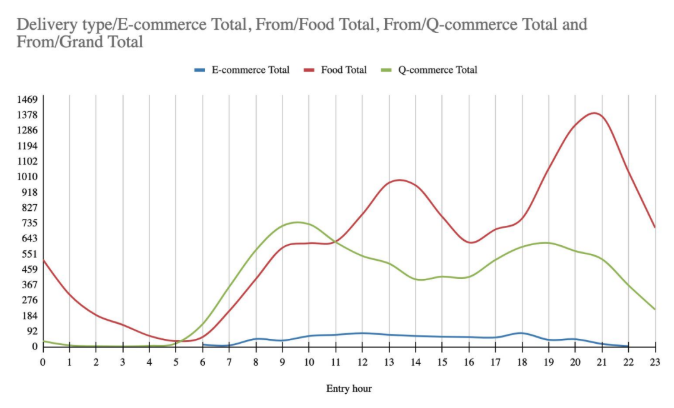
16 days of deliveries at an upscale housing complex in Hyderabad - this is from the pitch deck of @lastmile_one (published w their permission) who are building a inside society delivery robot unbundling the last and most painful / time consuming 100m of delivery. The data doesn't have QServices like Snabbit, Instahelp etc. That would have been interesting to see. Most interesting: how small Ecom is relative to QCom. And how big food is relative to these two. And surprised by the 2-3-4am food orders!
Sajith Pai tweet media
English
13
5
71
10.3K
Yogi Adityanath
Yogi Adityanath@myogiadityanath·
An MoU by Invest UP is a preliminary step before detailed due diligence and project evaluation gets done. The MoU with Puch AI is similarly an initiation of the process by Invest UP to explore potential in the AI sector. MoUs are non-binding on the State Government. Any further progress including any Government permission, approval or license is subject to detailed evaluation of prospective investors proposal . Any prospective investor falling short of the above will automatically have their MoU terminated. Uttar Pradesh remains committed to transparent, responsible, and future-focused development.
Yogi Adityanath@myogiadityanath

New Uttar Pradesh is embracing the power of Artificial Intelligence. A ₹25,000 Crore MoU with Puch AI will bring AI Parks, large-scale data center infrastructure, AI Commons, and an AI University to the state. This initiative will strengthen governance, drive innovation, and create future-ready opportunities for our youth.

English
745
858
6.2K
843.8K
Talin
Talin@IamTalin·
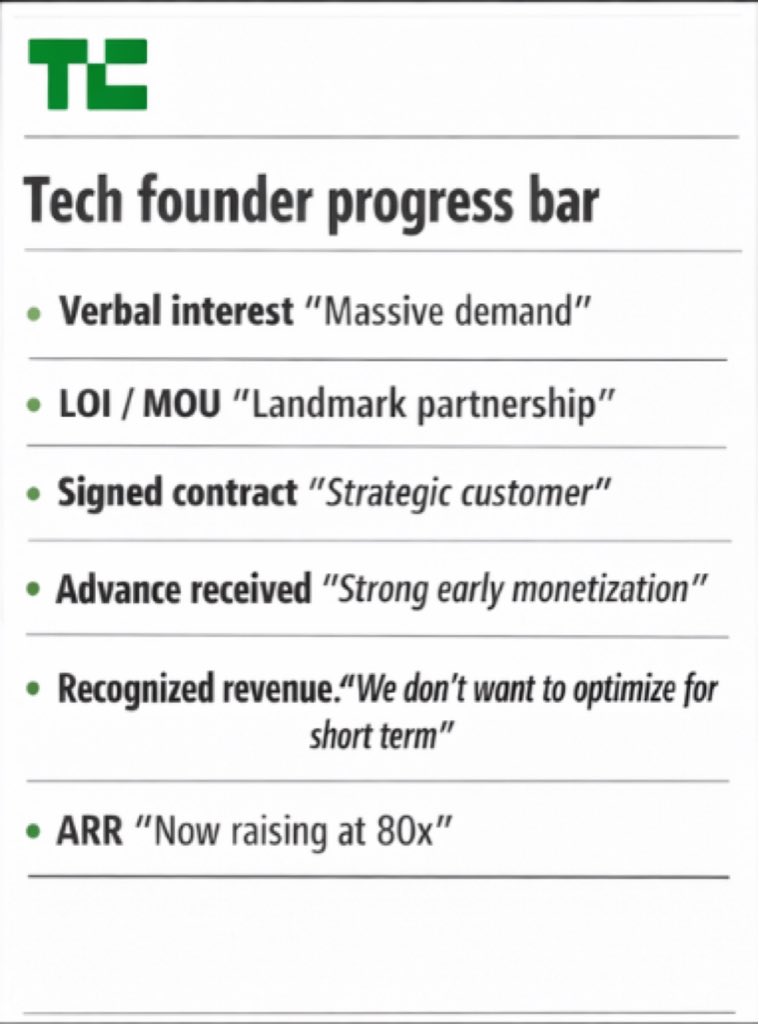
Startup traction gets translated for the timeline
Talin tweet media
English
2
1
13
1.3K
Talin
Talin@IamTalin·
@alysha_lobo Insane, I meant good idea stage vcs where it's not just a cheque machine. I've seen a few good ones but i wish there were more with more independent conviction like you said
English
0
0
1
29
AML
AML@alysha_lobo·
I think rather than talking about idea stage startups, let me talk about startups that went quickly from idea to revenue WITHOUT VC money. Two come to mind: - DocketRun: Coming out of small town Hubballi, and building in manufacturing, the founder was struggling to convince Indian VCs to take a bet on him and his idea. So, he did the next best thing… he went to his customers > got LOIs (letters of intent) > took a bank loan + some money from family and just built. He sold IN HIS BACKYARD and has been doing so well that he paid back friends and family with interest + repaid his bank loan. Today he own ALL of his company & sells to Hitachi, Mitsubishi etc - ProLearner: Cornell Uni alum who came back to India to build here. Again, got shuffled around by VCs so he gathered some cash and went off to build a simple prototype that he could talk to customers about. In fact he moved his base to Gujarat to be close to his customers and learn about their pain points. Again, FULLY bootstrapped hardware + software he counts Bridgestone, Mahindra, NTT as clients and is now expanding to the Middle East. The common thread here is they didn’t wait for VC validation! The problem these days is social media esp X glorifies founders who can raise and NOT the ones who actually build!
English
1
0
1
188
AML
AML@alysha_lobo·
🚨💣STARTUP INDIA, buckle up for Saturday truth bombs. I’m going to say a few things that Indian founders usually won’t say out loud. Over the last 2 odd years I’ve been on the ground in India, working very closely with founders from idea stage all the way to Series A/B, and also spending a fair bit of time with funds across the spectrum. I sit in a slightly unusual position in this ecosystem — I’m not a full-time VC, I’m not a founder either. I’ve spent most of my time as an operator, globally, and as someone who enables networks across founders, funds, and companies. Which basically means I get to see both sides of the table more than most people do. And more importantly, a lot of founders tell me a lot of things they will never say publicly, because they are scared of VCs, they are worried about access to capital, or they don’t want to burn bridges. I usually try to pass that feedback back to funds in a constructive way, protecting founders where needed. But I think some of this needs to be said openly, especially for early founders who are just entering the system. So here goes: “We invest at paper napkin stage” is one of the most overused lines in this ecosystem. It sounds great, and I’m sure there are a few genuine cases, but in reality most decisions are still supported by proxies — early signals, pedigree, prior affiliations, how you present, and yes, a surprising amount of Excel-based thinking even at stages where that shouldn’t be the primary lens. You’ll be told it’s about conviction, but you’ll still be pushed into projections, assumptions, and frameworks that try to reduce uncertainty as quickly as possible. I want founders to know that most VCs are structurally designed to say no, that’s NOT the issue. The issue is how that “no” is often delivered — a lot of founders walk away without any real understanding of what didn’t work, because the answer is usually something superfluous like “not enough signal” or “doesn’t fit our thesis”, which in many cases is just uncertainty dressed up as a decision. Very few people will actually tell you where they think your business could break. Risk aversion in India is very real, it’s just not called that. It shows up in more polite forms — like where you studied, where you’ve worked, how you speak, how you present yourself in a room. Founders from non-traditional paths or Tier 2/3 India feel this immediately, even if nobody explicitly says it. There is also a lot more FOMO in early-stage investing than people would like to admit. You’ll see funds move quickly when others are already in, you’ll see pressure to get onto cap tables, and sometimes the urgency has less to do with your company and more to do with how the fund wants to position itself or deploy capital. And this is important — a lot of Indian VCs are not forming independent conviction as often as you would hope. They are watching what’s happening in the US and then mapping that back here. You can literally see waves move — SaaS, edtech, now AI, now “deep tech”, now defense, now robotics — and the same funds will move across these categories over time. There are exceptions, for example imho fintech investing in India did carve out its own path, and quick commerce to some extent as well, but a lot of the rest follows a pattern of observing what’s working elsewhere and then adapting it locally. The operator gap is something founders need to pay a lot more attention to. If someone is investing in enterprise SaaS, it’s worth asking whether they’ve ever actually sold enterprise software themselves?? If they’re investing in AI, have they built anything meaningful or are they just experimenting at a surface level?? If they’re investing in hardware or robotics, have they seen a deployment go wrong in the real world?? A lot of the time, founders end up spending a significant portion of the conversation explaining their space to the very people evaluating them. There’s also a very real gap internally within funds that founders don’t see — what partners say at a high level and what analysts evaluate on are not always aligned, which means you can walk out of one conversation feeling strong alignment and then find yourself re-explaining everything in the next. It creates confusion, and most founders just absorb that friction silently. And please, don’t get overly swayed by the “we’ll take you to Silicon Valley” narrative. This one needs to be said clearly. You don’t need to be necessarily be in San Francisco, you need to be where your customer is. Period. I’ve seen too many founders get excited about Bay Area trips, demo days, and immersion programs, and come back with no real customer insight, no distribution, and no meaningful progress. You are not building a company by attending events and walking around SF. If your customers are in India, stay here and go deeper. If they’re in Southeast Asia, go there. If they’re in the US, figure out where exactly, not just Silicon Valley, it could be the MidWest or Miami. Get the VC to take you there. Geography should follow customers, not self serving VC narratives. On capital, especially for early-stage founders, it’s worth rethinking how much you actually need. In software, the cost of getting something off the ground has dropped significantly — as @mcuban pointed out recently on @tbpn , it’s never been easier to build software: ship, test, and start charging. Your first validation can come from customers, not investors. Dilution is not something you need to rush into if you don’t have to. Hardware is a different game, of course, capital matters there, but even in hardware I’m seeing founders find alternative paths — working with China, using labs, building in smaller batches, and being more capital efficient than before. One thing I’ll tell early founders very clearly — don’t get overly impressed by funds that say they’ve done 100+ investments. In many cases, more smaller yet intentional portfolios lead to better attention and support. If a fund is spread too thin, you need to ask yourself how much time they realistically have for you once the cheque is written. And please, do diligence on your VCs the same way they do on you: Talk to founders they’ve backed, not just the ones they showcase. Ask what actually happened AFTER the investment — did they help you get customers? did they show up when things got difficult? or was it mostly intros, programs, and surface-level engagement. At the end of the day, VCs are one input. Your customer is the only real signal that matters. There are good investors in India, I’ve worked with some and continue to do so. But founders need to go in with their eyes open and separate X/LinkedIn narrative from reality. If you’ve been through this, you already know exactly what I’m talking about.
Dr. Datta M.D. (Radiology) M.B.B.S. 🇮🇳@DrDatta_AIIMS

Raising funding from VCs in India is significantly more difficult compared to raising funding in Silicon Valley. Do not let anyone tell you otherwise. If anyone tells you that it is not, they are lying! In India, apart from your "key unobvious insight", you need 1/3 things (depending on the VC): 1. Hockey Stick Growth 2. Significant Retention 3. Money in the Bank Been on both sides of the table (trying to raise and doing due diligence for VCs), so can assure you that no one, I repeat no one is going to take a bet on you at idea stage. Unless you are a rockstar in your field or have a rockstar founding team with people who have raised money before and successfully returned money to their previous investors!

English
23
35
313
93.6K
Talin
Talin@IamTalin·
@thsottiaux Plan mode, not sure if it’s there in the codex app but it’s definitely not in conductor This is probably a agents.md instruction but I don’t add it there as it’s not needed all the time - dumb down explanation and explain with flows
English
0
0
0
27
Tibo
Tibo@thsottiaux·
What are we consistently getting wrong with codex that you wish we would improve / fix?
English
1.2K
14
872
144.5K
Vaibhav Domkundwar
Vaibhav Domkundwar@vaibhavbetter·
If you deeply believe in the Legal AI market (AI law firms and what not) and if you had the following options to make an investment, which one would you choose: - Harvey - Legora - Anthropic (Legal is a vertical with a CEO) Yes, factor in the valuation differences etc but focus on who is likely to win the biggest in the long run.
English
12
1
24
9.1K
Talin
Talin@IamTalin·
Working from cafés is f****** terrible in BLR, dm if you wanna come and jam about AI & work in some open spaces tom
Talin tweet media
English
1
0
2
294
Roy
Roy@im_roy_lee·
BREAKING: Cluely CEO officially responds to TechCrunch
English
1.8K
576
14.7K
3.9M
Talin
Talin@IamTalin·
@signulll I think the right name for this role is Entrepreneur in residence
English
0
0
0
54
signüll
signüll@signulll·
the most underrated hire right now is a great product person. when i say product person i'm def not talking about a product manager. perhaps i think there has to be somewhat of a new role. i don't have a good name for it yet but maybe something like "product thinker".. someone with an intuitive grasp of the product as it exists, where it's soft, where it sings, & how to iterate it toward something even sharper. in some sense, this person has to cohesively hold in their head where this product should be 2 years from now & work backwards from that. i say this cuz when building was hard, engineering was the bottleneck & the status hierarchy often reflected that. building is no longer hard. which means the variance in outcomes has shifted almost entirely to judgment on what to build, how to sequence it, & how to talk about it. & the story matters as much as the thing. internally, it organizes the team around a shared model of why. externally, it shapes the interpretive frame users bring to their first experience. you can't retrofit narrative onto a product & expect it to land, it has to be load bearing from the start. the rarest version of this person sits at the intersection of culture & deep technology. someone genuinely bilingual. they know what's technically possible & they know which cultural currents are real vs. ephemeral. that combo is what separates products that feel inevitable from products that feel assembled. before ppl clap back with this person has always been valuable, i know.. i am just saying now they might be the most *important* person in the room. their value compounds like never before.
English
450
748
6.3K
1.4M
Nikunj Kothari
Nikunj Kothari@nikunj·
When you think Opus as a legible PM / designer, and Codex as an less legible 10x engineer, life just gets simpler.. Current workflow is > plan plan plan with Opus > run plan “autonomously” with Codex > review with @DevinAI > host on @Railway > build on @conductor_build
English
21
9
261
27.1K