Ian Humphreys

104 posts

Ian Humphreys banner
Ian Humphreys

Ian Humphreys

@IanRHum

Computational structural biology. PhD from Baker lab @UWproteindesign

Seattle, WA Katılım Mayıs 2018
188 Takip Edilen535 Takipçiler
Sabitlenmiş Tweet
Ian Humphreys
Ian Humphreys@IanRHum·
Thrilled to share that today we report our human protein interactome in @ScienceMagazine! Predicting which pairs of proteins in the human proteome is a great challenge due to the shallow eukaryotic evolutionary signals but hugely important to understand. science.org/doi/10.1126/sc…
English
4
84
368
49.3K
Ian Humphreys retweetledi
Andrew Favor
Andrew Favor@andrew_favor·
We are pleased to share our new preprint: “De novo design of RNA and nucleoprotein complexes”. This work extends the principles of de novo protein design to RNA and DNA, enabling the generative design of complex multi-polymer structures! (1/6) doi.org/10.1101/2025.1…
English
9
52
195
20.6K
Ian Humphreys retweetledi
Green Ahn
Green Ahn@Green_Ahn·
pH gradients are central to physiology, from vesicle acidification to the acidic tumor microenvironment. But how do we program proteins to respond to pH? In our new preprint biorxiv.org/content/10.110…, we developed computational methods to rationally design pH-sensitive binders. 🧵
English
1
25
114
10.2K
Ian Humphreys retweetledi
Magnus Bauer
Magnus Bauer@kinasekid·
Phosphorylation on tyrosines control key pathways in immunity, cancer, and metabolism. For the first time, we can now design proteins that specifically recognize individual phosphotyrosines, even in disordered regions. (1/8) Preprint: biorxiv.org/content/10.110…
English
2
43
165
21.4K
Ian Humphreys retweetledi
Adam Broerman
Adam Broerman@adam_broerman·
We sought to make proteins both potent and FAST. We used #proteindesign to design precise control over protein interaction lifetimes, enabling us to construct rapid-response circuits, biosensors, and switchable cytokines. Now published @Nature! Links to paper and tutorial below.
English
11
99
454
31.7K
Ian Humphreys
Ian Humphreys@IanRHum·
Thrilled to share that today we report our human protein interactome in @ScienceMagazine! Predicting which pairs of proteins in the human proteome is a great challenge due to the shallow eukaryotic evolutionary signals but hugely important to understand. science.org/doi/10.1126/sc…
English
4
84
368
49.3K
Ian Humphreys
Ian Humphreys@IanRHum·
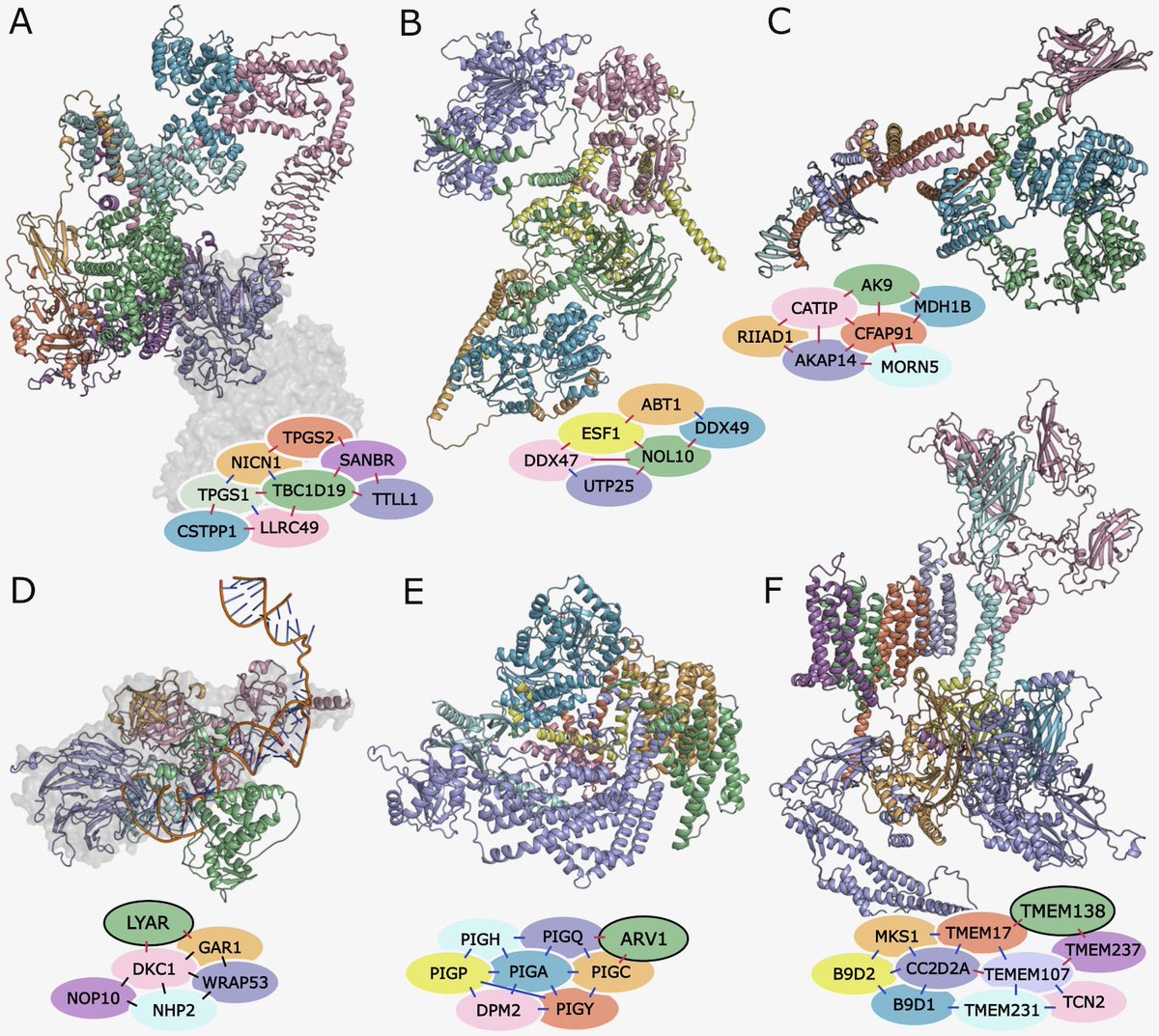
We find predicted interactions which can be linked to GPCRs, cancers, and other genetic diseases. We map SNP data into the interfaces, and assemble higher order oligomers to explore some of these systems, but there’s much more to look at on our website: prodata.swmed.edu/humanPPI
Ian Humphreys tweet media
English
1
0
1
595
Ian Humphreys retweetledi
Rohith Krishna
Rohith Krishna@r_krishna3·
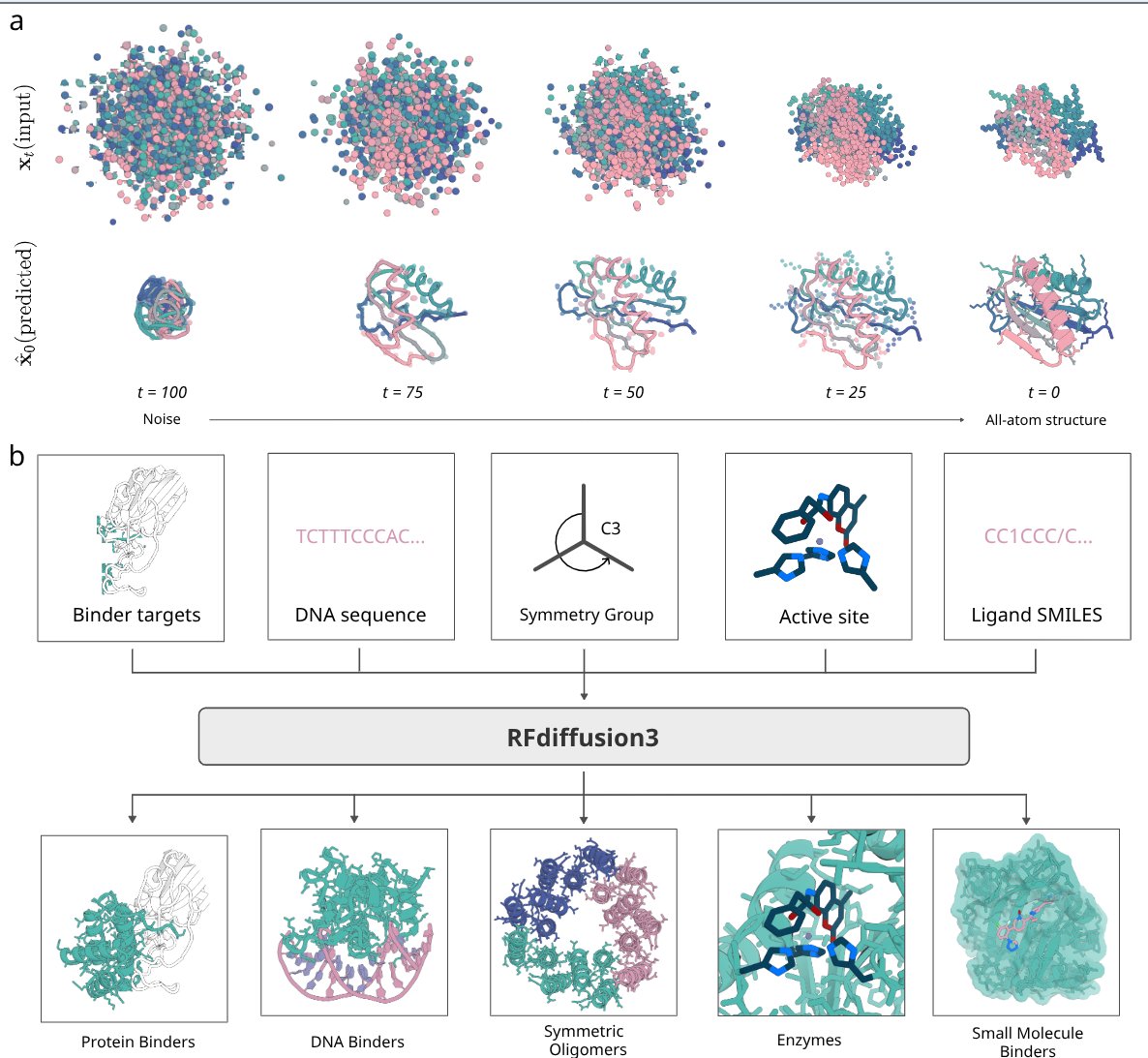
We asked ourselves what could we do if we worked cooperatively as a team to create a single model that could design any biomolecular interactions. Yesterday, we reported details of RFdiffusion3, the next step towards building functional proteins straight from the computer.
Rohith Krishna tweet media
English
4
33
191
9.5K
Ian Humphreys retweetledi
Jasper Butcher
Jasper Butcher@butcher_jasper·
Very excited to share our paper "De novo Design of All-atom Biomolecular Interactions with RFdiffusion3", now on BioRXiv. biorxiv.org/content/10.110… 1/n
GIF
English
5
90
409
31.3K
Ian Humphreys retweetledi
Rohith Krishna
Rohith Krishna@r_krishna3·
We built RF3 with @nvidia’s latest cuEquivariance accelerations, letting us iterate fast. Now we’re sharing the full stack: ModelForge — open-source infra for training biomolecular AI. Start your project here 👉 github.com/RosettaCommons…
English
4
42
166
9.4K
Ian Humphreys retweetledi
Yo Akiyama
Yo Akiyama@yoakiyama·
Excited to share work with @ZhidianZ, Milot Mirdita, Martin Steinegger, and @sokrypton biorxiv.org/content/10.110… TLDR: We introduce MSA Pairformer, a 111M parameter protein language model that challenges the scaling paradigm in self-supervised protein language modeling 🧵
English
8
52
194
26.2K
Ian Humphreys retweetledi
Pushmeet Kohli
Pushmeet Kohli@pushmeet·
The #AlphaFold 3 model code and weights are now available for academic use. We @GoogleDeepMind are excited to see how the research community continues to use AlphaFold to address open questions in biology and new lines of research. github.com/google-deepmin…
Pushmeet Kohli@pushmeet

We love the excitement & results from the community on AlphaFold 3 and are doubling the AF Server daily job limit to 20. Happy to also share that we're working on releasing the AF3 model (incl weights) for academic use, which doesn’t depend on our research infra, within 6 months.

English
21
260
1K
186.5K
Ian Humphreys
Ian Humphreys@IanRHum·
A great thread from Paul that mirrored a lot of my experiences in the Baker lab!
Paul T Kim@paultkim_ipd

With David and the Baker Lab in the spotlight today, I wanted to share some insights into the @UWproteindesign and how it operates, a glimpse behind the curtain. I had planned to write this post-graduation, but now seems as good a time as any. (Got twitter blue free trial so this could all fit in less tweets!) First, the lab is enormous. ~60 grad students, ~60 postdocs, a handful of visitors, undergrads, and a surrounding institution of another 150 or so. Collaboration is strongly encouraged (even mandated) by David, who sets up pro-collaboration incentives. Notably, he's fine with grad students graduating without a sole first-author paper—it's acceptable to "only" have worked as a co-first author. This is a key ingredient in the secret sauce: the tight collaboration between wet lab and dry lab. It ensures that all our work is ultimately grounded in strong wet-lab validation—our "oracle" is the real world, not another computational model. While we have regular meetings for different subgroups and the entire group, much information travels through the lab via informal one-on-one interactions. In some ways, it reminds me of a classic "tribe of humans in the state of nature"—100-200 people with no clear hierarchy, passing information via "gossip". It’s maybe not the most complete way of ensuring everyone is on the same page, but saves time as we aren’t drowning in endless meetings. Does David stay in touch with all these grad students and post-docs? Remarkably, yes. Unlike some very large labs known for being run entirely by post-docs, he knows exactly what everyone is working on and the stage of their projects. Each member has monthly one-on-ones with him, and monthly subgroup meetings that David attends. If he suggests you try something at your previous one-on-one, you'd better have it done by the next. Does he actually contribute research ideas, or is he more of a detached big-picture project manager? Definitely the former. He understands the intricacies of a shocking range of topics. I'll be discussing some arcane deep learning concept with him, and then he'll turn around and talk to someone about the details of a catalytic mechanism. He's actually the most hands-on PI I've ever had—if anything, he verges on over-managing rather than being too detached. How does he keep track of everything? Partly, he's just a brilliant person with exceptional recall. But he has also built infrastructure above and below him in the lab to handle many of the details, bureaucracy, big picture, and management tasks. This allows him to spend most of his day doing what he's most passionate about and skilled at: walking around talking to people about science. He also lives very much in the moment and in his own words, “never thinks very far ahead". To keep up with tools, methods, and wet lab techniques, he does the occasional project and design campaign himself on the side when time allows. It's still a tremendous cognitive load to keep all this in his head, but as much as possible, he has offloaded non-scientific cognitive burdens. It helps that he’s in the lab in person most days of the year, rarely traveling for conferences or talks, instead doing them over Zoom or not attending. (1/2).


English
0
0
5
389
Ian Humphreys retweetledi
The Nobel Prize
The Nobel Prize@NobelPrize·
BREAKING NEWS The Royal Swedish Academy of Sciences has decided to award the 2024 #NobelPrize in Chemistry with one half to David Baker “for computational protein design” and the other half jointly to Demis Hassabis and John M. Jumper “for protein structure prediction.”
The Nobel Prize tweet media
English
509
8.4K
19.4K
9.1M
Ian Humphreys retweetledi
Yang Hsia
Yang Hsia@yhsia_ipd·
Yang Hsia tweet media
ZXX
2
5
40
2.3K
Ian Humphreys
Ian Humphreys@IanRHum·
Here’s our human protein-protein interactome. We mined the SRA, devised a new distillation dataset for protein complexes, trained a new version of RF2 to screen millions of protein pairs, and identify > 18k binary interactions. biorxiv.org/content/10.110…
Ian Humphreys tweet media
English
3
43
195
15.2K