Sabitlenmiş Tweet

The most powerful sentence I ever read had no grammar lesson in it.
No strategy. No data. No expert quote.
It was a man on the internet saying —
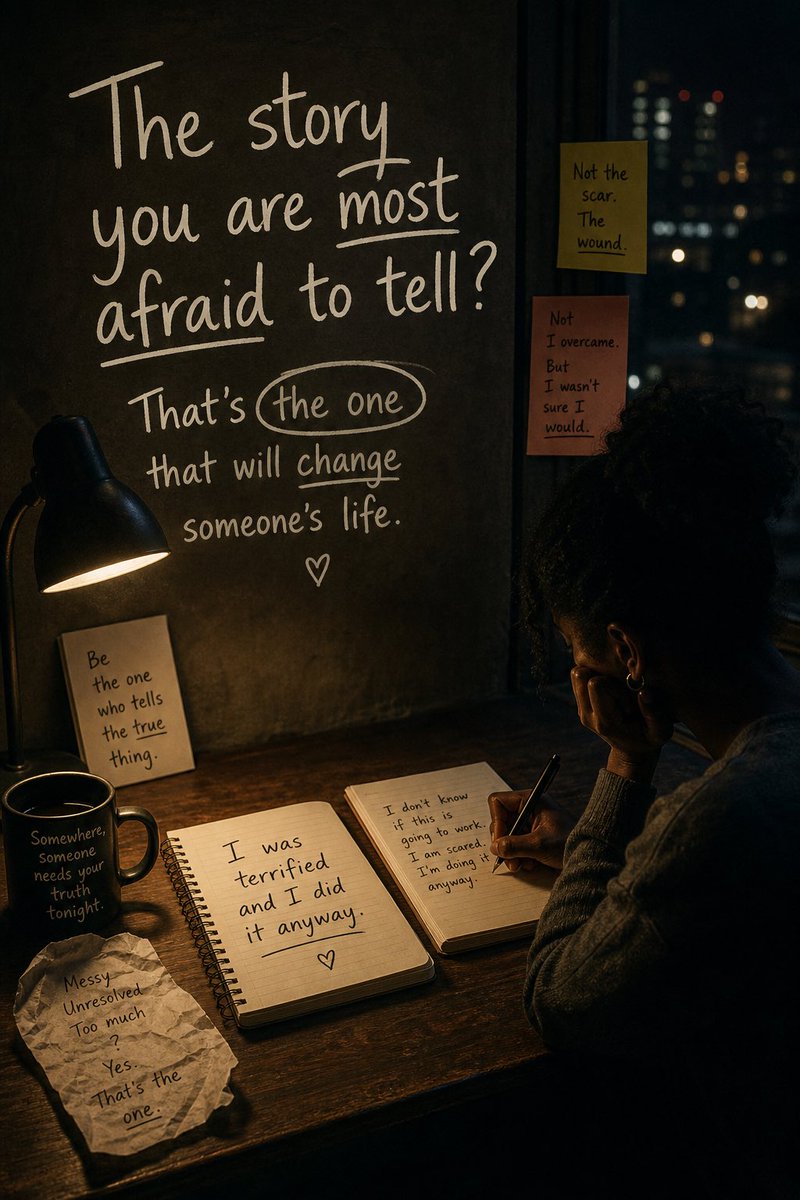
“I was terrified and I did it anyway.”
I read it at 2am and couldn’t sleep after.
We have been taught to present the version of ourselves that has already arrived.
The clean version. The composed version. The one with the right words and the straight back and the answer ready before the question finishes.
Show your highlight reel. Hide the blooper reel.
Post the win. Bury the loss.
So we write stories with the struggle already resolved.
“I was broke — but now I’m thriving.”
“I was lost — but now I have clarity.”
“I was broken — but I healed.”
And people read it and nod politely and scroll away.
Because they can feel the distance between the storyteller and the story.
But then someone writes —
“I don’t know if this is going to work. I am scared. My hands shake every time I think about it. I am doing it anyway because staying still scares me more.”
And the comments section breaks open.
Because that sentence didn’t describe someone else’s life.
It described yours.
That is the paradox nobody tells you about storytelling.
The more specific your vulnerability —
the more universal your reach.
You think your particular fear is too small. Too embarrassing. Too personal to matter to anyone outside your own head.
But specificity is not a wall between you and your reader.
It is a door.
The writer who says “I was sad” loses you instantly.
The writer who says “I sat in my car outside the house for 25 minutes because I didn’t know how to go inside and pretend everything was fine”
owns you completely.
Because you have sat in that car.
Maybe not that car. But a car. A bathroom. A stairwell. A corner of a party where nobody could see your face properly.
Vulnerability is not oversharing, it is not dumping your trauma on a timeline and calling it content.
It is the precise, deliberate, courageous act of letting people see the part of your experience that is true —
before it became a lesson.
Not the scar. The wound.
Not the mountain top. The slope where your legs gave out and you sat down and seriously considered going back.
Not “I overcame.”
But “I wasn’t sure I would.”
That moment — unresolved, unpolished, still bleeding slightly at the edges —
is where your reader lives.
Because here is what nobody tells you about the people reading your story.
They are not reading to admire you.
They are reading to find themselves.
They are scrolling through a timeline full of performance and highlight reels and carefully curated strength —
desperately looking for one person who will say the true thing.
Be that person.
The greats understood this.
Chimamanda didn’t just write about Biafra. She wrote about a girl watching her world collapse and not knowing what to hold onto first.
Fela didn’t just sing about oppression. He sang about the specific, daily, grinding humiliation of a people being told they do not matter.
They were not brave despite the vulnerability.
They were powerful because of it.
And here is the plot twist,
the story you are most afraid to tell?
The one that makes you pause before you type it. The one you have started and deleted four times. The one you think is too messy, too unresolved, too much
that is the one.
That is exactly the one.
Because your reader is not sitting somewhere with a perfect life waiting to be impressed by yours.
They are sitting with their own fear, their own doubt, their own 2am that won’t end
and what they need is not your answer.
They need to know you asked the same question.
We want to see you as we read your story.
Not the version of you that survived.
The version of you that wasn’t sure you would.
Show us that person.
That is where the connection lives.
That is where the writing becomes something more than content
and starts becoming truth.
What story have you been afraid to tell?
Start there. That’s the one that will change someone’s life, including yours.
English