Sabitlenmiş Tweet

1/ 🧵
If you’re asking which blockchain has the best technology and best future, the honest answer is this: there is no single “best” in isolation. There is only alignment with reality. And the closest thing to that alignment today is anything that extends, not competes with, Bitcoin. That’s where @Coredao_Org and its native asset Core become extremely interesting.
Most blockchains try to replace Bitcoin: faster, cheaper, more expressive. But in doing so, they sacrifice what actually matters: security and credibility. Core flips this. It doesn’t try to outdo @Bitcoin. It plugs into Bitcoin’s strength.
Through its design, Core leverages Bitcoin’s Proof-of-Work (hash power as a signal), economic alignment with Bitcoin holders, and a consensus model (Satoshi Plus) that ties both together. This is a fundamentally different philosophy: instead of building a new center of gravity, Core orbits the strongest one that already exists.
Core’s consensus is not just PoW or PoS. It’s a three-part system: Bitcoin miners (hash signaling), CORE stakers (economic weight), and validators (execution layer). This creates a layered defense: hash power acts as an external security anchor, staking provides internal economic alignment, and validators handle operational efficiency. No single actor dominates all three.
That balance is rare. Most chains are either PoS, capital-heavy and sometimes cartel-like, or PoW, secure but not expressive. Core blends both without copying either.
One of the most misunderstood but powerful aspects is the native path for Bitcoin yield without breaking custody.
Bitcoin already has primitives like timelocks (CLTV) and script-based conditions. Core builds around this idea: Bitcoin doesn’t need to be moved or trusted to become productive. Users can lock BTC under defined conditions, participate in network security, and earn yield tied to Core’s economy.
This avoids rehypothecation, removes reliance on lending desks, and eliminates custodial risk. It is a clean extension of Bitcoin, not a distortion of it.
CORE’s supply design is also deliberate. It is capped at 2.1 billion tokens and distributed over a long emission schedule of more than 80 years. That number mirrors Bitcoin’s philosophy, 21 million vs 2.1 billion, a scaled unit structure. The long emission curve prevents early concentration, keeps incentives alive for decades, and aligns with Bitcoin’s long-term security horizon.
Predictability matters: there are no arbitrary changes, no sudden dilution events, and the market can price it rationally over time. Most chains front-load supply, reward insiders early, and fade. Core stretches distribution across generations.
Distribution itself is another key strength. Instead of being dominated by venture capital, a large portion was distributed to users through an airdrop model, with ongoing emissions rewarding participation such as staking, validators, and ecosystem activity.
This created wider ownership, stronger grassroots alignment, and less dependence on insider exits. It echoes Bitcoin’s early distribution in spirit, participation over privilege.
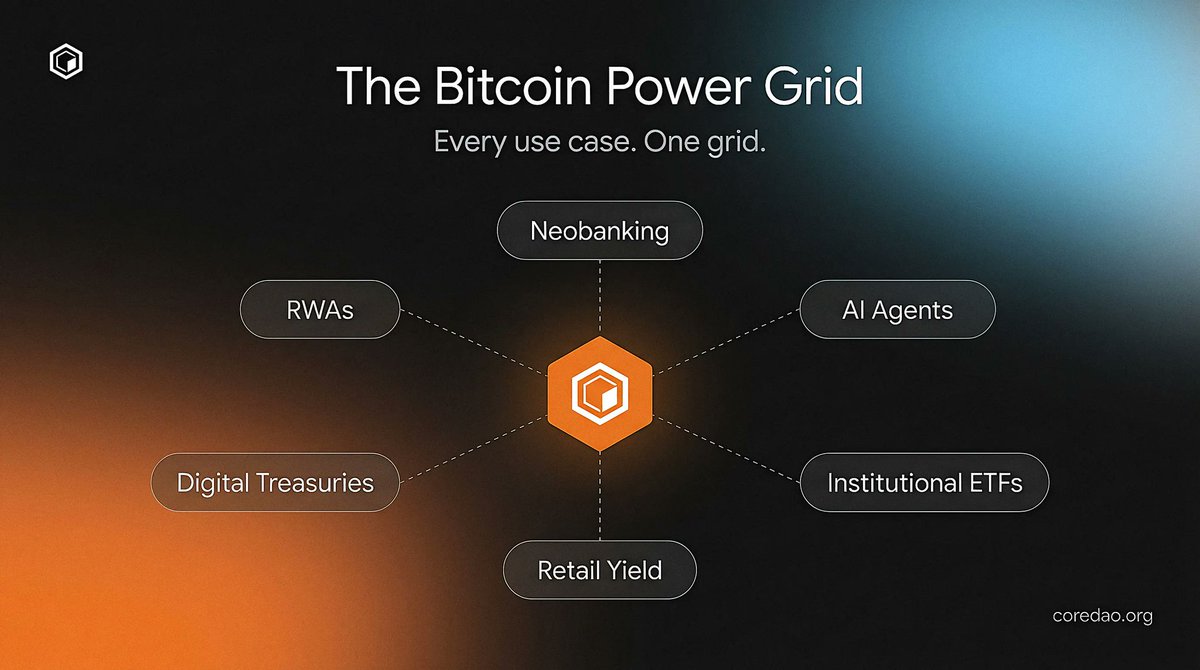
Core also understands something many systems ignore: users are not the same. Conservative holders want safety and self-custody. Yield seekers want returns. Retail users want simplicity. Institutions want compliance.
Instead of forcing one model, Core builds multiple rails, BTC staking, dual staking, payment layers, and institutional integrations, all feeding back into CORE demand. This is not just technology; it is economic architecture.
There is also a deeper layer. Bitcoin’s future challenge is not adoption but long-term security economics as block rewards decline. Core contributes to solving this by creating additional incentive layers tied to Bitcoin, giving miners and participants new economic surfaces, and increasing the usefulness of holding BTC.
MASTR@MastrXYZ
Which blockchain has the best technology? Which one has the best future? Why?
English