Infra Signals Guy

387 posts

Infra Signals Guy banner
Infra Signals Guy

Infra Signals Guy

@InfraSignalsGuy

https://t.co/kwFqV0B3l6: Seeing what changes when AI systems meet real-world infrastructure. A weekly memo on the hidden constraints shaping AI.

Weekly memo → Katılım Aralık 2025
263 Takip Edilen73 Takipçiler
Sabitlenmiş Tweet
Infra Signals Guy
Infra Signals Guy@InfraSignalsGuy·
In 1914 Churchill made a bet that looked reckless: take the British Navy off coal and make it dependent on foreign oil. It changed everything. Europe in 2025 is facing the same decision about AI. And getting it exactly backwards.
English
1
0
0
23
Infra Signals Guy retweetledi
paolo trivellato
paolo trivellato@paolo_scales·
i’ll probably regret leaking this but screw it: full guide on how i used claude cowork to generate 7-figures on linkedin for 24h, i’m sending it to EVERYONE who likes + comments “COWORK” (must be following + RT for priority access)
English
1.1K
323
1.2K
93.2K
Infra Signals Guy
Infra Signals Guy@InfraSignalsGuy·
In 1914 Churchill made a bet that looked reckless: take the British Navy off coal and make it dependent on foreign oil. It changed everything. Europe in 2025 is facing the same decision about AI. And getting it exactly backwards.
English

1
0
0
23
Infra Signals Guy
Infra Signals Guy@InfraSignalsGuy·
@The_AI_Investor The interesting part is what this says about OpenAI’s stack. They’re no longer optimizing for a single universal compute fabric, but for multiple execution paths tuned to different AI behaviors.
English
0
0
1
219
The AI Investor
The AI Investor@The_AI_Investor·
Hi all, Just posted my portfolio updates with a new trade Today, OpenAI signed a multi-year agreement to purchase up to 750 megawatts of AI compute capacity from chipmaker Cerebras Systems, with the capacity phased in through 2028. Cerebras builds a single wafer-scale processor that behaves like one giant chip, while NVIDIA uses many smaller GPUs connected together. Cerebras relies on massive on-chip SRAM and extremely high bandwidth, which can make long, token-by-token reasoning run very fast, but it also limits total memory capacity. NVIDIA GPUs use large HBM memory pools that scale well across systems, which makes them better for very large models and high concurrency.
English
5
3
44
17.1K
Infra Signals Guy
Infra Signals Guy@InfraSignalsGuy·
@Yuchenj_UW This also signals a shift in how OpenAI optimizes. Instead of one universal stack, we’re moving toward workload-specific compute paths tuned for latency, not developer convenience. That’s a big strategic change.
English
0
0
0
62
Yuchen Jin
Yuchen Jin@Yuchenj_UW·
OpenAI’s multibillion-dollar partnership with Cerebras makes total sense. Sam made the right call. Cerebras chips are insanely fast at inference, sometimes 20x Nvidia GPUs, similar to Groq. My biggest issue with ChatGPT and GPT-5.2 Thinking/Pro is latency. Cerebras software stack is nowhere near CUDA, but for accelerating a small set of GPT models, it’s absolutely worth it, especially to win more users against Google Gemini. Honestly, I wouldn’t be surprised if Sam paid $20B to acquire them.
Yuchen Jin tweet media
English
41
27
400
59.5K
Infra Signals Guy
Infra Signals Guy@InfraSignalsGuy·
@StockMKTNewz Technically impressive. Politically unresolved. For many European buyers, sovereignty isn’t just about data location, it’s about control, dependency, and long-term leverage. That decision won’t be purely technical
English
1
0
1
42
Evan
Evan@StockMKTNewz·
Amazon $AMZN just posted this: “Now generally available: the AWS European Sovereign Cloud.” x.com/awscloud/statu… Nvidia also commented on the story “Organizations across Europe can now build and scale full‑stack AI applications on the AWS European Sovereign Cloud using NVIDIA Blackwell, NVIDIA Run:ai for workload orchestration, and NVIDIA AI Enterprise for development and deployment. Together, AWS and NVIDIA are empowering customers to innovate securely and compliantly within Europe.”
English
16
22
186
32.8K
Infra Signals Guy
Infra Signals Guy@InfraSignalsGuy·
This is a fascinating test case. AWS solves the technical sovereignty problem, but the harder question is political and economic: will European buyers accept “sovereign-by-architecture” from a US hyperscaler, or prefer a fully European stack even if it’s less capable? That tension is only going to intensify.
English
4
0
0
86
Shay Boloor
Shay Boloor@StockSavvyShay·
$AMZN made the AWS European Sovereign Cloud generally available with $NVDA Blackwell baked in. This allows regulated European customers to run advanced AI workloads entirely in-region.
English
26
19
216
30.2K
Infra Signals Guy
Infra Signals Guy@InfraSignalsGuy·
@wesroth This fits a broader pattern. Latency and inference are being pulled closer to users across the entire stack, not just GPUs, but networking, placement, and execution outside the data center. That shift is only going to accelerate over the next few years.
English
0
0
0
48
Wes Roth
Wes Roth@WesRoth·
OpenAI has announced a major partnership with Cerebras to add 750 megawatts of ultra low-latency compute to its infrastructure. Cerebras, known for building massive AI chips that bypass traditional bottlenecks, will enable faster, real-time responses from OpenAI's models ideal for tasks like coding, image generation, and running agents. This move helps OpenAI scale high-value workloads with snappier interactions and will be rolled out in phases through 2028.
Wes Roth tweet media
English
11
3
68
5.1K
Infra Signals Guy
Infra Signals Guy@InfraSignalsGuy·
@JonhernandezIA This also explains why scale alone won’t be the moat. If value comes from combining many models, the winners are the ones who control routing, interfaces, and failure modes not just the biggest model.
English
0
0
0
35
Jon Hernandez
Jon Hernandez@JonhernandezIA·
📁 Ben Horowitz says large foundation models are not universal brains. They are infrastructure. Real value comes from combining many models for specific use cases. Cursor proves it by running over 13 models and building its own coding model. The edge is no longer size, but orchestration.
English
29
35
332
14.5K
Infra Signals Guy
Infra Signals Guy@InfraSignalsGuy·
@cristianoamon @Qualcomm Completely agree. Robotics exposes the limits of cloud-first AI. Once inference must be local, efficiency beats raw compute and the winners look a lot more like Qualcomm than traditional data center players.
English
0
0
0
99
Cristiano R. Amon
Cristiano R. Amon@cristianoamon·
Robotics is the next big wave of AI—and it’s an edge AI challenge. You can’t put a server in a robot. It needs high performance, power efficient computing, long battery life, sensor integration, real-time intelligence, and more. @Qualcomm is readily taking on this challenge. Watch my @business interview with @CarolineHydeTV.
English
13
31
116
8.7K
Infra Signals Guy
Infra Signals Guy@InfraSignalsGuy·
🧠 AI isn’t “running out of GPUs.” It’s hitting the same wall oil did decades ago: scarcity at the old price point. 📉 In the 1970s, oil supply looked capped. Demand exploded. Prices rose. 📈 That price pressure unlocked innovation: horizontal drilling, fracking, entirely new extraction models. We’re seeing the same pattern in AI today: • GPU shortages • HBM memory bottlenecks • Exploding training & inference costs And the response? • Billions invested in advanced memory packaging (HBM, 3D stacking) • New GPU architectures optimized for memory locality • Software breakthroughs squeezing 30–60% more efficiency from the same hardware My strategic reflection: Scarcity doesn’t stop progress it changes the innovation curve. ❓ The real question: Are today’s “AI shortages” a hard limit… or just the price signal that triggers the next wave of breakthroughs? #AI #Infrastructure #Economics #Innovation
English
0
0
1
39
Infra Signals Guy
Infra Signals Guy@InfraSignalsGuy·
@AlanWeckel Second-order effect: no team owns end-to-end latency anymore. Edge, network, and core are optimized separately — risk lives in the seams.
English
0
0
0
16
Alan Weckel
Alan Weckel@AlanWeckel·
#CES2026 reinforced what we’re tracking: “Physical AI” is the new edge and it will drive more ingress traffic back to the core. Robotics + agents get the buzz, but the infra story is telemetry. Edge inference (car, PC) doesn’t replace cloud, it feeds it. 3 signals: • Multi-gig Automotive Ethernet rising w/ zonal architectures • Inference handoff: local for fast tasks, core for heavy reasoning + training loops • Power + copper: endpoint density accelerates ACC/AEC need The HW is impressive. The $200B+ switching market behind it is the thesis. #CES2026 #AIInfrastructure #Networking #650Group
Alan Weckel tweet media
English
1
0
0
76
Infra Signals Guy
Infra Signals Guy@InfraSignalsGuy·
I keep seeing teams celebrate faster GPUs. But every real AI failure I’ve seen lately happened after the GPU. I wrote this to explain why latency isn’t broken ownership is. ⬇️
English
1
0
1
38
Infra Signals Guy
Infra Signals Guy@InfraSignalsGuy·
@JonhernandezIA Designing everything as a digital twin only works if the physical system behaves predictably. In AI infra, latency tails, routing, and delivery timelines are where the “simulation” breaks
English
0
0
0
45
Jon Hernandez
Jon Hernandez@JonhernandezIA·
📁 Jensen Huang, CEO of Nvidia, says designing the world without AI no longer makes sense. Today, no one designs chips without software or systems without simulation. Tomorrow, the same will apply to factories, industrial plants and AI infrastructure. Everything will be built first as a digital twin and run with artificial intelligence. That future is not coming. It is already here.
English
42
127
431
18.1K
Infra Signals Guy
Infra Signals Guy@InfraSignalsGuy·
@rohanpaul_ai This has to keep going. With AI, every token still burns GPUs, CPUs, power, and cooling. High per-token pricing isn’t stable when the underlying infra is this capital- and OPEX-heavy.
English
0
0
0
192
Rohan Paul
Rohan Paul@rohanpaul_ai·
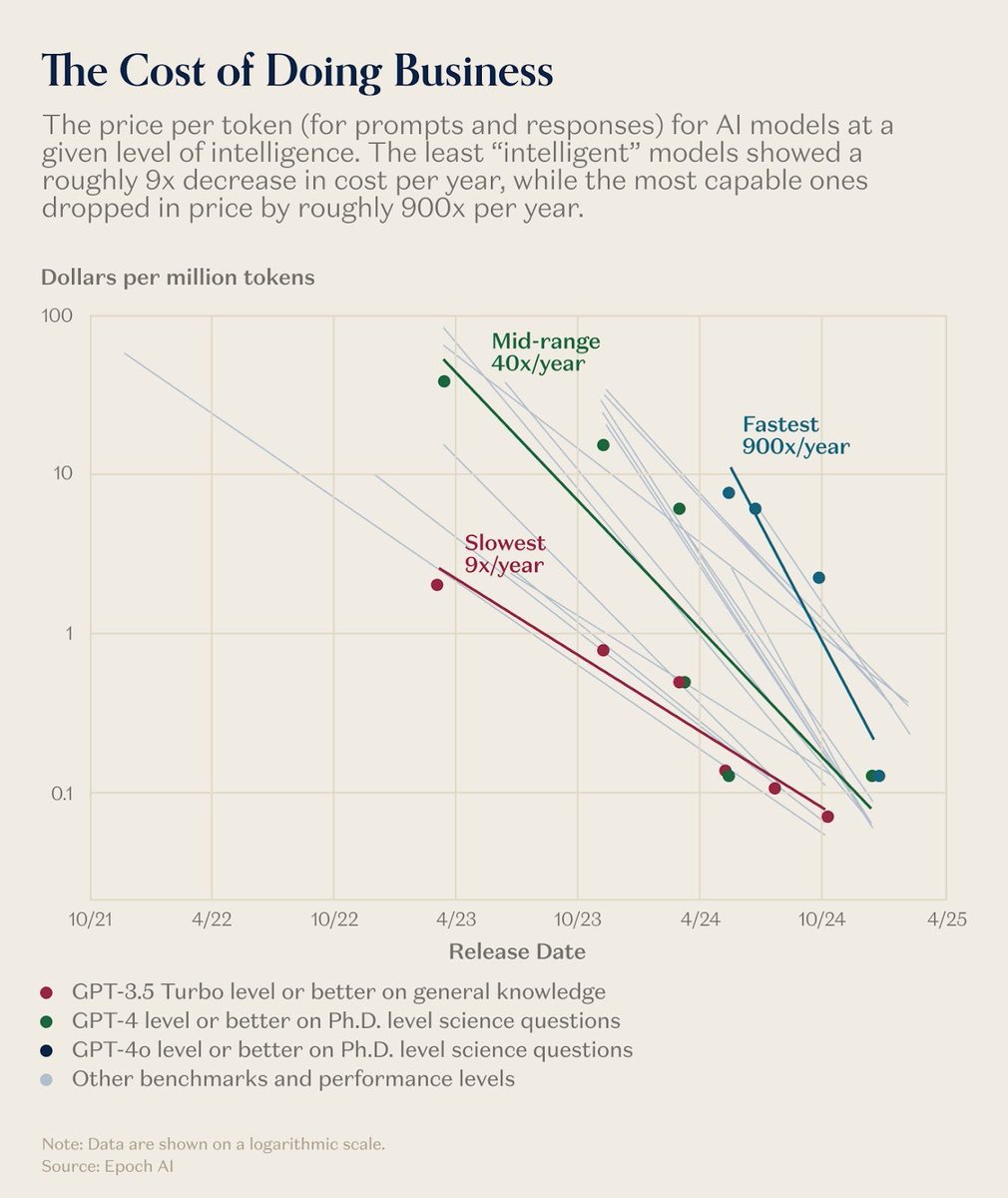
LLM token prices are collapsing fast, and the collapse is steepest at the top end. The least "intelligent" models get about 9× cheaper per year, mid-tier models drop about 40× per year, and the most capable models fall about 900× per year. Was same with "Moore’s Law, the best contemporary example of Jevons paradox. This extraordinary collapse in computing costs – a billionfold improvement – did not lead to modest, proportional increases in computer use. It triggered an explosion of applications that would have been unthinkable at earlier price points. " --- a16z .substack.com/p/why-ac-is-cheap-but-ac-repair-is
Rohan Paul tweet media
English
57
205
860
56.3K
Infra Signals Guy
Infra Signals Guy@InfraSignalsGuy·
@HedgieMarkets Dark fiber survived the dot-com bust because it could sit idle cheaply. AI can’t. Each agent call consumes GPUs, energy, and ops in real time. No customers = no revenue = no patience. Very different economics.
English
0
0
3
66
Hedgie
Hedgie@HedgieMarkets·
🦔 Bezos says AI is an "industrial bubble" not a "financial bubble," and that's supposed to make it okay. His argument: investors may lose money, but society still gets the inventions. Like the dot-com bust left us with the internet infrastructure. He's not wrong about the pattern. The dot-com crash left behind dark fiber that companies still use today. But notice the framing shift. We went from "it's not a bubble" to "it's a bubble, but it's the good kind." That's progress, I guess. My Take The guy with billions riding on AI telling you the AI bubble is actually fine is worth taking with some skepticism. Yes, some useful technology will survive whatever correction comes. But trillions in investment requires more than "useful." It requires world-changing returns to justify the spending. The real question is who pays for the difference between what was invested and what actually pays off. In the dot-com crash, retail investors and pension funds took massive losses. The infrastructure survived, but people's retirement accounts didn't. Bezos emerged from that wreckage as one of the richest people alive. When billionaires tell you bubbles can benefit society, ask who specifically benefits and who holds the bag. Hedgie🤗
English
22
36
250
18.8K
Infra Signals Guy
Infra Signals Guy@InfraSignalsGuy·
@mvcinvesting Exactly. Infrastructure rarely flips overnight. When new tech arrives, the system re-tieres: premium workloads move up, everything else flows down. GPUs are behaving like every mature infra layer before them.
English
3
0
3
529
M. V. Cunha
M. V. Cunha@mvcinvesting·
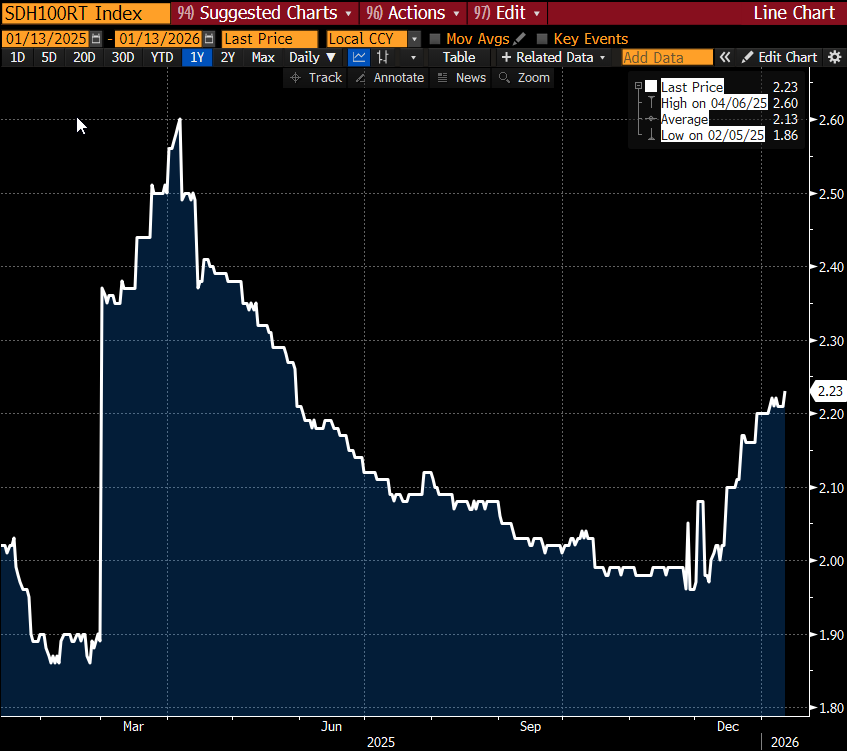
$NBIS $CRWV $IREN $CIFR Another bullish signal for AI infrastructure stocks: H100 rental prices continue to rebound from November lows and are now at an 8-month high. This pushes back against the bear case that older GPUs would quickly become obsolete as newer generations emerge. Each chip eventually finds its place in the hierarchy of workloads. AI adoption will only accelerate from here, across both lighter and heavier workloads, and performance per dollar matters. h/t @matthew_sigel
M. V. Cunha tweet media
English
28
122
1K
174.7K