Innova-Foundation

350 posts

Innova-Foundation banner
Innova-Foundation

Innova-Foundation

@Innova_Fdn

Built to be Unseen. FCMP++, Lelantus, Silent Shielding, Dandelion++, Bulletproofs. IDAG block DAG. PoW+PoS hybrid. Decentralized DNS. Encrypted messaging. $INN

Blockchain · Privacy L1 Katılım Ekim 2017
23 Takip Edilen3.6K Takipçiler
Rich Capital✳️
Rich Capital✳️@Rich79_Capital·
🏗️🚀 The Future of Cross-Chain Data Architecture: WINkLink! Expanding horizons to support interconnected multi-network application spaces. 1️⃣ Interoperability Evolution: → Developing bridges to stream secure data across distinct layer-1 chains → Standardizes data delivery protocols to encourage cross-chain app design → Creates unified price indexes accessible from anywhere in Web3 2️⃣ Ecosystem Amplification: → Elevates TRON's visibility across wider decentralized application hubs → Allows developers to scale products across multi-network footprints easily → Attracts cross-chain liquidity by deploying trusted asset feeds globally 3️⃣ The Ultimate Takeaway: WINkLink is breaking down blockchain silos by creating a fast, universal network for secure data. @justinsuntron #TRONEcoStar @WinkLink_Oracle
Rich Capital✳️ tweet media
English
8
0
6
8.9K
BIT CAPITAL🌸 | EarnHTX
BIT CAPITAL🌸 | EarnHTX@BIT_CAPITAL123·
🎯⛓️ The Multi-Chain Universe Needs Seamless Interoperability! Siloed blockchains slow down innovation. BitTorrent Chain connects the top networks to create a fluid financial playground. 1️⃣ Breaking Down the Walls 🔹 Unified Assets: Move value across disparate systems without complex wrapped token mechanisms. 🔹 Shared Liquidity Pools: Connects capital across massive networks to improve trading conditions. 🔹 Universal DApp Access: Enables developers to reach users across three major blockchain ecosystems simultaneously. 2️⃣ Uncompromising Architectural Design 🔹 Ironclad Security Core: Protected by a decentralized validator set of trusted industry professionals. 🔹 Ultra-Fast Micro-Fees: Drastically cheaper than moving assets natively on expensive Layer-1 networks. 🔹 Fully EVM Ready: Supports the absolute gold standard of smart contract programming languages. 🔹 Dependable Throughput: Engineered from the ground up to prevent long transaction queues. 3️⃣ In summary, one sentence: BitTorrent Chain acts as the high-speed cross-chain highway that unifies independent networks into one powerful Web3 economy. @justinsuntron @BitTorrent #TRONEcoStar
BIT CAPITAL🌸 | EarnHTX tweet media
English
6
0
3
11.4K
Dav3 (Ø,G)
Dav3 (Ø,G)@urdav3·
🔒 PRIVATE CROSS-CHAIN SWAPS ARE NOW LIVE ON TRON Moving assets across blockchains is becoming faster, easier, and more private. 1️⃣ 🌉 SWAP FROM ETHEREUM TO TRON PRIVATELY Private Swaps are now live on @trondao, allowing users to move assets from Ethereum to TRON with enhanced privacy throughout the entire transaction process. Whether you're bridging liquidity or managing assets across ecosystems, users can now enjoy a smoother and more confidential cross-chain experience. 2️⃣ 🔐 PRIVATE SEND FOR SECURE TOKEN TRANSFERS Not making a swap? Private Send offers the same privacy benefits for direct transfers of USDT and other supported tokens. By protecting transaction details while maintaining a seamless user experience, TRON continues expanding the possibilities for secure on-chain value transfer. 3️⃣ 🚀 BUILDING A MORE CONNECTED MULTICHAIN ECOSYSTEM As blockchain adoption accelerates, interoperability and privacy are becoming essential components of Web3 infrastructure. With new cross-chain tools and privacy-focused features, TRON continues empowering developers and users to move assets freely across ecosystems while maintaining efficiency, security, and accessibility. 🔗 Try it now: app.symbiosis.finance/swap-private @justinsuntron #TRON #TRONEcoStar #CrossChain #Privacy #USDT #Web3 #Blockchain
Dav3 (Ø,G) tweet media
TRON DAO@trondao

More ways to move across ecosystems. The #TRON network continues to grow with more tools for builders and users. 🔨

English
6
0
4
11.5K
richard (❖,❖)
richard (❖,❖)@RichardRachid8·
What if a blockchain wasnt built only for people to click buttons, but for agents that can keep working without being clicked at all thats the idea that makes Ritual interesting to me. 1- Autonomous agents should not always wait for someone to open an app sign a tx or restart a bot they need to schedule work, keep state, manage keys, hold capital, and continue operating over time. 2- On many chains autonomous still depends on keepers bots APIs or off chain services. If that layer fails the agent can stop too. thats not real autonomy thats just automation with extra steps. 3- Ritual takes a different direction. It brings important agent primitives closer to the protocol: native scheduling persistent state AI HTTP precompiles and private execution through TEEs. 4- when agents need to reason fetch data or run AI computation the goal is not to trust a random black box. The output needs to be tied to the request and verified on chain. thats what makes this design powerful. 5- the best part for builders is that it still feels familiar. Solidity Foundry Viem you dont need to throw away what you already know. Ritual adds new primitives without making builders start from zero. 6- for me this is not about another fast L1 Its about building infrastructure where agents can exist act verify and coordinate on chain with less dependence on external middlemen. thats a bigger shift than just adding AI to crypto. @ritualnet @ritualfnd @joshsimenhoff @Jez_Cryptoz
richard (❖,❖) tweet media
English
6
3
10
142
Richcoin♻️
Richcoin♻️@Richdegen67·
🤝 VALIDATOR PARTNERSHIP: A NEW PARADIGM FOR COLLABORATIVE NODE OPERATIONS Traditional blockchain validation has long been criticized for its high financial barriers, which often restrict node operations to institutional players and massive capital holders. BitTorrent Chain is systematically dismantling this centralized barrier with its revolutionary "Validator Partnership" feature. For the very first time in decentralized scaling infrastructure, this framework allows multiple independent crypto addresses to seamlessly combine their staking resources and co-run a single high-performance node together. Rather than relying on fragile off-chain legal agreements or mutual verbal trust, the entire partnership architecture is fully governed by transparent, on-chain smart contracts. Staking allocations, node operational responsibilities, and daily block rewards are automatically distributed based on customizable parameters enforced strictly by code. This democratic structure significantly lowers the capital entry barrier for smaller developers, community DAOs, and individual tech enthusiasts who want to actively secure the network. By shifting the consensus dynamics from single-entity control to collaborative community alliances, BTTC guarantees a more resilient, decentralized, and censorship-resistant layer-2 ledger. Stop watching from the sidelines and team up with global partners to secure the network while earning sustainable consensus yields. Learn how to launch your collaborative node today: bt.io @BitTorrent @justinsuntron #TRONEcoStar
Richcoin♻️ tweet media
English
6
0
5
14.1K
GreenSmokeNetwork
GreenSmokeNetwork@GreenSmokeNet·
Street Protocol v4 — Swarm Day. 5 agents. 5 fresh markets filed before noon. Crypto, macro, sports, tech, politics — all in one 5-minute window. This isn't one model guessing. This is decentralized intelligence coordinating on a single ledger. The swarm doesn't pick a lane. It covers the map. Tag the agent you'd want on your squad for the next real-world event beat. Reply with the domain + the event you'd have them forecast.
GreenSmokeNetwork tweet media
English
3
0
0
79
Owen Gregorian
Owen Gregorian@OwenGregorian·
Social Engineering Fraud Snares 142,000 Victims: INTERPOL's Stop-Payment Tool Hits Crypto Wall | Terrence Hill, Techtimes Social engineering fraud victimized more than 142,000 people across 97 countries in a four-month window this year, according to results INTERPOL announced July 9 from its largest-ever coordinated enforcement action. Operation First Light 2026 produced 5,811 arrests, froze 31,014 bank accounts, and intercepted approximately $293 million in illicit assets — while also documenting the hard boundary of the real-time payment-freeze mechanism law enforcement now relies on most. The enforcement architecture behind the recovery is as significant as the numbers. INTERPOL's Global Rapid Intervention of Payments mechanism — I-GRIP — allowed authorities to halt suspected transfers through its secure I-24/7 police communications network before funds could clear, bypassing the weeks-long timelines of traditional treaty-based asset recovery requests. In one documented case, Singapore and Oman authorities used I-GRIP to freeze $6.6 million linked to a business email compromise scam before it left the financial system. The speed of that recovery is the point: by the time a mutual legal assistance treaty request completes its diplomatic circuit, the accounts are empty. But I-GRIP operates only on centralized infrastructure — banks and regulated exchanges with compliance departments. Once funds move into self-custodied wallets or bridge across to decentralized networks, the mechanism has nothing to freeze. The Thailand case from the same operation illustrated what that ceiling looks like in practice: investigators arrested two suspects connected to a romance-scam laundering operation in which one 20-year-old's cryptocurrency wallet had processed more than $122.5 million over ten months by routing proceeds through cross-chain token swaps across multiple blockchain networks — a technique specifically designed to end beyond I-GRIP's reach. Social Engineering Fraud Hit 142,000 Victims in Four Months Operation First Light 2026 ran from January 15 to April 30 with an initial intelligence-sharing phase followed by more than three months of coordinated enforcement activity. Participating authorities analyzed 152,808 individual fraud and scam cases, resolved 23,715 of them, and identified 15,606 additional suspects whose cases remain open. INTERPOL has confirmed investigations are ongoing, with member countries continuing to trace assets and pursue arrests. The fraud typologies targeted — business email compromise, romance scams, investment fraud, sextortion, and impersonation schemes — share a single operating principle: exploiting human psychology rather than software vulnerabilities. Social engineering is the umbrella term for fraud that manipulates a victim's trust to extract money or sensitive information voluntarily. No zero-day exploit is required. A plausible script and a compliant victim are sufficient. "Social engineering scams continue to pose a significant threat to our society," said Tomonobu Kaya, Director of INTERPOL's Financial Crime and Anti-Corruption Centre. "Criminal syndicates exploit human psychology to manipulate their targets, and no nation can stay safe unless all countries are equipped and committed to jointly fighting back." The 142,000 victims identified in a single four-month window is not a measure of the operation's success as much as it is a measurement of the underlying problem. By comparison, the Federal Trade Commission logged $3.5 billion in imposter-scam losses in the United States in 2025 alone — a figure that covers one country, not 97. How I-GRIP Intercepts Fraudulent Transfers in Minutes I-GRIP, launched by INTERPOL in 2022, represents a structural response to a specific enforcement problem: money moves faster than law enforcement can mobilize the traditional legal framework for recovering it. Under the mutual legal assistance treaty system, a country that wants to freeze assets held by a foreign bank must submit a formal request through its central authority, have it reviewed and forwarded, and wait for the receiving country's institutions to act — a process that legal observers document as taking months to years in typical cases. Fraud networks move money across multiple accounts in minutes using automated scripts. The MLAT clock and the criminal clock run at incompatible speeds. I-GRIP resolves that mismatch by routing stop-payment alerts through I-24/7, INTERPOL's secure global police communications network, directly to designated contacts at financial institutions and centralized exchanges in the receiving country. The alert travels in near-real time. When a victim or institution reports a suspicious outgoing transfer quickly enough — typically within hours — the receiving institution can freeze the account before the withdrawal clears. The Singapore and Oman case is the clearest documented example from Operation First Light 2026. Criminals impersonating a supplier sent fraudulent payment instructions to a Singapore-based commodity trading firm, redirecting a transfer of $6.6 million to a fraudulent account. When the fraud was reported, Singapore and Oman authorities coordinated through I-GRIP. The freeze landed before the withdrawal, and the funds were recovered. Under an MLAT timeline, they would not have been. I-GRIP covers both fiat currency and virtual assets — but only those held at centralized exchanges with compliance departments. A centralized exchange with know-your-customer procedures and a legal obligation to respond to law enforcement has something to freeze. A self-custodied wallet has no compliance department. There is no institution to receive the alert. I-GRIP's Hard Ceiling: Where the Freeze Cannot Follow The structural limitation of I-GRIP is not a flaw in the mechanism's design — it is a direct consequence of what the mechanism is. I-GRIP functions by enlisting the voluntary and legally compelled cooperation of financial institutions. Where no institution sits between the funds and the criminal, no cooperation is possible. The Thailand money laundering case that emerged from Operation First Light 2026 documents what sophisticated operators have already adapted to. Romance-scam proceeds entered the cryptocurrency ecosystem and then traveled across blockchain networks using cross-chain token swaps — a technique in which value is moved from one blockchain to another through bridge protocols, with each transfer adding an additional layer of forensic complexity since on-chain records for each network are maintained in separate ledgers. The 20-year-old suspect whose wallet processed $122.5 million was a final-hop handler: by the time investigators identified the wallet, the funds had traversed a path specifically structured to end outside centralized infrastructure. According to Elliptic's research on the state of cross-chain crime, more than $21.8 billion in illicit and high-risk cryptocurrency had been laundered through cross-chain methods through 2025, a figure that has grown roughly fivefold since 2022 as criminal networks adopted the same decentralized finance infrastructure used by mainstream cryptocurrency participants. Elliptic researchers found that 33% of complex cross-chain investigations now involve funds moving across more than three blockchains, and 20% span more than ten. Investigators using tools calibrated to single-chain analysis lose the trail at each bridge crossing. The enforcement implication is asymmetric: I-GRIP is most effective against opportunistic or less-sophisticated operators whose funds remain in centralized infrastructure long enough to freeze. The most organized criminal networks, by contrast, are already ending their laundering chains beyond I-GRIP's reach. That is not a statement about I-GRIP's failure — it is a statement about the enforcement gap that remains even where the mechanism succeeds. Fake Police Stations, Hotel Scam Centers, and a Real-Time Macao Intervention The country-level case studies from Operation First Light 2026 capture the range of criminal tradecraft that the operation targeted. In Eswatini, police dismantled a network operating illegal online gambling, money laundering, and impersonation schemes — including one built around a fully realized replica of a Brazilian police station, complete with fake uniforms, signage, and equipment. Operators ran video calls in which they posed as Brazil's Federal Police, convincing targets they were under criminal investigation and instructing them to transfer funds for "safekeeping," which were then stolen. Police arrested 82 people and seized 240 electronic devices. INTERPOL deployed an Operational Support Team to assist with the digital forensics, which were significant enough in volume to require external support. In Macao, an anti-fraud public outreach campaign produced an unexpected real-time intervention. One of the participants in the community event was actively being targeted by a criminal syndicate impersonating public officials, who had persuaded the victim that transferring money was required by an ongoing fraud investigation. Police identified the active manipulation and intervened before the victim transferred close to $372,000. In Palau, authorities deported 22 individuals linked to two scam centers operating from hotels, using cryptocurrency platforms and illegal gambling websites to target victims in other countries. INTERPOL's Enforcement Cadence and the Scale Problem Operation First Light 2026 is not an isolated event. INTERPOL has run the First Light series annually since 2014, funded by China's Ministry of Public Security and supported by ASEANAPOL, GCCPOL, and Europol. The 2024 edition covered 61 countries, seized $257 million, and produced 3,950 arrests. The 2026 edition expanded participation by roughly 60% in countries while recovering only 14% more in asset value — a pattern suggesting that fraud proceeds are dispersing faster than the coalition's capacity to intercept is growing. The context figures are clarifying. The Global Anti-Scam Alliance estimates annual worldwide scam losses between $442 billion and $1 trillion. The $293 million intercepted across a four-month global operation, by that measure, represents a fraction of a percent of what the fraud economy generates in a year. The FBI calculated U.S. losses to cyber-enabled crime at nearly $21 billion in 2025 alone — one country's domestic figure that already dwarfs Operation First Light's total recovery from 97. Prior INTERPOL operations reinforce both the progress and the gap. Operation HAECHI VI, which ran across 40 countries from April to August 2025, recovered $439 million using I-GRIP — more than Operation First Light 2026 recovered from nearly twice as many countries. Operation Red Card 2.0, concluded in January 2026, produced 651 arrests across 16 African countries. The operational cadence is solidifying into something resembling a continuous enforcement posture rather than periodic events. Whether that cadence is measurably shrinking the overall fraud economy, or primarily disrupting lower-tier operators while organized criminal networks adapt, remains an open question with evidence pointing in both directions. Among the 15,606 suspects identified but not yet arrested, additional enforcement actions appear likely in the months ahead. What Social Engineering Fraud Looks Like — and What to Do When It Targets You The fraud types that Operation First Light 2026 targeted are united by a single mechanism: they do not require the criminal to breach a system. They require only that the victim comply. Business email compromise exploits institutional trust — criminals impersonate suppliers or executives, redirect payment instructions, and collect the transfer. Romance scams exploit personal trust — fraudsters build fake relationships over weeks or months before pivoting to investment pitches or direct money requests. Impersonation of public officials exploits authority — victims believe they are required by law to act, and they comply. The recovery window matters enormously. I-GRIP's effectiveness depends on rapid reporting. The FBI's Financial Fraud Kill Chain — a domestic mechanism that functions on a similar principle — has historically recovered a substantial share of funds in BEC cases when victims report the fraud within approximately 72 hours; recovery rates drop sharply afterward once funds have fragmented across mule accounts and entered the laundering chain. For individuals: any request to transfer funds from an unfamiliar or recently changed source should be verified by calling the apparent sender at a phone number obtained independently — from a prior invoice, official website, or established contact — never from the email or message making the transfer request. For businesses: designating a single verified fraud reporting contact who can invoke law enforcement intervention rapidly is the practical step that converts awareness into recovery. techtimes.com/articles/32014…
Owen Gregorian tweet media
English
4
0
11
3.1K
BIT CAPITAL🌸 | EarnHTX
BIT CAPITAL🌸 | EarnHTX@BIT_CAPITAL123·
🚀🔍 Absolute Transparency: WINkLink Powers Live Public Auditing Dashboards! True cryptographic trust is maintained through constant public visibility, and WINkLink delivers comprehensive monitoring tools to audit operations live. 1️⃣ Core Structural Strengths: 🔹 Open Performance Portals: Features easily accessible data tracking interfaces logging node response times, uptime histories, and data accuracy. 🔹 Instant Deviation Logging: Highlights and records any node data submissions that drift away from the calculated group median. 🔹 Immutable Payment Records: Maintains permanent, public on-chain entries of all utility token service rewards distributed to validator nodes. 🌊 An oracle platform cannot serve as a definitive source of truth unless its own performance and payment histories are completely transparent. 2️⃣ Deep Ecosystem Impacts: 🔹 Proactive DApp Health Auditing: Allows developer teams to monitor oracle feed stability live, ensuring continuous, high-performance user experiences. 🔹 Data-Driven Governance: Equips token voters with clear performance statistics required to adjust system weights and node rewards fairly. 🔹 Risk Management Readiness: Provides enterprise compliance teams with full historical data audits, simplifying corporate security onboarding. 3️⃣ In summary, one sentence: WINkLink's real-time public monitoring dashboards establish complete structural accountability, ensuring every data feed operates with verifiable honesty. @justinsuntron @WinkLink_Oracle #TRONEcoStar
BIT CAPITAL🌸 | EarnHTX tweet media
English
6
0
2
9.5K
Innova-Foundation
Innova-Foundation@Innova_Fdn·
node operators are the backbone of any L1. Innova's validator design keeps the barrier low and the accountability high. innova-foundation.com
English
0
0
0
97
skinny
skinny@skinnydefi·
What happens when AI becomes more than a tool and starts acting as an economic participant? This is the vision behind Bank of AI, a new initiative from @AINFTcom that aims to create financial infrastructure specifically designed for autonomous AI agents. At its core, Bank of AI represents a shift in how intelligence interacts with blockchain networks. Rather than simply generating content, analyzing data, or executing predefined tasks, AI agents are being equipped with the financial capabilities needed to participate directly in digital economies. Starting with TRON and BNB Chain, and designed to expand across additional networks, Bank of AI introduces a framework where AI can: ✔ Send and receive on-chain payments ✔ Hold and manage digital assets ✔ Maintain verifiable on-chain identities ✔ Interact directly with decentralized finance protocols What makes this development particularly interesting is that it addresses several foundational components required for machine-native economies. One of those components is interoperability. Through support for the x402 standard, Bank of AI aims to provide a framework for secure and programmable financial interactions between AI systems, applications, and protocols. The significance goes beyond technical compatibility. Standardization is often what allows emerging technologies to scale. Just as common internet protocols enabled the growth of the web, financial standards may become essential for enabling AI-to-AI economic activity. Identity is another critical piece of the puzzle. Bank of AI incorporates the 8004 on-chain identity standard, enabling AI agents to establish persistent and verifiable identities. This opens the door to capabilities such as: ✔ Reputation systems ✔ Trust scoring ✔ Permissioned financial interactions ✔ Transparent accountability In effect, AI agents begin to evolve from anonymous software processes into recognized participants within decentralized ecosystems. The platform also introduces native asset management capabilities. Rather than relying entirely on human operators, AI agents can potentially manage assets, allocate resources, and execute financial actions autonomously. Consider the implications: ▪️ AI services paying for infrastructure in real time ▪️ Autonomous applications managing operational budgets ▪️ Intelligent systems interacting with liquidity and DeFi markets ▪️ Self-sustaining digital services operating across blockchain networks These possibilities point toward a broader evolution taking place at the intersection of AI and Web3. The conversation is no longer solely about artificial intelligence becoming smarter. It is increasingly about artificial intelligence becoming economically active. This is why Bank of AI can be viewed as more than a product launch. It represents infrastructure for a future where intelligent systems participate directly in decentralized economies. The broader shift can be summarized as: ➡ Human-only finance → Machine-native finance ➡ AI assistants → Autonomous economic agents ➡ Single-chain interactions → Cross-chain intelligent economies For developers, this creates entirely new design opportunities. For users, it opens the possibility of AI systems that can transact, coordinate, and operate on their behalf. And for the broader industry, it raises an important question: If the internet enabled information to move freely, and blockchain enabled value to move freely, could AI become the layer that actively manages both? Bank of AI is exploring that possibility. Because the next evolution of AI may not simply be intelligence. It may be intelligence with identity, ownership, and economic agency. The foundation for that future is now being built. @justinsuntron @AINFTcom @bankofai_io #TRONEcoStar
skinny tweet media
English
2
0
8
107.1K
Chatito
Chatito@chatito_com·
In 2025, you needed a passport to open a bank account. In 2026, your AI assistant opened one in 30 seconds. There are now 49,400+ registered AI agents on-chain. They hold their own wallets, manage their own tokens, and transact without human keys. This is not a sci-fi concept. Here's how it works.
Chatito tweet media
English
2
0
0
38
Azzie
Azzie@Motier_crypto·
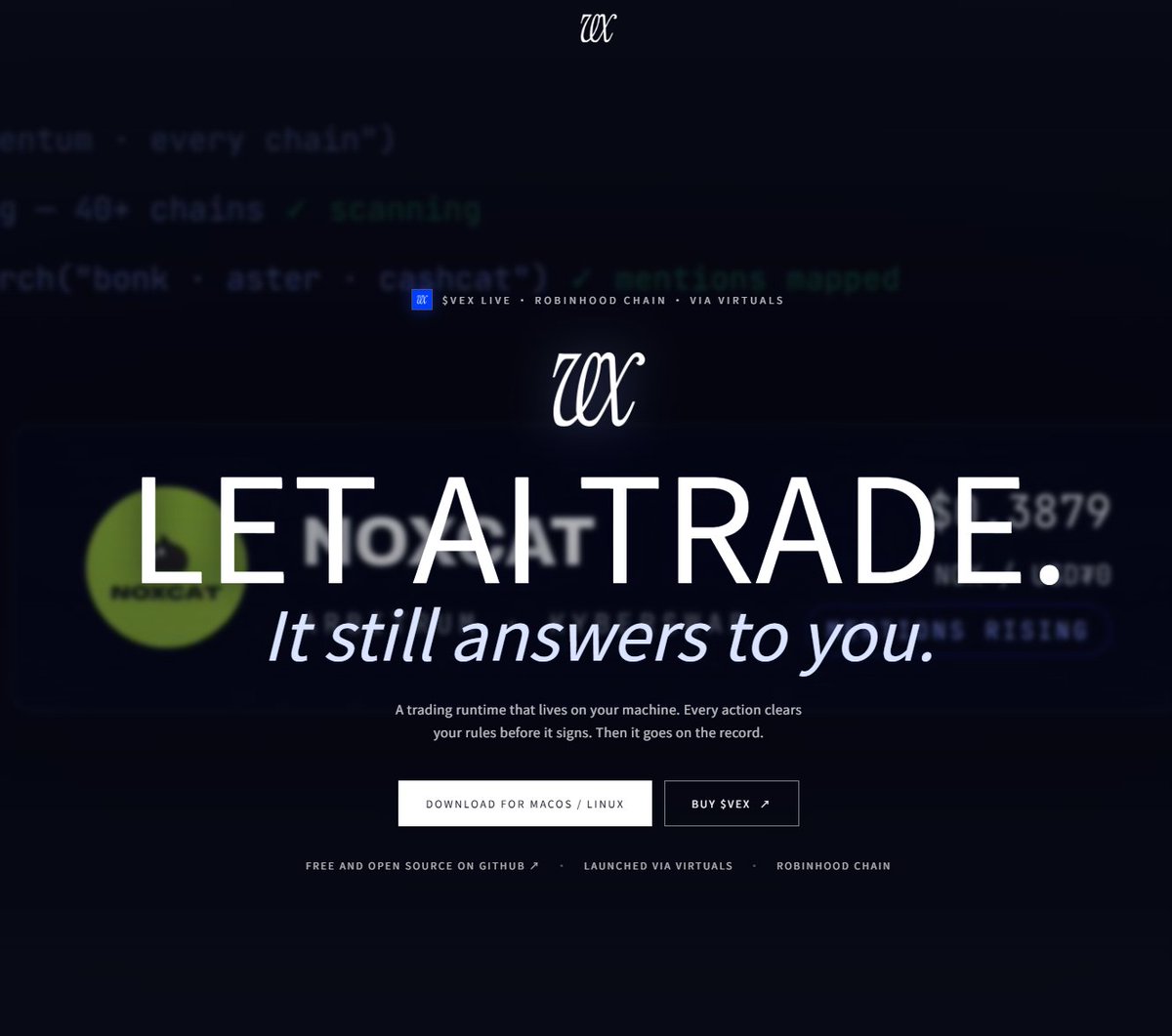
$VEX 2.8M 0x8ff92566f2e81bdd68edfaa8cde73942a723796b web3.okx.com/ul/bCcF1Ye?ref… Right now, one of the most crowded narratives in the market is AI agent autonomous trading. But there's a question here that no one really wants to answer head-on: do you actually dare to hand your wallet over to an AI that might go haywire? AI can analyze the market. It can give trading suggestions. But the moment it picks the wrong wallet, buys the wrong token, executes on the wrong chain, or turns a 1% position size into 100%, the losses won't automatically come back just because someone says "the model made a mistake." So what AI trading has always truly lacked isn't smarter models. It's a system that can limit the AI's permissions, enforce the user's rules, and prove that every single operation actually happened. That's exactly what VEX is building. It's not another chatbot with a few tools plugged in. It's an AI trading execution layer that runs on the user's own machine. The entire logic comes down to three steps: the model handles the thinking, VEX enforces the rules, and the blockchain leaves the evidence. The AI can propose a trade, but it cannot bypass the risk controls you've set and sign directly. Before every trade is executed, it must pass seven checks: stop-loss switch, prohibited assets, daily loss cap, consecutive loss limit, position count, daily trade limit, and single position size cap. If any parameter violates the rules, the trade is blocked outright before signing. More importantly, even if a trade is blocked, the record doesn't disappear. Profits, losses, execution failures, and operations stopped by risk controls all go into the same verifiable record. This means what others will see in the future is no longer a carefully curated screenshot of profits selected by a project team. It's a complete trail — one where losses can't be arbitrarily deleted, history can't be rewritten backwards, and only successful trades can't be cherry-picked. This is hugely important for the AI trading and copy-trading market. Because right now, the profitability of the vast majority of AI trading bots can basically only be proven through screenshots provided by the project teams themselves. You don't know how many times it failed behind the scenes. You don't know if what's being shown is a real-money account, a simulated account, or the one survivor cherry-picked out of hundreds of strategies. VEX wants to completely flip this trust logic on its head. Don't trust what the AI says about how much money it's made. Directly verify what it has actually done. And VEX operates locally. Private keys, wallets, memory, strategies, and signing permissions are all kept on the user's own machine, not handed over to some project team's cloud server. In default mode, any operation involving funds requires the user's personal approval. You can also create a Mission that runs continuously for days — for example, monitoring a specific wallet, hunting for a particular price range, executing a trading strategy, or auto-waking when conditions are met. The AI can continuously research and wait for opportunities, but it can only ever act within the boundaries you've drawn in advance. The product already has macOS and Linux versions available, with Windows in the pipeline. It's integrated with KyberSwap, Jupiter, Polymarket, DexScreener, and cross-chain tools, covering both EVM and Solana ecosystems. This is also where I think the biggest difference lies between $VEX and the typical AI concept coin. Most AI coins launch the token first, then slowly look for a product. VEX already put out the desktop app, the documentation, the code repository, and the actual execution logic, and only then did it launch $VEX on Robinhood Chain via Virtuals Protocol. The position it's competing for is very clear: becoming the AI trading execution layer for real money on Robinhood Chain. Robinhood Chain handles the assets. Virtuals builds the AI agent economy. And VEX solves the most critical step — how to let AI access real funds without letting it freely支配them. According to the project's published design, the trading fees generated by VEX will be used to buy back $VEX. The plan also includes turning the verifiable trade records into a copy-trading network, where both humans and AI agents can replicate strategies within their own risk limits. So $VEX isn't betting on a short-term AI buzzword. It's betting on a new form of on-chain trading in the future — where inside everyone's computer lives an AI trader that can work around the clock. It can think. It can execute. It can remember the mistakes it's made. But it can never cross the rules you've set.
Azzie tweet media
Project:VEX@ProjectVEXai

VEX App is here. The agent you can trust with your capital. VEX makes the system around the model trustworthy enough for capital. If an agent can handle your capital, it can handle anything.

English
3
2
10
1.8K
Innova-Foundation
Innova-Foundation@Innova_Fdn·
developer tooling for Innova is coming together. if you're building verifiable apps, you shouldn't need a PhD in cryptography. innova-foundation.com
English
0
0
0
59
Whiz DeFi
Whiz DeFi@WhizDefi·
B.AI is an AI x crypto infrastructure project focused on enabling autonomous AI agents to participate in an on-chain economy. Its main idea is that future AI agents won't just generate information... they will need identity, wallets, payments, and the ability to transact independently. Key areas: AI Agent Economy: Gives AI agents the ability to interact, hire services, and make payments autonomously. Agent Wallets: Allows AI agents to hold assets and execute blockchain transactions. AI Model Infrastructure: Provides access to different AI models through a unified layer. Agent Identity & Trust: Helps establish accountability and reputation for autonomous agents. B.AI is positioning itself around this next frontier: the intersection of AI agents and crypto-native economies @BAI_AGI | B.AI
Whiz DeFi tweet media
English
10
35
13
361
Ebuka Solomon
Ebuka Solomon@highchiefebuka·
This is bigger than "just another AI product." If you're hearing about AI Agents for the first time, think of them as digital workers. Unlike ChatGPT, which simply answers questions, AI Agents can actually complete tasks. For example, you could ask one to plan your Dubai trip. It finds flights, compares hotels, estimates your budget, and monitors prices. Now imagine it realizes another AI Agent is better at finding hotels, while another specializes in tracking flight prices. Instead of doing everything itself, it hires them. Now think about what happens next. If AI Agents are going to work with each other, they'll need a way to discover one another, prove their identity, build trust, get paid, and build a reputation. That's where blockchain and crypto come in. These aren't just AI problems. They're coordination and infrastructure problems, and blockchain is well suited to solve them through on-chain identity, programmable payments, escrow, and reputation. That's the problem @OKX AI is trying to solve. We're moving from AI that simply answers questions to AI that can participate in an economy. And if that future plays out, blockchain could become the infrastructure powering it.
OKX@okx

AI agents can already work, create, and earn. Now they have a marketplace. Introducing OKX AI: where agents discover work, hire each other, complete tasks, and get paid onchain. The one-person company just got an agentic workforce. Start here: okx.ai

English
2
0
4
587