Interfor

1.7K posts

Interfor banner
Interfor

Interfor

@InterforInt

Global Investigations-Intelligence-Security

New York Katılım Ocak 2010
532 Takip Edilen409 Takipçiler
Interfor
Interfor@InterforInt·
Today’s business leaders are navigating far more than markets. They’re navigating geopolitical instability, cyber warfare, AI competition, supply chain disruption, and global uncertainty, all at the same time. This week’s Interfor International LLC Security Digest covered several major developments shaping the global landscape right now: → Rising tensions involving Iran, the Strait of Hormuz, and the possibility of renewed military escalation in the Middle East. → China-U.S. discussions around trade, AI, semiconductors, and global supply chains. → A growing Ebola outbreak in Central Africa raising concerns around regional spread and global health preparedness. → Escalating drone strikes between Ukraine and Russia, including nuclear force drills. → Increasing concerns around cyber threats, national security, and critical infrastructure. The reality is that leaders today are no longer operating in isolated business environments. Economic risk, geopolitical instability, cyber threats, supply chains, and market strategy are now deeply connected. Understanding how these forces intersect is becoming one of the most important strategic advantages organizations can have. Follow the @InterforInt International Company Page for weekly insights on global #Security , geopolitical #risk, #cybersecurity, #investigations, and the forces shaping today’s operating environment.
Interfor tweet media
English
0
0
1
14
Interfor
Interfor@InterforInt·
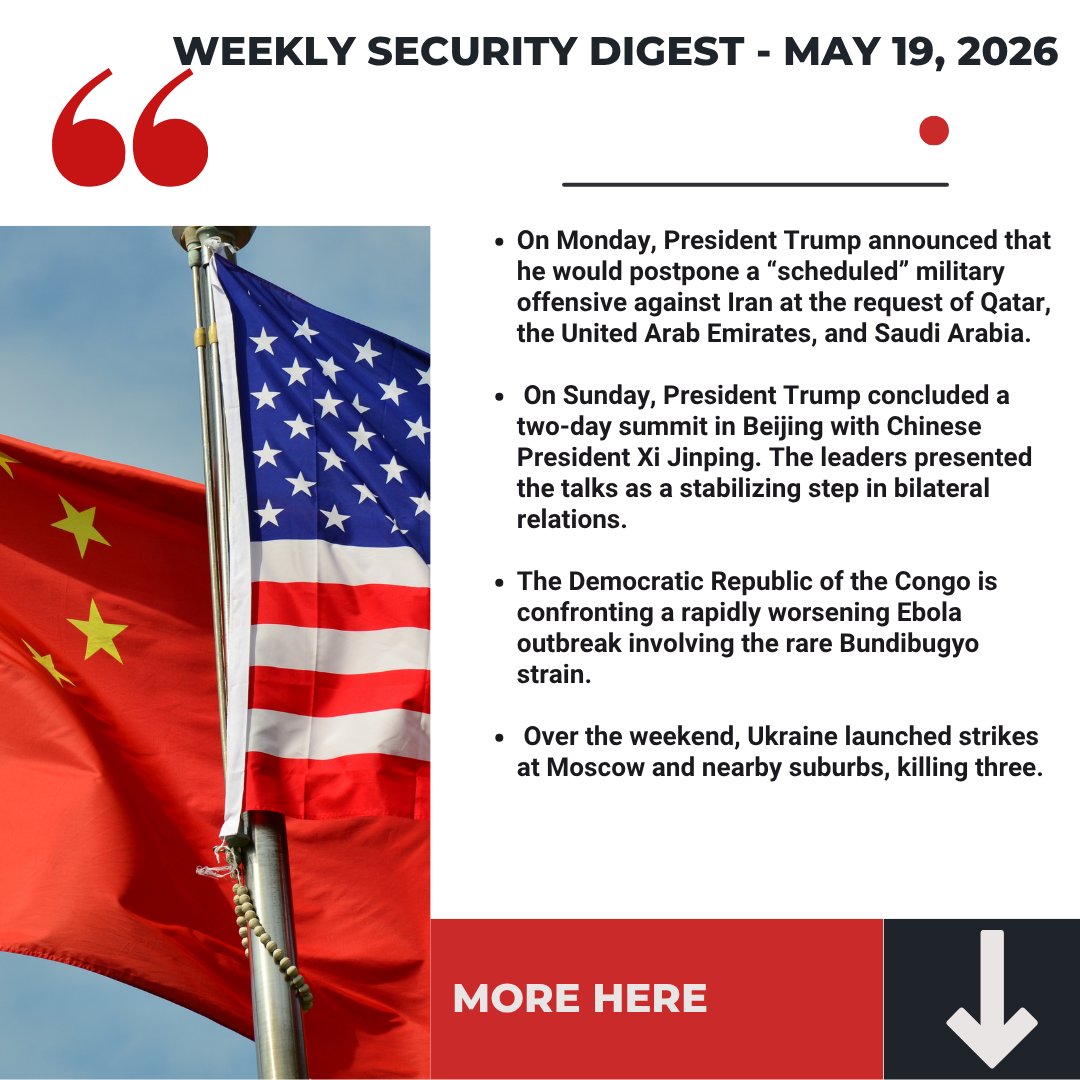
Interfor International‘s Weekly Security Digest - May 19, 2026 Middle East → On Monday, President Trump announced that he would postpone a “scheduled” military offensive against Iran at the request of Qatar, the United Arab Emirates, and Saudi Arabia. The Gulf states have not confirmed their role in Trump’s decision, but mediators are reportedly pushing to regain diplomatic momentum on two key issues: Iran’s nuclear program and the Strait of Hormuz. President Trump agreed to delay attacks for two to three days but instructed Secretary Hegseth to be prepared to launch attacks at a moment’s notice. International Affairs → On Sunday, President Trump concluded a two-day summit in Beijing with Chinese President Xi Jinping. The leaders presented the talks as a stabilizing step in bilateral relations. #security #geopolitics #risks #threats #intelligence interforinternational.com/interfor-inter…
Interfor tweet media
English
0
0
2
45
Interfor
Interfor@InterforInt·
If you operate internationally, this week probably got your attention. Because the world feels less stable than it did 30 days ago. This week’s global developments reinforced a reality many organizations are already feeling firsthand: Geopolitical instability, economic uncertainty, cyber threats, and regional conflict are no longer isolated events. They are increasingly interconnected and capable of impacting markets, operations, supply chains, and leadership decisions in real time. This week’s briefing covered several major developments: → Escalating U.S.-Iran tensions and continued uncertainty around diplomacy, military escalation, and the future of negotiations surrounding Iran’s nuclear program. The Strait of Hormuz remains a major focal point for global energy markets and commercial security concerns. → President Trump’s upcoming summit with Xi Jinping in Beijing, where trade, investment, and Taiwan are expected to play central roles. The meeting comes amid growing geopolitical competition between the U.S. and China and increasing concern around military positioning in the region. → A rise in terrorism and antisemitic threats across Europe, including the U.K.’s decision to raise its terrorism threat level following recent attacks. Security officials across the region continue to monitor broader risks tied to extremism and civil unrest. → Organized crime investigations in Italy connected to narcotics trafficking, money laundering, and targeted violence tied to transnational criminal networks operating across Europe and South America. → Public health concerns tied to the hantavirus outbreak in Argentina, which has triggered international monitoring efforts and renewed conversations around climate-related disease exposure and global preparedness. → Political instability in the Philippines following the impeachment proceedings against Vice President Sara Duterte, a major development that could reshape the country’s political landscape ahead of the 2028 election cycle. In today’s environment, organizations are expected to navigate not only operational and financial challenges, but an increasingly complex global risk landscape that can evolve rapidly. That’s why staying informed matters. Follow the @InterforInt International Company Page for weekly insights on global #security, #geopolitical developments, cyber #threats, and evolving #risk impacting businesses, investors, and organizations worldwide
Interfor tweet media
English
0
0
1
7
Interfor
Interfor@InterforInt·
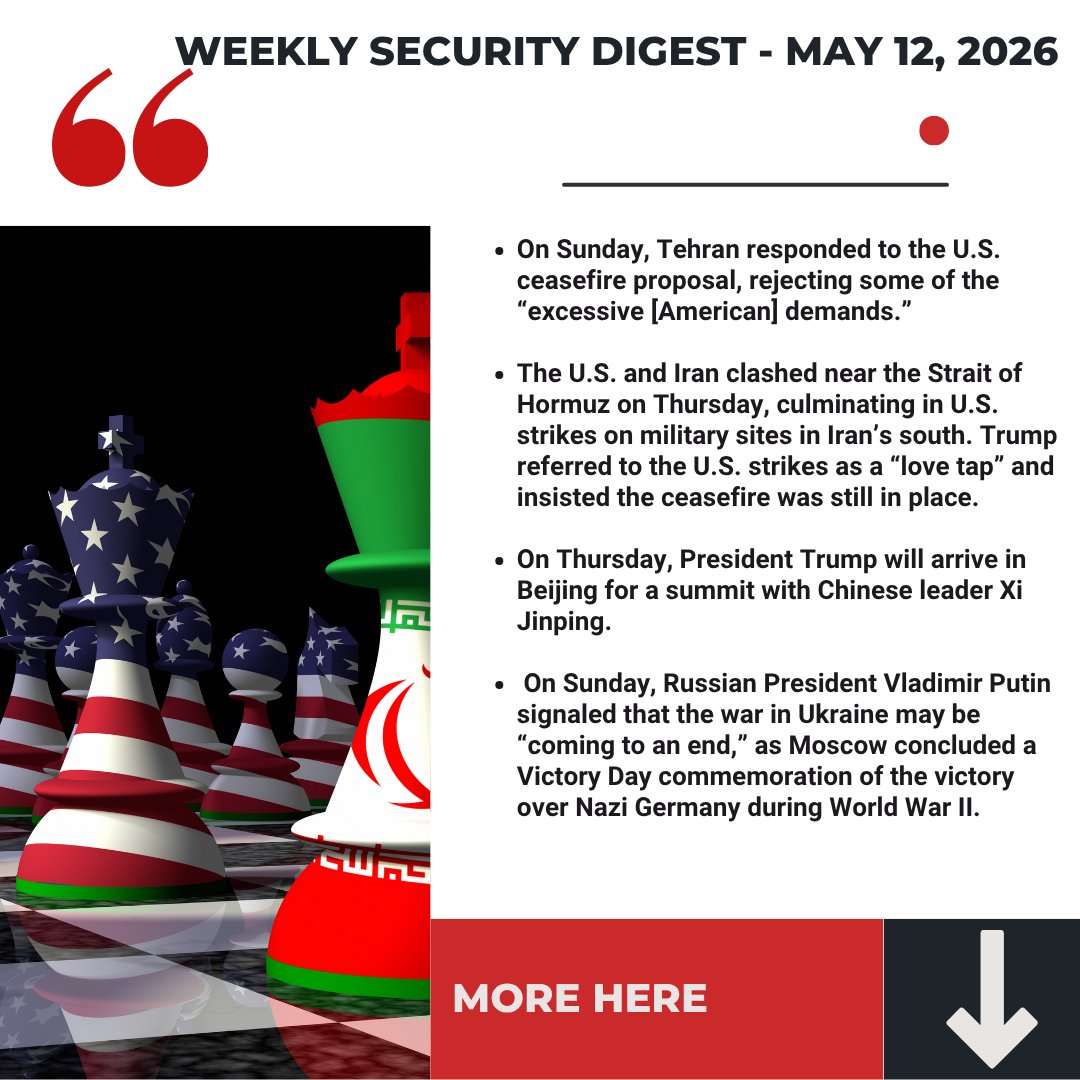
Interfor International‘s Weekly #Security Digest - May 12, 2026 Middle East → On Sunday, Tehran responded to the U.S. ceasefire proposal, rejecting some of the “excessive [American] demands.” The issue of enriched #uranium remains a key sticking point for both parties. President Trump claims that #Iran previously agreed to give up its enriched uranium, though Iran denies ever agreeing to such a deal. Trump stated on Monday that the #ceasefire is “on life support” and met with his national security team to discuss diplomatic and military options. International Affairs → On Thursday, President Trump will arrive in #Beijing for a summit with Chinese leader Xi Jinping. The summit is expected to focus on trade and investment. However, President Xi may also attempt to dissuade Trump from further arms sales to Taiwan. interforinternational.com/interfor-inter…
Interfor tweet media
English
0
0
1
250
Interfor
Interfor@InterforInt·
The world is getting more unstable. Most leaders are still operating like it’s not. This week’s global #security landscape is shifting fast; here are the headlines leaders shouldn’t ignore. At Interfor International, we’re tracking: Middle East escalation risk → U.S.–Iran tensions in the Strait of #Hormuz are approaching a potential inflection point between containment and conflict Southeast Asia #instability → Thailand’s withdrawal from a long-standing energy pact with Cambodia signals rising regional friction with limited paths to resolution China’s global expansion strategy → Chinese automakers are rapidly gaining share in Europe as they pivot to building for foreign markets Russia–Ukraine ceasefire dynamics → Temporary #ceasefires continue to signal intent, but not durability Rising domestic #security threats in Europe → The U.K.’s elevation to a “severe” #threat level reflects a broader surge in internal security risks Public health and containment risk → A suspected #hantavirus outbreak on a stranded cruise ship highlights ongoing global containment challenges Political realignment in Africa → Nigeria’s opposition consolidation could reshape the 2027 electoral landscape Legal and political pressure in Europe → Italy’s pardon #investigation is exposing cracks in institutional credibility Our view is that these aren’t isolated headlines. They’re signs that point to a more #volatile operating environment across markets. The leaders who win right now aren’t reacting to risk. They’re anticipating it. Want this breakdown in your feed each week? Follow the @InterforInt International Company Page.
Interfor tweet media
English
0
1
1
46
Interfor
Interfor@InterforInt·
Interfor International‘s Weekly Security Digest - May 5, 2026 Middle East → On Monday, President Trump initiated Project Freedom, aimed at creating a safe path through the Strait of #Hormuz for global shipping. In response, Tehran launched projectiles at U.S. Navy vessels and U.S.-flagged ships in the Strait and land targets in the U.A.E. Iran did not immediately claim responsibility, but Foreign Minister Araghchi warned the U.S. and U.A.E. against continued aggression in the Strait. With no recent progress in diplomatic #negotiations, this week’s events materially increase the risk of the resumption of war. International Affairs → Thailand has unilaterally withdrawn from its 25-year-old joint energy exploration agreement with Cambodia, following two rounds of armed conflict between the neighbors last year. Prime Minister Anutin had pledged the cancellation as a campaign promise, though he framed it as a policy decision given the deal's limited progress since 2001. Cambodian authorities claim they will now seek resolution under the United Nations Convention on the Law of the Sea. The prospect of productive bilateral negotiations remains remote. #safety #security #intelligence #Geopolitics interforinternational.com/interfor-inter…
Interfor tweet media
English
0
1
3
84
Interfor
Interfor@InterforInt·
A passenger tries to storm the #cockpit, a flight declares an emergency, and the headline spreads. So suddenly, everyone is asking the same question, is flying becoming less safe? The short answer is no. But the type of #risk people are seeing is changing. Recent incidents, like the attempted cockpit breach on a @united Airlines flight out of Newark, are not about aircraft failure. They’re about human behavior inside a highly controlled system. That distinction matters. Because from a #security standpoint, commercial aviation today is built with layers of protection that didn’t exist 20+ years ago. But here’s the more useful question: What should travelers actually pay attention to when traveling? From a #risk perspective, there are a few practical things that matter far more than most people realize: 1. Watch #behavior, not noise If someone is visibly intoxicated, escalating, or agitated before takeoff, take note. Most incidents don’t come out of nowhere. 2. Follow crew instructions, immediately In any disruption scenario, the fastest path to stability is coordinated compliance. Delays and confusion make situations worse. 3. Stay seated when it matters Turbulence, not human conflict, remains the most common cause of in-flight injury. Seatbelt discipline is still one of the simplest ways to reduce risk. 4. Don’t escalate the situation Intervening can help, but only if it’s coordinated. Random escalation from passengers can complicate crew response. 5. Think in systems, not moments One incident does not define the safety of an entire system. Aviation remains one of the most secure and regulated environments in the world. The reality is that we’re not seeing a breakdown in aviation safety. We’re seeing isolated human disruptions inside a system designed to handle them. And in nearly every case, it does. Travel informed, stay situationally aware, and take control of your #safety from the moment you step into the airport.
Interfor tweet media
English
0
0
1
49
Interfor
Interfor@InterforInt·
Most headlines obsess over the mega-deals. The billion-dollar ones. The flashy stuff. But if you actually want to understand where the market is going, look a bit lower. The middle market is where things get real. On May 20 at 12 PM ET, Interfor Academy is hosting a live session on the M&A outlook for 2026 and what the current deal activity is quietly telling us beneath the surface. Because the deals getting done right now don’t look anything like the headlines. We’re bringing in two people who are actually in it day to day: - Rick Giovannelli (Co-Chair, Management Committee, K&L Gates) - Ryan Breen (Partner, KPMG – Mid-Atlantic Private Audit) Moderated by Jeremy Hurewitz, who leads Interfor Academy and wrote Sell Like a Spy. We’ll get into: → What’s actually risky right now (and where the upside is) given the geopolitical noise → How AI is starting to change deal-making in practice—not just in theory → What higher interest rates, inflation, and the PE exit backlog really mean for deal flow → Why the middle market might be the clearest signal of what’s coming next If you’re an investor, operator, or advisor, it’s worth tuning in. Live on Zoom on May 20, 12 PM (ET). Register through the link below: us02web.zoom.us/webinar/regist… @Selllikeaspy @KLGates @KPMG
Interfor tweet media
English
0
0
2
38
Interfor
Interfor@InterforInt·
Most headlines focus on mega-deals. But if you want to understand where the market is actually heading… watch the middle market. On May 20 at 12 PM ET, Interfor Academy is hosting a live discussion on the M&A Outlook for 2026, and what the current market is telling us beneath the surface. The deals getting done right now don’t match the headlines. We’re bringing together two leading practitioners who are in the trenches of corporate deals: 𖧹 Rick Giovannelli (Co-Chair, Management Committee, K&L Gates) 𖧹 Ryan Breen (Partner, KPMG – Mid-Atlantic Private Audit) Moderated by Jeremy Hurewitz, Head of Interfor Academy and author of Sell Like a Spy. During the webinar, we’ll cover: → The real risks and opportunities in today’s geopolitical environment → How AI is shaping the deal landscape → What interest rates, inflation, and the PE exit backlog mean for deal flow → Why the middle market may be the best leading indicator right now If you're operating in today’s environment, whether as an investor, operator, or advisor, this is a conversation you don’t want to miss. May 20th, 12PM (ET) Via Zoom. Save your seat now: us02web.zoom.us/webinar/regist… @KPMG @KLGates @Selllikeaspy
Interfor tweet media
English
0
0
1
34
Interfor
Interfor@InterforInt·
Moral licensing is how good people justify bad decisions. Every good decision starts to feel like a credit. One you can “spend” later on a bad one. In this video, Tom Hardin, known as “@iamtipperx” shares how that process unfolded in real time. A former hedge fund analyst turned informant in the Galleon Group insider trading scandal, he now helps organizations understand how pressure, incentives, and rationalization escalate into real exposure. In last week’s conversation with Interfor Academy Head @Selllikeaspy Jeremy Hurewitz,  Tom broke down how moral licensing quietly turns small decisions into real risk. And here’s the uncomfortable truth: Even when the upside is real, it’s rarely worth it. In one case, millions were made. The personal gain? $46K. The cost? A career. At Interfor, this is why we focus on more than just response. We help organizations identify the early signs, behavioral patterns, pressure, and rationalization, before they become incidents. Because by the time something is visible, it’s often already too late. Where do you see “moral licensing” show up most in organizations today?
English
0
1
3
41
Interfor
Interfor@InterforInt·
Interfor International‘s Weekly Security Digest - April 28, 2026 Middle East → Iranian negotiators proposed reopening the Strait of #Hormuz in exchange for an end to the U.S. #blockade and an end to the #war. The Iranian proposal puts off addressing U.S. demands on nuclear and other issues until later talks. → On Tuesday, the U.A.E. announced its intention to leave OPEC., effective May 1. This decision reflects Abu Dhabi’s plans to increase energy production, unhindered by O.P.E.C. quotas. Importantly, the move is also likely to please the Trump administration, which has criticized O.P.E.C. for how it exerts control over global #oil prices. interforinternational.com/interfor-inter…
Interfor tweet media
English
0
0
0
40
Interfor
Interfor@InterforInt·
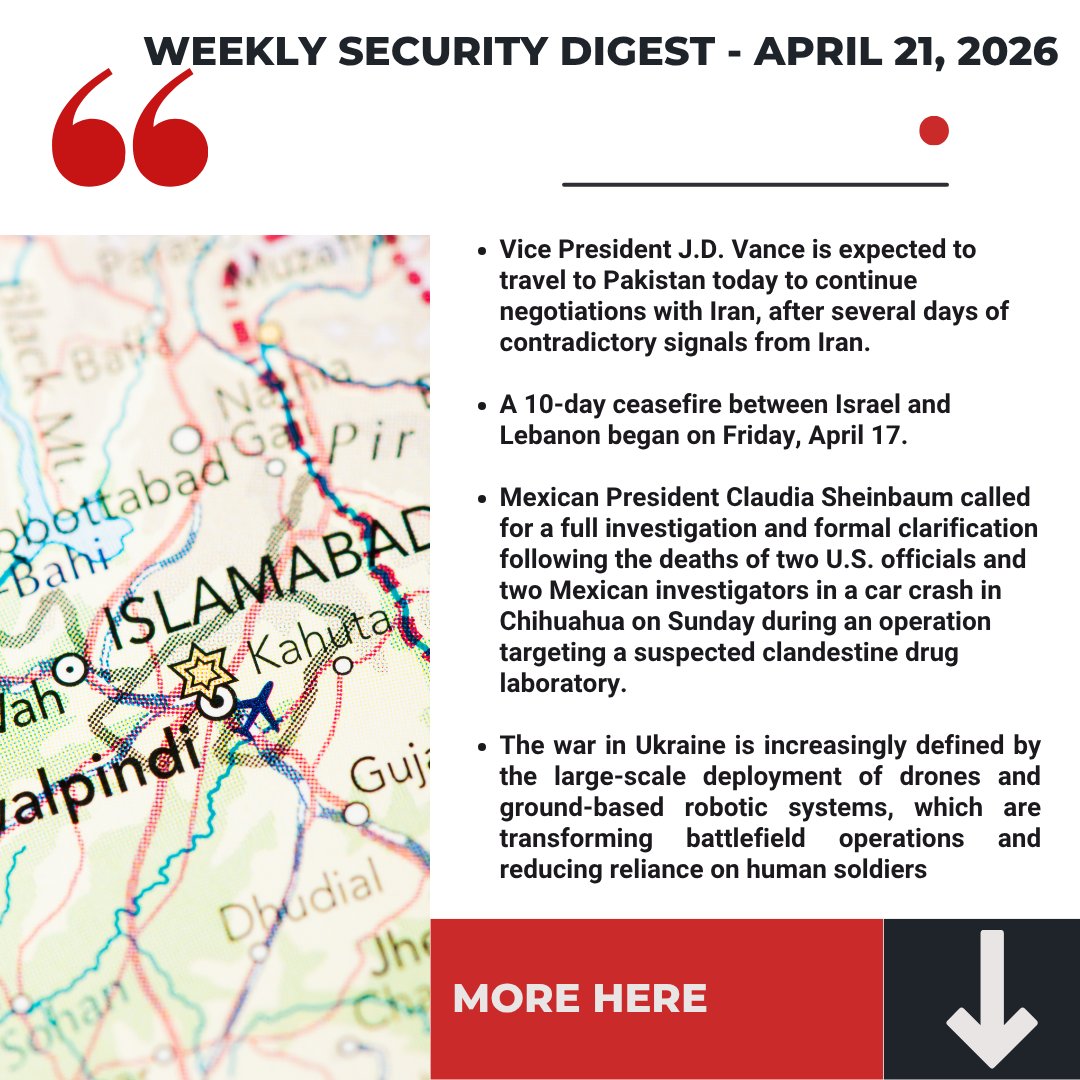
Interfor International‘s Weekly Security Digest - April 21, 2026 Middle East → Vice President J.D. Vance is expected to travel to Pakistan today to continue negotiations with Iran, after several days of contradictory signals from Iran. On Saturday, Iranian Foreign Minister Abbas Araghchi announced that the Strait of Hormuz would open for international shipping traffic; however, the I.R.G.C. fired on commercial vessels just hours later. U.S. officials interpreted these events as evidence that divisions remain within Iran’s leadership, in particular between the leadership of the I.R.G.C. and lead negotiator Mohammad-Bagher Ghalibaf. International Affairs → Mexican President Claudia Sheinbaum called for a full investigation and formal clarification following the deaths of two U.S. officials and two Mexican investigators in a car crash in Chihuahua on Sunday during an operation targeting a suspected clandestine drug laboratory. #security #geopolitics #middleeast #ukraine #mexico interforinternational.com/interfor-inter…
Interfor tweet media
English
0
0
1
56
Interfor
Interfor@InterforInt·
He went from hedge fund analyst to FBI informant. This month we’re hosting a conversation with Tom Hardin @iamtipperx , known as “Tipper X,” one of the most prolific insider trading informants in U.S. history. Tom helped build more than 20 criminal cases in what became the largest insider trading #investigation of a generation. Now, he advises Fortune 500 companies, boards, and leadership teams on behavioral risk and ethical decision-making. In this Interfor Academy session, we’ll go beyond theory: → What actually drives smart professionals to cross the line → How risk shows up inside organizations before it becomes visible → What leaders can do to identify and mitigate it early This isn’t about headlines. It’s about understanding how decisions are made under pressure and what that means for your organization. If you work in compliance, legal, or leadership, this will be a valuable discussion. Join us on April 23 at 12pm EST. Register now to join the discussion: us02web.zoom.us/webinar/regist…
Interfor tweet media
English
0
2
5
141
Interfor
Interfor@InterforInt·
Most people don’t think about personal #security on the subway… Until something happens. That’s the problem. Over the past month, we’ve seen a series of unprovoked attacks in the NYC #subway system, including a violent incident at Grand Central Terminal. These aren’t coordinated #threats, they’re unpredictable, and that’s what makes them dangerous. Because you can’t “profile” risk, you have to manage exposure to it. If you’re taking the #subway, especially in high-traffic systems like NYC, here are a few fundamentals: 1. Control your environment 𖧹 Avoid empty cars, especially late at night 𖧹 Position yourself near the conductor or in populated areas 𖧹 If something feels off, change cars at the next stop, no hesitation 2. Manage your attention 𖧹 Limit distractions (headphones, phone) when entering/exiting stations 𖧹 Do a quick scan: who’s around you, who’s moving erratically 3. Create distance early 𖧹 Most incidents escalate from proximity 𖧹 If someone is acting unpredictably, move, don’t wait for confirmation 4. Trust pattern breaks 𖧹 Sudden aggression, pacing, shouting, fixation, these are signals 𖧹 You don’t need to be right, you need to be early 5. Have a simple exit plan 𖧹 Know where you are in the system 𖧹 Identify exits as you enter platforms 𖧹 Don’t get boxed into corners or dead-end areas This isn’t about fear. It’s about operating with awareness in environments where you don’t control who enters the system. The subway moves millions of people safely every day, but safety is not passive. It’s a series of small decisions made early. #Awareness isn’t paranoia, it’s preparation.
Interfor tweet media
English
0
1
1
87
Interfor
Interfor@InterforInt·
What happened at @sama home isn’t an isolated incident. And right now, that reaction is moving in the wrong direction. Public figures, especially those operating at the center of high-stakes industries like AI and crypto are becoming exposed. Not just digitally, but physically. What’s more concerning is the reaction. The normalization, and in some cases, celebration, of these incidents on social media reflects a growing disconnect between perceived and actual risk. This is where most individuals and organizations fall short. They think about #security after an incident. But effective #protection is proactive. Threat monitoring is not theoretical. It’s not a “nice to have.” It’s a critical layer that enables early detection, real-time awareness, and informed response, before a situation escalates. Done correctly, it allows teams to: 𖧹 Identify credible threats before they materialize 𖧹 Track changes in sentiment and intent across digital channels 𖧹 Assess risk dynamically, not statically 𖧹 Act with precision, not reaction In today’s environment, situational awareness isn’t optional. It’s foundational. And in many cases, it’s the difference between disruption, and prevention. @WSJ wsj.com/tech/ai/sam-al…
Interfor tweet media
English
0
0
0
15
Interfor
Interfor@InterforInt·
The Middle East isn’t escalating… yet. That’s the problem. #Geopolitical tensions remain contained, for now, but the risk of miscalculation is rising. In the #MiddleEast, negotiations between the U.S. and Iran collapsed over nuclear terms, prompting a U.S. blockade of Iranian ports in the Strait of Hormuz. While both sides appear reluctant to return to full-scale conflict, the current situation introduces meaningful risk, particularly in contested maritime environments where a single incident could trigger escalation. At the same time, we are closely monitoring potential secondary escalation areas: 𖧹 Strait of Hormuz: Elevated risk of naval incidents amid blockade enforcement 𖧹 Bab al-Mandab: Limited but notable probability of Houthi disruption 𖧹 Israel–Lebanon dynamics: Renewed diplomatic engagement, though Hezbollah has already rejected potential agreements Outside the region, several developments reflect a broader trend: increasing overlap between geopolitical risk, regulatory environments, and corporate exposure: 𖧹 #Hungary’s election signals a shift in EU political alignment 𖧹 #China is tightening control over supply chains as a national security priority 𖧹 Legal actions against multinational firms (e.g., @LafargeGroup case) highlight rising compliance and reputational risk 𖧹 North Korea continues advancing maritime strike capabilities What this means for organizations is that #risk is no longer isolated to conflict zones, it is increasingly systemic, crossing regulatory, operational, and reputational domains. At @InterforInt , we continue to monitor these developments in real time, helping clients anticipate, not react to, emerging threats. Follow our Company Page for ongoing analysis.
Interfor tweet media
English
0
1
1
21
Interfor
Interfor@InterforInt·
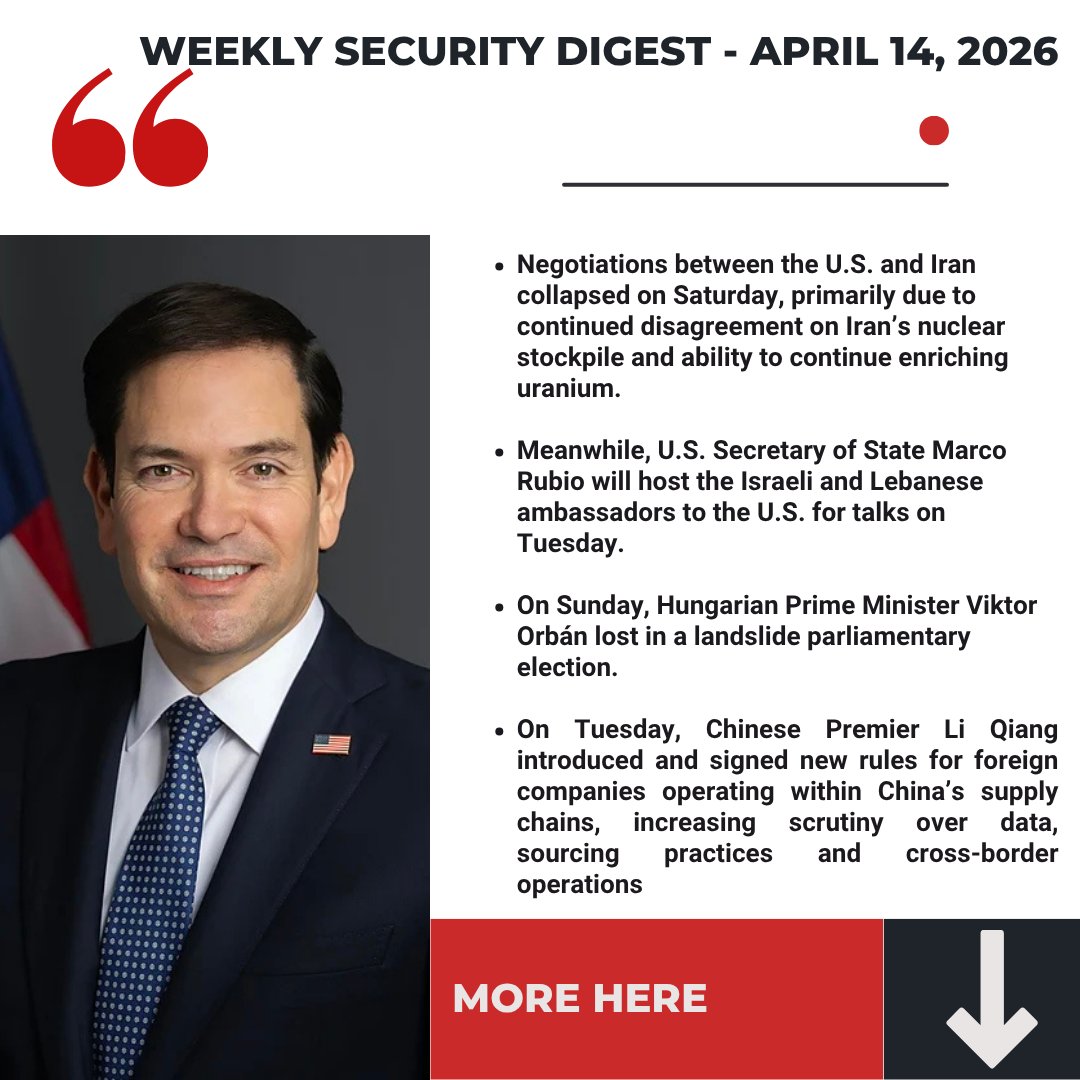
Interfor International‘s Weekly Security Digest - April 14, 2026 Middle East Negotiations between the U.S. and Iran collapsed on Saturday, primarily due to continued disagreement on Iran’s nuclear stockpile and ability to continue enriching uranium. → Meanwhile, U.S. Secretary of State Marco Rubio will host the Israeli and Lebanese ambassadors to the U.S. for talks on Tuesday. Israel and Lebanon have not held direct negotiations since 1993. #geopolitics #internationalintelligence #middleeast #iran #israel #lebanon interforinternational.com/interfor-inter…
Interfor tweet media
English
0
1
1
35
Interfor
Interfor@InterforInt·
A #ceasefire in name only. Even as one is being discussed, #strikes across the Middle East haven’t stopped. Iran has targeted infrastructure in Saudi Arabia, Kuwait, and the UAE, and Israel’s operations in Lebanon continue. If this is a pause, it’s a fragile one. The bigger risk is what comes next. Iran is signaling it may charge $1 per barrel for #oil moving through the Strait of #Hormuz. That creates a clear tension: → Enforce it, and Gulf states push back → Ignore it, and Iran escalates Either way, #instability increases in a critical global chokepoint. Meanwhile, the economic impact is already building with energy disruption, delayed global shipping, and rising food insecurity from fertilizer constraints. Even if the fighting slows, the ripple effects won’t. So, the real question isn’t whether there’s a ceasefire. It’s whether it can hold. For a deeper breakdown of what’s happening, and what comes next, read our full analysis: interforinternational.com/a-tenuous-ceas…
Interfor tweet media
English
0
0
1
58
Interfor
Interfor@InterforInt·
A temporary #ceasefire between the U.S. and Iran has been announced. This isn’t just de-escalation, it’s a pause. Even as this takes effect, a Reuters report underscores how fragile the situation remains: Pakistan says it will stand with Saudi Arabia if the conflict resumes. In our recent op-ed in @thehill , we wrote about how quickly regional tensions can expand beyond their original scope. What we’re seeing now reinforces that point in real time. Even with a ceasefire in place, the underlying dynamics haven’t changed. When military pacts activate, even implicitly, the risk changes: 𖧹 Conflicts are no longer contained 𖧹 Deterrence becomes less predictable 𖧹 Miscalculation becomes more likely The Middle East is already operating in a fragile equilibrium. The introduction of additional committed actors, alongside a short-term pause in fighting, doesn’t remove #risk, it can compress it. This is how localized conflict becomes regional. And once that threshold is crossed, the ability to control escalation becomes far more limited. For a deeper look at how these dynamics play out, read our full piece in The Hill: thehill.com/opinion/intern…
Interfor tweet media
English
0
0
1
51
Interfor
Interfor@InterforInt·
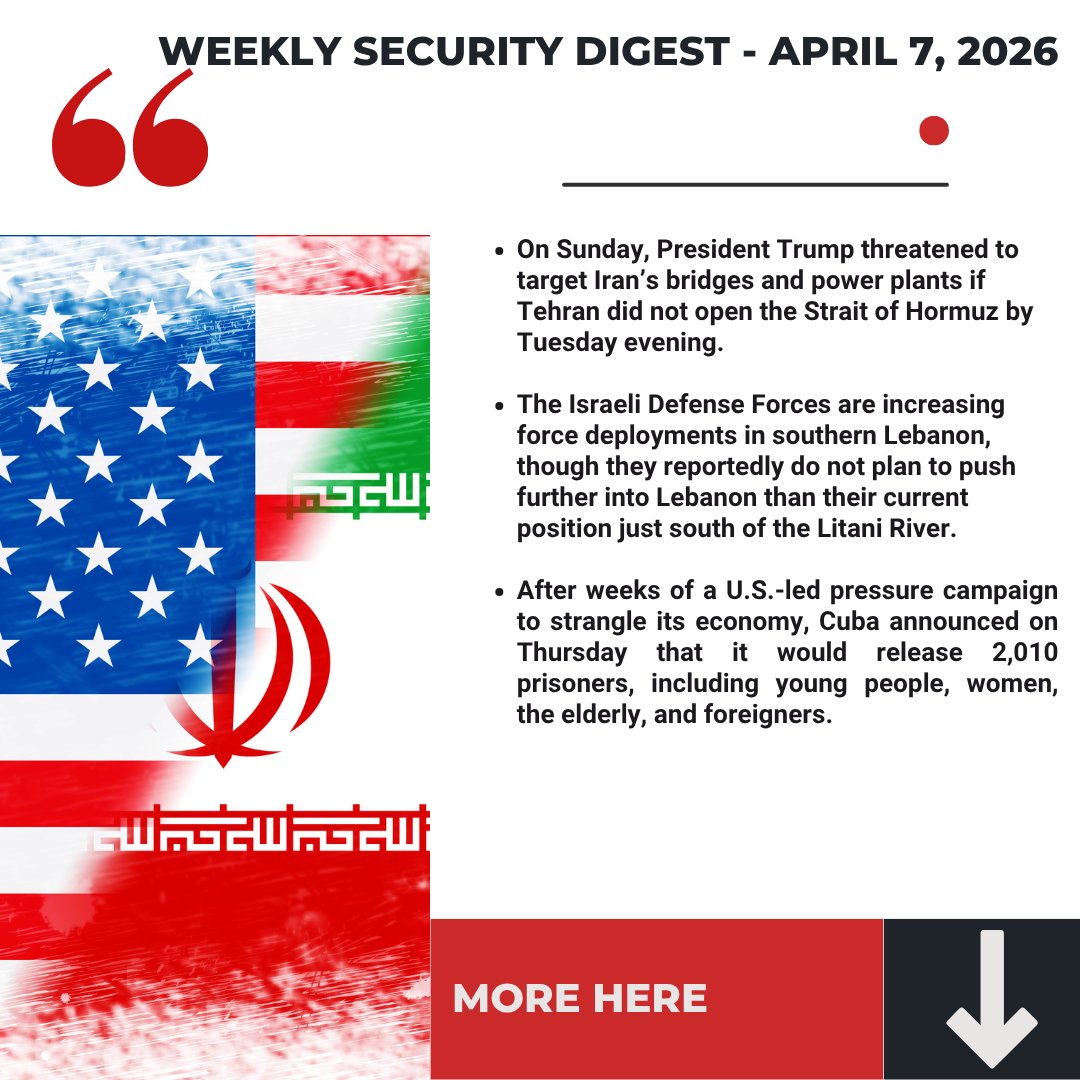
Interfor International‘s Weekly Security Digest - April 7, 2026 On Sunday, President Trump threatened to target Iran’s bridges and power plants if Tehran did not open the Strait of Hormuz by Tuesday evening. Hungarian Prime Minister Viktor Orbán convened an emergency National Defense Council meeting following last week’s discovery of explosives near the TurkStream pipeline in neighboring Serbia, a critical route for Russian gas supplies to Hungary. After weeks of a U.S.-led pressure campaign to strangle its economy, Cuba announced on Thursday that it would release 2,010 prisoners, including young people, women, the elderly, and foreigners. interforinternational.com/interfor-inter… #geopolitics #security #iranwar #cuba #hungary
Interfor tweet media
English
0
0
1
27