Tunde Okunoye

1K posts

Tunde Okunoye banner
Tunde Okunoye

Tunde Okunoye

@IsrlJoseph

Technology, Politics, and Development alumnus @ParadigmHQ @OpenTechFund @BKCHarvard
Internet Katılım Ocak 2023
1.1K Takip Edilen47 Takipçiler
Tunde Okunoye retweetledi
Access Now
Access Now@accessnow·
Zambia’s de facto cancelation of RightsCon an attack on rights and freedoms: Special Rapporteur ohchr.org/en/statements-…
English
0
7
13
509
Tunde Okunoye retweetledi
RUSI
RUSI@RUSI_org·
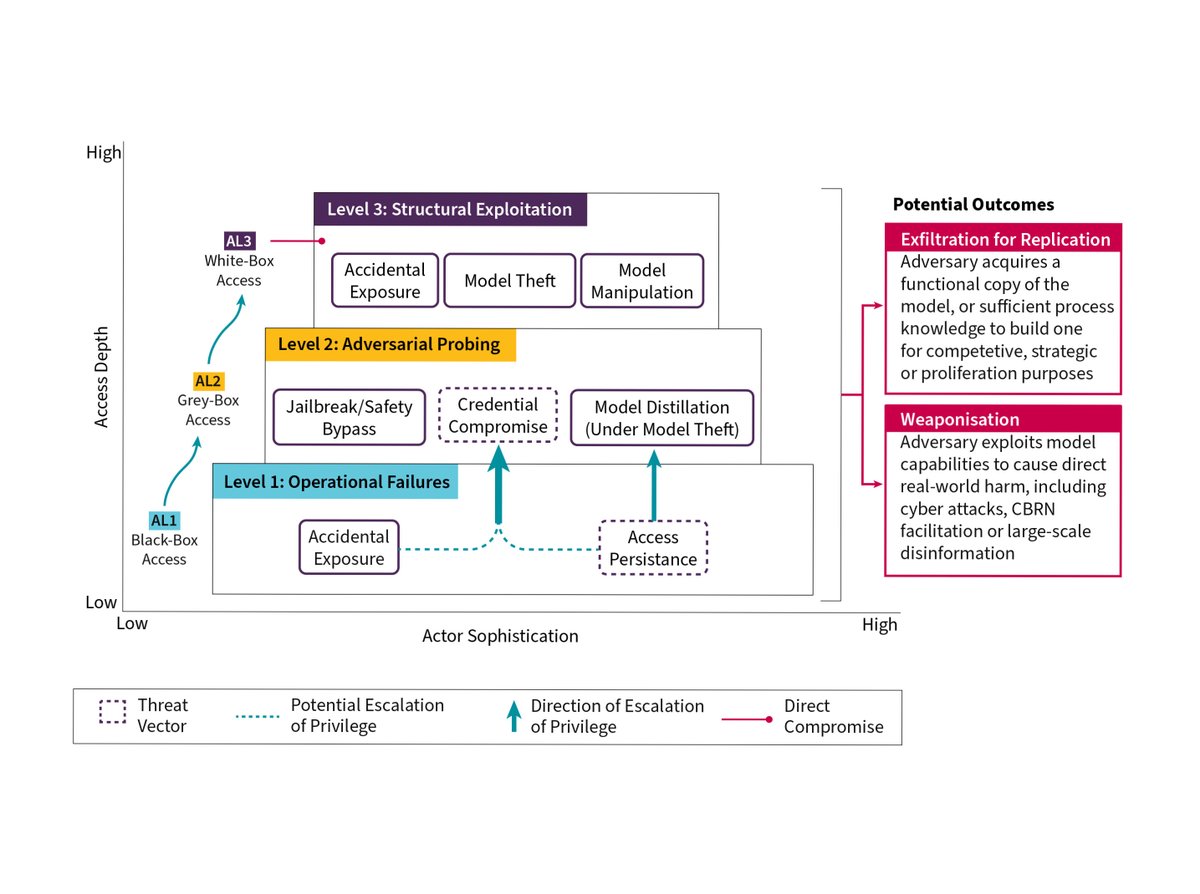
External assessment of new AI models is essential to ensure they are unable to cause large-scale harm such as supporting WMD development, or automating cyberattacks. However, industry norms around these external AI model evaluations are varied and inadequate which make them ripe for exploitation. They therefore require urgent coordination and collaboration to ensure the security of the most sophisticated AI models currently available. Our latest paper by @LouMarieHSD, Elijah Glantz and @dcuthbert delivers a critical framework for securely enabling third-party evaluation of frontier AI models, directly addressing the urgent need for robust safety and security in the defence and security sector as AI capabilities rapidly advance.  The image is a visual representation from the paper of direct and indirect pathways of access exploitation that may lead to weaponisation of the model to cause real-world harm. Read the paper: bit.ly/4u7w2w3
RUSI tweet media
English
0
13
22
2.8K
Tunde Okunoye retweetledi
Mario Nawfal
Mario Nawfal@MarioNawfal·
🇹🇷🇬🇭 A single Turkish ship anchored off Ghana's coast generates over a quarter of the country's electricity. The MV Karadeniz Powership Osman Khan is 299 meters long and pumps out up to 480 MW of power. It has been doing this since 2017. No power plant to build. No years of construction delays. Karpowership, the Turkish private company behind it, has quietly turned this model into a global business, deploying floating plants to countries with chronic energy deficits across Africa and beyond. Africa has an infrastructure gap that traditional investment has failed to close for decades. Turkey found a way to monetize that gap with engineering.
English
584
2.5K
14.9K
2M
Tunde Okunoye retweetledi
Just Ozed
Just Ozed@Just_Ozed·
Lagos is daring to dream big. What you’re seeing here is the ongoing construction of Phase 2 of the Lagos Blue Line mass transit rail project. Following the successful launch and operation of Phase 1 running from Mile 2 to Marina for over two years work on the next phase is advancing rapidly. And this is just one section of the rail corridor currently taking shape. Step by step, Lagos is expanding a modern urban rail system designed to transform mobility for millions across the city.
English
22
243
742
47K
Tunde Okunoye retweetledi
The Eastleigh Voice
The Eastleigh Voice@Eastleighvoice·
Speaking at the inauguration of the United Nations Nairobi Expansion Project in Gigiri, UN Secretary-General António Guterres criticised the global financial system for forcing African countries to pay borrowing costs three times higher than those of developed nations, despite some having stronger financial stability and growth prospects. Guterres also called for permanent African representation on the UN Security Council and a stronger voice for Africa within the IMF and World Bank.
English
30
251
942
189.1K
Tunde Okunoye retweetledi
D. H Bwala
D. H Bwala@BwalaDaniel·
Africa is entering a new era of strategic independence. Our continent is no longer defined by old spheres of influence, but by partnerships built on mutual respect, shared prosperity, sovereignty, and tangible economic value. In my engagement with RT on the Africa-France Summit in Nairobi, I reiterated Nigeria’s position under President Bola Ahmed Tinubu: we welcome constructive cooperation with all global partners, France, Russia, China, the United States, and others, provided such relationships advance development, security, industrial growth, and the welfare of our people. Africa’s future must be shaped by Africans, driven by our aspirations, and anchored on dignity, balance, and shared progress in the global order.
English
13
47
109
4.5K
Tunde Okunoye retweetledi
Anders Fogh Rasmussen
Anders Fogh Rasmussen@AndersFoghR·
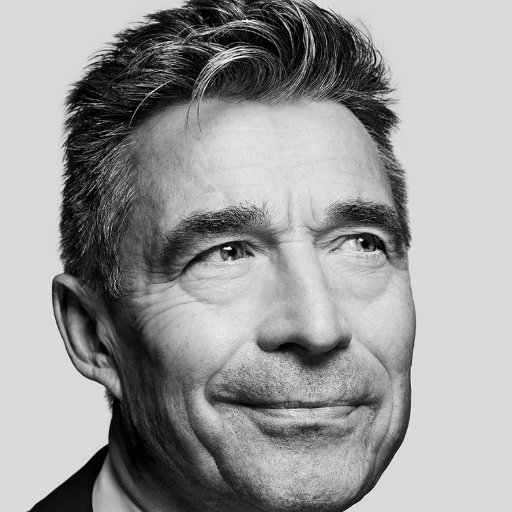
The world's democracies are being targeted one by one. That has to stop. China has imposed trade boycotts on Australia, Lithuania, South Korea and Canada. Each time, the target stood alone. Each time, it worked. The answer is not self-sufficiency. It is collective action. Today I launch After the Rupture: An alliance of middle-power democracies led by a D-7: seven democracies representing 30% of the global economy, acting together on trade, technology, critical minerals and defence. Not a new institution. A coalition of the willing, and the able. Full paper → shorturl.at/33GOA
English
122
853
1.6K
74.4K
Tunde Okunoye retweetledi
Alexander De Croo 🇺🇳
Alexander De Croo 🇺🇳@alexanderdecroo·
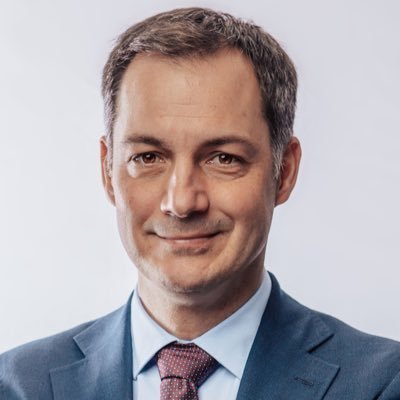
Democracies are not measured only by whether they survive. They are also judged by whether they can represent, respond and deliver for people. @UNDP’s new report explores what that means for democracy and development in Latin America and the Caribbean. go.undp.org/qo2
English
6
18
43
2.8K
Tunde Okunoye retweetledi
Rest of World
Rest of World@restofworld·
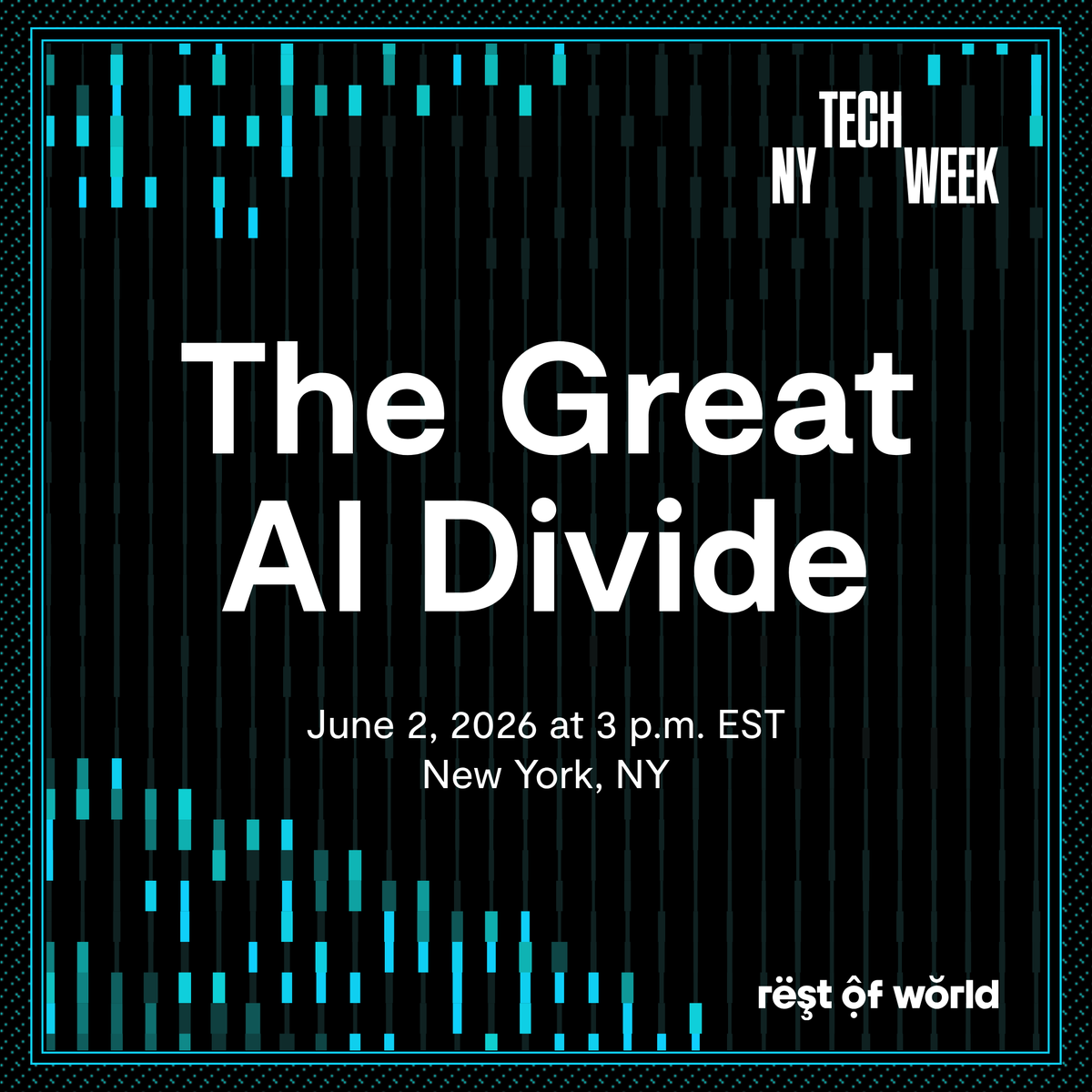
The U.S. and China control 90% of global computing power. Where does that leave everyone else? We're bringing together experts at NYC @techweek_ to discuss the unequal AI economy and whether a more equitable path is possible on June 2. Join us: partiful.com/e/2UzoY58jttvp…
Rest of World tweet media
English
0
2
1
441
Tunde Okunoye retweetledi
António Guterres
António Guterres@antonioguterres·
The war in Sudan is tearing apart the country. Civilians are paying an unconscionable price, with women & children suffering most. I repeat my call for an immediate cessation of hostilities, a sustainable ceasefire, and a Sudanese-led, civilian, democratic transition.
English
145
212
551
34K
Tunde Okunoye retweetledi
António Guterres
António Guterres@antonioguterres·
Africa’s enormous potential is being constrained by an unfair international system. That must change. We must keep pressing for a system that gives Africa the voice, resources & representation it has long been denied.
English
390
628
1.4K
69.3K
Tunde Okunoye retweetledi
Natali Simmonds
Natali Simmonds@NJSimmondsbooks·
I wanted to run the London Marathon but training takes too long and is too hard as a pudgy 47yo woman, so I got an Uber to the finish line. It's not fair that athletic people get to gatekeep long-distance running. I'm still a Marathon runner! This is what AI 'writers' sound like
English
62
6K
54.5K
404.1K
Tunde Okunoye retweetledi
Council on Foreign Relations
CFR Europe expert @LianaFix has always been fascinated by history. She took that intellectual curiosity and turned it into a career that has since influenced European politics—from both sides of the Atlantic. cfr.org/articles/how-i…
English
0
3
22
4.2K
Tunde Okunoye retweetledi
Journal of Democracy
Journal of Democracy@JoDemocracy·
You hear the term “competitive authoritarianism” all the time these days, but it was first introduced in our pages by Steven Levitsky and Lucan Way in 2002 to describe a type of political regime that is neither democratic nor fully authoritarian. Read the essay: muse.jhu.edu/pub/1/article/…
English
1
63
133
18.5K
Tunde Okunoye retweetledi
Oguntoye Opeyemi
Oguntoye Opeyemi@Equityoyo·
This is indeed the opportunity created by 𝐏𝐫𝐞𝐬𝐢𝐝𝐞𝐧𝐭 𝐁𝐨𝐥𝐚 𝐀𝐡𝐦𝐞𝐝 𝐓𝐢𝐧𝐮𝐛𝐮 𝐢𝐧 𝟐𝟎𝟐𝟑 𝐰𝐡𝐞𝐧 𝐡𝐞 𝐬𝐢𝐠𝐧𝐞𝐝 𝐭𝐡𝐞 𝐫𝐞𝐯𝐢𝐬𝐞𝐝 𝐄𝐥𝐞𝐜𝐭𝐫𝐢𝐜𝐢𝐭𝐲 𝐀𝐜𝐭 𝟐𝟎𝟐𝟑. This young man has taken advantage of that provision, which gives individuals, businesses, estates, factories, and communities the ability to generate up to 1 megawatt (1MW) of electricity without obtaining a license from the Nigerian Electricity Regulatory Commission (NERC). As a stakeholder in the sector, this could be another opportunity for the government to reduce its over-dependency on the national grid. Kudos to this young man, he has surely gotten the grip on his house network, with a proper metering and monitoring system for his neighbours.
English
608
1.9K
6.3K
643K
Tunde Okunoye retweetledi
IFC
IFC@IFC_org·
Water is economic infrastructure, supporting ~1.7 billion jobs worldwide. In this chat with @Diop_IFC, Aliko Dangote outlines how investment in reliable water systems — including Nigeria’s ~400 mini dams — can support jobs, food security, and livelihoods: wrld.bg/a5AX50YWFpN
English
3
17
43
2.4K
Tunde Okunoye retweetledi
Echoes of War
Echoes of War@EchoesofWarYT·
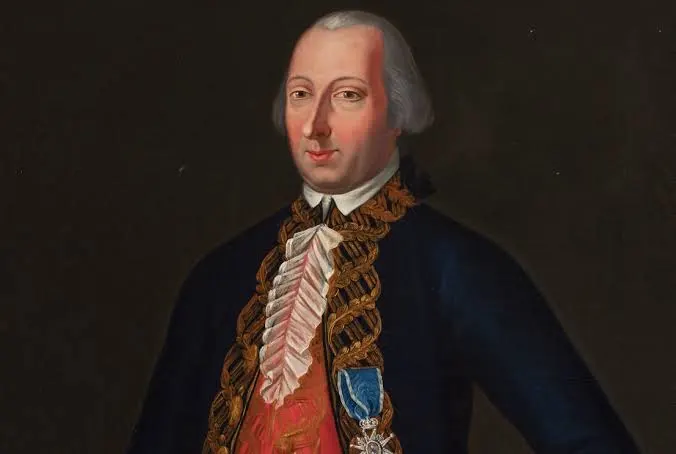
245 years ago today, a 35-year-old Spanish nobleman fired a single artillery shell that redrew the map of North America, broke British power in the Gulf of Mexico, and arguably saved the American Revolution. His name was Bernardo de Gálvez. He's not in your textbook. He should be. When Spain entered the war against Britain in June 1779, the American cause was bleeding out. Washington's army was unpaid and shrinking. The Continental dollar was worth pennies. The British had taken Savannah and were preparing to take Charleston. France was helping, but France alone couldn't bankrupt the British Empire. Spain could. And in New Orleans sat the man who would prove it. Bernardo de Gálvez y Madrid was 33 years old, the governor of Spanish Louisiana, a battle-scarred career officer who had been wounded fighting Apaches in northern Mexico and Algerians in North Africa. The day he learned Spain had declared war, he didn't wait for orders from Madrid. He raised an army of Spanish regulars, Louisiana Creoles, free Black militia from New Orleans, Acadian refugees, German settlers, and Choctaw scouts, and he went on the attack. In three months he took Manchac, Baton Rouge, and Natchez. The next year he took Mobile. The British presence on the Gulf shrank to one last fortress. Pensacola, the capital of British West Florida, defended by Major General John Campbell with 1,500 redcoats, the 3rd Waldeck Regiment of German mercenaries, loyalist battalions from Maryland and Pennsylvania, and a powerful alliance of Creek and Choctaw warriors led by the brilliant mixed-race chief Alexander McGillivray. Gálvez arrived off Pensacola in March 1781 with 7,000 men and a fleet. The Spanish naval commander, Admiral Calbo de Irazábal, refused to enter Pensacola Bay. The entrance was narrow, raked by British guns at Fort Barrancas Coloradas, and treacherous with sandbars. So Gálvez did something insane. He boarded his own little brig, the Galveztown, hoisted his personal pennant, and sailed her into the bay alone, in full view of the British batteries, daring the Royal Navy to sink him. The British fired and missed. The Spanish fleet, shamed, followed him in. For this he was awarded the right to put the words "Yo Solo," meaning "I alone," on his coat of arms by the King of Spain. The siege ground on for two months. Gálvez was shot in the abdomen and the finger directing artillery and refused to leave the field. The British defenses at the Queen's Redoubt, also called the Crescent, held against everything thrown at them. And then, on the morning of May 8, 1781, a Spanish howitzer crew lofted a shell over the parapet. It dropped, by pure luck or perfect skill, directly into the open powder magazine. The explosion killed roughly 100 defenders in a single instant. Waldeck grenadiers, British regulars, loyalists, all gone. The blast tore the redoubt's wall open like paper. Spanish grenadiers and Louisiana militia poured through the breach within minutes and turned the captured British guns on the inner works. Campbell knew it was over. The next morning, May 9, white flags went up. By May 10 the entire province of West Florida belonged to Spain. Over 1,100 British troops marched out as prisoners of war. The strategic consequences were catastrophic for Britain. The Gulf Coast was lost. The Mississippi was a Spanish river from source to sea. Britain could no longer reinforce its southern armies by sea from the Caribbean, and the Royal Navy's Caribbean squadron had to be redeployed. Five months later, Cornwallis surrendered at Yorktown, in a siege funded in part by 500,000 silver pesos that Gálvez and the people of Havana raised in a matter of days to pay French Admiral de Grasse's fleet to come north. Without that money, no French fleet. Without the French fleet, no Yorktown. Without Yorktown, no independence on those terms. Gálvez was made Count of Gálvez and Viscount of Galveztown. The bay he charted in Texas still bears his name, Galveston. His portrait hangs in the United States Capitol by act of Congress. In 2014, he was made an honorary citizen of the United States, an honor given to only eight people in American history, including Lafayette, Churchill, and Mother Teresa. He died of yellow fever in Mexico City at 40 years old, three years after the war ended. Most Americans have never heard his name.
Echoes of War tweet media
English
195
2.2K
6.7K
215.3K
Tunde Okunoye retweetledi
World Bank Africa
World Bank Africa@WorldBankAfrica·
How do we make AI work for everyone? By putting it in the hands of millions in their own languages and on their own terms. Small AI is scaling impact from agriculture to healthcare in emerging markets. See the promise in action: wrld.bg/wJoR50YW2BI
English
3
11
21
1.4K
Tunde Okunoye retweetledi
Aakash Gupta
Aakash Gupta@aakashgupta·
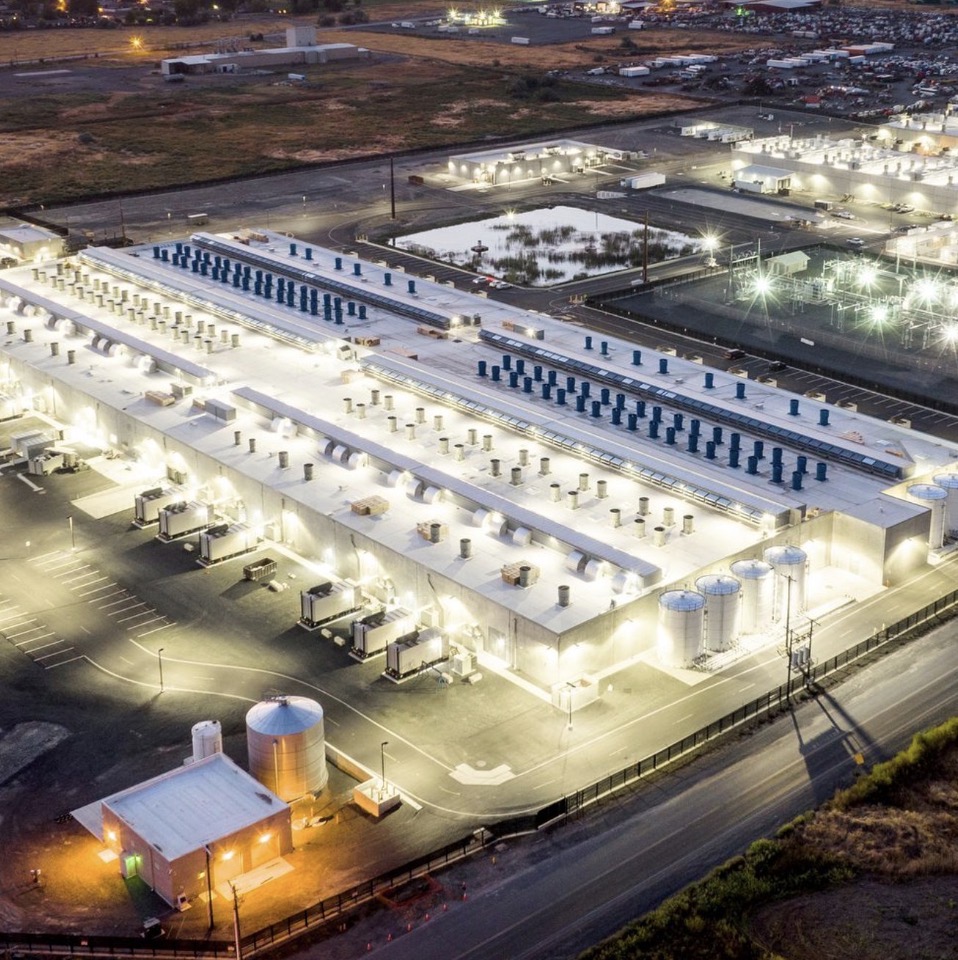
Residents living within a half-mile of new AI data centers are reporting dizziness, nausea, vertigo, and sleep disruption from sound they can't hear. The source is infrasound. Frequencies below 20 Hz sit beneath the floor of human hearing but not beneath human physiology. The body's vestibular system registers low-frequency vibration directly, triggering the same response as motion sickness. The cooling systems and gas turbines running these facilities 24/7 produce exactly this range. Noise ordinances were written for audible noise. Decibel measurements start at 20 Hz. Infrasound doesn't appear. A 200-megawatt data center with tens of thousands of tons of cooling equipment can run around the clock with zero measurable noise violation under any existing zoning law in the country. The developers know this. They're not randomly selecting sites. Rural jurisdictions get targeted because they lack the legal staff, the engineering expertise, and the regulatory framework to mount any challenge. These facilities require new transmission interconnects that take 5 to 10 years to process through utilities. Building behind-the-meter with gas turbines bypasses that queue. Speed to power, zero delay, zero grid dependency. Households who bought before the announcement have two options. Sell at a price no buyer will pay, or stay and live with symptoms their family doctor has no framework to diagnose as infrastructure-related. That cost never appears in a hyperscaler's earnings call. The regulation will catch up eventually. It always does. But the facilities will already be running. The permits will grandfather everything in place. The turbines don't stop when the legal framework finally notices them.
Aakash Gupta tweet mediaAakash Gupta tweet media
English
296
5.5K
10K
545.4K