JABREK

77 posts

JABREK

JABREK

@JABREK88

Katılım Mart 2026
525 Takip Edilen179 Takipçiler
RIGM7
RIGM7@RIGAM07·
I used to think “audience” meant numbers on a screen. Then I watched a small creator with barely any followers build a tighter, more active circle than accounts 100x bigger. That’s when something clicked for me about @RallyOnChain . Rally doesn’t treat influence like a billboard you rent. It feels more like a neighborhood you co own. The value isn’t in how loud you can shout, but in how deeply people choose to stay. I’ve seen creators with modest reach create real gravity because ownership changes behavior. People don’t just consume, they participate. What stands out to me is how the system makes influence visible in a way that isn’t hidden behind platform algorithms. On chain signals don’t care about who you are off platform. They show what actually happens. It creates a strange kind of honesty. Not perfect, but harder to fake. And that shifts power quietly back to creators who build trust instead of chasing trends. There’s also something bigger here that’s hard to explain unless you’ve felt it early. Being part of Rally right now reminds me of arriving before a city is fully built. Streets are still forming, names aren’t final, but the people there already believe in what it could become. That shared belief becomes the brand itself. I don’t see the community as an add on. It is the product. Tools can be copied, features can be replicated, but a group of people who feel like they are building something together is much harder to reproduce. That’s where Rally feels different to me. Here’s the question I keep coming back to. If influence becomes transparent and community owned, what happens to the creators who built everything on borrowed platforms? Do they adapt, or does a new class of creators take their place? Curious how you see it. Is this shift overdue, or are we overestimating how much people care about ownership?

RIGM7 tweet media
English
74
2
89
1.4K
JABREK
JABREK@JABREK88·
@RIGAM07 @RallyOnChain The on chain transparency part is underrated. It’s not just about trust, it actually changes how people collaborate. You can see who consistently contributes, not just who shows up when it’s convenient.
English
0
0
0
32
Opeeett.eth
Opeeett.eth@LunggaJR·
I didn’t expect to see institutions treating @zksync like live infrastructure this early but that’s exactly what’s happening. The way I’ve come to understand it is this: ZKsync isn’t being approached as a “platform to try,” but more like a clearing layer that quietly sits behind decisions already made elsewhere. The interesting part isn’t the branding of partnerships it’s what each participant brings with them. When a former U.S. Comptroller of the Currency builds on it, that’s not just another founder; it’s regulatory memory entering the system. When a network tied to $600B+ in deposits connects, it’s not volume it’s balance sheet gravity. I tend to map this using a mental model closer to air traffic control than payments infrastructure. Each institution is a flight path. Alone, it’s predictable. But as more routes intersect, coordination becomes the real product. That’s where network effects stop being linear. 10 institutions don’t just mean 10 flows they create 45 potential intersections. At 100, it’s not growth, it’s density. This is how systems like SWIFT or Visa scaled not by adding nodes, but by multiplying relationships. From that angle, the role of $ZK feels less abstract. It’s not a narrative token it’s the control surface. Today, it functions as: the governance token shaping protocol level decisions the only native asset of the ZKsync network the gas token for ZKsync Gateway, where transactions from different chains and zones are settled before reaching Ethereum What stands out to me is the “stem cell” design. Not as a promise, but as a constraint: governance defines how its role evolves, not assumptions baked in early. I keep coming back to a simple question: If institutions are choosing infrastructure based on coordination efficiency rather than raw throughput… are we underestimating how early these network effects actually start to lock in? Curious how others see it does this look like early stage infrastructure formation, or are we projecting patterns from past networks too quickly?
Opeeett.eth tweet media
English
12
3
113
129.9K
JABREK
JABREK@JABREK88·
@LunggaJR @zksync The “control surface” framing for $ZK is clean. It avoids the usual token narratives and puts focus on governance where it actually matters.
English
0
0
1
16
Opeeett.eth
Opeeett.eth@LunggaJR·
I once watched a bank treasury team reconcile positions across three systems that didn’t agree. It felt less like finance and more like archaeology. That moment changed how I think about infrastructure. 1) The system as a “warehouse of promises” Traditional finance doesn’t move assets directly. It moves claims on assets. Global bank deposits alone exceed $100 trillion (BIS data), yet much of this value sits in layered systems where reconciliation, not execution, is the core activity. FX markets settle around $7.5 trillion per day (BIS Triennial Survey), but settlement risk persists because payment legs don’t finalize simultaneously. What struck me is this: we’ve built a global warehouse of promises, but the inventory is constantly being re counted. Onchain systems flip this. They don’t store promises first and reconcile later they verify state as it changes. 2) Why institutions can’t just “use a blockchain” I’ve spoken with compliance teams who don’t reject blockchain they reject exposure. Not everything can be public: trade intent counterparty identity position sizing At the same time, they can’t rely on opaque systems either. This creates a paradox: Privacy is required, but so is verifiability. That’s where architectures like Prividium come in using zero knowledge proofs to separate what must be hidden from what must be proven, while anchoring settlement on @zksync / Ethereum. It’s less about replacing trust, and more about redefining what needs to be trusted at all. 3) Capital as “idle inventory” Another thing I didn’t fully appreciate until recently: A significant portion of institutional capital isn’t deployed it’s parked. Pre funding in correspondent banking, collateral for settlement cycles, buffers for delayed reconciliation… These aren’t edge cases they’re structural. When settlement compresses from days to near instant: liquidity doesn’t just move faster it frees up entirely new capacity It’s like turning warehouse stock into just in time flow. 4) The real comparison isn’t speed it’s coordination People often frame this as: “blockchain = faster settlement” That’s incomplete. The deeper shift is coordination: fewer intermediaries shared state instead of duplicated ledgers execution tied directly to verification In traditional systems, agreement is negotiated after the fact. Onchain, agreement is embedded in execution. That’s a very different design philosophy. 5) The uncomfortable question If the current system works albeit inefficiently how much inefficiency is actually tolerated on purpose? And if onchain infrastructure removes those frictions: who benefits most? and who loses control? Curious how others see this: Is the real barrier to onchain finance technology, or is it the institutional comfort with systems that are inefficient but predictable? Reply or quote interested in perspectives beyond the usual crypto native lens.
Opeeett.eth tweet media
English
8
3
155
133.5K
JABREK
JABREK@JABREK88·
@LunggaJR The FX point stands out. $7.5T daily volume but still relying on staggered settlement windows… feels like scale outpaced design. Curious how much of that risk is actually priced in vs just accepted.
English
0
0
1
14
RIGM7
RIGM7@RIGAM07·
I didn’t expect to take ZKsync seriously at first. But when I looked closer at @zksync it didn’t feel like a “blockchain project.” It felt more like watching a new clearing layer quietly forming underneath existing finance. 1) Proof points aren’t logos, they’re signals of jurisdiction and weight When a former U.S. Comptroller of the Currency builds on ZKsync, that’s not just a name it’s someone who understands how banking systems are supervised choosing this infrastructure. And when networks like Cari represent $600B+ in deposits, I don’t read that as “crypto adoption.” I read it as balance sheet gravity touching a new rail. Different institutions here aren’t redundant they represent regulation, custody, liquidity, and distribution. That mix matters more than the count. 2) The network behaves less like software, more like a switchboard I think of it like an old telephone exchange. One bank connecting isn’t interesting. Ten banks create optionality. A hundred banks create dependency. Because the value isn’t in the nodes it’s in the possible interactions between them. That’s the same combinatorial effect that scaled SWIFT and card networks: not volume first, but connectivity density. ZKsync seems to be optimizing for that layer of interaction, not just throughput. 3) $ZK sits at the coordination layer, not the speculation layer $ZK today has a very specific role: It’s the only native asset of the ZKsync network It functions as a governance token (protocol upgrades, fees, parameters) It acts as the native gas token for ZKsync Gateway, where transactions across chains and Prividium zones are bundled and settled to Ethereum I think of it less like a currency, and more like a voting system attached to infrastructure that moves value. The “stem cell design” is interesting but what matters right now is that governance exists before the network fully matures, not after. 4) The subtle shift I can’t ignore Most crypto systems try to attract institutions. This one feels like it’s being assembled by them, piece by piece, each adding a different function. That raises an uncomfortable question: If institutional networks scale through connectivity, not branding are we early in adoption, or just early in recognition? Curious how you see it: Is this actually a new financial layer forming, or just another integration narrative dressed differently?
RIGM7 tweet media
English
16
6
179
122.9K
JABREK
JABREK@JABREK88·
@RIGAM07 @zksync The $600B deposit reference changes the framing. It’s less about “crypto liquidity” and more about traditional balance sheets finding new settlement paths.
English
0
0
1
35
RIGM7
RIGM7@RIGAM07·
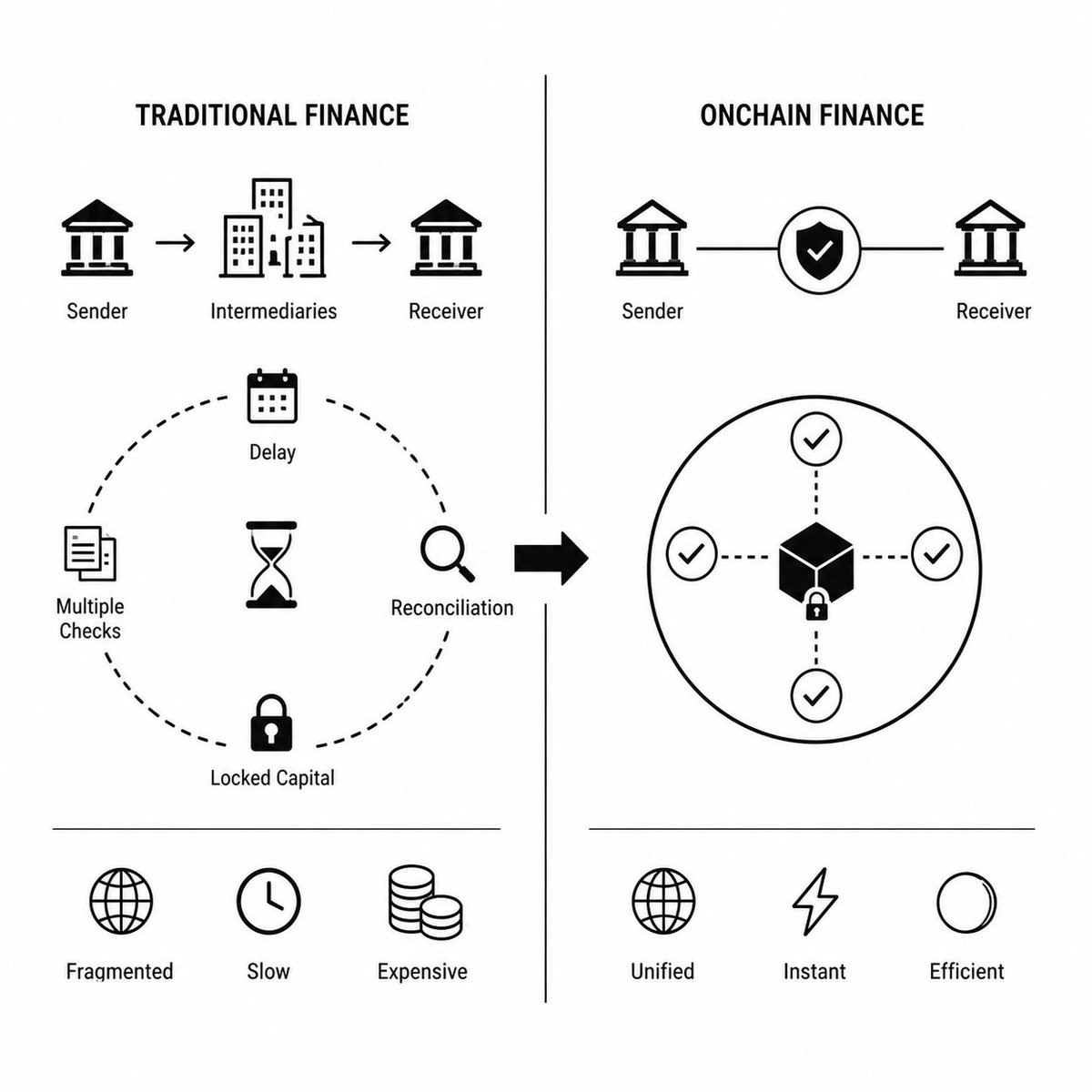
I used to think settlement was just a back office detail. Then I watched how much capital sits idle just to keep the system functioning. When I first looked closely at traditional finance flows, one number stuck with me: trillions of dollars are locked daily in correspondent banking and pre funded accounts just to make cross border payments work. The Bank for International Settlements has repeatedly highlighted how liquidity gets fragmented across jurisdictions for this reason. That’s not a scaling problem. It’s a coordination problem disguised as infrastructure. A different lens: finance as “reservoir engineering” We’ve built a system where value is stored in isolated reservoirs (banks, nostro/vostro accounts, clearing systems), and moving money means pre positioning water everywhere in advance. It works. But it’s inefficient by design. Onchain systems flip this model: Instead of pre-funding → you rely on synchronized state Instead of delayed reconciliation → you get shared verification Instead of trapped liquidity → you get conditional movement The shift isn’t just faster pipes. It’s removing the need for reservoirs in the first place. But here’s where most crypto explanations fall apart. Banks don’t reject blockchains because they’re slow to adapt. They reject them because the requirements are fundamentally different: Transaction privacy isn’t optional Execution environments must be controllable Compliance cannot depend on blind trust in validators Yet… they still need global connectivity and liquidity Most public chains solve openness. Most private systems solve control. Neither solves both at once. This is where @zksync (through architectures like Prividium) becomes interesting not as a product, but as a design choice. Zero knowledge proofs introduce a different model: You don’t reveal the transaction → you prove it’s valid You don’t trust intermediaries → you verify mathematically You don’t isolate systems → you settle on a shared base layer (Ethereum) It’s less like “moving finance onto blockchain” and more like replacing reconciliation with proof. System comparison, from the inside In the current system: Settlement = messaging + reconciliation + trust layers Finality = delayed and conditional Capital = distributed and idle In an onchain model: Settlement = state transition verified by proofs Finality = deterministic Capital = programmatically coordinated Same economic activity. Different physics. What I keep coming back to is this: If the current system requires locking capital everywhere to create trust… and the new system uses cryptographic proof instead… Then the real question isn’t speed or cost. It’s this: Do we still need to pay for trust the same way? Curious how you see it: Is the biggest unlock here capital efficiency, or is it the removal of reconciliation as a concept altogether? Reply or quote I’m more interested in disagreement than agreement.
RIGM7 tweet media
English
15
2
94
111K
JABREK
JABREK@JABREK88·
@RIGAM07 I think people forget that reconciliation is a whole industry on its own. Entire teams exist just to make sure numbers match across ledgers. That doesn’t disappear easily.
English
0
0
0
14
Opeeett.eth
Opeeett.eth@LunggaJR·
I didn’t expect payout speed to feel like this. I watched a creator pull roughly $350 in just a few days on @RallyOnChain and it didn’t feel like luck. It felt more like a timed spotlight where only the sharpest ideas stay visible long enough to get paid. What stands out is the structure. Most of the reward flows to the top 3, which changes how you think about posting. It’s less about volume, more like placing a precise bet on one strong idea and letting it compete. The AI layer makes it even stranger in a good way. It’s almost like an invisible curator that quietly tests content in the background, then amplifies what actually resonates instead of what just shouts the loudest. I’m starting to see it less as “posting content” and more like entering short tournaments where clarity and timing decide everything. Curious how others see this: does concentrating rewards at the top push better work, or does it discourage experimentation?
Opeeett.eth tweet media
English
53
3
54
611
JABREK
JABREK@JABREK88·
@LunggaJR @RallyOnChain The reward structure almost forces originality. If you repeat what others are saying, you just don’t make it into that top bracket.
English
0
0
0
6
Opeeett.eth
Opeeett.eth@LunggaJR·
I joined the @FragmentsOrg waitlist because BTC-Jr feels less like a “new coin” and more like getting a backstage pass to Bitcoin’s workshop. The way I picture BTC-Jr is like those arcade token machines I used as a kid you drop in one big coin, but suddenly you have smaller tokens that let you play more games without breaking the original coin. That’s the mental model that clicked for me: not replacing BTC, but giving it more ways to move around and do things without feeling heavy. Another reason I signed up is honestly curiosity. I treat projects like this the way I treat new coffee shops I don’t expect perfection, I just want to taste the idea early and see how it evolves. Fragments feels like someone trying to slice Bitcoin into usable “notes” instead of one giant bill. Maybe that works, maybe it sparks debates but that’s exactly the kind of experiment I like watching from the front row. If you’re also the type who signs up just to see where things go, here’s the waitlist I used: 👉 link.fragments.org/rally IMPORTANT! During April, 10 random waitlist signups win $200 each. $2,000 total which honestly feels like finding a forgotten banknote in an old jacket pocket. Also following FragmentsOrg to keep tabs feels like one of those communities where just hanging around early might matter later. Curious though do you see BTC-Jr as a clever toolkit for Bitcoin… or just another experiment that might fizzle out? Drop your take or quote this I want to hear the skeptical side too.
Opeeett.eth tweet media
English
13
2
14
89.6K
JABREK
JABREK@JABREK88·
@LunggaJR @FragmentsOrg What stuck with me is how BTC-Jr sounds less like a shortcut and more like an adapter like plugging an old device into a modern socket without rebuilding the device itself.
English
0
0
0
9
JABREK
JABREK@JABREK88·
@RIGAM07 @RallyOnChain I like the pressure of the top heavy rewards. Sounds stressful, but it forces me to be more deliberate before hitting publish. Makes every post feel like a real shot instead of filler.
English
0
0
0
28
RIGM7
RIGM7@RIGAM07·
I noticed something small but loud this week. A creator I follow pulled in around $350 in just a few days, and it made me rethink how fast attention can turn into income. What struck me is how @RallyOnChain feels less like a lottery and more like a heat map in a kitchen. The hottest dishes get pushed to the front, and the chefs who nail the flavor keep getting bigger plates. The AI seems to sniff out what people actually enjoy, not just what gets posted the most. Another angle that stayed with me is the reward split. Most of the pot going to the top 3 feels like a race track where only clean laps matter. It creates pressure, but also clarity. You know exactly why someone earns fast, because performance is visible and measurable, not hidden behind vague metrics. Still, I keep wondering if this model favors bold creators over careful ones, or if it pushes everyone to level up faster than usual. Have you seen payouts move this quickly on other platforms, or is this kind of speed changing how you plan your content? Curious to hear your take or examples.
RIGM7 tweet media
English
51
2
45
673
RIGM7
RIGM7@RIGAM07·
i didn’t expect a waitlist to feel like joining a group chat but here we are with @FragmentsOrg the reason i signed up for BTC-Jr is kinda simple: bitcoin has always felt like that expensive kitchen set at your parents’ house you can use it… but everyone’s lowkey scared to touch it BTC-Jr feels like someone finally said “what if we actually cook with it?” not breaking bitcoin just making it less… ceremonial from what i get so far: it’s not about wrapping BTC into something else it’s about letting it move in smaller, more flexible ways like turning a hardcover book into sticky notes same content, but now you can actually use pieces of it when you need them another thing that stood out to me: it doesn’t feel like you’re asking permission to use BTC it feels like plugging into a system that’s already alive less “request access” more “tap and go” that shift is subtle, but kinda changes the vibe completely also yeah, i won’t pretend i ignored this part 😅 April giveaway: 10 random waitlist signups win $200 each $2,000 total if you’re curious, here’s the link: link.fragments.org/rally i’m still early, still poking around but i like where this is going question tho: if bitcoin becomes too easy to use… does it lose the discipline that made it valuable? or is that exactly what it’s been missing this whole time? curious what side you’re on reply or quote this, i wanna see different takes
RIGM7 tweet media
English
15
3
16
111.2K
JABREK
JABREK@JABREK88·
@RIGAM07 @FragmentsOrg what’s interesting is the psychological shift. bitcoin has always been about patience and restraint. if BTC-Jr changes that into flow and movement, it might attract a completely different user base.
English
0
0
0
9
JABREK
JABREK@JABREK88·
@RIGAM07 @RallyOnChain That wave analogy is real. I’ve been early on a few posts and they still didn’t move. Makes me think distribution is being quietly optimized behind the scenes.
English
0
0
0
17
JABREK
JABREK@JABREK88·
@RIGAM07 Bittensor pushes intelligence forward, but I’ve been stuck thinking about what happens after inference. Decisions still need somewhere to land, especially under uncertainty.
English
0
0
0
12
RIGM7
RIGM7@RIGAM07·
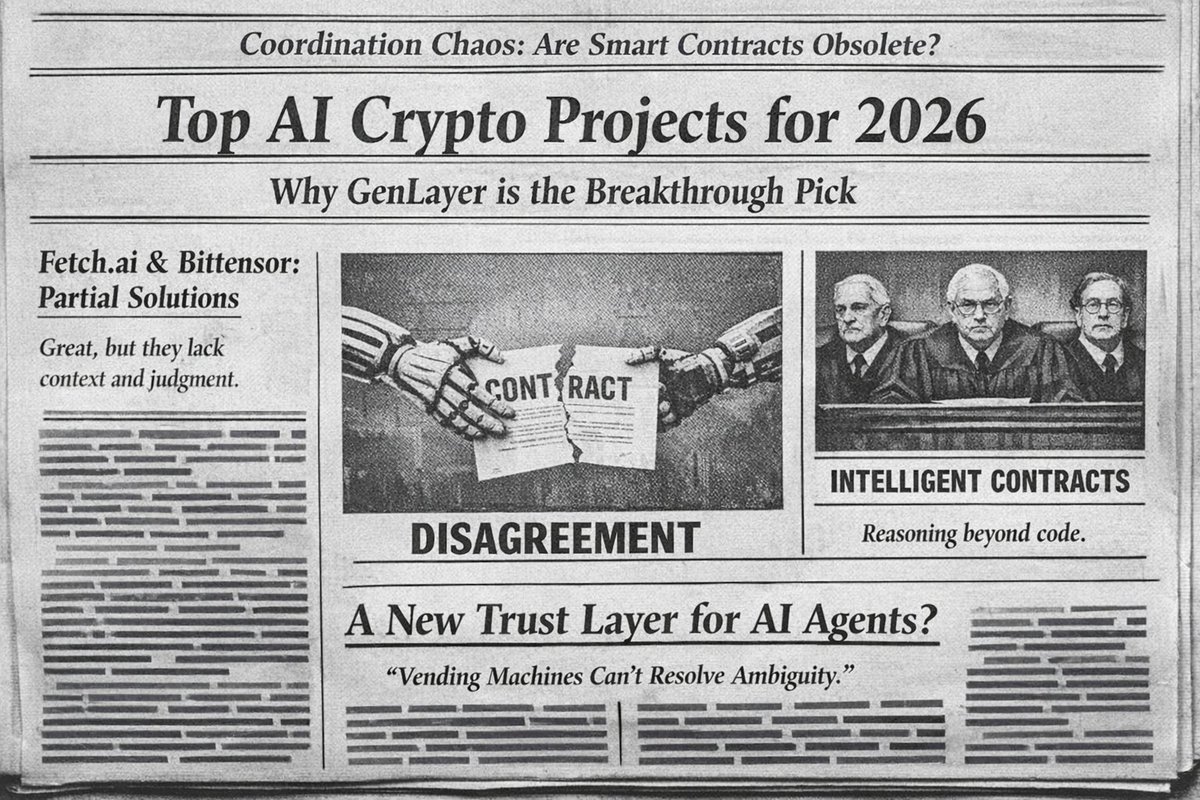
Most people are underestimating how messy 2026 will get. I learned this the hard way while testing a few early AI agents to automate simple onchain tasks. Individually, they worked fine. But once they started interacting, delegating, and making assumptions about each other, things broke in subtle ways. Not bugs in code, but gaps in judgment. That’s when it clicked. Smart contracts were never designed for this kind of environment. They are like vending machines. Deterministic, rigid, and blind to context. AI agents, on the other hand, behave more like negotiators in a crowded market. They interpret, adapt, and sometimes misinterpret. When you put both together, you get friction that current infrastructure cannot resolve. So the real problem for 2026 is not scaling AI agents. It’s coordinating them. Here’s how I currently see the landscape: First, Fetch.ai I like how it treats agents as economic actors. The idea of autonomous agents transacting and optimizing in open markets is compelling. But it still assumes that agents can trust the execution layer once they agree on something. Second, Bittensor. Strong approach to decentralized intelligence itself. It solves how models compete and improve. But it stops short at what happens when those models actually need to commit decisions onchain in uncertain conditions. Both are important pieces. But neither fully addresses what happens when agents disagree, hallucinate, or operate under ambiguity. That’s where @GenLayer feels fundamentally different to me. The concept of Intelligent Contracts is not just an upgrade. It’s a shift in what we expect from the chain itself. Instead of acting like a vending machine, the chain starts behaving more like a panel of judges. Not a single deterministic outcome, but a process that evaluates intent, context, and conflicting inputs before reaching consensus. Almost like multiple perspectives being reconciled before something is finalized. This matters because AI agents don’t fail in obvious ways. They fail in interpretation. If two agents sign a deal but interpret the same data differently, a traditional smart contract has no way to resolve that. It just executes. An Intelligent Contract can actually reason about the disagreement. That’s why I see GenLayer as the breakthrough project for 2026. Not because it is faster or cheaper, but because it introduces a new trust layer that matches how AI systems actually behave. We are moving from code that executes instructions to systems that evaluate outcomes. And that raises a question I keep coming back to: If AI agents become the primary users of blockchains, do we still want chains that blindly execute, or ones that can interpret and arbitrate? Curious how others see this. Are we overcomplicating the base layer, or is this exactly the shift we’ve been missing?
RIGM7 tweet media
English
13
0
16
122.3K