
JC Invest
174 posts

Yalnızca yüksek zekaya sahip insanlar bu soruyu çözebilir.
Sen çözebilir misin?

Türkçe

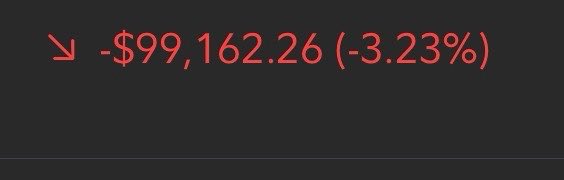


$SPX dropped 170+ $QQQ down 31+ at the lows today. 🤯
April and May were the best months of trading we saw in over 5 years.
June could be the start of a deeper pull back especially if $SPX stays under 7500 and $QQQ under 722 next week.
I'm hosting another webinar this Tuesday to go over my exact plan for the summer.
I'll post a sign up link this weekend. Stay tuned....
Have a great weekend and STUDY your trades!! 🫡
English
JC Invest retweetledi

RIP to the portfolios of 20 year old gamblers with $500 to their name.
Watcher.Guru@WatcherGuru
JUST IN: 🇺🇸 Pattern Day Trader rule officially ends, eliminating the $25,000 minimum for day trading stocks.
English
JC Invest retweetledi


For those underwater $NBIS CCs:
$360-$410s now exist
Godspeed 🫡
English
JC Invest retweetledi


JC Invest retweetledi

JC Invest retweetledi

Put these tickers in your watchlist:
$NVDA, $AMD, $AVGO, $PLTR, $SMCI, $DELL, $ORCL, $MU, $INTC, $VST, $ETN, $CEG, $RKLB, $ASTS, $TSM
Trump pumps 🇺🇸
Thank me later
English
JC Invest retweetledi

🚨 Jim Cramer on $NBIS and Situational Awareness led by Leopold Aschenbrenner:
“When this man touches something it turns to gold. Jensen Huang introduced me to Nebius two years ago. He said ‘I want you to keep an eye on them.’ The stock was at $16… always worth listening.”
English
JC Invest retweetledi



🚨 MICHAEL BURRY WARNS THREE UPCOMING IPOs COULD COMPLETELY CRASH THE STOCK MARKET.
Michael Burry reported that the upcoming public listings for SpaceX, OpenAI, and Anthropic are going to pull more capital out of the market than the entire dot-com wave of 2000.
Adjusted for inflation, just these three companies will raise more money than the hundreds of tech firms that flooded the market at the peak of the 2000 bubble.
The historical data from 2000 shows exactly why this is dangerous for stocks.
That year, the market saw 446 IPOs raise a record $108.15 billion. The Nasdaq peaked on March 10, 2000, at the exact moment this massive supply of new shares hit the market, right before crashing 80%.
The crash happened because of a simple liquidity drain.
When giant companies go public, big institutional funds need cash to buy the new shares.
To get that cash, they have to sell their existing stock positions. This creates immediate selling pressure on the most expensive tech stocks.
Today, the setup is identical but much more concentrated. Instead of hundreds of small startups spreading out the drain, just three mega companies are absorbing the market's capital.
This directly impacts current market leaders.
Microsoft has 49% of its $627 billion cloud backlog tied to OpenAI, and Oracle has 54% of its pipeline dependent on it.
The same big funds that need to buy the new IPOs are the ones currently holding these tech giants.
In the first quarter of 2000, the average IPO nearly doubled on its first trading day because cash was easily available.
By the fourth quarter, capital markets dried up.
Gross IPO proceeds collapsed 63% in a single quarter, and average first-day gains dropped to just 14% as companies rushed into layoffs and bankruptcies.
When an unprecedented amount of money is pulled out of existing stocks to fund a single massive IPO wave, the broader market historically runs out of the liquidity needed to sustain its peak.


English
My largest holding baby $NBIS !!!
Shay Boloor@StockSavvyShay
Leopold Aschenbrenner disclosed ownership of 12.4M Class A shares of $NBIS. That represents a 5.6% stake in Nebius.
English
JC Invest retweetledi

LEOPOLD ASCHENBRENNER'S SITUATIONAL AWARENESS LP, KNOWN FOR IT'S EARLY CALLS ON $BE, $SNDK, & $INTC DISCLOSES A 5.6% STAKE IN NEBIUS $NBIS.
Leopold has been a big believer in the neoclouds & built positions in CoreWeave & Iren...he now adds Nebius to the fund.
$NBIS +6.8%

English
JC Invest retweetledi

Most people buying $NBIS think they’re getting a pure GPU cloud, but whats often overlooked is their private venture portfolio worth close to $7B that almost no analyst bothers to put in the model.
A quick backstory, since it matters here. Nebius came out of the old Yandex breakup in 2024 and relisted on Nasdaq that October, and founder Arkady Volozh held onto the AI cloud along with equity in a handful of private companies that most NBIS holders couldn’t name if you put them on the spot.
ClickHouse is the crown jewel, and Nebius owns about 28% of it. If you don’t know the name, it’s the open-source column database that powers real-time analytics, observability, and data warehousing for AI builders, and it just bought Langfuse to push deeper into the agentic stack. Back in January it closed a $400M Series D led by Dragoneer at a $15B valuation, which is double where it sat only eight months earlier, so the Nebius slice alone runs about $4.2B. This is no sleepy holding either, because ClickHouse already serves 3,000+ cloud customers, has grown recurring revenue past 250% year over year, and counts Tesla, OpenAI, Anthropic, Microsoft, and Meta as users while quietly taking share from Snowflake and Databricks.
Then you’ve got Avride, which is their autonomous driving and delivery robotics unit running self-driving cars and sidewalk delivery bots through a deep Uber partnership across several cities. Nebius still owns roughly 83% of it after that Uber-led round priced the business near $2.7B, so that stake works out to around $2.2B on its own.
Toloka handles the AI training data side, and it has repositioned around expert-in-the-loop work, which means domain specialists labeling and grading frontier model outputs rather than running basic crowd tasks. Nebius kept a majority interest there after a $72M round that Bezos Expeditions led, and management keeps flagging real upside from the current $600M to $700M mark. TripleTen, the edtech arm, stays wholly owned and reskills working adults into software, data, and QA careers through paid bootcamps. Add up just those visible stakes and you’re already staring at nearly $7B of embedded value.
The crowd got the latest quarter backwards, and the numbers explain why. Q1 2026 revenue came in at $399M, up 684% year over year, with the core cloud growing 841% at a 45% adjusted EBITDA margin, and then GAAP net income printed $621M Nebius was suddenly profitable.
Cash flow is where I’d point anyone who wants the real picture, since operating cash flow hit $2.26B on the back of customer prepayments and ARR jumped 54% in a single quarter to $1.92B against a $7B to $9B target for year-end. None of this demand is hopeful guesswork either, because Meta has committed up to $27B, Microsoft up to $19.4B, and NVIDIA bought 8.3% of the company for $2B in March in exchange for preferred access to Blackwell Ultra and Vera Rubin chips, with Bloom Energy stacking a 328 megawatt power deal on top of all that.
Volozh said it straight on the Q1 call when he told everyone that whatever they build, they sell, and they’re still early, and his CFO has been funding the $20B to $25B of 2026 capex through asset-backed debt tied to the Meta and Microsoft contracts, which is how you finance a buildout that size without shredding your existing shareholders.

English
@kevinxu @michaelsikand @amitisinvesting @citrini @aleabitoreddit @ChrisCamillo @ChairmansLedger @cantonmeow @PaperGainsInc technical king
English

best 18 traders to follow on X:
@amitisinvesting = finX king
@citrini = deep research king
@aleabitoreddit = bottleneck-maxxer
@michaelsikand = asymmetric king
@kevinxu = swing trading king
@ChrisCamillo = 8 figure king
@ChairmansLedger = 9 figure king
@cantonmeow = charting king
@KawzInvests = AI infra king
@Gubloinvestor = small cap king
@CKCapitalxx = early to lots of names
@jiahanjimliu = best $IREN poster
@BryzonX = first to $HLIT
@JKeynesAlpha = $QS king
@bubbleboi = tpot finance poaster
@alc2022 = great guy to inverse
@Liathetrader = daily setup queen
@StockSavvyShay = media mogul
follow them all and learn.
English
JC Invest retweetledi

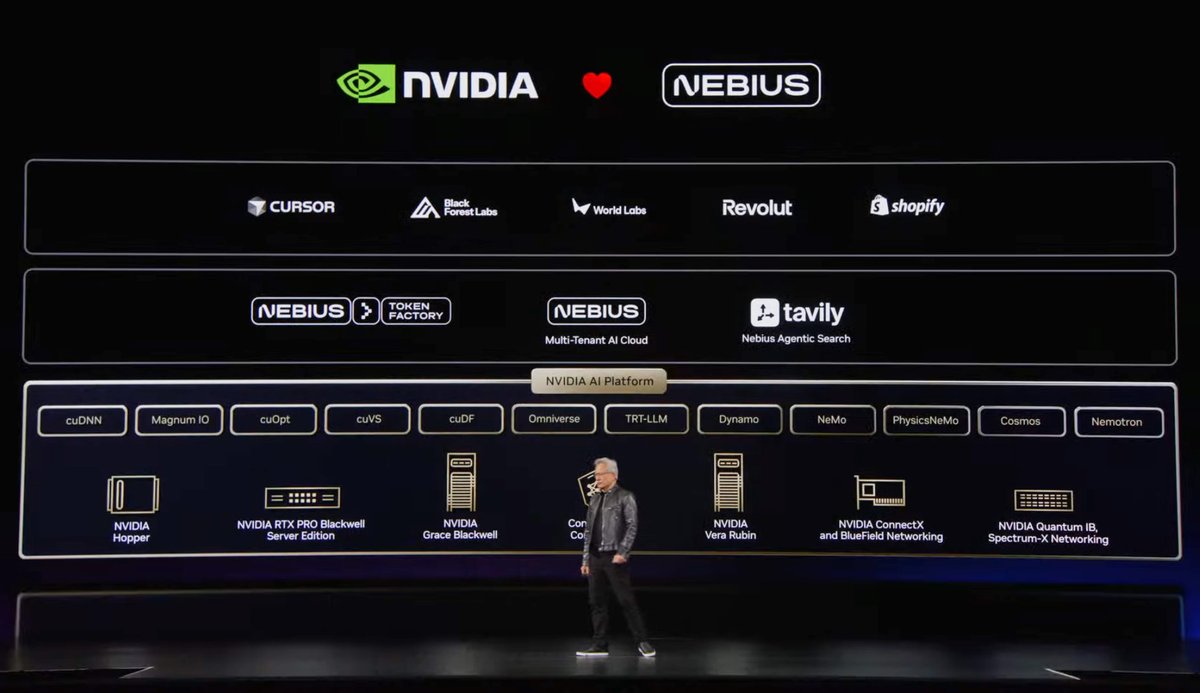
Jensen Huang’s “five-layer AI cake” shows how value stacks from energy and chips all the way up to models and applications.
Energy
$GEV $VST $TLN $OKLO $BE $CEG
Chips
$NVDA $TSM $AVGO $MU $AMD $INTC
Infrastructure
$ORCL $CRWV $NBIS $IREN $GLXY $APLD
Models
$NVDA $GOOGL $MSFT $AMZN $META $BABA
Applications
$TSLA $PLTR $SAP $CRM $SHOP $APP

English
JC Invest retweetledi

You think you missed $QCOM? Think it ran too far too fast?
Bears had 5 straight days to break it below $200.
They couldn’t.
Haven’t you figured out why?
Next stop $230. New ATH. 10% move. Do I care? HELL NO.
The chart is ripping because the story changed.
The real trade is $QCOM to 400+ when the market stops valuing it like a cell phone chip maker.
$QCOM is no longer just a phone company.
A major hyperscaler just signed up for custom AI silicon.
First shipment: December. 7 months out.
“This particular engagement, which we are going to ship in December, is a custom product we are working with a hyperscaler.”
Management framed it as multi-generation.
Translation: years of custom silicon revenue. Not a one-off science project.
Data center revenue today? Basically zero.
Tomorrow?
“Success in this area presents to us a potential multibillion-dollar revenue opportunity in a couple of years.”
That is fresh multibillion-dollar revenue and TAM sitting inside a stock still priced like the old Qualcomm.
Not the new Qualcomm.
AI200 and AI250 launch in 2026 and 2027.
Rack-scale inference systems.
PCIe scale-up.
Ethernet scale-out.
Liquid-cooled.
Open AI framework support.
Built for existing data center infrastructure.
"With the ability to connect our custom processors to NVIDIA's rack-scale architecture, we're advancing our vision of high-performance, energy-efficient computing to the data center." QCOM CEO. Nvidia NVLink Fusion announcement.
That means QCOM custom processors can connect into Nvidia rack-scale AI architecture.
People still don't get it.
Phones were the base.
Data center revenue is the re-rate.
Same playbook the market eventually realized and rewarded in $MRVL once investors finally understood the custom silicon ramp.
Except $QCOM has something most custom silicon stories do not:
A massive install base.
Product matters.
Moat matters more.
"The install base is the single most important part of an architecture."
- Jensen Huang
Nvidia’s edge is not just the chip.
It is millions of developers already building on CUDA.
QCOM is running its own version of that playbook.
Their AI stack already lives across billions of devices.
Phones. Laptops. Cars.
AI200 is not some random science project.
It is the Snapdragon family scaled into the data center.
Same software DNA.
Same ecosystem.
Same edge AI footprint.
They did not spend a decade trying to build a developer base from scratch.
They already had one.
It was sitting in your pocket.
So no, I don't think $200 is late.
December starts the ramp.
$230 hasn't reclaimed yet
Old highs come next.
$300 when the street accepts the data center story.
$400+ when the multiple finally re-rates.

English
