Jose Manuel Amor

6.4K posts

Jose Manuel Amor banner
Jose Manuel Amor

Jose Manuel Amor

@JMAafi

Partner, Afi. Research. Views generally my own. 🇺🇦🇪🇺

Madrid Katılım Aralık 2010
1K Takip Edilen1.3K Takipçiler
Jose Manuel Amor retweetledi
Menthor Q
Menthor Q@MenthorQpro·
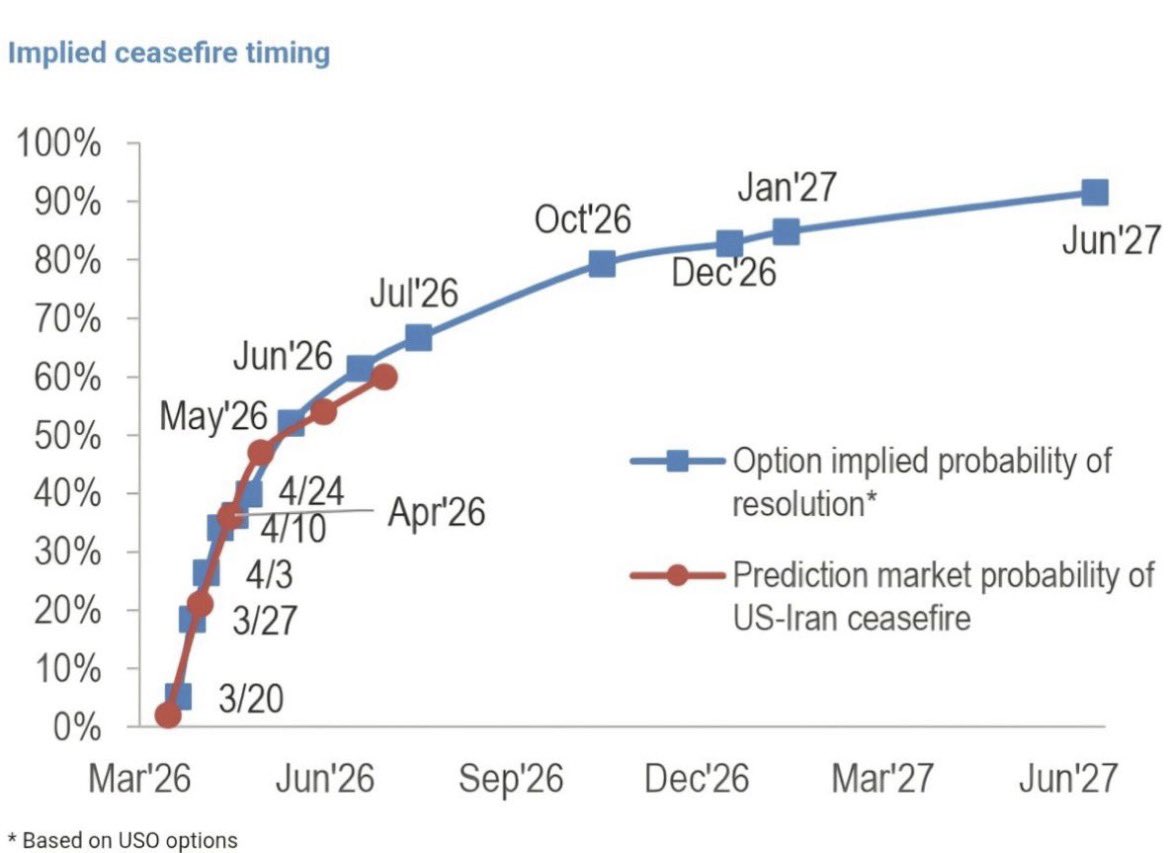
Markets are pricing both the probability and timing of a US–Iran ceasefire. Prediction markets imply ~60% odds by mid-2026, while oil options suggest a gradual resolution with risk fading into 2027. The option surface shows hedging demand, not panic, meaning markets are pricing insurance against shocks rather than a structural supply disruption.
Menthor Q tweet media
English
8
21
80
11.8K
Jose Manuel Amor
Jose Manuel Amor@JMAafi·
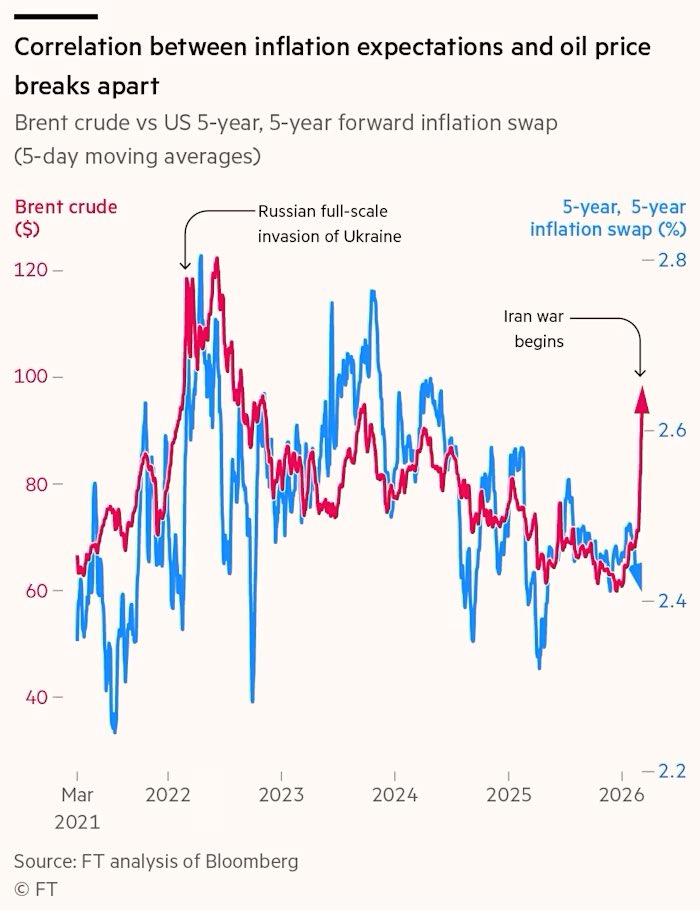
@albertedwards99 @FT @hakyungkim_ @rbrtrmstrng 5Y5Y is an implicit rate built on 5Y and 10Y breakevens... so it does not make much sense to look at it now. 5Y BEI rises on top of 10Y and the 5Y5Y is below the 10Y BEI. Better concentrate attention in 2-5Y breakevens. Those surely remain well correlated to oil.
English
0
0
0
60
Albert Edwards
Albert Edwards@albertedwards99·
Chart of the week @FT Unhedged column with @hakyungkim_ & @rbrtrmstrng is a chart from my latest note. The FT headline is "Higher oil prices are just a short-term worry: Long-term inflation expectations are staying steady". Mine was "Investor complacency invites a market shock"
Albert Edwards tweet media
English
8
29
107
9K
Jose Manuel Amor retweetledi
Afi
Afi@Afi_es·
En este primer episodio,@JMAafi, socio director de Análisis Económicos y de Mercados de Afi, y Raúl Viñas, analista y experto en geopolítica de Afi, responden a la pregunta: ¿Está la Unión Europea condenada a la irrelevancia #geopolítica?
Español
1
1
0
108
Jose Manuel Amor retweetledi
Olivier Blanchard
Olivier Blanchard@ojblanchard1·
I find it hard not to have as a central scenario where oil prices will remain very high for a long time, higher than the market current prices. I am no expert on geo-politics and defense technology, but this is what I think I have learned: Fully protecting ships in the strait of Hormuz is basically impossible. Not enough time to stop missiles or drones. There is no reason, whether or not Trump declares that war is over, to think that Iran will not continue for some time to threaten to destroy the ships that try. Why should they stop? The risk will thus remain sufficiently high that most non Iranian ships will not take the risk. Thus, the shortfall of 20 million barrels a day is likely to last for long. The scope for increased supply from elsewhere is very limited in the short run. Perhaps 2 million barrels at the most. The 400 million barrels reserve release can only add 3-4 million barrels or so daily. The short run elasticity of demand for oil is very low, at most -0.1, and probably less. This suggests to me prices closer to 150-200 dollars per barrel (or more, but I hesitate to give higher numbers…) than to the current market price. To repeat. I am no expert (As an economist, I have a bit more sense about the next step, namely what such a price would to the world economy). I would be more than happy to be proven wrong.
English
82
378
1.6K
534.5K
Jose Manuel Amor retweetledi
Olivier Blanchard
Olivier Blanchard@ojblanchard1·
On the effects of higher oil prices: The conclusions from our 2009 paper (with Marianna Riggi) nber.org/papers/w15467 are going to be tested. (but there is more to the current episode than higher oil prices)
English
2
42
154
20.8K
Jose Manuel Amor retweetledi
Afi
Afi@Afi_es·
Hoy hemos celebrado una formación para periodistas junto a @APIE_es para analizar cómo la #geopolítica está transformando la #economía y los #mercados.🌍
Afi tweet media
Español
1
2
5
379
Jose Manuel Amor retweetledi
Velina Tchakarova
Velina Tchakarova@vtchakarova·
Kremlin has proposed a wide-ranging economic partnership with Trump administration, including its return to the dollar settlement system. Looking at the Russian seven points provided by @christogrozev, it looks like Russia positions itself for reversed Nixon amid New Cold War.
Velina Tchakarova tweet mediaVelina Tchakarova tweet media
English
76
135
445
93.7K
Jose Manuel Amor
Jose Manuel Amor@JMAafi·
Siempre llegando allí donde nuestros clientes necesitan tomar decisiones. Puedes suscribir un trial de nuestros servicios de research aquí afi-research.es/ES/secciones/2…
Afi@Afi_es

📊El EU‑ETS arranca 2026 en un entorno de mayor volatilidad geo, climática y especulativa. Desde @Afi_Research analizamos: caída de correlación TTF‑EUA, exigencias en aviación y marítimo, factores fundamentales (clima/ generación energética) y posicionamiento táctico futuro.

Español
0
0
0
60
Jose Manuel Amor retweetledi
Steve Hou
Steve Hou@stevehou·
🔥 Use AI to read this and re-read. Huge ramifications for the decade and beyond.
Hanno Lustig@HannoLustig

Two questions about Japan. 1/ Why has 🇯🇵been able to accumulate so much debt (275% of GDP in 2023) up until now without triggering a fiscal crisis? 2/ Will 🇯🇵 be able to continue harvesting these excess returns? 1/ Why has 🇯🇵 been able to accumulate so much debt (275% of GDP in 2023) up until now without triggering a fiscal crisis? The Japanese public sector was funding itself at below-market floating rates by having the BOJ issue reserves (91% of GDP in 2023) and then investing in risky assets (181% of GDP), including foreign assets. Between 2013 and 2023, the public sector earned an extra 6.25 % of GDP per annum (in excess of its below-market funding costs) by taking on interest rate risk, currency risk and equity risk. As a result, between 1997 and 2023, the net debt, liabilities minus assets, of the entire public sector has only grown from 24.7% to 94.3% of GDP, a 70% of GDP increase, despite the fact that the cumulative primary fiscal deficit of the general government exceeded 133% of GDP during the same periods and despite growth being close to zero. 2/ Will 🇯🇵 be able to continue harvesting these excess returns? No. Probably not. In a counterfactual exercise without QE and YCC (no funding by issuing reserves; the public sector funds itself at true no-YCC market rates), we find that the extra 6.25% of GDP is reduced to 2.75% of GDP. If we then force the government to hedge the currency risk (like the financial sector), then there is no excess return left. The no-QE/no-YCC counterfactual assumes that market bond yields would have been 200 bps higher. Since the BOJ's tentative switch to policy normalization in 2022, the 10-year JGB yield has already increased by more than 200 bps. The long end has increased even more. This suggests these excess returns harvested by the public sector will disappear going forward, unless the BOJ reverts back to massive QE and/or YCC. Bottomline: Low-rate policies and financial repression are easy to start, but hard to exit. Japan has been running an interesting experiment for the rest of the world, especially advanced economies, and Europe in particular. I hope we all learn from it. Joint work with YiLi Chien and Hal Cole. dx.doi.org/10.2139/ssrn.4…

English
3
2
27
11.9K
Jose Manuel Amor
Jose Manuel Amor@JMAafi·
El inicio del 2026 viene marcado por una aceleración, a momentos caótica, en la geopolítica global. La implementación de la doctrina “Donroe” de la Estrategia de Seguridad Nacional de EE. UU. no se ha hecho esperar. La inestabilidad doméstica en Irán como guinda. Y sólo es 9/1.
Afi@Afi_es

👇 Algunos de los vectores clave que están configurando el escenario geopolítico actual. El orden global se reescribe: las normas se diluyen, se cruzan umbrales antes impensables y la ambigüedad pesa tanto como la fuerza. No hay nuevo equilibrio, sino su fabricación.

Español
1
0
0
115
Velina Tchakarova
Velina Tchakarova@vtchakarova·
My most important analysis for 2025 is out: „A Grand Strategy for Europe in the New Cold War“. The coming decade will test whether Europe can reinvent itself as a conscious actor in global affairs or become a geographic backyard between two geopolitical blocs. (link in reply)
Velina Tchakarova tweet media
English
59
161
630
185.2K
Jose Manuel Amor retweetledi
OSINTdefender
OSINTdefender@sentdefender·
The Center for Strategic and International Studies (CSIS), an American bipartisan think-tank based in Washington, has issued a public rebuke of the Trump Administration’s National Security Strategy (NSS) released on Thursday, stating that the strategy effectively “declares war on European politics, Europe’s political leaders, and the European Union,” adding that it could result in the destruction of the NATO Alliance.
OSINTdefender tweet media
English
281
715
2.3K
325.9K
Jose Manuel Amor retweetledi
Velina Tchakarova
Velina Tchakarova@vtchakarova·
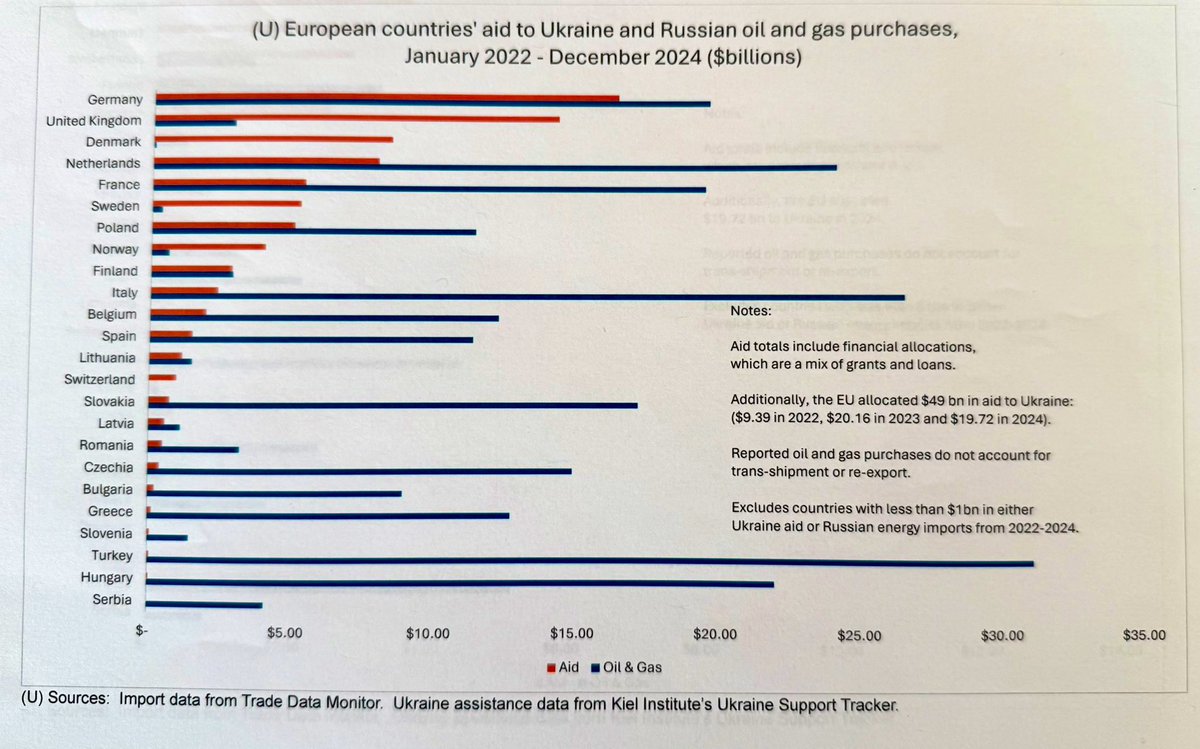
These are the discrepancies between European aid for Ukraine and European oil and gas purchases from Russia between January 2022 and December 2024.
Velina Tchakarova tweet media
English
34
55
201
33.7K
Sam Badawi
Sam Badawi@Sam_Badawi·
The market rebounds this morning as Fed Williams says that the they can cut rates in the near term given the modestly restrictive policy. Bad news after bad news, the slightest hope will become a positive catalyst. Fed funds futures now pricing in a 55% chance of a cut vs 29% a day ago. $SPY jumped from -0.32% to +0.5% in moments after.
English
17
13
176
33.9K
Valdo
Valdo@reachvaldo·
You don’t have The Psychology of Funnels? like + reply “$” and I’ll DM it to you for FREE.
Valdo tweet media
English
2.2K
411
4.8K
433.4K