

J.Neon
4.4K posts

J.Neon
@JNeonWave
Engineering is magic abiding by the constraints of thermodynamics.
The Netherlands Katılım Temmuz 2023
419 Takip Edilen251 Takipçiler

@JNeonWave @josepramonbosch Només semblar, no t'emociones. A la que rasques una mica, et surt la EA (estupidesa accentuada)
Català

En BCN, los separatistas destruyen el mural de homenaje a Luis de la Fuente. Su odio, nuestra victoria.


Español

@JNeonWave @Aibabur También podría esperar a tu puta madre que seguro que le gusta la leña.
Español
🔴🔥🌳 Ahi va un hilo de mi experiencia con los permisos de poda... un día iba paseando a caballo al lado del pantano y vi un montón de encinas secas, se me ocurrió ir a por el motosierra y hacerlas leña....
Español
@Peduca46 @Doct_Tricornio Estoy de acuerdo con lo que está leyendo.
Pero sinceramente, no se ha parado ni a quitar una coma del slop de chat gpt.
Compara ese video con uno suyo de hace 3 años y notaras a lo que me estoy refiriendo.
Español
@JNeonWave @Doct_Tricornio Otros se quedan mirando el dedo que apunta a la Luna.
Español

🔴 La mejor reflexión acerca de los incendios que vas a escuchar en redes: SÓLO RETUITEA
Español
@Clint_Davey1 Now overlay the Blue Banana region (the most crowded and industrialised region in Europe) and you will get a new perspective on the neglected influence of the Spanish Empire in modern Europe.
en.wikipedia.org/wiki/Blue_Bana…
English

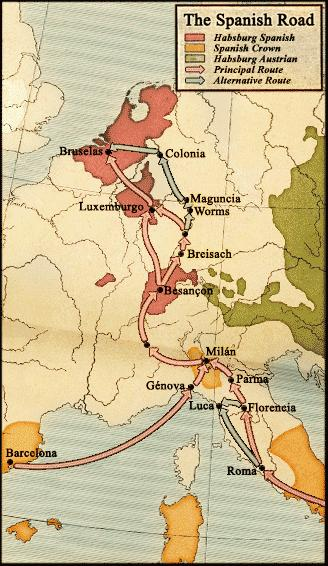
The Spanish Road was a fascinating piece of 16th century logistics and diplomacy.
The Spanish empire in Europe had two vitally important nodes - Flanders and Milan.
Both were nearly always on the front line of Spain's many enemies, and there was a frequent need to shuttle forces between them.
To facilitate this, the Spanish had to use a network of forts, roads and local alliances to ensure a clear path stretching through the Italian alps, Burgundy, Luxembourg and parts of Germany.
Forces raised in Spain might hop over to Sardinia, then to Genoa, then to Milan, then to Besancon, then Breisach, then Luxembourg, then Brussels.
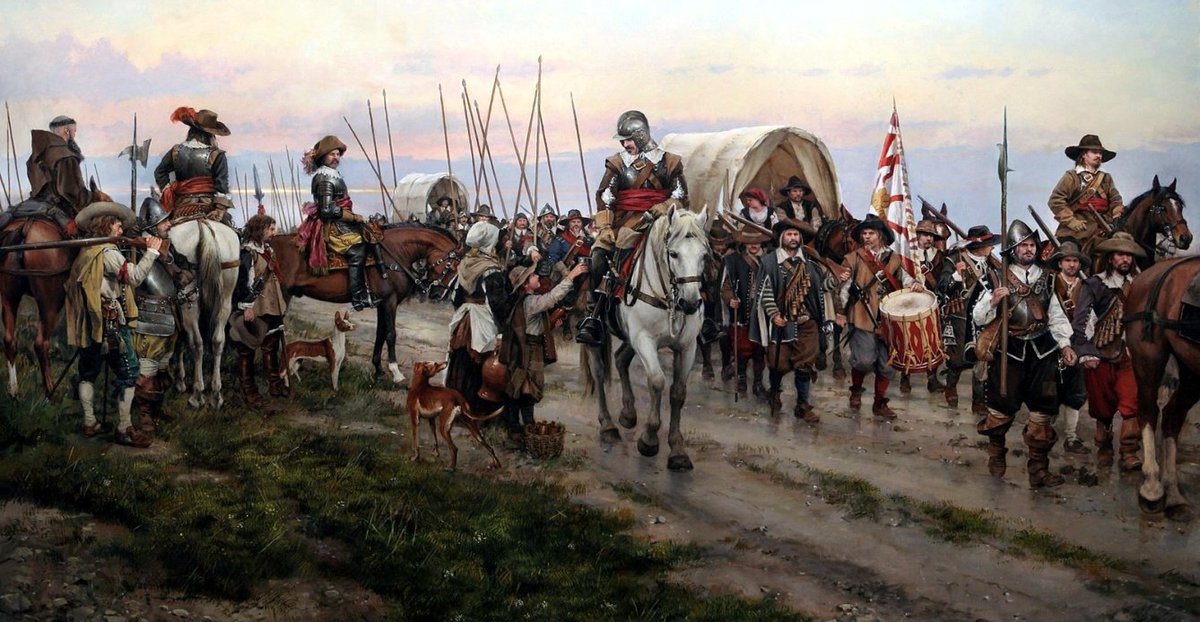
The Spanish Road was constantly bustling with battle-hardened Tercios, supply wagons, ambassadors, merchants, the odd Papal nuncio, cavalry patrols and all other kinds of people.
Like a kind of highway at the centre of European warfare.
English
J.Neon retweetledi
Being exceptional isn't enough. You also have to be in a place that rewards excellence.
English
@Aibabur Alfonso, si después de tanto esperar al vigilante fluvial le dices que no porque te vas con los caballos al Rocío, qué quieres que te diga. Cuestión de prioridades y la tuya ni es el monte, ni los bañistas ni nada. La tuya es quedarte con la leña por la cara.
En fin...
Español
@Thebasilisk79 @patrickbetdavid @PalmerLuckey If you convince Vlad and Xi on that, you have a Nobel prize almost guaranteed.
Until then, you better like to be in the same side of this guy.
English

@patrickbetdavid @PalmerLuckey Why are you showcasing weapons of death and destruction?
Can we concentrate on things that don’t kill ?
English
Leave it to entrepreneurs to solve bigger problems.
@PalmerLuckey presents the “Barracuda” missile on Japanese TV:
“It’s much less expensive than a conventional missile… It’s cheaper to make 100k of these than 1,000 existing missiles.”
Brilliant 👇🏽
English
J.Neon retweetledi

J.Neon retweetledi

Congratulations on saving the planet with recycling, turning your AC down, and struggling with paper straws
Meanwhile, in Pakistan...
Writer: Ian
English
J.Neon retweetledi

Earth is still bound to the Late Cenozoic Ice Age, and our planet's average global temperature still hovers around a very livable 15°C.
This is far below the world's long-term planetary average of 18°C to 24°C - seen throughout most of Earth's biological history. It makes the idea of a global warming crisis seem out of sync with reality.
Despite four decades of continuous climate alarmism, roughly 10% of the Earth's total land area remains permanently capped by glacial ice, which covers 15 million square kilometers (5.8 million square miles).
That is nearly a third of its extent during the peak of the Last Glacial Maximum (26,000 to 19,000 years ago), when continental ice sheets reached their historical zenith.
The Antarctic ice sheet remains the largest and thickest body of ice on the planet, extending up to 4.8 kilometers (about 3 miles) deep. It holds roughly 90% of global ice volume and accounts for 85% of total glacial land cover. Spanning 14 million square kilometers (5.4 million square miles), Antarctica alone makes up 8.3% of Earth's total land surface.
A basic geographical reality is often forgotten: land comprises a mere 28% of the planet's surface. All human cities, towns, and infrastructure combined occupy just 1% to 3% of that land (while deserts take up 33% and forests 31%).
We live on an ocean world, and waters cover 72% of the globe to an average depth of 2.3 miles.
Crucially, the oceans hold 86% of the global carbon reservoir and absorb over 90% of retained thermal energy. By contrast, the atmosphere holds a fraction of a percent of each. The oceans—not human industrial activity—serve as the true long-term regulatory engine for atmospheric carbon dioxide and global climate stability.
The current Quaternary Glaciation is part of an ice age cycle that began 34 million years ago with the thermal isolation and glaciation of Antarctica, later intensified by the closure of the Isthmus of Panama and orbital variations (Milankovitch cycles).
Carbon dioxide was not the driver of these immense shifts.
All of human civilisation, agriculture and technological progress has unfolded within a brief, warm respite: the Holocene interglacial period, which began just 11,700 years ago.
Yet for 40 years, the narrative has been dominated by a campaign driven by an unaccountable bureaucratic authority—the United Nations—pushing an agenda of global control.
The promised catastrophe of runaway, unprecedented warming never arrived.

English


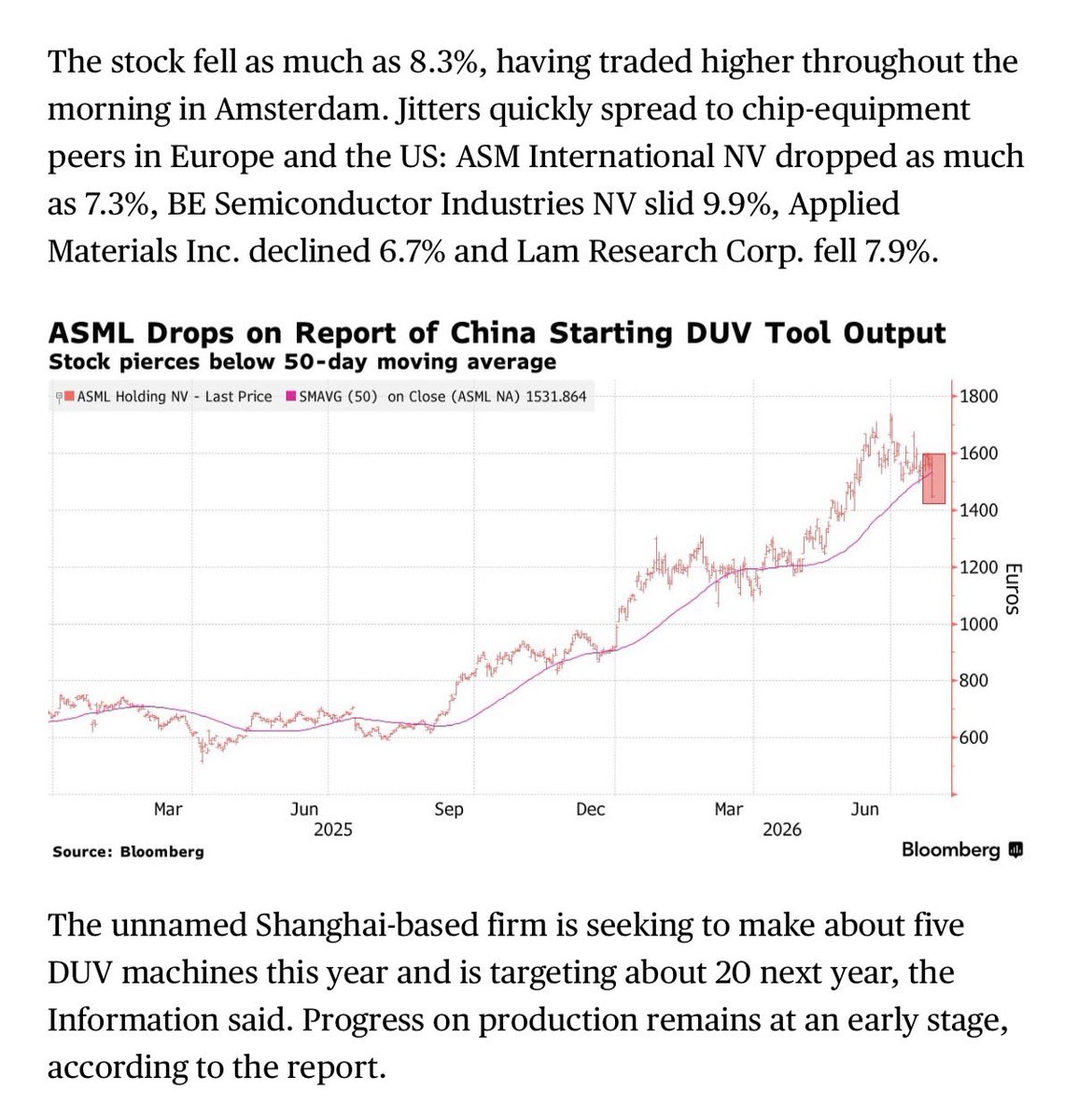
🚨BREAKING: China has begun mass production of DUV lithography machines for the first time
ASML: nobody can touch our monopoly
China: targeting 5 DUV machines this year and 20 next year
Chip equipment stocks:
ASML -8.3%
ASM International -7.3%
BE Semiconductor -9.9%
Applied Materials -6.7%
Lam Research -7.9%
It’s over

English
@JorgeSa42988133 @MJMendezCasarie Iran lo demuestra aniquilando a su población, hundiéndola en la miseria.
Español

@MJMendezCasarie Irán demostró q la producción estatal de armas es mucho más eficiente q la privada, un dron iraní q vale 50000usd, si lo hace un privado en usa sale 10 veces más caro. La industria militar privada es un esquema Ponzi
Español

“No soy anarquista. Creo en el gobierno, pero en un gobierno limitado. En mi opinión, el gobierno debe limitarse a funciones muy simples. La primera es defender al país de enemigos extranjeros. Durante mucho tiempo intenté encontrar una forma de privatizar la defensa nacional, pero nunca lo logré. Es fácil imaginar cómo privatizar la educación, pero no la defensa nacional. Me resigno a que tengamos que pagar el doble de lo necesario para contar con una defensa eficaz, porque, en promedio, todo lo que hace el gobierno cuesta el doble de lo que costaría si lo hiciera el sector privado.
La segunda función del gobierno es proteger a los ciudadanos contra la agresión y la coerción de otros ciudadanos: impedir que te asalten, que entren a robar en tu casa o que violen tus derechos. Sin embargo, creo que desempeña esa función de manera muy ineficiente porque dedica gran parte de su tiempo a hacer cosas que nunca debió asumir.
La tercera función es definir las reglas del juego. ¿Qué es exactamente la propiedad privada? Si un avión vuela a 10.000 pies sobre tu casa, ¿está invadiendo tu propiedad? ¿Y si vuela a solo unos metros? No existe una respuesta natural. Alguien debe establecer esas reglas, y esa sí es una función legítima del gobierno.
La cuarta función consiste en proporcionar un mecanismo para resolver los conflictos sobre el significado y la aplicación de esas reglas. Es decir, un sistema judicial independiente.
Esas son, en mi opinión, las cuatro funciones esenciales del gobierno.”
— Milton Friedman
Español
@GrassiTrevor They could be filled with sand on purpose after a layer was laid, so they could reuse the poles a layer up.
English
@GrassiTrevor Interesting, but Occam's principle tells me they were pole holders for visual references to align the blocks.
English

Many times I'm asked, 'why not just drop a light and camera down the shafts on a string to see what's there?' It's a perfectly valid question, which is why I've already done it, with an 8k, 360° camera, to catch every side passage, tunnel and adjacent chamber. I've done it to MANY of them. I've documented, to their visible bottoms, about half the shafts on the Giza Plateau, and unless you've been there, you have no idea what a massive task that was... even though the vast majority are filled with sand to ground level.
Recently, I've confidently stated that there are over a thousand vertical shafts at Giza, between the Eastern, Western and Southern Cemeteries, but in the past week, I've looked deeper into the matter. I have carefully zoomed in on satellite imagery and placed a red arrow on every single shaft that is clearly visible. Given the final count of copied layers in photoshop, and the obvious fact that many of them are still buried and not visible at all, I amend by previous statement.
THERE ARE AT LEAST 3,000 SHAFTS AT GIZA! In the Western Cemetery alone are at least 1,800, near the Second Sphinx mound and the NC2 Complex. Yet still, we're told there's 'nothing to see beneath the pyramids'.
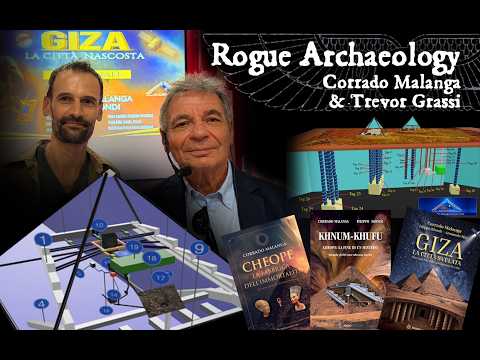
Tomorrow I will share the satellite image maps, as they are included in my interview with Corrado Malanga,
[ youtube.com/watch?v=tPA8Uo… ]
but today I will share this clip as an example. This one is not at Giza. Do you know where it is?
YouTube
English
J.Neon retweetledi

"Un hombre malvado es capaz de quemar su propia nación hasta los cimientos para poder gobernar sobre sus cenizas."
Sun Tzu

Español
@CCosaco @RobertoLai74153 Los cortafuegos también son vias de acceso y ralentizado del fuego. Sin ellos no hay quien se acerque, y la temperatura no baja.
Te conocerás el monte, pero los mecanismos que hacen posible la extinción… son otro tema.
Español
@RobertoLai74153 La realidad es que el fuego se salta los cortafuegos mejor mantenidos. Lo estoy viendo ahora en el incendio que afecta a Robledo, zona que conozco como la palma de mi mano.
Español
Antiguo encargado del mantenimiento de los cortafuegos de Madrid... TIRA DE LA MANTA.
Dice qué toda esta destrucción tiene el objetivo de presionar para que se firme el fraudulento Pacto de Estado frente a la "Emergencia Climática" por el Pacto Verde Europeo de PPPSOE.
Español

@JaviRodrigo11 Una trilera q se postula para los Óscar de cine, patética,incompetente, dimite inmediatamente,sobras,incapaz de gestionar nada
Español

Ayuso se emociona, no aguanta y rompe a llorar ante los medios de comunicación al mencionar el Valle del Tiétar y los incendios.
Con este gesto, espontáneo, sincero, natural y humano; acaba de ganar por súper mayoría absoluta las elecciones del año que viene en la Comunidad de Madrid.
Español

Luis de la Fuente, en el polideportivo de Marazuela para acompañar a los desalojados: "Es mi obligación estar aquí para animar a la gente, sintiéndonos partícipes de su dolor" #Echobox=1785066541" target="_blank" rel="nofollow noopener">elmundo.es/espana/2026/07…
Español
Los partidos de 'ultraderecha' no van a eliminar a los homosexuales, ni a reinstaurar la esclavitud, ni a quitar todos sus derechos a las mujeres, ni a forzar matrimonios.
No son como los musulmanes.
Español