Jason Major
133.8K posts

Jason Major
@JPMajor
Space exploration aficionado and occasional NASA image processor.
Rhode Island, USA Katılım Ocak 2010
4.6K Takip Edilen73.6K Takipçiler
Jason Major retweetledi

A space weather contender in the #NOAASatelliteShowdown. ☀️
Team Stormy Sun!
On Jan. 18 to 19, 2026, @NOAA’s #GOESEast satellite observed a coronal mass ejection during a strong solar storm, with the moon and three planets visible in the same view.
Like to vote!
English
Jason Major retweetledi

A clear night at Kielder Starcamp! Very pleased with this pic of the Orion Nebula I got with my @Seestar_astro ...

English

All the stars are moving.
Relative to what, in what direction, and at what rate—not to mention how apparent from our point of view—vary considerably.
Corey S. Powell@coreyspowell
@BillyZigouras Here's a time-lapse photograph showing the obvious motion of Barnard's Star over the period of just 16 years. You will retract your meme now, correct? earthsky.org/space/astronom…
English
Jason Major retweetledi

At 5,500 light-years away, Messier 4 is the closest globular cluster to Earth. Globular clusters are spherical groups of stars, held together by gravity.
This image spans the wide range of wavelengths that Hubble’s instruments are sensitive to: go.nasa.gov/4uChHZ2

English
Jason Major retweetledi

TIMELAPSE: Gorgeous sunrise from Jamestown this morning looking east past the mansions of Newport, Sakonnet Light, & Cuttyhunk out on the Cape. Crashing waves and a distant marine layer seeping north giving some extra beauty! 🌅
@NBC10 - @natwxdesk
English
Jason Major retweetledi

One of the biggest surprises of NASA's OSIRIS-REx mission was that the target asteroid, Bennu, turned out to be a jagged, rugged world covered in large boulders, with just a few smooth patches.
Here's why >> go.nasa.gov/4sRd9MI

English
Jason Major retweetledi

A G2 (Moderate) Geomagnetic Storm Watch has been issued for 19 Mar 2026 (UTC day) due to the arrival of CMEs that left the Sun on 16 Mar. For more information, see: youtube.com/shorts/MZIjop9…

YouTube

English
Jason Major retweetledi

@SpaceLuisa @Science_George Keeps the planetary science kids out of trouble
English

@Science_George @JPMajor 🤣🤣🤣 indeed. Hey the positive, more objects for the next generation of scientists to study!
English

Saturn officially has way too many damn moons
Corey S. Powell@coreyspowell
Astronomers have discovered 11 more moons around Saturn, bringing its total to 285--by far the most of any planet in the solar system. The true number may be unknowable, if you count every ring particle as its own little moon. minorplanetcenter.net/mpec/K26/K26F1…
English
Jason Major retweetledi

A fridge-size space rock spectacularly broke apart over Ohio at 40,000 mph, creating a loud boom and a rare "fireball" that shone in the bright blue daytime sky. The rare sight, which exploded with the equivalent force of 250 tons of TNT, was also seen from space. livescience.com/space/meteoroi…
English
Jason Major retweetledi

Apollo 15 Lunar Rover Footage Upscaled and Interpolated to 60 FPS
Incredible upscaled footage from onboard the Apollo 15 Lunar Rover captured by Jim Irwin using the 16mm DAC camera. This footage has been upscaled and Interpolated to 60 FPS and synchronised to the mission audio by Moonpans
Original footage source: Apollo Flight Journal
Full video in comments
English
Jason Major retweetledi

When scientists recently trained Hubble on Comet K1, they got a big surprise—the comet was breaking apart! The odds of that happening while Hubble watched are … well, astronomical: news.stsci.edu/3OXyAx3
English
Jason Major retweetledi

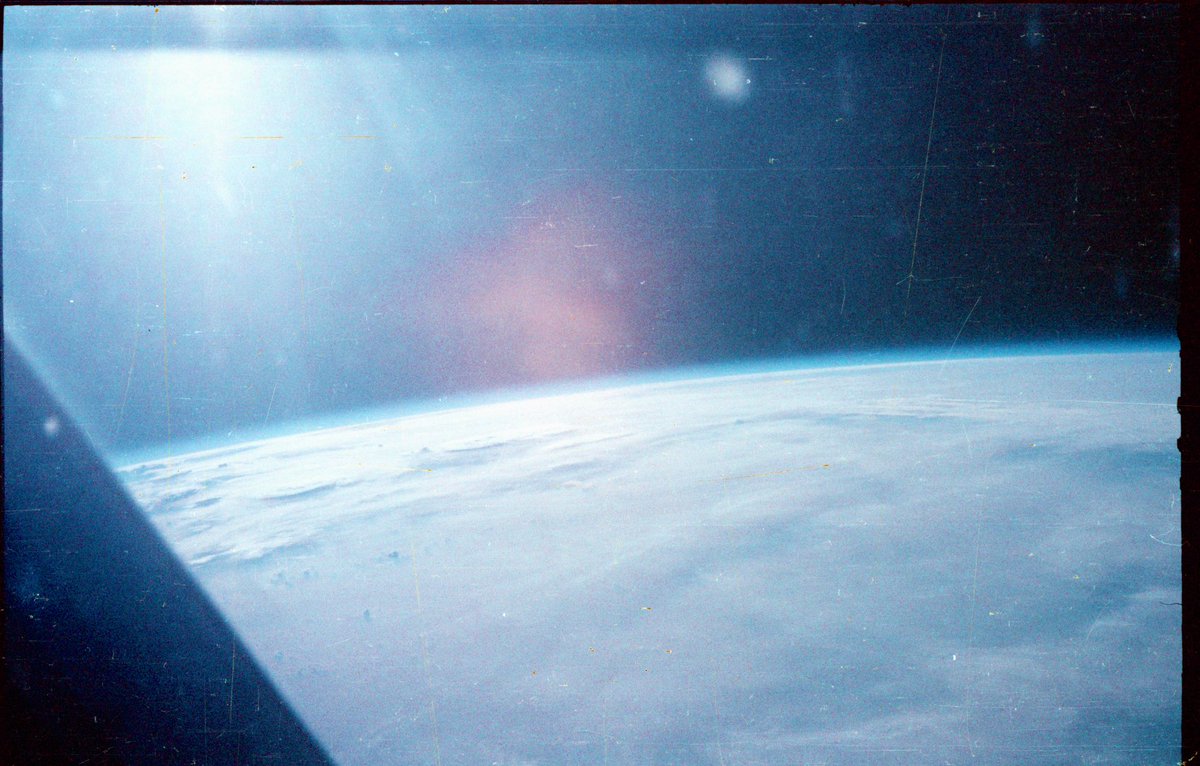
Day 032, orbit 0498 – Here is the very first picture I took from the Cupola… just like when you’re flying on a plane, clouds ⚪ are at times the only thing as far as the eye can see – the biggest difference being that we’re about 390 km higher than a commercial jetliner!
The blue 🔵 tone of the image comes from the atmosphere, which scatters the shorter wavelengths of light, such as blue and violet. You see the same effect from a plane, though more faintly. Near the top of the picture, along the curve of the Earth, you can clearly see how thin the atmosphere is, fading from a pale to a deeper blue before disappearing into the black of space ⚫…
Second pic is my very first picture from Dragon, with heart-shaped clouds, which I took as a message to spread good vibes. More pictures soon! 🌍
📷 Credit: NASA/ESA – S. Adenot (1), NASA/ESA/SpaceX (2) #εpsilon


English