Jeff Young

4.3K posts

Jeff Young banner
Jeff Young

Jeff Young

@JYKines

EdD(c) (Kinesiology), MS, FMFA, CSCS; CEO, MRF Institute; Director, NY State PA Coalition; Board Member, USREPs; S&C and Medical Fitness Expert

New York, NY Katılım Temmuz 2013
275 Takip Edilen343 Takipçiler
Jeff Young
Jeff Young@JYKines·
@Hybridathlete And doesnt improve CRF unless the person is very deconditioned. It's great for recovery, mental health, and getting in some extra caloric burn, but shouldn't be compared to running. Also, stress on joints is good - provides a stimulus to make them stronger and more resilient.
English
1
0
2
1.4K
Jeff Young
Jeff Young@JYKines·
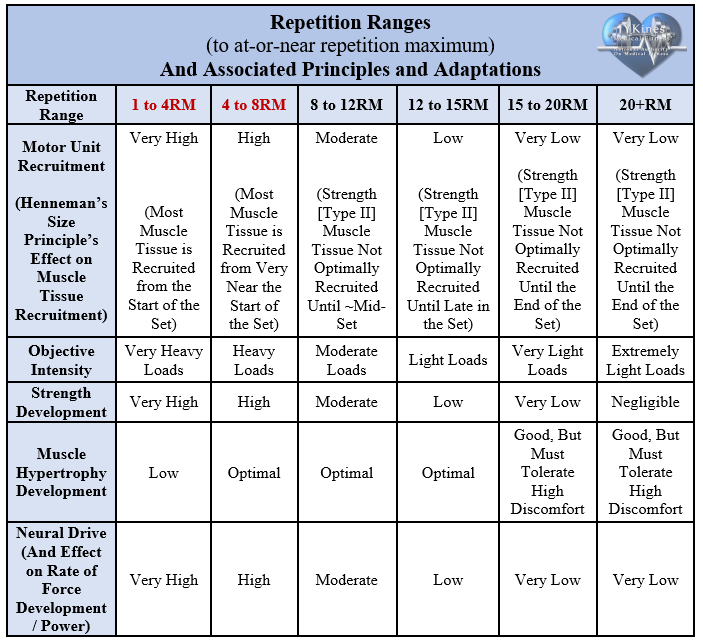
Simply put: . The reason why people should spend some (but not all) of their time training in the 4 to 8 repetition range -- and occasionally in the 1 to 4 repetition range (taking sets to at or within a rep of muscle failure) is because, with the possible exception of *optimizing* lean muscle tissue (which isn't optimized in the 1 to 5 rep range), the three primary adaptations we want to optimize and maintain throughout the lifespan -- strength, power, and lean muscle tissue -- are occurring in those lower repetition ranges. . Especially when the load is being lifted, during each repetition, with the intent of maximal velocity (explosiveness). . Most people, no matter what their age or medical/musculoskeletal condition, after building a level of tolerance and learning proper form in the moderate to high(er) repetition ranges, can eventually spend some time training in the 4 to 8 repetition range to near repetition maximum/muscle failure. . Since most of "the magic" (neuro-musculoskeletal optimization) happens in the lower rep ranges with heav(ier) loads lifted with the intent of maximal velocity, it's a borderline crime to avoid them.
Jeff Young tweet media
English
0
0
1
15
Jeff Young
Jeff Young@JYKines·
Most studies don't show the big picture. They don't mention that you can throw pretty much anything at people with low fitness and they'll see results as long as the program provided sufficient stimulus. They don't mention that suboptimal programs will lead to faster plateaus. They just conclude that most anything "works". It's deceptive.
English
0
0
0
20
Strength For Life
Strength For Life@Strength4_Life·
🏋️‍♂️💪The Effects of Different Resistance Training Modalities on Muscle Strength in Community-Dwelling Older Adults: A Network Meta-Analysis karger.com/ger/article-ab…
Strength For Life tweet media
English
3
18
72
2.9K
Jeff Young
Jeff Young@JYKines·
@toylan20 It isn't dieting. It's eating healthy foods in a state of caloric balance to maintain goal weight. Change the mindset.
English
0
0
0
170
toylan
toylan@toylan20·
You finally get in shape and realize you have to keep dieting and tracking calories forever.
English
113
354
9K
239.3K
Jeff Young
Jeff Young@JYKines·
@jerryteixeira That's only if you look at through a hypertrophy lens. There is more to resistance training adaptations than muscle growth.
English
0
0
0
48
JT | Jerry Teixeira
JT | Jerry Teixeira@jerryteixeira·
Your muscles don’t have eyes. They can’t see if you are using a barbell, your body, an exercise band or machines. All they know is whether or not you're doing hard sets. As long as you are, and they are below about the 30 rep range, you are going to build muscle on a per set basis.
English
7
3
46
6.6K
Jeff Young
Jeff Young@JYKines·
@ZacGoodman_ Motor unit recruitment is a function of: 1. Load 2. Proximity to failure 3. Fatigue 4. Intent to lift with velocity and corresponding neural drive You're welcome 🫵🤜🤛💪
English
0
0
1
24
Zac Goodman
Zac Goodman@ZacGoodman_·
One of the main benefits of using low reps sets is the lowered perception of fatigue. A hard set of 10 can crush an athlete… a set of 3 even with heavier loads can be repeated multiple times in a session/week. Perception supports or inhibits Motor Unit recruitment.
English
1
0
28
1.7K
Jeff Young
Jeff Young@JYKines·
@ZacGoodman_ Rather than rely on the interpretation of someone like Beardsley, why not become intimately familiar with Henneman's Size Principle directly through the research so that you can understand your last sentence, and Beardsley, are incorrect?
English
1
0
0
39
Zac Goodman
Zac Goodman@ZacGoodman_·
@JYKines Refer to the work of Chris Beardsley, he talks extensively about POE and how it affects MU recruitment and HTMU. The literature/studies he references in his book and online content is helpful.
English
1
0
1
61
Jeff Young
Jeff Young@JYKines·
@CoreyTwine Who were/are your mentors, helping you to understand the importance of these concepts and principles?
English
0
0
0
17
Corey Twine
Corey Twine@CoreyTwine·
Resistance training is not just sets, reps, and a favorite exercise menu. As Larsen et al. lay out, autoregulation is a way to adjust training variables around the individual’s daily fluctuations in performance, and those fluctuations reflect fitness, fatigue, and readiness, including non training stressors. They also make the point that using an old 1RM or a fixed percentage may not always reflect the athlete’s current maximal strength level. That is a big deal, because it means prescription is not just about assigning load. It is about matching the stimulus to the person who showed up that day. What I appreciate about this review is that it keeps the conversation where it belongs: on the training variables that actually drive the adaptation. Across 14 studies, all autoregulation training protocols increased 1RM, and the authors conclude that both subjective methods, like repetitions in reserve based RPE and flexible daily undulation, and objective methods, like velocity targets and velocity loss, could be effective for enhancing maximal strength because they may account for daily fluctuations in fitness, fatigue, and readiness. They even note that velocity based methods may help because they provide objective feedback during the lift. In other words, good resistance training is not passive. It requires adjustment, interpretation, and a practitioner willing to make the call when the planned load, the chosen method, or even the preferred exercise no longer matches the actual demand. That is where professionalism comes into play. Preference cannot outrank demand. If an exercise choice does not load the pattern, the tissue, or the quality that needs to be developed, that has to be identified clearly and professionally. Not in a derogatory way, just as a fact of the matter. Too often that gets passively accepted, when in reality it is usually a knowledge and competency issue. Better coaching is not about letting every preference slide. It is about understanding the intended adaptation, respecting daily readiness, and prescribing training in a way that actually meets the need.
Corey Twine tweet media
English
2
3
12
652
Jeff Young
Jeff Young@JYKines·
@DanielBerglind Yes, as the authors clearly conclude, both can work. But for some reason you excluded a critical point: Both can work IN THE EARLY STAGES OF TRAINING. Why did you exclude that?
English
0
0
1
31
Daniel Berglind, PhD
Daniel Berglind, PhD@DanielBerglind·
A well-designed resistance-training program makes progression a consequence, not a goal. As muscle size increases, force capacity increases too, so the same load becomes easier. To keep effort high, you must gradually add reps or load. Both can work 💪 pubmed.ncbi.nlm.nih.gov/38286426/
English
2
10
45
1.3K
Jeff Young
Jeff Young@JYKines·
@drmikehart You're incorrect. Breaking up the FITT-VP principle as though one variable is more important than the others shows a lack of understanding of the fundamentals of exercise science.
English
0
0
0
13
Jeff Young
Jeff Young@JYKines·
@drmikehart This is a play on words and nothing more. While you don't *need* to, depending on goals and preferences, for many people 4-6 days per week is optimal and therefore, the much better choice.
English
2
0
1
326
Mike Hart, M.D
Mike Hart, M.D@drmikehart·
You don't need to lift weights more than 3 days per week.
English
19
0
45
77.3K
Jeff Young
Jeff Young@JYKines·
@forgebitz How many developers do you know? What sample size are you pulling from? What did your survey look like?
English
0
0
0
58
Klaas
Klaas@forgebitz·
i don't know a single developer using gemini models
English
679
34
2K
200.6K
Jeff Young
Jeff Young@JYKines·
@jake_tuura All major muscles need heavy load. They all need light and moderate loads to, to balance intensity.
English
0
0
0
130
Jake Tuura
Jake Tuura@jake_tuura·
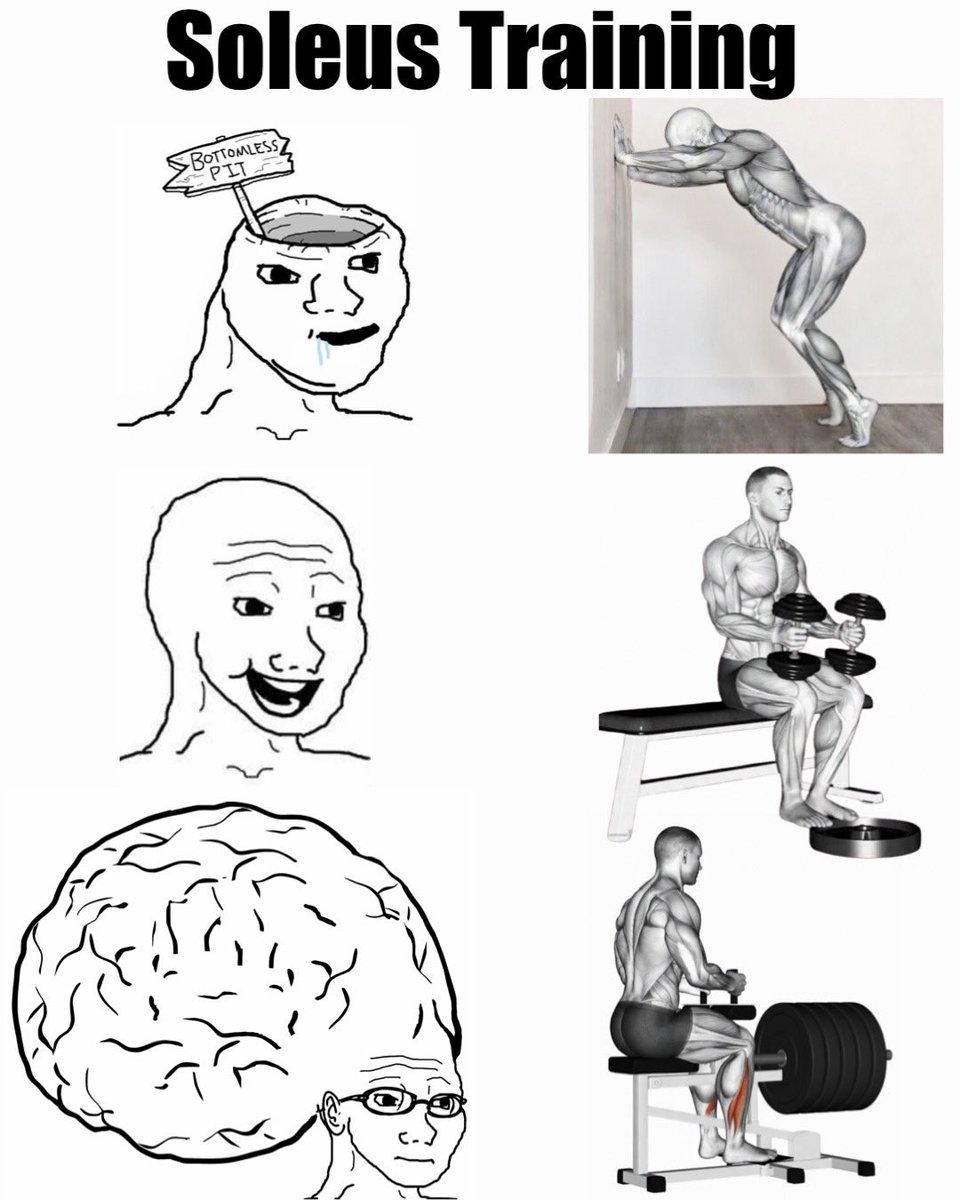
Soleus needs heavy load. From the podcast with Seth O’Neill: "For most steps when you're jogging, you're probably looking at about 7-8 times body weight at most speeds in steady state running. If you then accelerate, the soles will get about 10 times body weight... this is internal force production. And that depends on the lever arm and the axis of movement. So if we are looking at measuring that externally, we use an isometric strength test in a flex knee position, single-leg... If you hit twice body weight as an external force production on that test, the internal force will be between 7-12 times body weight, depending on how big your foot is basically. So that equates to the typical internal physiological load. So externally, twice bodyweight is our target. Internally, that will be then somewhere in the region of our typical demands."
Jake Tuura tweet media
English
9
15
138
16.6K
Jeff Young
Jeff Young@JYKines·
@MoAImam Of course it can. This is just basic physiology.
English
0
0
0
7
Mo Imam
Mo Imam@MoAImam·
Physiological mechanisms of neuromuscular impairment in diabetes-related complications: Can physical exercise help prevent it? Neuromuscular deterioration and performance decline with diabetes 👇 physoc.onlinelibrary.wiley.com/doi/full/10.11… Image
Mo Imam tweet media
English
3
12
34
1.7K
Keith Siau
Keith Siau@drkeithsiau·
Skipping breakfast is associated with depression and anxiety, according to a new study ⚠️
Keith Siau tweet media
English
39
100
384
43.8K
Jeff Young
Jeff Young@JYKines·
@wolfstrength Yes.... This is exactly how it was back in the day. I miss those days.
English
0
0
1
280
Deep Squats, Shallow Thoughts
Before everyone had their own set of Bluetooth headphones and antisocial behavior became the norm, it was quite normal for multiple people to work in together on the same piece of equipment. The first gym I went to had one bench press, and it was very normal for 3 to 4 people who had never met each other before to work in together on that bench. The way commercial gyms are now though, stuff like that is pretty rare and I understand why people get annoyed. But resting 3 to 5 minutes (sometimes more!)- at least for some lifts- is necessary to get the most out of them.
Carlos That Notices Things@QuetzalPhoenix

Whoever started telling gym goers to rest 3 to 5 minutes between sets was a scam artist who sells home gym equipment

English
17
4
234
44.3K
Jeff Young
Jeff Young@JYKines·
@BowTiedHRT I thought my question was simple and clear. You made a claim and I was just asking how you measured and verified it. That's all. Nevermind. 🙂
English
0
0
1
122
SilverFoxLeo
SilverFoxLeo@BowTiedHRT·
@JYKines It wasn’t in a vacuum. Did you understand from my post that all I was doing was walking to the exclusion of resistance training in tandem?
English
1
0
5
764