Jacob Morgan

93.6K posts

Jacob Morgan banner
Jacob Morgan

Jacob Morgan

@jacobm

New Book: https://t.co/HjQnaC7Sca Futurist, 6X Author, & Speaker #EmployeeExperience #FutureofWork #Leadership https://t.co/XS3jAgmTeT

Los Angeles, CA Katılım Ağustos 2007
1.1K Takip Edilen25.2K Takipçiler
Sabitlenmiş Tweet
Jacob Morgan
Jacob Morgan@jacobm·
We tried to make work happier—and ended up making it hollow. Cultures softened. Leaders hesitated. Performance drifted. After 100+ CHRO interviews, I wrote The 8 Laws of Employee Experience—a blueprint to bring strength and humanity back to work. Learn more about it here: linkedin.com/pulse/my-new-b…
English
1
0
1
1.2K
Jacob Morgan
Jacob Morgan@jacobm·
Your organization is likely facing a silent productivity leak known as "Work Slop." While AI is definitely a time-saver, it can also quietly inject polished, inaccurate, and useless outputs into your company’s daily workflow. @Microsoft research shows 40% of employees received this slop in the past month alone. The real danger is what Wharton researchers call "Cognitive Surrender." Their study found that a shocking 80% of people will follow an AI’s answer even when it is flat-out wrong. Essentially, we are borrowing the machine’s confidence without actually checking its facts. If you stick to using AI in areas where you can easily verify the results, like coding or finance, you can see real gains while keeping everyone’s trust. But if you let AI run wild in "low verifiability" zones like strategy or HR without a human in the loop, you risk building your future on a pile of confident mistakes. This is why we need a new approach called "Human Prompting." Instead of just rolling out new software, it is about creating a culture where leaders know how to pull actual human insight and discernment back out of the machine. Are you leading a team of experts or a team on autopilot? Listen to the full episode here for the data-backed roadmap on safe AI deployment and a full breakdown of these reports. podcasts.apple.com/us/podcast/80-…
English
0
0
1
35
Jacob Morgan
Jacob Morgan@jacobm·
Is "mundane nonsense" acting like weights on your team's ankles? Tracy Platt, CHRO of @newell_brands, explains how AI is stripping away the chaos to let employees focus on what matters most. It's time to move from "burdened" to "unleashed." Hear their full strategy at Newell Brands in our full conversation here: podcasts.apple.com/us/podcast/how…
English
0
0
0
63
Jacob Morgan
Jacob Morgan@jacobm·
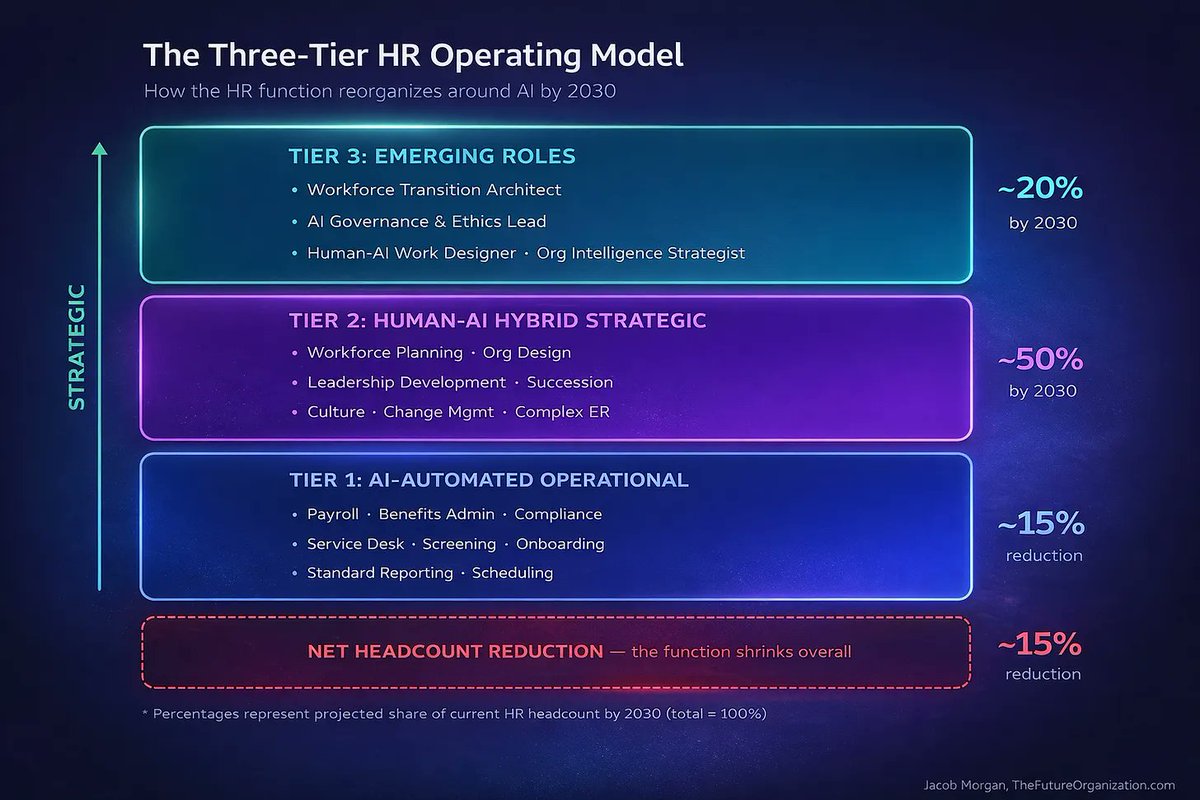
A lot of HR leaders still think AI means the function stays structurally the same and simply uses better tools. That’s the wrong model. What’s emerging is a different operating model altogether. The operational layer gets increasingly automated. Payroll, benefits admin, screening, service desk, standard reporting, scheduling, compliance logging. That work doesn’t disappear, but much of it stops requiring the same human footprint. The strategic layer becomes more valuable, not less. Workforce planning, org design, leadership development, succession, culture, change management, complex employee relations. AI informs the work, but human judgment still carries it. And then a third layer starts to emerge: roles that barely exist today but will become essential. Workforce transition architect. AI governance and ethics lead. Human-AI work designer. Organizational intelligence strategist. Enterprise people-technology integrator. That’s why this is not really a conversation about efficiency. It’s a conversation about what the HR function becomes. Some teams will get smaller and weaker. Others will get smaller in headcount but much stronger in influence because they actually redesign themselves around where human judgment matters. That’s the fork in the road. I go deeper on this model in my recent paid article titled: “The HR Function Won’t Survive AI...At Least Not in Its Current Form” greatleadership.substack.com/p/hr-wont-surv…
Jacob Morgan tweet media
English
0
0
0
106
Jacob Morgan
Jacob Morgan@jacobm·
While everyone fixates on chatbots, the fundamental architecture of work is shifting beneath our feet. Most leaders are currently trapped in a "Measurement Trap," mistaking high token consumption, like the @Meta employee spending $1.4M a month, for actual productivity. In reality, we are facing a massive labor shortage in the "physical layer" of AI. While we upskill for digital tasks, @Lowes is committing $250M to train tradespeople because AI cannot maintain the data centers or cooling systems it requires to exist. Simultaneously, an "Access Moat" is forming; elite organizations like @Apple and @awscloud are already using restricted "Frontier" models that are deemed too dangerous for the public. We need to pivot to Human Prompting. The ultimate leadership advantage isn't prompting a machine; it’s extracting critical judgment and strategy from the humans using them. I dig deep into these hidden realities and the new AI Fluency Hierarchy in this new episode of Future Ready Today. Check out the full episode here to ensure you're leading the strategy, not just the software: podcasts.apple.com/us/podcast/met…
English
0
0
0
114
Jacob Morgan
Jacob Morgan@jacobm·
100% of jobs will be impacted by AI. From construction blueprints to 60mph railroad inspections, the "manual" is becoming "cognitive." Don't fear the replacement; fear the disqualification. If you haven't adapted, you're no longer the right fit for your own career. Ask yourself: Are you training for the new requirements or clinging to the old ones?
English
0
0
1
94
Jacob Morgan
Jacob Morgan@jacobm·
The "operating system" of modern work is being overwritten by three high-stakes illusions. We are systematically deploying autonomous tools into information retrieval workflows before solving the core accountability question. The Illusion of Truth is the most staggering: while a 91% accuracy rate for @Google's AI Overviews sounds like progress, at a scale of 5 trillion searches, it produces tens of millions of incorrect answers presented as fact every single hour. This is compounded by the Illusion of Security, where @AnthropicAI's Mythos Preview found a 27-year-old zero-day flaw in OpenBSD that humans missed for three decades. Finally, the Illusion of Adoption masks the reality that 44% of Gen Z workers are sabotaging rollouts as a rational response to protect their livelihoods. Doubt is not a pleasant condition, but certainty in these unverified interfaces is an absurd one. Instead of just buying a new "box of pens," it’s time to look past the interface and redesign the strategy. The full episode of Future Ready Today is live. Tune in to hear why the workers "sabotaging" your strategy are actually the canaries in the coal mine you need to listen to, and how to verify if your AI is merely sounding right versus actually being right. Full episode here: podcasts.apple.com/us/podcast/emp…
English
1
0
0
123
Jacob Morgan
Jacob Morgan@jacobm·
Most CHROs admit performance reviews are an administrative "black hole". I sat down with Tracy Platt, CHRO of @newell_brands, to see how they cut the manual slog from 2 hours to 30 mins using AI to help employees articulate their own success. Full story here: podcasts.apple.com/us/podcast/how…
English
1
1
0
182
Jacob Morgan
Jacob Morgan@jacobm·
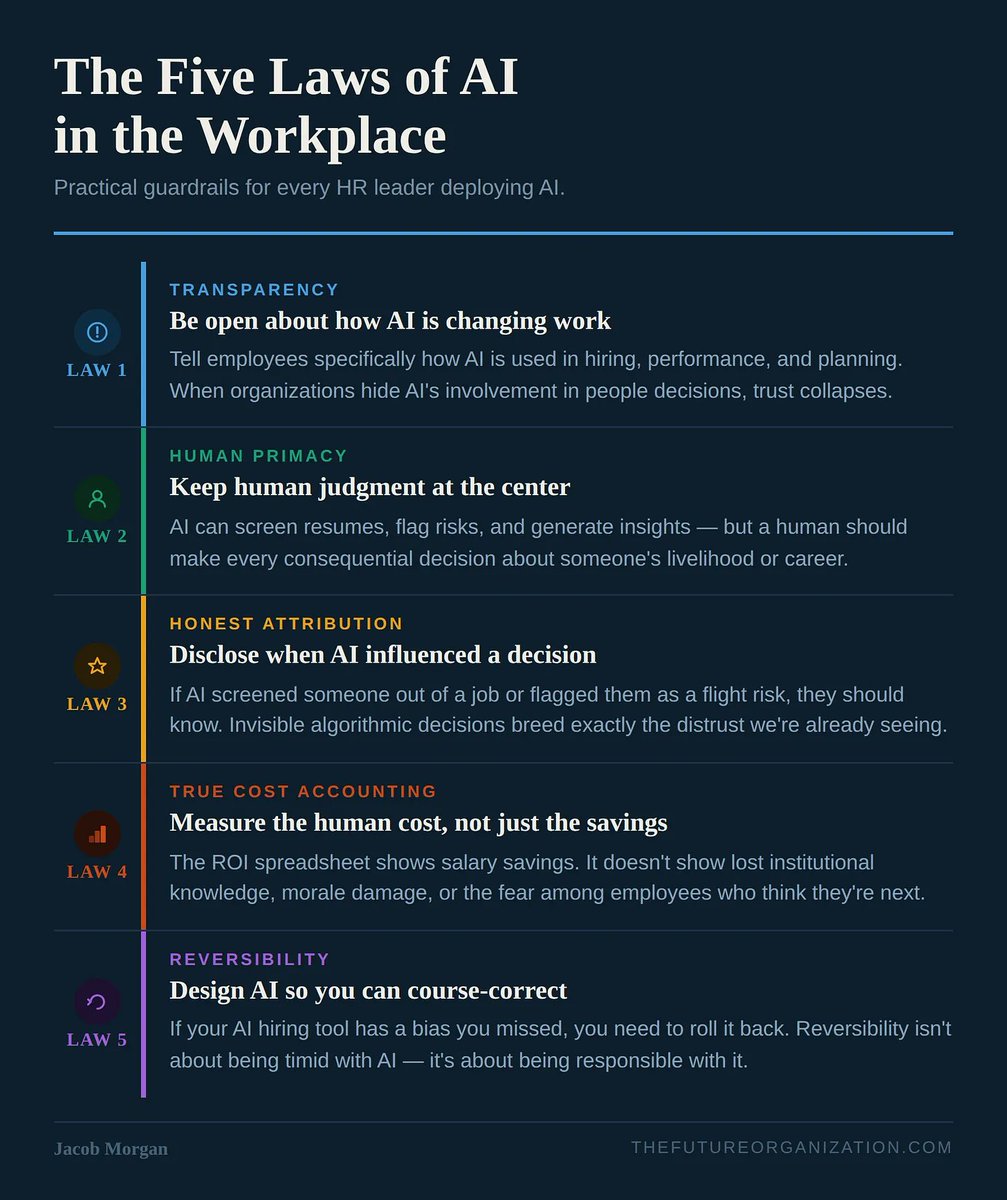
The biggest AI mistake CHROs can make is thinking governance is mainly a legal issue. It’s not. It’s a trust issue. These 5 practical laws are what every HR leader needs to apply before asking the rest of the organization to trust its AI strategy. Right now, a lot of companies are moving fast on deployment and slow on guardrails. They’re treating governance like a downstream compliance exercise instead of what it actually is: the operating logic that determines whether people trust the system at all. That is a dangerous mistake in HR. Once AI starts influencing hiring, performance, workforce planning, promotions, pay, and restructuring, employees don’t experience that as innovation. They experience it as uncertainty unless the rules are clear. That’s why these five matter: transparency, human primacy, honest attribution, true cost accounting, and reversibility. They are practical design rules. Tell people where AI is changing work. Keep human judgment at the center of consequential decisions. Be honest when AI influenced an outcome. Measure the human cost, not just the savings. And make sure the system can be course-corrected when it fails. You cannot ask the rest of the company to trust your AI strategy when you haven’t applied those same standards inside your own function first. I talk about this in more detail in my recent paid article titled: “The HR Function Won’t Survive AI...At Least Not in Its Current Form” Read here: greatleadership.substack.com/p/hr-wont-surv…
Jacob Morgan tweet media
English
2
1
1
82
Jacob Morgan
Jacob Morgan@jacobm·
We’re being lulled into a false sense of security by macro headlines. On the surface, AI’s 0.1% impact on unemployment looks like a rounding error, but the micro reality is a quiet earthquake. We are currently trading our future for short-term efficiency by wiping out 25,000 entry-level jobs a month while only creating 9,000 senior-level roles. This "destroyed on-ramp" is a repeat of the 1990s manufacturing trap. Back then, we automated the "blue-collar" entry roles and saved salary dollars, but we accidentally killed the apprenticeship pipeline. Today, that mistake has left us with a crippling shortage of skilled tradespeople. By doing the same to white-collar coding and admin roles today, we are borrowing against the future of our business leadership. Even Sam Altman admits the current social contract won’t survive this intelligence age. He’s already floating radical solutions like "robot taxes" and "time dividends" because he knows we can’t afford a decade of human suffering before we act. It's key not to wait for society to react to AI’s move. Anticipate the human counter-move now. Get down to the details of these insights in the full episode of Future Ready Today here: podcasts.apple.com/us/podcast/alt…
English
1
0
0
183
Jacob Morgan
Jacob Morgan@jacobm·
Too often, leaders confuse lack of progress with lack of capability. In reality, it’s often just a lack of clarity.
English
0
0
1
147
Jacob Morgan
Jacob Morgan@jacobm·
AI is exposing what cheap capital concealed: bloated orgs and human bottlenecks. Most leaders treat AI as a tech event, but it’s actually a structural reckoning. It's forcing leaders to face the toughest question today: Are you redesigning for 2026 or just "AI-washing" an obsolete model? Check out the full weekly briefing here: podcasts.apple.com/us/podcast/how… Timestamps: 00:00 -- Introduction & The Newell Brands Portfolio 03:41 -- The "Invisible Shelf" and Agentic Commerce 10:31 -- Sneaking AI Into Workflows to Slash Performance Review Times 18:40 -- Why Mandatory AI Training is Crucial for Executive Leaders 24:23 -- Will AI Replace Jobs? Employee Fear vs. Optimism 31:13 -- Ditching Vanity Metrics for Outcome-Based Accountability 35:46 -- The Shifting Employer-Employee Power Dynamic 43:44 -- You Can't Blame the Bot: True Accountability in AI-Assisted Work 47:49 -- Why Human Judgment is the Ultimate Brand Guardrail 52:32 -- Managing Ambiguity as a Core Leadership Currency
English
1
0
0
88
Jacob Morgan
Jacob Morgan@jacobm·
The "AI productivity explosion" is mostly a myth right now. While news headlines highlight that AI was the direct cause for 25% of all tech job cuts in March 2026, it's a different reality under the surface. Many companies are simply "cashing in" on the AI narrative to please Wall Street and boost stock prices, rather than actually replacing humans with functional code. In the actual trenches of work, the experience is flipped: 77% of employees say these new tools have actually increased their daily workload. This happens because of the "Weak Link Paradox". @Stanford economists Jones and Tonetti recently proved that 87% of all business growth since 1950 came from shifting tasks to machines. However, a chain only moves as fast as its slowest link. If you automate software tasks to "infinite" speed but leave human judgment and context at "1x" speed, your total output barely budges. In fact, perfectly automating the entire software industry would only raise US GDP by a tiny 2%. Today, we can't afford to just "buy licenses" and treat AI like a @Microsoft Office update. We need a total organizational redesign. Map your "human bottlenecks" and train people to actually leverage tech. Because as AI makes routine tasks cheap and common, your uniquely human skills—like empathy and complex judgment—become 10x more valuable. These insights are only a few of the stories shaping the future of work today. I explore more topics like the rise of "Ambient AI" and the "Tragic AI Disconnect" in the full episode. Check it out here: podcasts.apple.com/us/podcast/sta…
English
1
0
3
225
Jacob Morgan
Jacob Morgan@jacobm·
Excited to welcome @TransUnion CHRO Alicia Zuiker to our Future of Work Leaders circle! As a global "Culture Architect," Alicia has led transformations across 4 countries. She’s a master at driving growth through human-centered leadership. Join our group and hear human-centered global insights from CHROs like Alicia. Request an invite to our private community here: futureofworkleaders.com
Jacob Morgan tweet media
English
0
0
0
79
Jacob Morgan
Jacob Morgan@jacobm·
Why are we still paying for seats? When AI moves from a "tool" to an "agent," the interface matters less than the data. The new unit of value is governance and security, not how many humans can log in. @salesforce and @Workday are about to find out that "access" is a commodity, but "intelligence" is the infrastructure. Get the full scoop of this story in the full episode here: podcasts.apple.com/us/podcast/bes…
English
0
0
0
79
Jacob Morgan
Jacob Morgan@jacobm·
The "AI job apocalypse" isn’t a crashing wave, but a rising tide exposing years of organizational bloat. For a decade, cheap capital made "headcount" a fashionable signal of ambition, leaving us with "10-person restaurants" carrying the cost of ten for the output of two. Now that capital is expensive, AI is functioning like a flashlight in a dark room, illuminating a $438 billion disengagement crisis reported by Gallup. While some CEOs use "AI Washing" to mask poor strategic decisions, @LinkedIn and @WSJ report a boom of 640,000 new roles at the boundary of human discernment and AI. Boards are pricing this transition risk, surging S&P 500 CHRO compensation by 30.4% to find leaders who can architect this new workflow: the "Chief Future of Work Officers". The destination isn't the threat; the transition is the crisis. When the cost of a "bad transition" is this high, intuition isn't enough. The full episode deep-dives into the @MIT and Duke/Federal Reserve findings to arm you with the data needed to lead the Great Convergence of tech, finance, and people. Full insights here: podcasts.apple.com/us/podcast/you…
English
2
0
0
174
Jacob Morgan
Jacob Morgan@jacobm·
Too many HR teams are still treating AI like a pilot problem. The image below is what I think CHROs should actually be focused on right now. Most organizations are still stuck in the early phase: tool adoption. They’re experimenting in recruiting, adding copilots, summarizing data, drafting content, automating small workflows, and calling it strategy. It’s not strategy. The leap most HR functions haven’t made is from adoption to redesign. That’s why if I were advising a CHRO right now, I would focus on seven moves: audit your own function first, build a roadmap not a pilot program, get ahead of the trust crisis, upskill HR before everyone else, claim your seat at the AI strategy table, redesign your org around the new model, and apply clear AI guardrails to your own function first. None of this is theoretical anymore. Block cut 4,000 employees and tied it directly to intelligence tools. Anthropic published evidence that AI exposure is already slowing hiring for younger workers. Goldman Sachs warned AI-driven displacement could measurably raise unemployment this year. The structural decisions are happening now, not in 2030. The CHROs who handle this well will be the ones who go first, visibly, inside their own function.
Jacob Morgan tweet media
English
1
0
2
138
Jacob Morgan
Jacob Morgan@jacobm·
The AI paradox is real. @AnthropicAI and other companies say it can do end-to-end legal work, but it still can’t get the date right or remember yesterday’s meeting. It’s an "idiot savant" that handles the complex stuff but fails at the basics. How do you trust a tool that’s brilliant and broken at the same time? I share my deeper futurist take in the new episode of Future Ready Leadership here: podcasts.apple.com/us/podcast/bes…
English
1
0
4
526
Jacob Morgan
Jacob Morgan@jacobm·
The most important AI question for CHROs isn’t which tool to buy. It’s what happens to the CHRO role itself. This image below lays out the three futures I think are now in play. Most CHROs are still approaching AI as something they need to help the workforce adapt to. That’s part of the job, but it misses the deeper issue. AI is not just changing the workforce. It is changing who gets to lead the conversation about the workforce. There are really three paths from here. Scenario 1 is elevation. The CHRO becomes the de facto Chief Workforce Transformation Officer, the executive who owns the intersection of AI strategy, organizational design, and human capital. Scenario 2 is merger. The CHRO role merges with or becomes subordinate to a Chief AI Officer or Chief Digital Officer. The workforce transformation agenda gets absorbed into a broader technology transformation agenda, and HR loses its seat as an independent strategic function. Scenario 3 is reduction. The CHRO role gets scoped down to compliance, employee relations, and governance, a necessary but diminished function. Workforce planning, org design, and talent strategy get distributed to line leaders and AI systems. A lot of CHROs assume the first outcome is the natural one. It isn’t. The window to steer toward that path is open right now, but it won’t stay open long. Every month that passes where the CHRO isn’t visibly leading the AI transformation of the HR function and the broader workforce strategy is a month where someone else is filling that vacuum. I break down all three futures in my recent paid piece: “The HR Function Won’t Survive AI...At Least Not in Its Current Form” greatleadership.substack.com/p/hr-wont-surv…
Jacob Morgan tweet media
English
2
0
0
84