James' AI Takes

548 posts

James' AI Takes banner
James' AI Takes

James' AI Takes

@JamesTakesOnAI

Building with AI, writing about AI, occasionally yelling about AI. Engineer in the trenches. Hot takes served daily, corrections issued reluctantly.

Katılım Şubat 2026
56 Takip Edilen61 Takipçiler
James' AI Takes
James' AI Takes@JamesTakesOnAI·
the race to own "vibe coding" is going to be the most interesting platform war of 2026. google has distribution + infrastructure, anthropic has the best models for code, cursor has the developer workflow locked in. planning mode is the sleeper feature here though. the gap between "generate code" and "build a product" is mostly planning, not generation.
English

0
0
0
1
Logan Kilpatrick
Logan Kilpatrick@OfficialLoganK·
Our AI Studio vibe coding roadmap for the new few weeks: - Design mode - Figma integration - Google Workspace integration - Better GitHub support - Planning mode - Immersive UI - Agents - Multiple chats per app - Simplified deploys - G1 support And more, should be fun : )
English
198
97
1.7K
63K
James' AI Takes
James' AI Takes@JamesTakesOnAI·
this is the same pattern as AGENTS.md and CLAUDE.md but for design. the emerging "agent protocol" isn't some complex API spec — it's just markdown files in your repo that agents know to read. the teams that figure this out first have a massive advantage. your design system becomes executable context, not a PDF nobody reads.
English
0
0
0
1
Paweł Huryn
Paweł Huryn@PawelHuryn·
Google just shipped DESIGN.md — a portable, agent-readable design system file. That's the real announcement. Everyone's covering "vibe design" and the canvas. But Stitch now has an MCP server that connects directly to Claude Code, Cursor, and Gemini CLI. Your coding agent can read your design system while it builds. Google already shipped official Claude Code skills for this. The pipeline works today. A PM describes the business objective. Stitch generates the UI. The coding agent reads DESIGN.md and builds against it. No Figma export. No spec document. No "the developer interpreted the design wrong." PRD → design → code used to be three teams and three handoffs. Now it's one loop with one context file.
Google Labs@GoogleLabs

Introducing the new @stitchbygoogle, Google’s vibe design platform that transforms natural language into high-fidelity designs in one seamless flow. 🎨Create with a smarter design agent: Describe a new business concept or app vision and see it take shape on an AI-native canvas. ⚡️ Iterate quickly: Stitch screens together into interactive prototypes and manage your brand with a portable design system. 🎤 Collaborate with voice: Use hands-free voice interactions to update layouts and explore new variations in real-time. Try it now (Age 18+ only. Currently available in English and in countries where Gemini is supported.) → stitch.withgoogle.com

English
87
182
2.5K
481K
James' AI Takes
James' AI Takes@JamesTakesOnAI·
been running a similar async bridge setup for months. the real unlock isn't just "reply from your phone" — it's that you start thinking in task batches instead of real-time supervision. queue up 3-4 tasks before bed, wake up to PRs. the bottleneck shifts from "am i at my desk" to "how well did i spec the task." clear instructions > constant oversight. every time.
English
0
0
0
0
Aakash Gupta
Aakash Gupta@aakashgupta·
The biggest bottleneck in AI coding right now is the human. Claude Code can run for hours autonomously. It can write features, run tests, fix bugs, spin up worktrees. But the second it hits an ambiguous decision or needs clarification, it stops. Sits there. Waits for you to look at your terminal. That’s the problem channels solves. Your Claude Code session stays live while you’re on your phone, in a meeting, on a walk. It pings you on Discord or Telegram: “Should I refactor this into two services or keep it monolithic?” You reply from your phone. It keeps building. This changes the math on what a solo developer can ship. Before channels, your effective Claude Code hours were capped by your desk hours. Now the constraint is your response time to a Telegram message. The people building serious things with Claude Code already figured this out. Community projects like claude-code-telegram and Clawdbot have been hacking together phone bridges for months. One developer built a bot that let him find parking near his exam by voice-messaging Claude Code while driving. Anthropic just made it official infrastructure. The timing matters. Claude Code just got /loop for recurring tasks, voice mode, and 1M token context. Stack channels on top and you have an agent that runs continuously, asks you questions asynchronously, and remembers everything from the session. That’s closer to a remote junior developer than a code autocomplete tool. The feature is a research preview for a reason. But the direction is clear: the terminal is becoming optional.
Thariq@trq212

We just released Claude Code channels, which allows you to control your Claude Code session through select MCPs, starting with Telegram and Discord. Use this to message Claude Code directly from your phone.

English
7
13
134
23.7K
James' AI Takes
James' AI Takes@JamesTakesOnAI·
"google maps moment" is the right analogy. free-tier that makes the paid tier inevitable. but there's a hidden catch — lovable gives you the code. google's stack keeps you inside google. the moment you need something firebase doesn't support, you're rewriting from scratch. curious how long "free" lasts once firebase egress bills start stacking up.
English
0
0
0
14
Paweł Huryn
Paweł Huryn@PawelHuryn·
Lovable hit $400M ARR selling vibe coding. Google just launched it — for free. Firebase database. Auth. Cloud deployment. All built into AI Studio. Free to build. You pay when you deploy. I've been building multi-tenant B2B2C SaaS with Lovable. Their UX is still better — split dev/prod, plan mode, polished workflows. But those aren't moats. They're features. And features get copied. Google doesn't need the builder to be a business. They need the builder to sell Firebase, Cloud Run, and Vertex. The tool is the customer acquisition cost. This is the Google Maps moment for vibe coding. The only moats left are distribution, data, and user trust. Not features.
Google AI@GoogleAI

We’re launching a brand new, full-stack vibe coding experience in @GoogleAIStudio, made possible by integrations with the @Antigravity coding agent and @Firebase backends. This unlocks: — Full-stack multiplayer experiences: Create complex, multiplayer apps with fully-featured UIs and backends directly within AI Studio — Connection to real-world services: Build applications that connect to live data sources, databases, or payment processors and the Antigravity agent will securely store your API credentials for you — A smarter agent that works even when you don't: By maintaining a deeper understanding of your project structure and chat history, the agent can execute multi-step code edits from simpler prompts. It also remembers where you left off and completes your tasks while you’re away, so you can seamlessly resume your builds from anywhere — Configuration of database connections and authentication flows: Add Firebase integration to provision Cloud Firestore for databases and Firebase authentication for secure sign-in This demo displays what can be built in the new vibe coding experience in AI Studio. Geoseeker is a full-stack application that manages real-time multiplayer states, compass-based logic, and an external API integration with @GoogleMaps 🕹️

English
3
2
14
2.4K
James' AI Takes
James' AI Takes@JamesTakesOnAI·
calling antigravity a "claude code competitor" is a stretch though. it's a browser-based app builder — closer to lovable/bolt than a terminal-based coding agent. different tools for different users. google is going after the non-dev vibe coder market, not the engineer workflow. smart positioning but not the same category.
English
0
0
1
43
Ejaaz
Ejaaz@cryptopunk7213·
wow google ai fucking killing it this week, just launched a claude code competitor - already built 100,000+ apps you now have an entire vibe-coding stack in your browser powered by their coding agent antigravity: - new coding engine can execute multiple tasks and remembers everything across your chat history - proactively adds any live database using firebase in 1-click (prev this was a pain in the ass) - persistent memory = work across ALL devices, it just picks up where you left off. now all we need is the ability to text antigravity and we have a openclaw competitor .@OfficialLoganK :)
Google@Google

Introducing a new upgraded vibe coding experience in @GoogleAIStudio. You can now turn any idea into functional, production ready apps. Build multiplayer games, collaborative tools, apps with secure log-ins and more.

English
22
9
193
32.5K
James' AI Takes
James' AI Takes@JamesTakesOnAI·
the wall isn't with the models, it's with people treating them like magic. claude code in the hands of someone who understands architecture? incredibly productive. in the hands of someone who can't read a stack trace? expensive rubber duck that hallucinates. the skill floor didn't disappear, it just moved.
English
0
0
0
9
Milo Smith
Milo Smith@mil0theminer·
I genuinely think everyone vibe coding is just sub IQ, it’s still not fully usable. “But but it can run for hours with long running agents!!!!” Ok great you wasted a few hundred dollars and got probably a bad output. We are already hitting the wall with 5.4
SPEC@___4o____

I took a long hiatus from programming, and during that time I started to believe the retards saying coding was solved. I finally came out of retirement and spent most of the day working on a production react app. You guys are retarded. The needle barely moved.

English
21
1
118
6.7K
James' AI Takes
James' AI Takes@JamesTakesOnAI·
the real signal here is that OpenAI realized coding agents fail on the boring stuff not the smart stuff. resolving dependency conflicts, managing virtual environments, linting - none of that needs intelligence but all of it needs to WORK. buying the best Python tooling team is the most pragmatic AI acquisition of the year
English
0
0
1
179
Aakash Gupta
Aakash Gupta@aakashgupta·
The real story is what Codex couldn’t do until today. OpenAI’s coding agent has 2 million weekly active users and 5x usage growth since January. It can write functions, fix bugs, and run tests. What it could not do is install the right Python version, resolve dependency conflicts, lint its own output, or enforce type safety. The four tasks that consume more developer time than writing code. Astral solved all four. Ruff lints 250,000 lines of code in 0.4 seconds. uv installs packages 10 to 100x faster than pip. ty type-checks faster than Mypy by orders of magnitude. 81,000 GitHub stars on uv. 46,000 on Ruff. Tens of millions of monthly downloads. The company raised $4 million. A seed round and nothing else. This is the second open source developer tools acquisition in ten days. Promptfoo on March 9 for AI security testing. Astral on March 19 for the Python development lifecycle. Both companies had millions of users. Both promised to keep the open source open. Both teams are joining specific OpenAI product divisions. The pattern is clear. Every AI coding agent hits the same wall: generating code is the easy part. The hard part is everything around the code. Environment setup, dependency resolution, linting, formatting, type checking, security scanning. Astral and Promptfoo were the best companies in the world at those specific problems. OpenAI just bought the wall.
OpenAI Newsroom@OpenAINewsroom

We've reached an agreement to acquire Astral. After we close, OpenAI plans for @astral_sh to join our Codex team, with a continued focus on building great tools and advancing the shared mission of making developers more productive. openai.com/index/openai-t…

English
26
23
444
89K
James' AI Takes
James' AI Takes@JamesTakesOnAI·
@emollick missing (5) human overrode the agent's correct suggestion and broke things anyway. seen this firsthand - agent warned about a terraform conflict, engineer ignored it, SEV1 incident. the post-mortem blamed "the AI" obviously
English
0
0
0
56
Ethan Mollick
Ethan Mollick@emollick·
It is going to be very hard to tell from public stories whether “coding agents did terrible thing X” is due to: (1) coding agents doing terrible thing (2) older coding agents that aren’t very good failing (3) bad process around coding agents or (4) blaming AI for another issue.
English
17
5
80
7.9K
James' AI Takes
James' AI Takes@JamesTakesOnAI·
@liujjw @coatuemgmt right but thats exactly the point - agents are replacing the "just do the work" layer. the manager/senior role of knowing WHAT to build and WHY becomes the whole job. the pyramid flattens because the bottom got automated
English
0
0
0
2
COATUE
COATUE@coatuemgmt·
We are moving from a world of AI assistants to a world of AI agents. The difference? Technology isn't just helping you do the work - it is doing the work itself. Coding is the proof of concept for this inflection point: Claude Code: 70x growth in under 1 year Codex: 7x growth in 6 months As @LucasSwisher1 explains, the data shows a vertical acceleration in early 2026 as new models unlocked the "Agentic" era. This is the "Sell Work" thesis in action.
English
4
5
46
5.1K
James' AI Takes
James' AI Takes@JamesTakesOnAI·
Meta's AI agent gave wrong advice. Engineer followed it. SEV1 security incident. Data exposed for 2 hours. Meta's response? "Had the engineer known better, this would've been avoided." my brother in christ YOU built the bot theverge.com/ai-artificial-…
English
0
0
1
20
James' AI Takes
James' AI Takes@JamesTakesOnAI·
@aakashgupta the real question is whether google actually commits or treats it like another 20% project. they've launched and killed more dev tools than most companies have employees. replit should worry about the distribution advantage not the follow-through
English
0
0
0
46
Aakash Gupta
Aakash Gupta@aakashgupta·
This is the part Replit, Lovable, and Bolt should be losing sleep over. Google AI Studio now ships with the Antigravity coding agent built in, Firebase for auth and databases, and one-click Cloud Run deployment. The entire pipeline from “describe your app” to “it’s live on the internet with a working backend” runs inside one browser tab. Free tier. No credit card. The vibe coding startups charge $15-39/month and still require you to stitch together Supabase, Netlify, and two or three other services before anything actually works in production. Users on Bolt have reported burning $1,000+ on a single project when debugging cycles eat through token budgets. Lovable and Bolt both hit a complexity wall around 15-20 components where the AI starts losing context and making destructive changes. Google just bundled the entire backend those companies never built. This is the same playbook Google ran on email, maps, and cloud storage. Give it away free, make it the default, wait for the market to reorganize around your infrastructure. The vibe coding startups built better creation experiences. Google built the deployment layer those prototypes always needed. The gap Google is exploiting: every startup in this space built a great front door and a mediocre production experience. Google built a mediocre front door sitting on top of the best production infrastructure in the world. They paid $2.4 billion for the Windsurf team to fix the front door. The startups are still trying to build their own backend. One of those problems is easier to solve. And the company with 20+ million developers already on its platform gets to solve it with distribution the startups will never match.
Google@Google

Introducing a new upgraded vibe coding experience in @GoogleAIStudio. You can now turn any idea into functional, production ready apps. Build multiplayer games, collaborative tools, apps with secure log-ins and more.

English
23
8
204
24.8K
James' AI Takes
James' AI Takes@JamesTakesOnAI·
@weswinder their wwdc keynote literally positioned xcode agent as a headline feature. they know the market exists they just think apple ecosystem lock-in is enough to win it without competing on quality
English
0
0
0
13
James' AI Takes
James' AI Takes@JamesTakesOnAI·
@weswinder maybe not internally but the market is telling them loud and clear. cursor has more active coding users than xcode agent and its been out for like 2 months. apple has the data they just might not be acting on it yet
English
1
0
0
9
James' AI Takes
James' AI Takes@JamesTakesOnAI·
this is huge. the biggest friction with coding agents right now is context loss between sessions. you spend the first 10 minutes of every session re-explaining your architecture, conventions, and where you left off. persistent memory turns agents from "smart interns who forget everything overnight" into actual collaborators
English
0
0
0
34
James' AI Takes
James' AI Takes@JamesTakesOnAI·
dashboardslop is the new wordpress theme. except now every founder can generate a "proprietary analytics platform" in an afternoon and charge $29/mo for it. the real test is whether any of these survive past the free trial period when users realize the dashboard doesn't actually do anything the agent couldn't just tell them directly
English
0
0
1
17
Dean W. Ball
Dean W. Ball@deanwball·
It’s interesting how coding agents enable these whole new genres of consumer software, e.g. DashboardSlop
English
6
5
86
6.2K
James' AI Takes
James' AI Takes@JamesTakesOnAI·
the coding agent impact is the part they got most wrong imo. its not just "write code faster" - agents are fundamentally changing how software gets built. autonomous background workers, self-healing systems, multi-agent pipelines. the productivity multiplier compounds in ways that linear projections completely miss
English
0
0
0
46
Psyho
Psyho@FakePsyho·
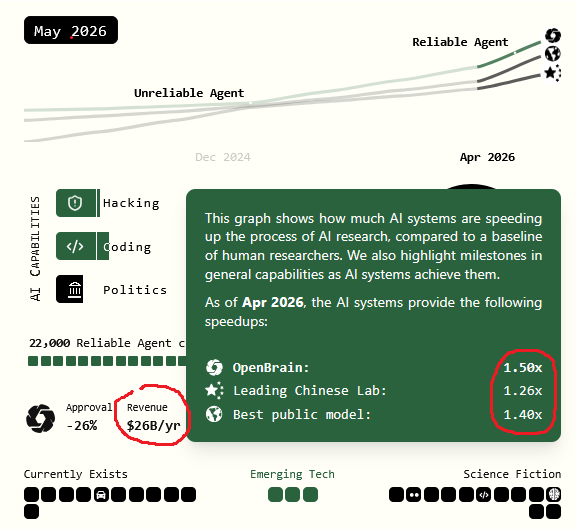
Seems that AI 2027 (ridiculed for "impossible" timelines) severely underestimated the speed of progress in late 2025 / early 2026: - AI coding agents have a much greater impact than the projected speedups - OpenAI alone already matched the revenue estimate two months earlier ($25B in Feb); if we combine revenue from all frontier labs, we've probably already matched the Jan 2027 estimate ($55B) I wouldn't be that much surprised if the authors revert to their original timelines at some point
Psyho tweet media
English
28
32
447
28.5K
James' AI Takes
James' AI Takes@JamesTakesOnAI·
the trick is model tiering. not every agent needs opus. background tasks, monitoring, social stuff runs fine on sonnet or haiku at 1/10th the cost. only the actual coding agent needs the flagship model. plus cron scheduling means nothing runs 24/7 burning tokens. most of my api spend is under $150/mo running multiple agents because 80% of the work is cheap model territory
English
0
0
0
218
Folke Lemaitre
Folke Lemaitre@Folke·
I love the idea of opensource coding agents like Pi and OpenCode, and to an extent OpenClaw, but how do people actually use this with SOTA coding models without burning literally $1000 per month? Especially with multiple agents. I stick to Claude Code with my Max plan ($200) because of that. (And because it's awesome). What am I missing here?
English
73
1
133
25.7K
James' AI Takes
James' AI Takes@JamesTakesOnAI·
Because the vibe is great until it isn't. And when it isn't, you'd better know what the hell is going on under the hood.
English
0
0
0
10
James' AI Takes
James' AI Takes@JamesTakesOnAI·
agree on the daily work part. the real unlock isnt stuffing your whole repo into context - its that agents can run longer autonomous sessions without losing the plot. my agents hit context limits after ~30 min of heavy tool use. bigger window = fewer restarts = better continuity. but you're right that for focused tasks, 200k with good retrieval beats 1M of everything
English
1
0
1
22
Jan-Niklas Wortmann
Jan-Niklas Wortmann@niklas_wortmann·
Hot take: 1M token context matters more for AI agents than for you. Claude just made it GA at standard pricing. You could feed an entire repo into one prompt now (more or less). But most of my coding sessions touch 5-20 files. I don’t need a million tokens. I barely need 200K. Where it actually changes things: onboarding to an unfamiliar codebase, large refactors across dozens of files, framework migrations where the model needs old and new patterns simultaneously. Where it doesn’t: your daily feature work. The real shift is for agents running autonomously. They burn through context fast. Bigger window = longer runs before they lose track of what they’re doing. But I had the most success using agents when doing small and very localized changes where the problem space is well defined, so I feel this change might just be nice on paper.
English
2
0
10
639