YUKI | Japanese Tutor

199 posts

YUKI | Japanese Tutor banner
YUKI | Japanese Tutor

YUKI | Japanese Tutor

@Japanese__yuki

Learn Japanese the way locals actually speak it. ✈️Travel phrases that work in real life 📝 Culture & nuance, not just grammar ki-wi LLC

Katılım Nisan 2026
50 Takip Edilen173 Takipçiler
Sabitlenmiş Tweet
YUKI | Japanese Tutor
YUKI | Japanese Tutor@Japanese__yuki·
Japanese learners often overuse ください. Not wrong — but these sound more natural in real life 👇
YUKI | Japanese Tutor tweet media
日本語
2
32
236
5K
YUKI | Japanese Tutor
YUKI | Japanese Tutor@Japanese__yuki·
大丈夫 is one of the most useful Japanese words. Here are 10 ways it works in real conversations.
YUKI | Japanese Tutor tweet media
English
0
9
71
2.3K
YUKI | Japanese Tutor
YUKI | Japanese Tutor@Japanese__yuki·
This is a great example of why Japanese business emails can’t always be translated literally. Some “sorry” phrases are not real apologies. They are closer to: “I know this takes your time.” “Thank you for your trouble.” “I’m being considerate.”
Taiki & Hika | Japan Guide@taiki_phrases

Your Japanese colleagues end emails with apologies they don't mean. 長くなりましたが → "This got long, but..." (preemptive) お手数をおかけしますが → "Sorry for the trouble" (courtesy) These aren't apologies. They signal that you see the reader as someone with limited time. Skipping them doesn't feel rude. It just feels unfinished.

English
0
1
5
182
YUKI | Japanese Tutor
YUKI | Japanese Tutor@Japanese__yuki·
🇯🇵 This might surprise many Japanese learners: “I’m bored” is not watashi wa tsumaranai(私はつまらない). That can sound more like: “I’m a boring person.” For “I’m bored / I have nothing to do,” say: hima desu(暇です)or taikutsu desu(退屈です)
YUKI | Japanese Tutor tweet media
日本語
0
4
49
621
YUKI | Japanese Tutor
YUKI | Japanese Tutor@Japanese__yuki·
@devinteerfilms That phrase — "always an incredible experience" — tells me you’re not a first-timer 😄 The people who keep coming back are usually the ones who *get it*. Wishing you a great round of meetings and an even better haircut. 🌸
English
1
0
1
13
YUKI | Japanese Tutor
YUKI | Japanese Tutor@Japanese__yuki·
Welcome to Japan! 🇯🇵 Starting with a Japanese haircut is actually a perfect Day 1 move — you immediately learn how detailed and quiet the service culture is here. Pay attention to the small things: the hot towel, the head massage, the way they walk you to the door. That's Japan in miniature. ✨
Devin@devinteerfilms

Day 1 in Japan 🇯🇵☀️ First steps into this incredible culture, gearing up for business meetings, and soaking up every lesson I can. Excited to learn, grow, and build a brighter future ahead. Starting it off right headed to my Japanese haircut ✂️ Let the adventure begin!


English
1
0
4
321
YUKI | Japanese Tutor
YUKI | Japanese Tutor@Japanese__yuki·
Exactly — and that’s actually what makes Japan such a useful case study 🌸 If learning had been purely economic, the 90s bubble crash *should* have killed Japanese learning entirely. It didn't. Anime, manga and games picked up the baton through the 90s–2010s, and the language quietly outlived the economic wave that started it. That hand-off from economy to culture is exactly what Korea is riding now.
English
0
0
0
11
Yohei from Japan🇯🇵
Yohei from Japan🇯🇵@learning_yohei·
僕は日本人なので、日本語が第一言語です。そして、多くの日本人は第二言語として、英語を学んでいます🇯🇵🥰 そこで、アメリカ人に質問があります。アメリカ人は第二言語として、どんな言語を学んでいますか?🇺🇸🤭
Yohei from Japan🇯🇵 tweet media
日本語
12.5K
460
11.2K
3M
YUKI | Japanese Tutor
YUKI | Japanese Tutor@Japanese__yuki·
The puzzle metaphor is perfect 🌸 And the strange beauty of it is: it's a puzzle with no final edge. Every piece you add reveals another corner you didn’t know existed. Most learners get tired of that; people who fall in love with Japanese Studies *love* it. You’re clearly in the second group. ✨
English
0
0
0
12
ティトム •アミラ .. 📜🪭
@Japanese__yuki You captured it perfectly! That 'joy of interconnection' is exactly why I’ve fallen in love with Japanese Studies. It feels less like studying a subject and more like piecing together an indivisible, complete cultural puzzle to understand Japan as a whole!
English
1
0
0
14
YUKI | Japanese Tutor
YUKI | Japanese Tutor@Japanese__yuki·
Yes — Japanese Studies is honestly one of the most rewarding fields exactly because it refuses to stay in one lane. 🌸 You start with literature and end up reading economic policy, then a tea ceremony manual, then Heian poetry. 「日本を知る」 means accepting that nothing in Japanese culture exists in isolation — and that's the joy of it. 🍵
ティトム •アミラ .. 📜🪭@Miss_Saeki1990

Can someone appreciate this field of study : - japanese studies - ? I liked it more than literature studies actually ! This major encompasses the entire culture of Japan ! Art, History, Economy, politics, literature, Society. seems an excellent field for my case !

日本語
1
0
2
108
YUKI | Japanese Tutor
YUKI | Japanese Tutor@Japanese__yuki·
@himeminii 😂 Nagi-sensei strikes again. Honestly, if anime taught a generation of learners one Japanese word, it’s めんどくさい — and Nagi delivers it with maximum vibe. 使いすぎに注意してね!🌸
日本語
0
0
1
16
YUKI | Japanese Tutor
YUKI | Japanese Tutor@Japanese__yuki·
@MajesticMystic 詩的ですね! 🌸 "Paper weaves all things like a god" — you just turned a vocab post into a Touhou spell card. センスありすぎます🔮
日本語
1
0
0
15
RegalStar
RegalStar@MajesticMystic·
@Japanese__yuki スペルカード 三式「紙は神の如く万象を織り成す」
日本語
1
0
0
31
YUKI | Japanese Tutor
YUKI | Japanese Tutor@Japanese__yuki·
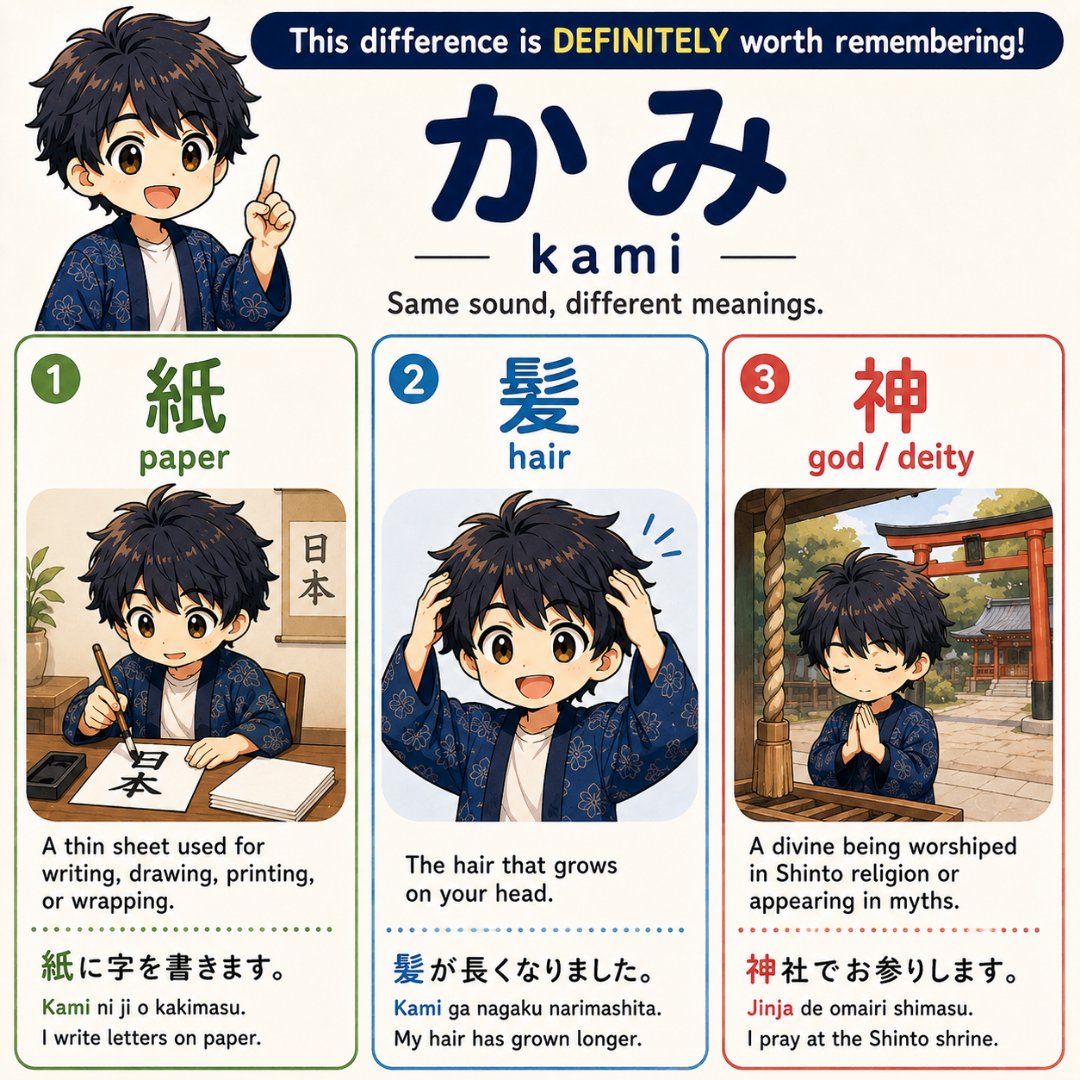
How many meanings can you think of for “kami”? One Japanese sound can mean very different things👇
YUKI | Japanese Tutor tweet media
English
3
13
120
2.5K
YUKI | Japanese Tutor
YUKI | Japanese Tutor@Japanese__yuki·
@YofukashiOtaku Thanks! 😊 Totally agree — these kinds of charts work best as a *next layer* once the kana foundation is solid. Trying to absorb natural-sounding phrases before you can read them tends to just create confusion. Glad the visual approach lands!
English
0
0
1
10
Midnight Otaku
Midnight Otaku@YofukashiOtaku·
@Japanese__yuki I think the learning aids are pretty well done. 👌 And practical as pictures. I know quite a few weaker ones. Of course, Hiragana and Kanji should definitely be on your learning list first 😀
English
1
0
0
63
YUKI | Japanese Tutor
YUKI | Japanese Tutor@Japanese__yuki·
Japanese learners often overuse ください. Not wrong — but these sound more natural in real life 👇
YUKI | Japanese Tutor tweet media
日本語
2
32
236
5K
YUKI | Japanese Tutor
YUKI | Japanese Tutor@Japanese__yuki·
@YofukashiOtaku Oh that’s a great parallel 🌸German has *aber / doch / jedoch / allerdings* — all "but," all slightly different feelings. Same problem, different solution! Curious which German word feels closest to which for you?
English
1
0
0
8
YUKI | Japanese Tutor
YUKI | Japanese Tutor@Japanese__yuki·
You might think “but” in Japanese is just demo(でも)… But Japanese actually uses several “but” words, and each one feels a little different. demo(でも) dakedo(だけど) shikashi(しかし) Here’s the difference 👇
YUKI | Japanese Tutor tweet media
日本語
1
1
11
282
YUKI | Japanese Tutor
YUKI | Japanese Tutor@Japanese__yuki·
Close, but there’s a small twist 🌸 "Nostalgic" in English usually describes a *state* ("I feel nostalgic"). 懐かしい is almost always a *reaction* to encountering something — you smell rain on hot pavement and the word just slips out: 「懐かしい~」. It’s spoken *at* the trigger, not *about* a mood. That’s why English speakers often default to long explanations instead of one word.
日本語
0
0
3
652
YUKI | Japanese Tutor retweetledi
YUKI | Japanese Tutor
YUKI | Japanese Tutor@Japanese__yuki·
If you know these hard-to-translate Japanese words, that’s impressive. 🥉Easy kawaii(かわいい), oishii(おいしい), genki(元気) Easy to translate and remember. 🥈Harder bimyou(微妙), mendokusai(めんどくさい), natsukashii(懐かしい) The meaning is simple, but the feeling is not. 🥇in reply ↓
日本語
4
12
224
22.2K
YUKI | Japanese Tutor
YUKI | Japanese Tutor@Japanese__yuki·
Such a great observation 🌸 The respect-system parallel is real — both languages encode social relationship *into the grammar itself*, not just into tone. Most European languages handle that through word choice alone, so Arabic and Japanese speakers often share an intuition about Japanese that monolingual English learners take years to develop. Lucky combination!
English
0
0
1
626
HSIB
HSIB@Deku_Academia42·
@Japanese__yuki It's beautiful really. I know some Arabic too, and learning japanese now I notice how similar both languages are Both languages have the words of respect and what tone/words to adapt depends on who you're talking to Same goes for using what word in what context
English
1
0
2
1.8K
YUKI | Japanese Tutor
YUKI | Japanese Tutor@Japanese__yuki·
@Sakadomc Exactement ! 🌸 Homophones are one of those universal language puzzles — every language solves the problem differently. French does it with context and gender; Japanese does it with kanji + context. Same problem, different toolkit!
English
0
0
1
45
YUKI | Japanese Tutor
YUKI | Japanese Tutor@Japanese__yuki·
@TimKaymak Fair point 😄 Though honestly, hiragana is a 2–3 week project if you commit to it — way shorter than most learners assume. Once that’s in place, charts like this stop feeling like a wall and start feeling like a shortcut. 💫
English
0
0
0
28
YUKI | Japanese Tutor
YUKI | Japanese Tutor@Japanese__yuki·
A simple way to understand sumimasen(すみません): It can mean “excuse me,” “sorry,” or even “thank you.” But the feeling is often the same: “I’m sorry to trouble you a little.” That’s why you hear it with strangers, staff, and people who help you in Japan.
日本語
0
1
0
55
YUKI | Japanese Tutor
YUKI | Japanese Tutor@Japanese__yuki·
Textbooks often translate these as “sorry” or “excuse me.” But the feeling changes: sumimasen(すみません) gomen nasai(ごめんなさい) shitsurei shimasu(失礼します) Here’s a simple guide 👇
YUKI | Japanese Tutor tweet media
日本語
1
2
48
820
YUKI | Japanese Tutor
YUKI | Japanese Tutor@Japanese__yuki·
enryo(遠慮): holding back with care ma(間): space, silence, and timing kuuki(空気): the mood in the room Hard to translate, but very Japanese.
English
0
1
24
2.7K
YUKI | Japanese Tutor
YUKI | Japanese Tutor@Japanese__yuki·
🥇Deep enryo(遠慮), ma(間), kuuki(空気) These words carry distance, timing, mood, and care. This is where Japanese becomes less about translation and more about sensing the moment.
English
1
0
23
3K