Jeremy Gurewitz

1.3K posts

Jeremy Gurewitz banner
Jeremy Gurewitz

Jeremy Gurewitz

@JeremyGurewitz

cofounder/ceo https://t.co/XVLomjak0z

CPT Katılım Aralık 2018
1.3K Takip Edilen1.7K Takipçiler
Sabitlenmiş Tweet
Jeremy Gurewitz
Jeremy Gurewitz@JeremyGurewitz·
Incredibly excited to announce that Solace has raised a $14M Series A, led by @inspiredcap, with participation from our existing investors @craftventures and @torchcapital. We connect people to healthcare advocates. Solace is deeply personal to me. Read on to hear the story...
English
12
7
93
12.8K
Julian Shapiro
Julian Shapiro@Julian·
i live on ranch, and it cost me less than buying an apartment in california. the downside is isolation from city life. if that doesn't bother you, quality of life shoots up. you'll become obsessed with animals 😂 i have 2 mini cows, mini horses, poodles. must stop, but... learning to train them is too fun. i've included a video of my mini cow giving "hello friend" head nods to my new mini horse i'm also building a soundshed on the property with two hifi audio systems to incept my friends to fall in love with the hobby. over time, you also become interested in being off grid. think solar, starlink, rain catchment, cattle + chickens, herb + fruit + veggie garden. life slows down and you start to value building these skills—to self-sustain. going outside between Zoom calls and just looking at the trees and hearing wind rustle through them is so calming. this is how i grow up. shouldn't have done a full 15 years in the city in between. i've built a bunch of guest cabins, and friends can come stay for a couple weeks at a time. i put guitars + pianos + hifi in their cabins so they can feel creative next up is a giant golf cart racing course that traverses through the property
Julian Shapiro tweet mediaJulian Shapiro tweet media
English
74
13
705
56.1K
Jeremy Gurewitz
Jeremy Gurewitz@JeremyGurewitz·
Important to remember in the ai era what talking your book means
English
3
0
4
175
Michael Guimarin
Michael Guimarin@MichaelGuimarin·
As the US transitions from governance by the second estate to the third, China doubles down on first estate governance. Not a bad strategy per se, but not effective or sustainable. The meta story on why China lost to the west last time was that they couldn’t compete against second estate states. They then committed suicide and went right back to where they started. It should not be surprising when they lose again the .
Arnaud Bertrand@RnaudBertrand

You've doubtless read the numerous headlines these past few days on how Xi Jinping called for the Yuan to "become a global reserve currency." That's true, he actually said that. But, as is often the case, Western media are missing the forest for the trees. This is extracted from a speech in which Xi laid out a much grander vision of what a “modern financial system with Chinese characteristics” (中国特色现代金融体系) would look like, essentially China's answer to Wall Street. Fascinatingly, and in stark contrast to the actual Wall Street, Xi's main argument is that what matter most aren't the institutions or status that China is seeking to build up - such as having the Yuan as a global reserve currency. Those are secondary. Xi argues that what truly will make or break the system is its moral culture. As he describes it, the Western financial system is nihilistic, counterproductive and ultimately politically destabilizing. Nihilistic in the sense that finance without moral purpose becomes self-referential - it stops serving anything beyond itself. He calls it "脱实向虚" ("drifting from the real economy into the virtual"): when finance detaches from the real economy, it loses its reason for existing. It’s not creating wealth, it’s just moving numbers around. Counterproductive in the sense that it actually destroys the thing it depends on. As Xi explains "if [finance] becomes obsessed with self-circulation and self-expansion, it becomes water without a source, a tree without roots" (无源之水、无本之木). In other words, finance detached from the real economy - like a tree that has severed its own roots - ultimately kills the economy. Lastly, politically destabilizing in the sense that financial elites captured by greed become ungovernable - they corrupt regulators, buy politicians, evade accountability. The Qiushi commentary on Xi's speech is extremely blunt about this (qstheory.cn/20260131/f4889…): they say Xi seeks to "avoid the Western predicament of financial oligarchs hijacking public policy and deepening social division." “Financial oligarchs hijacking public policy” (“金融寡头绑架公共政策”) is remarkably blunt language. It's essentially saying that the West allowed oligarchs to capture the state (not wrong!). To avoid all of this, Xi lays out a vision for - in many ways - an anti-Wall Street: a 金融强国 ("financial powerhouse") that puts serving the real economy at its core. A system that - Xi argues - will ultimately make the Yuan a global reserve currency precisely because, ultimately, a global reserve currency is backed by trust. That's the forest: how you build trust is what matters. In my latest article I break down the full speech, how exactly Xi proposes to build this anti-Wall Street and what it reveals about a question we in the West have stopped asking: what is our financial system actually for? Full article here: open.substack.com/pub/arnaudbert…

English
1
1
7
2.5K
Jeremy Gurewitz
Jeremy Gurewitz@JeremyGurewitz·
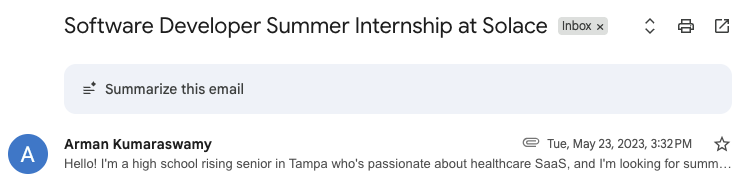
@ksw_arman You were a little different, and it was a bit of a different time for us :)
English
0
0
1
126
arman
arman@ksw_arman·
@JeremyGurewitz Calling me out 2.5 years later after I emailed you my resume! haha
arman tweet media
English
1
0
3
523
Jeremy Gurewitz
Jeremy Gurewitz@JeremyGurewitz·
If you're a new college grad, I'm begging you, just follow the instructions in the application. Don't try and connect with me on LinkedIn. Don't email me your resume. If you follow the instructions on the application, odds are high you'll get an interview.
English
1
0
5
1K
Jeremy Gurewitz
Jeremy Gurewitz@JeremyGurewitz·
@shiftj Founders really don't want to internalize 6. PMF is a combination of hitting the market with a differentiated product and staying that way, both from competition and the nature of your later cohorts being more demanding that your earlier ones. Invest heavily or die.
English
1
0
6
283
JC
JC@shiftj·
Things that surprise first-time founders: 1. You’re scared shitless but have to stand up and convey confidence 2. You’re often expected to know the answer but you’ve got no clue 3. Every problem eventually becomes your problem. 4. You only get the hardest, unsolvable problems. 5. You have to fire people you like, even if you won’t want to. 6. PMF is not forever. Once found you must fight to keep it. 7. The feeling that your company will fail doesn’t ever go away, not fully at least. 8. You fail so often you grow numb to it 9. Your failures have direct impact on people’s lives as well as their families. 10. You change roles so often you’re constantly inexperienced. What did I miss?
English
22
11
180
11K
🍓🍓🍓
🍓🍓🍓@iruletheworldmo·
i never want to read any other way again.
English
1K
6.1K
62.3K
3.3M
JC
JC@shiftj·
As a YC founder I've now watched 2 close friends build multi-billion dollar companies. Here's a few things that surprised me: 1/ it can be anyone There's nothing special about these guys. They're smart, committed, and work hard. But they're not geniuses. They just figured it out as they went. There's often a perception that unicorn founders are special cases or natural geniuses. In reality, they struck on something and held on for dear life as it started to get it's own legs. 2/ growth creates spend, not the other way around When you compare a unicorn to a slower growing company you realize something interesting. A slower growing company is spending to increase growth while a fast growing company is spending to support it. Meaning that unicorn companies often have more demand than they can deal with. Their product clicked and demand spiked - they're spending to keep up, holding on for dear life. The mistake founders make is thinking that headcount and spend is creating that growth. It's not. It's supporting the demand that already exists. 3/ momentum is everything The most fascinating thing watching these two work is how they utilized momentum. Every day, every week, every month, every quarter, every year. They'd take the momentum of the last and use it to fuel the next. Whether that's press, investors, feature builds, or anything in between. It felt like every move they made compounded into next one. They got initial momentum and continued to fuel it until they hit the finish line. 4/ build your own path Frankly - when I first saw their products - I thought they were stupid. In fact, they were stupid and looked nothing like the current versions. It doesn't matter what someone like me thinks. Build your own path, make your own product, and find your way - just like they did.
English
71
124
1.6K
111.6K
Jeremy Gurewitz
Jeremy Gurewitz@JeremyGurewitz·
If you use an auto apply service, it's trivially easy to tell because the application is terrible and we will reject you. If you're looking for a job, just apply directly.
English
2
0
1
311
Jeremy Gurewitz
Jeremy Gurewitz@JeremyGurewitz·
@jasonlk Dude you've been captured by your ai slop bot. This writing is ridiculous to read.
English
0
0
0
32
Chris Brown
Chris Brown@almostcmb·
For the first time in a very long time, we (@InspiredCap) are hiring an investor. We are a small partnership based in NYC focused on leading Seed & Series A and have raised ~$1b since founding in 2018. This person will work across the partnership and have the chance to interact with every part of the investment process. Beyond the obvious, here is some of what we are looking for: > Ridiculous levels of curiosity. You read everything. You use everything. Your desire to figure out how things work (and why) can never be satiated. > You believe that alpha exists at the intersection of disciplines and strive to connect the dots. > You are finance-literate but a technologist at heart. > You possess a quiet competence that enables you to proceed with limited direction. (You probably opted for a "create your own major" in undergrad if that was available). > You have a track record of making non-obvious life choices. > You love building networks and view the work associated with doing so as enjoyable versus a necessary evil. > You subscribe to a "work-life integration" world view If this feels like you (or someone you know), please get in touch.
English
20
10
208
49K
Michael Guimarin
Michael Guimarin@MichaelGuimarin·
This resonated with me and my experience at Princeton from 2006-2010. BAP is right, the cleansing had already happened by the time we were there. I've never told this story before. I took a class with probably the most right-wing professor we had. It was a class for 12 people and informally you might call this "The Path" class. Everyone who took this class...well, they did just fine. Anyway, as an affectation I got certified as a bartender in New Jersey ( I thought it would be fun, and coming from the West Coast, didn't understand the class implications of doing a service job as a freshman as a non-financial aid student). I tended bar for a few events around campus, but then my professor invited me to bartend for a private event. off campus. It was for a bunch of English professors who had all gone to Princeton in the late 1950s. These guys were in their 70s/80s. As I was there, i could tell that this group of professors, all long since retired, were much different from the culture on campus. they were Academics. And because I was "classically" educated and had the subtle academic style of the inheritor class, I was able to strike up a conversation with them. When I should have tended bar turned into a 4 hour socratic lecture, from them to me, to finish out my education as an "educated man". I've spent hours, days, reflecting on that lecture and what it meant to me. What it meant to being a "Man of the West" and why we don't teach what was taught. Like an echo of memory for a long-forgotten civilization Sometimes I think i'm maybe the last person to have had this learning as those men have long since died and no one on campus then or since even cares about what they had to say. It haunts me because I don't feel like I'm special and I know had they been allowed to pass on the teachings they had that entire classrooms of men like me would have gotten the same. And we could have had an inside "coming of age" nod to each other in the halls of power we're now forced to inhabit. As it stands no one cares, and what was crumbles. so BAP is right, things were bad long before the 2010s.
Bronze Age Pervert@bronzeagemantis

Wrote my own brief TAKE on the recent Compact DEI "Lost Generation" article, maybe you like, bronzeagepervert.yoga/p/compact-lost…

English
4
0
15
872
Kyle Harrison
Kyle Harrison@kwharrison13·
VCs are so unbelievably stupid. They think founders are pouring life force into building a company from nothing all for the benefit of the VCs personal process and network? Here's the story of a VC using customer references from a founder to then intro to a competitor: - VC expresses interest in a founder's company - Founder meets the VC to share the story - VC asks for introductions to the founder's customers to do "diligence" - Founder obliges - VC spends the whole call asking what the customer thinks of Competitor A; barely spends any time on the company's product - VC continues to email those customers, even sending them customized demos from Competitor A (clearly custom made by Competitor A for that specific customer) - VC is barely responsive to the founder, now clearly just farming the customer references for leads to send to Competitor A As VCs make themselves the main characters, they forget this, but we are a service industry. Without founders, we're out of the job. They are gracing you with their willingness to have a conversation about this entity they're breathing life into. They are NOT your personal GLG sourcing engine. Do your homework on your own time and dime, or get f*cked.
English
54
9
331
31.9K
Jeremy Gurewitz
Jeremy Gurewitz@JeremyGurewitz·
Harvard reducing their PhD programs is like Sequoia cutting their seed fund. Good for some headlines but doesn't really matter to the core mission.
English
0
0
1
328
Jeremy Gurewitz
Jeremy Gurewitz@JeremyGurewitz·
@MichaelGuimarin The only way reforms are successful is when the push in the direction the essence wants to go. Otherwise breakage. Explains a lot of what succeeds and fails and current modern life.
English
1
0
1
64
Michael Guimarin
Michael Guimarin@MichaelGuimarin·
The issue folks frequently run into, to their mortal peril, is they project the ability to separate the essence of something from the ritual of that thing. The reality is, most can’t separate the essence from the ritual. And if that’s the case, if you suggest a different ritual that requires an allegorical understanding of the essence you will literally create an existential crisis in the person you’re suggesting too. And they will try and kill you.
English
2
0
4
503
Jeremy Gurewitz
Jeremy Gurewitz@JeremyGurewitz·
It's all about people. In every direction
English
0
0
3
440
Jeremy Gurewitz
Jeremy Gurewitz@JeremyGurewitz·
Everyone has to learn the hard way.
English
0
0
0
366