Jeremy Vince
220 posts
Jeremy Vince
@JeremyVinceATL
Building AI startup for Proactive Intelligence - https://t.co/enz7FnyseC
Bay Area Katılım Kasım 2013
1.5K Takip Edilen207 Takipçiler

introducing SEND
reach your perfect customers on every channel, with 1 prompt
RIP to clunky dashboards, AI SDRs, and hours of setup :)
Comment "SEND" & ill dm you a free month of the paid plan
English
What takes most creators 2 hours (writing, editing, scheduling a week of tweets) takes Stanley users 10 minutes.
Reply "TIME" and I'll send you access.

English
Most AI pilots die the same way.
Great demo. Excited team. Six-month security review. New CFO. Budget freeze.
The tech worked. The org didn't.
Enterprise AI has a shipping problem, not a science problem.
English
Most enterprise AI pilots succeed.
They hit the metrics. The demo works. The team is excited.
And then nothing happens.
The pilot sits in a sandbox. IT raises security concerns. Legal wants a review. The CFO asks what it actually saved.
No one budgeted for production infrastructure.
No one mapped it to a live workflow.
No one owns the transition from experiment to operation.
So the pilot becomes a case study that lives in a slide deck. Technically successful. Operationally irrelevant.
90% of enterprise AI pilots never reach production. The technology worked. The organization didn't.
The failure is never the model. It is the distance between a proof of concept and a system that runs without someone championing it every week.
English
I hired thousands of people over 10 years.
The best ones never applied.
They showed up when the timing was right, when the mission was clear, and when they believed the vehicle could take them somewhere meaningful.
I see the same pattern with enterprise customers.
Nobody signs because you pitched them. They sign when the pain is undeniable and your solution is the only thing that makes it stop.
Our first enterprise pilot started because a VP of Sales couldn't explain why 40% of his top reps were spending time on accounts that would never close at forecast values.
He didn't need a pitch deck. He needed an answer.
We gave him one in 72 hours.
English
@OnatAksaray We built a system to be on prem and intentionally search and produce data insights.
English

@JeremyVinceATL hidden value requires intentional searching and interpretation
English
I spent 10 years hiring. Thousands of hires.
The biggest lesson? The best people never applied. They were already doing the work. You had to go find them.
AI is the same. The best insights aren't waiting in dashboards. They're buried in your data.
English
@DmitryBBLV We built a system to work securely in your data and autonomously find the signals. No tool to learn and no LLM seeing your data.
English

@JeremyVinceATL That’s a really good analogy. A lot of the highest-signal things in startups are invisible until you actively go looking for them
English


@JeremyVinceATL this is fire
can't imagine what incredible times are awaiting with AI
English
Most "AI transformations" look like this:
→ 6 months scoping
→ $500K in consulting fees
→ A dashboard nobody opens
→ Board asks "where's the ROI?"
We skip all of that.
30 days. On-prem. Autonomous intelligence that pays for itself before the invoice hits.
English
@JeremyVinceATL AI is beginning and future
one of the best things to leverage and get the most out of
English
The AI pricing war just started.
Anthropic went per-token. OpenAI will follow. Google's already there.
Every enterprise AI bill is about to become unpredictable.
Unless you own the infrastructure.
On-prem AI doesn't meter your curiosity. Ask a thousand questions. Same cost.
English
@dohypemyhustle Being on prem how we built NexDiscovery we don’t even need to have any billing.
English

@JeremyVinceATL Most AI use case don’t even need frontier reasoning, I think it will eventually be like cloud
you get inference as a service having your own opus instance billed per hour kinda thing
English
Thanks Joshua.
NexDiscovery proactively delivers data insights to answer questions before you ask - no LLM or GPU so your data stays safe. All while working with messy data.
English
Andrew Wilkinson runs 40+ companies with AI agents.
Most enterprises can't get ONE past security review.
The gap isn't ambition. It's infrastructure.
When AI runs on someone else's cloud, every use case is a new procurement cycle. When it runs on yours, you just turn it on.
English

I managed a team of 40 once. Good people. Experienced. Working hard every day.
About half of them spent most of their time doing work that existed because our systems couldn't talk to each other.
Reconciling data between platforms. Building reports that combined numbers from three sources. Translating what one system called a "customer" into what another called an "account."
That is what large departments actually look like when you pull back the curtain. Half the headcount bridging gaps between broken infrastructure.
A 5 person team with connected systems will outperform that every time. The work those extra people were doing disappears entirely when the data is already reconciled, already visible in one place.
The problem was never talent. It was fragmentation.
English
@HedgieMarkets The flat-rate experiment gave everyone a false baseline. Now that usage-based billing is real, CFOs are looking at the invoice and pulling the plug. Same models, same outputs, fraction of the cost on-prem. The subsidy era ending is the best thing that could happen for on-prem AI.
English

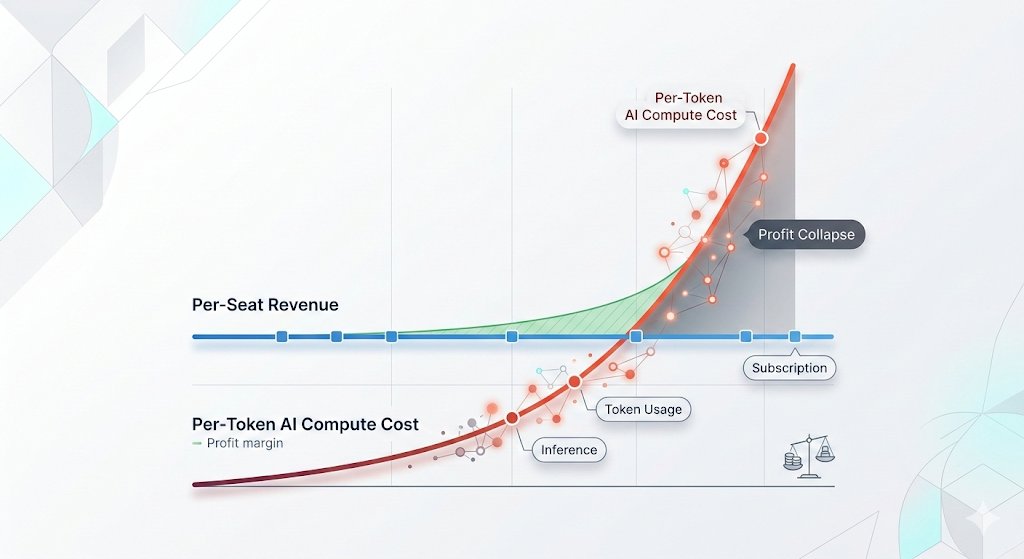
🦔Microsoft canceled its internal Claude Code licenses this week after token-based billing made the cost untenable, even for a company with effectively infinite cloud resources. Uber's CTO sent an internal memo warning the company burned through its entire 2026 AI budget in just four months. American AI software prices have jumped 20% to 37%, and GitHub (owned by Microsoft) is dropping flat-rate plans for usage-based billing across its products.
My Take
The AI subsidy era is ending in real time. The same company that put $13 billion into OpenAI and built the Azure infrastructure powering most of Anthropic's compute just looked at the bill from a competitor's coding tool and decided it was not worth paying. That is not a productivity failure on Anthropic's end. Token-based pricing is forcing every enterprise customer to confront the actual cost of running these models at scale, and the number turns out to be far higher than the flat-rate experiments suggested.
This ties directly to my Gemini Flash post yesterday. Anthropic, OpenAI, and Google all raised effective prices in the last six months. Enterprises that built workflows assuming AI costs would keep falling are now watching annual budgets evaporate in months. Two outcomes look likely from here. Either enterprises scale back AI usage to fit budgets, which slows the revenue ramp the labs need to justify their valuations ahead of IPOs, or the labs cut prices and absorb the losses, which makes the unit economics worse at exactly the wrong moment. Both paths land in the same place, the numbers stop working, and somebody has to take the writedown.
Hedgie🤗
English
A CEO said we "cracked the code."
He didn't care about our tech stack.
He cared that his team spent 3 weeks building a report that was outdated by the time it hit his desk.
We surfaced the same insight autonomously, before he asked.
AI that assists vs. AI that works.
English
@Entrepreneur The flat-rate experiment gave everyone a false baseline. Now that usage-based billing is real, CFOs are looking at the invoice and pulling the plug. Same models, same outputs, fraction of the cost on-prem. The subsidy era ending is the best thing that could happen for on-prem AI.
English

ICYMI: AI costs are surpassing employee salaries, says Nvidia’s Bryan Catanzaro. entrepreneur.com/business-news/…
English
I left a career placing executives into and from Fortune 500s.
Not because I stopped caring about talent. Because I realized the biggest talent gap isn't people. It's intelligence.
Companies are drowning in data and starving for insight. So we built NexDiscovery to fix that.
AI that runs inside your walls. On your terms. No cloud dependency. No vendor lock-in. Secure with no token cost.
The same instinct that helped me spot executive talent now helps me spot what enterprises actually need from AI.
And it's not another dashboard.
English
@sridharfyi Built proactive intelligence and found early traction in banking and nonprofit.
No data sent out of your walls - no tokens - no tool to learn. Revenue / cost consulting reports after correlating messy data.
English