Benjamin Ryan@benryanwriter
"Phone-Free Schools to Protect Adolescents"
Phones have transformed schools. In class, students scroll instead of attending to their studies. In hallways, eyes are locked on screens as everyone shuffles silently to their destinations. In cafeterias, friends engage with virtual content instead of each other.
It is well established that heavy use of smartphones and social media undermines well-being. In particular, adolescent anxiety and depression have spiked since smartphones became ubiquitous, with the heaviest users of social media struggling the most.1 In response, the US Surgeon General issued an advisory about the “profound risk of harm to the mental health and well-being of children and adolescents.”2 Consequently, many schools, districts, and entire states have implemented bell-to-bell policies that ban phones in high schools for the entire day to give adolescents a significant break from these technologies.
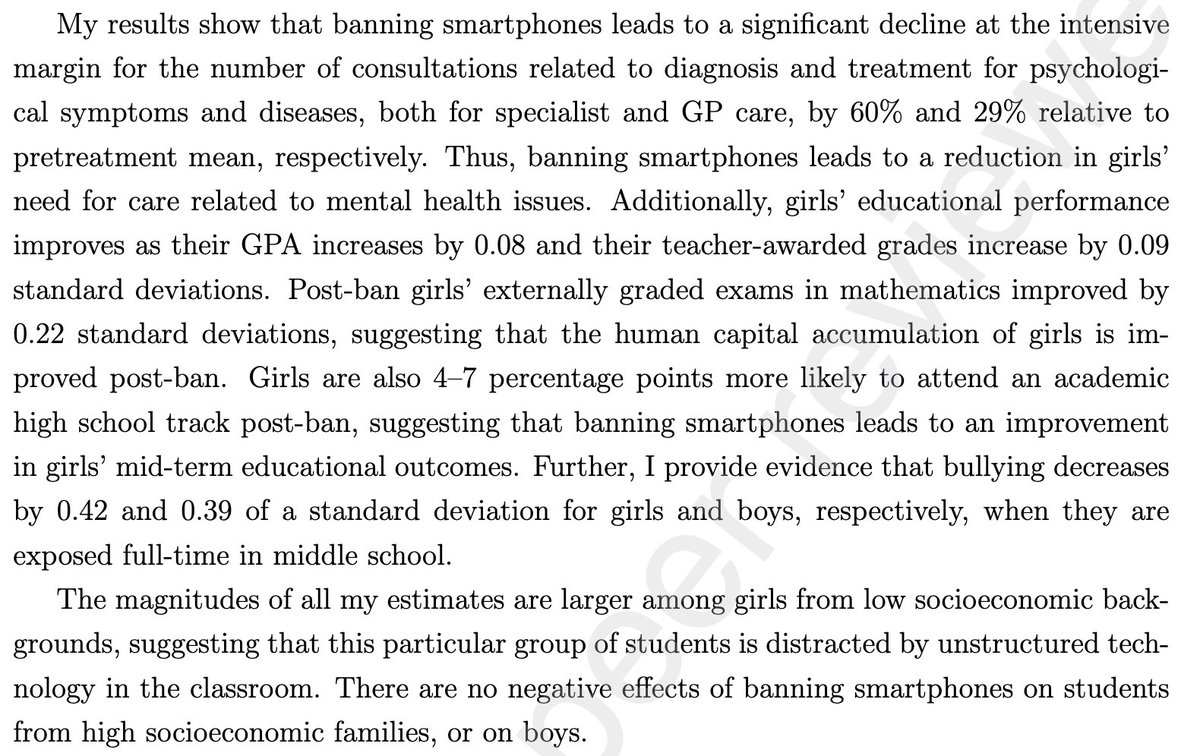
As these policies are new, the research on them is sparse, but so far findings are encouraging. Abrahamsson3 leveraged the varied onset of these policies to create a quasi-experimental study, analyzing 477 schools between 2010 and 2018. From this analysis, Abrahamsson found 3 changes among students from these prohibitions: (1) fewer consultations for psychological symptoms, (2) fewer incidents of bullying, and (3) gains for girls in both their grade point average and externally graded mathematics examinations.
Notably, these outcomes were particularly strong for students from low socioeconomic backgrounds and at schools with the strictest bans, requiring students to hand in or lock away their phones, not just place them on silent mode. Abrahamsson noted that, even on silent mode, phones can still pull at a student’s attention, distracting them as they wonder if someone messaged them or liked one of their social media posts.
A more recent study mirrored these findings: a statewide prohibition in Florida led to significant improvements in test scores and significant reductions in unexcused absences, with the strongest changes in middle and high schools.4 Both studies reflect earlier research focused at the school level, confirming that “student performance in high stakes exams significantly increases post ban”5 and that these improvements are “driven by the lowest-achieving students.”5 In other words, preliminary research points to phone-free schools as a potential way to reduce the achievement gap.
This research aligns with earlier evidence finding that device bans in classrooms are associated with improved academic outcomes.6 In younger grades, researchers have even found that students in schools with smartphone bans exercise more during recess, spending their time playing tag or kickball instead of scrolling or checking their notifications.7
Contradicting these findings, an influential 2025 study by Goodyear et al8compared schools with permissive and restrictive phone policies and declared, “There is no evidence that restrictive school policies are associated with overall phone and social media use or better mental wellbeing in adolescents.”8 But their methodology that fueled this strong claim is questionable. Most notably, 9 of the 10 permissive schools still had policies banning classroom phones, while only 4 of the 20 restrictive schools actually required phones to be put away for the day. Given this distinction without a difference, it is reasonable to trust the growing evidence that confirms phone-free schools are a benefit to students.
The mechanism by which phones impair learning is simple and intuitive. Teenagers receive dozens of notifications during the school day that draw their attention to an endless stream of videos, music, and games. Meanwhile, learning requires attention, and complex problem-solving requires focused, habituated attention. The harder the task is, the more self-control it takes to stay on task. When a phone is buzzing in a backpack or a student is glancing at a phone surreptitiously placed on their lap, it provides a distraction from that cognitive effort, leaving students in a constant state of half-attention.
Even having a phone nearby can distract from learning. In one study, students were randomly assigned to have their phones in their desks, their pocket, or another room.9 Notably, none of these conditions involved the student using their phone. Nonetheless, even having the phone nearby reduced the students’ cognitive capacity.
It all comes down to the limitations of our working memory—the place of conscious thought and the doorway through which new information enters our long-term memory—which can only process a few pieces of information at a time. That means if students are thinking about TikTok, wondering what that notification meant, or waiting for their crush to text them back, they cannot concurrently ponder the math lesson. And if students are not thinking about class content—actively considering it in their working memory—they do not learn it.
Moreover, a phone check costs more attention than the few moments it may take. Task switching places significant cognitive demands on our limited working memory. A quick glance at a push notification may only last seconds, but that sends a student into a spiral of distracted thoughts. To refocus, they have to expend cognitive energy trying to reorient themselves and subsequently catch up to a lesson that has moved on without them.
As the research indicates, there are social consequences to phones in schools, too. With easy distraction ever at hand, children are less likely to engage in conversations with their friends. If they do, constant buzzing and pings interrupt the flow, as each party tunes in and out to glance down at a notification. That means not making eye contact, actively listening to one another, or engaging in genuine conversation.
We all need a mixture of what sociologists call strong- and weak-tie relationships. Strong-tie relationships are exactly what the name implies: close friends, loved ones, and family members. But also important is a network of acquaintances and normal passersby—the gas station attendant with whom we briefly converse or the teacher who greets all students every morning at the door. These weak-tie relationships provide us with a sense of normalcy, safety, and belonging. Phones interrupt both types of relationships in the moment and further compromise their formation as they hinder the development of the very social skills that help us form these relationships.
Unsurprisingly, young people are desperate for breaks. About half of teens wish social media was never invented, and survey after survey finds that teens—like adults—wish they spent less time on their phones.10 But behavior rarely changes, in part because the apps young people use are designed to be addictive, and in part because it is very difficult for young people to separate from the platforms where all their peers are. Phone-free schools give young people the benefits of breaks without the downsides of the fear of missing out and social isolation that can occur if a young person tries to disconnect on their own.
One of us worked as a teacher and administrator in both phone-permissive and phone-free schools. The differences were apparent even before the bell rang. In the permissive school, students milled about a silent classroom, flicking their thumbs; in the restrictive school, students chatted with friends, pulled out decks of cards, practiced drawing, taught each other chess, showed off a new skill, or engaged whatever adolescent fancy drew their interest.
Phone-free schools give teachers back their time, give students back their attention, and have the potential to improve both student relationships and mental health. And phone bans cost next to nothing. That is why in just the past year, a dozen states—both those with a majority of Republican voters and those with a majority of Democrat voters—have passed laws requiring bell-to-bell policies for students of all ages.
So long as students are connected to their phones during the day, they are disconnected from each other, their teachers, their school, their friends, and real life. Bell-to-bell phone-free policies give high school students the ability to really connect in ways that are proven to help young people learn and thrive. We urge the American Academy of Pediatrics to help accelerate the adoption of these promising interventions by issuing a policy statement that encourages schools to adopt all-day cell phone bans.
Corresponding Author: Josh Golin, MA, Fairplay