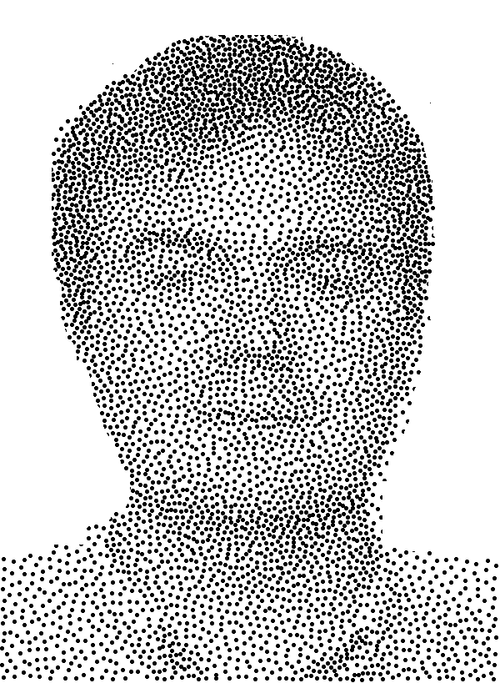
David Hilbert was once asked to say a few words at the funeral of a brilliant young student. He began with a heartfelt tribute, speaking of the student’s talent, promise, and tragically short life.
Then Hilbert added: “He had been working on a very interesting problem: “Let ε > 0, …….” and proceeded to deliver an entire mathematics lecture.
This is how flowers may appear to many insects
Photographer Craig Burrows used ultraviolet photography to reveal flower patterns that humans can't see but many insects including bees and butterflies use to find nectar and pollen
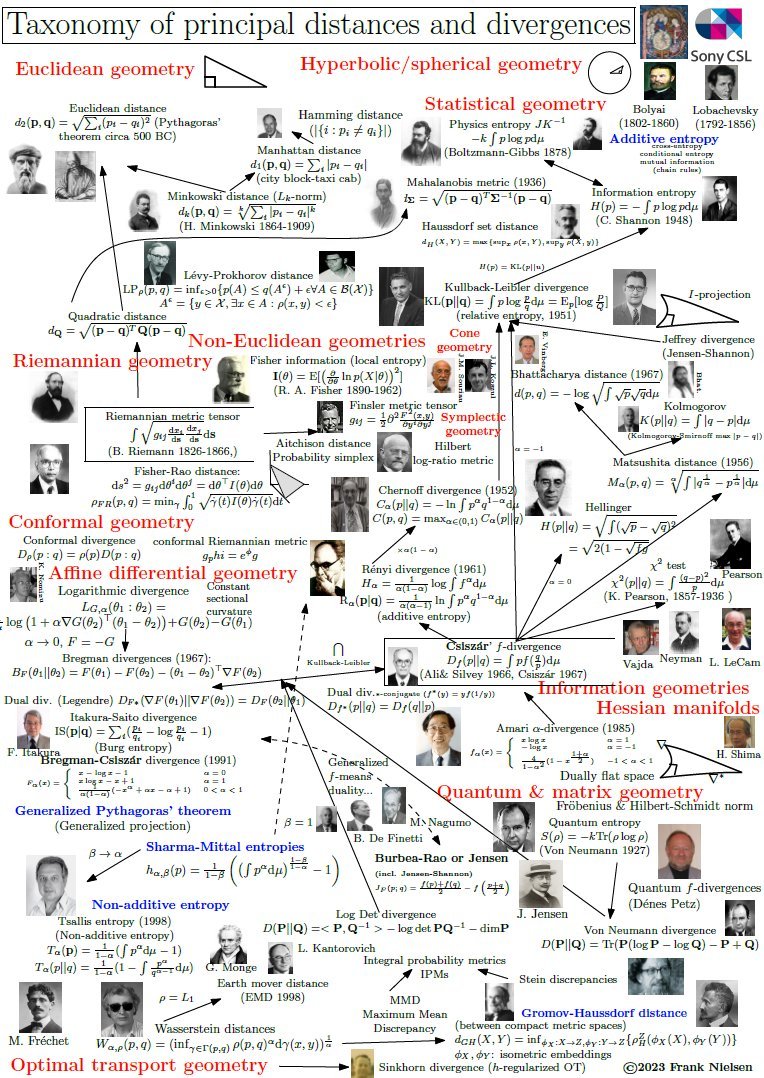
It's pretty remarkable just how much of the sum total of human knowledge and expertise can be condensed into something that fits into a $90 hard drive.
If you lost everything else, this would get you pretty far in terms of covering the basics (and not-so-basics) of most fields.
the alcubierre warp drive is one of those ideas that sounds like science fiction but comes directly from general relativity. the surprising part is that the spacecraft itself never moves faster than light through space. instead, the mathematics proposes moving space itself. compress spacetime in front of the ship, expand it behind, and the bubble carrying the spacecraft effectively travels faster than light while the ship remains locally at rest. in other words, the engine isn’t pushing the spacecraft through the universe. it’s trying to move the universe around the spacecraft.
that’s what makes the idea so fascinating. einstein’s equations don’t explicitly forbid this kind of spacetime geometry. the challenge isn’t the mathematics of the metric. it’s the physics required to create it. current models require enormous amounts of negative energy, or exotic matter, that has never been shown to exist in the quantities needed. over the years, physicists have proposed refinements that dramatically reduce the energy requirements, but a physically realizable warp drive remains entirely theoretical.
what i like most about the alcubierre metric isn’t whether we’ll ever build one. it’s what it teaches about physics. progress often comes from questioning the assumptions hidden inside a problem. for decades the question was, “how do we accelerate a spacecraft to the speed of light?” alcubierre asked a different question: “what if we don’t accelerate the spacecraft at all?” sometimes the biggest breakthroughs don’t come from finding a better answer. they come from asking a fundamentally different question.
In 1935, Albert Einstein and Nathan Rosen described a solution to Einstein's field equations that became known as the Einstein Rosen bridge, or wormhole. In the same year, Einstein, Podolsky, and Rosen published the EPR paper, highlighting the strange nonlocal correlations predicted by quantum mechanics.
In 2013, physicists Juan Maldacena and Leonard Susskind proposed the ER = EPR conjecture. It suggests that every pair of entangled particles may be connected by an extremely tiny, non traversable wormhole. This is not an established fact, but a theoretical idea that could help unite quantum mechanics with general relativity.
There is currently no experimental evidence confirming ER = EPR, but it remains one of the most fascinating ideas in modern theoretical physics. It offers a possible link between the geometry of spacetime and the quantum connections that exist between particles.
BOOM! OPEN SOURCE MRI!
You can now 3D-print the core of an MRI scanner.
A machine that hospitals pay $1.1 million to $3.4 million for has been broken open. The OSI² ONE and its educational siblings deliver real images of heads and limbs for a fraction of the cost, using a permanent-magnet Halbach array, 3D-printed structures, and fully open designs.
This is not a toy or a simulation. Working systems already produce in-vivo images in Leiden, Utrecht, Berlin, and Uganda.
The magnet alone—396 carefully oriented neodymium cubes in a cylindrical Halbach array—costs about $1,370. A complete scanner lands between $28,500 and $68,000 depending on the console and coils you choose.
No superconducting magnets. No liquid helium. No specialized power infrastructure. It runs from a standard wall outlet and weighs roughly 150 kg.
The physics is elegant. A Halbach array arranges permanent magnets so their fields reinforce inside the bore and nearly cancel outside. The result is a usable 50 mT field strong enough for diagnostic-quality imaging of extremities and the head when paired with clever gradient coils, RF coils, and modern reconstruction. Spatial resolution reaches about 1.5 × 1.5 × 5 mm³.
The designs are modular: build the magnet first, verify and shim the field with a 3D-printer-turned-field-scanner, then add gradients and RF hardware.
The plans are public
Everything needed to replicate or improve the system lives in open repositories:
• Primary project hub and documentation: opensourceimaging.org/project/osii-o…
• Full OSI² repositories (hardware, software, magnets): gitlab.com/osii/
• Educational build focused on the Halbach frame, shimming, gradients, and student workshops (Utrecht / Lili’s Proto Lab): github.com/LilisProtoLab/…
• Magnet-specific details: opensourceimaging.org/project/osii-o…
Hardware is released under CERN-OHL-W. Most software is GPL-3.0.
Where AI multiplies the impact
Low-field MRI has historically been limited by lower signal-to-noise and greater field inhomogeneity. That is exactly the regime where modern AI thrives.
Image reconstruction becomes dramatically better when deep networks trained on high-field data or physics-informed models denoise, correct for inhomogeneity, and push resolution beyond the raw acquisition limits. Real-time sequence adaptation can adjust gradients and RF pulses on the fly as the AI monitors signal quality.
Magnet design itself can be optimized by evolutionary algorithms or differentiable physics engines that search for better Halbach geometries or shim placements than human intuition alone can find.
Further out, local AI agents turn these scanners into autonomous diagnostic nodes. A small clinic or even a well-equipped garage workshop could run overnight scans, flag anomalies, and queue results for a remote radiologist—or eventually for a specialized medical model.
Synthetic data generation from the open designs lets researchers train robust models without proprietary hospital datasets. Robotics integration (patient positioning, coil placement, maintenance) becomes straightforward once the hardware is open and standardized.
In the longer arc of the Abundance Interregnum, this is the shape of things: sophisticated medical instruments that no longer require billion-dollar supply chains or national infrastructure.
A distributed network of open, AI-augmented low-field scanners could bring advanced imaging to places that have never had it, while simultaneously giving makers, universities, and small labs the ability to experiment, improve, and specialize the technology.
The plans are already on the table. The magnets are commercial off-the-shelf. The 3D printers exist in thousands of workshops. The AI tools for reconstruction and design optimization improve every month.
What was once the exclusive domain of major hospitals is becoming a community engineering project.
This is how abundance arrives—one open, reproducible, AI-extendable system at a time.