John Short, MBA, MSIS, CPHIMS, ✡️✝️

33.9K posts

John Short, MBA, MSIS, CPHIMS, ✡️✝️ banner
John Short, MBA, MSIS, CPHIMS, ✡️✝️

John Short, MBA, MSIS, CPHIMS, ✡️✝️

@JohnAShort

All views expressed/implied are my own. Biologist. Chemist. Microbiologist. Cyber. Data. AI. Telecom. SW. Solutions expert. Mill Sci & Geopolitics

Earth Katılım Şubat 2009
6.8K Takip Edilen681 Takipçiler
John Short, MBA, MSIS, CPHIMS, ✡️✝️ retweetledi
Joe Tippens
Joe Tippens@JoeTippen·
This is nothing short of a miracle. Dr John Campbell breaks down the study of an 83yr old woman with stage 4 breast cancer that had metastasised to the liver, spine and bones. Usually a death sentence. She took a daily dose of 222mg of FenBen for 8 months. Which normalised her liver enzymes. The tumor marker dropped from 316 to 36. There was an absence of any abnormal metabolic activity indicative of cancer. Please like, share, and follow my page. Information like this need to be heard and seen by everyone.
English

0
1.1K
2.9K
61.2K
John Short, MBA, MSIS, CPHIMS, ✡️✝️ retweetledi
Teortaxes▶️ (DeepSeek 推特🐋铁粉 2023 – ∞)
> In a post-race interview, Honor engineers said the robot used liquid-cooling tech adapted from Honor smartphones, with cooling lines running deep into the motor system to carry heat away. > two high-speed micro pumps, with flow rates reaching up to 6 liters per minute wow
RoboHub🤖@XRoboHub

Ran 21 km (13.1 miles) — and the motor was still cold. That’s the detail that matters. 🤖 Honor was the clear dark horse in this year’s robot half marathon. They swept 1st, 2nd, and 3rd, and also posted a strong top-6 finish overall. What stands out to me is that this was not just about bigger motors, or a gait tuned for long-distance running. They seem to have solved something more important — cooling. In a post-race interview, Honor engineers said the robot used liquid-cooling tech adapted from Honor smartphones, with cooling lines running deep into the motor system to carry heat away. Some reports added more detail: the setup used two high-speed micro pumps, with flow rates reaching up to 6 liters per minute, giving the system enough cooling capacity to handle sustained lower-joint motor load. That matters because once a robot starts overheating, output drops, stability goes with it, and the whole run can fall apart fast. And that’s exactly why this detail is interesting. Of course, that does not mean Honor has already surpassed teams like TienKung or Unitree across humanoid robotics as a whole. What it does suggest is that for the marathon task, they built a very strong system solution. And honestly, that alone is already a useful case for the industry. The bigger trend is moving fast. Last year, TienKung won in around 2 hours 40 minutes. This year, the winning time dropped to 50 minutes 26 seconds. Last year, most robots were still fully remote-controlled or only semi-autonomous. This year, around 40% were running with a much higher level of autonomy. So to me, the real signal is not just that robots got faster. It’s that the field is now moving past raw speed, and into the harder problems: autonomy, stability, and system reliability under load. If the pace of progress stays anywhere close to this, then next year’s race should be even more worth watching.

English
8
12
118
10.4K
John Short, MBA, MSIS, CPHIMS, ✡️✝️ retweetledi
The Aramaic Wire ܣܘܪܝܐ
The oldest prayer from the Apostles that miraculously still exists… Three years after the crucifiction, St Thomas sent Thaddeus to Edessa. Thaddeus not only brought the word, he brought the oldest Anaphora. This was a Eucharistic Prayer *from Jerusalem* which was prayed by the *Apostles themselves*. This prayer was kept alive in the Assyro-Chaldean churches, which are slowly going extinct. A prayer from the time of Christ. Not a few centuries later. Saving ancient Christianity = saving the prayers & treasures of the Apostles.
English
8
121
541
17.7K
John Short, MBA, MSIS, CPHIMS, ✡️✝️ retweetledi
Simplifying AI
Simplifying AI@simplifyinAI·
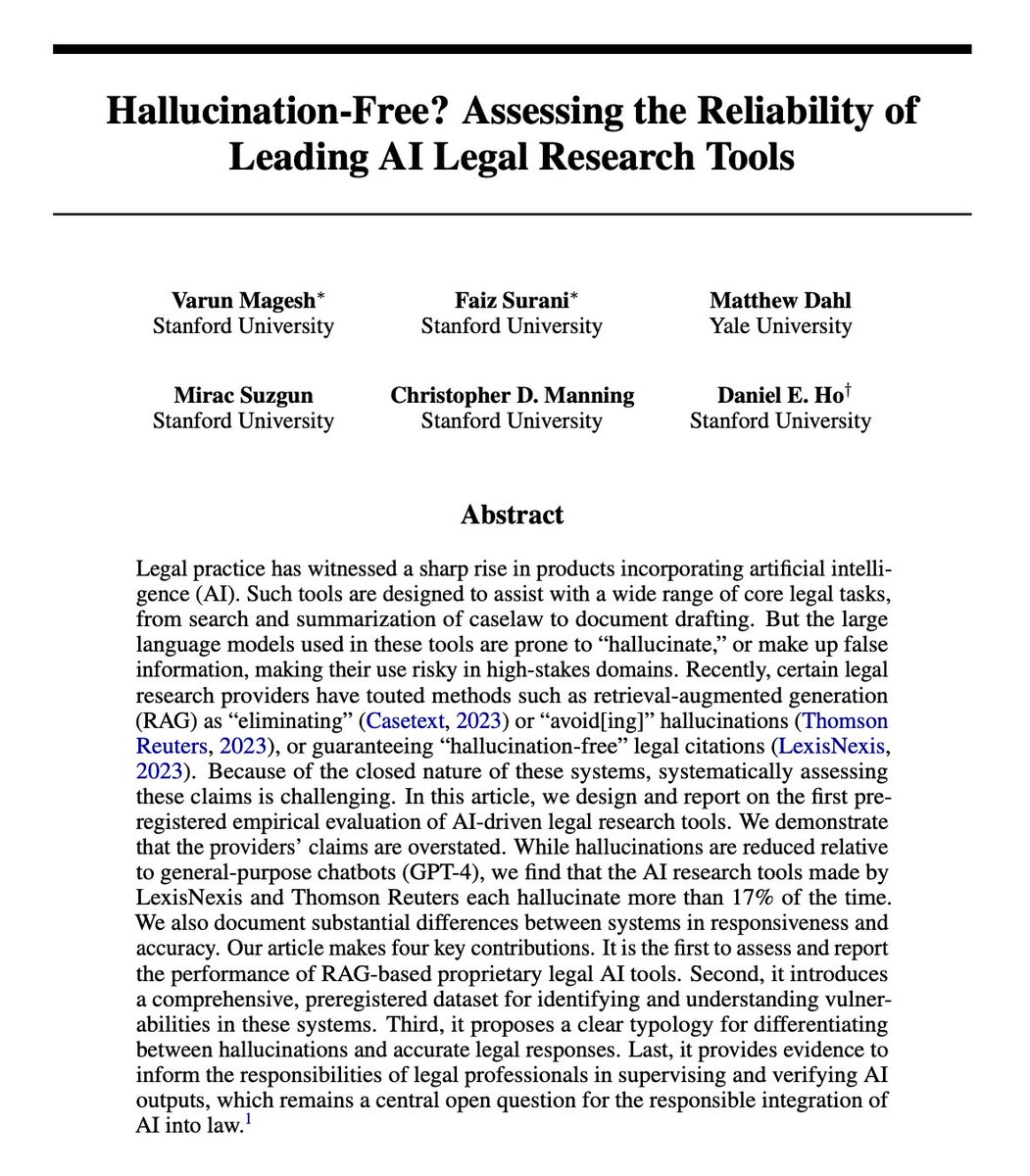
turns out "hallucination-free" AI was a lie the whole time.. stanford and yale just published the first real audit of LexisNexis and Thomson Reuters' legal AI tools.. the ones marketed to every lawyer in america as "100% hallucination-free." the results are brutal: → LexisNexis hallucinates 17% of the time → Thomson Reuters hallucinates 17% AND refuses to answer 62% of the time → one response claimed Justice Ginsburg dissented in Obergefell. she didn't. she joined the majority. → another cited a real case to defend a law the supreme court already overturned → Lexis even cited opinions by "Judge Luther A. Wilgarten", a judge who has never existed RAG doesn't kill hallucinations. it just hides them behind real-looking citations. and lawyers are getting sanctioned for trusting it. 100% peer-reviewed. from stanford law.
Simplifying AI tweet media
English
11
38
117
6.2K
John Short, MBA, MSIS, CPHIMS, ✡️✝️ retweetledi
Military Summary
Military Summary@MilitarySummary·
In #Odessa, #SBU special forces stopped a TCC minibus and detained military recruitment officers. Gunshots were reportedly heard. Details are still unclear, but it appears there was a conflict between the parties. 💰
English
1
12
38
3.7K
John Short, MBA, MSIS, CPHIMS, ✡️✝️ retweetledi
Atal
Atal@ZabihullahAtal·
🚨 BREAKING: A new research shows that AI can now run the entire scientific research process on its own. From idea to published paper, AI can now manage the entire research process independently. The paper, “The AI Scientist,” introduces a system that can generate original research ideas, write the necessary code, run experiments, analyze the results, and produce a full academic paper explaining its findings. It doesn’t stop there. The system also runs a simulated peer review process to evaluate its own work. This is a major shift from how AI has been used so far. Until now, models have mainly acted as tools helping with writing, coding, or brainstorming. What this work shows is something different: AI starting to take on the role of a researcher itself. What makes this even more significant is the cost. Each paper can be generated for less than $15. That dramatically lowers the barrier to experimentation and opens the door to running large volumes of research in parallel. The system was tested across multiple areas of machine learning, including diffusion models, transformer-based language models, and learning dynamics. In each case, it was able to generate complete research outputs rather than partial contributions. To assess quality, the researchers built an automated reviewer and found that its evaluations were close to human-level scoring. Some of the generated papers even met typical acceptance thresholds based on that review process. The bigger implication is not just automation, it’s acceleration. If systems like this continue to improve, research could shift from a slow, resource-constrained process to something far more scalable and continuous. check article link below
Atal tweet media
English
49
108
362
32.5K
John Short, MBA, MSIS, CPHIMS, ✡️✝️ retweetledi
Natalie Wolchover
Natalie Wolchover@nattyover·
Bacteria move around using a molecular machine called the flagellar motor that rotates faster than the flywheel of a race car engine and switches directions in an instant. After 50 yrs, scientists have finally figured out how it works. “My lifelong quest is now fulfilled.” Link⤵️
English
336
2.9K
20K
2.2M
John Short, MBA, MSIS, CPHIMS, ✡️✝️ retweetledi
The Kobeissi Letter
The Kobeissi Letter@KobeissiLetter·
It's official: The world is now experiencing its biggest energy crisis in history, with 600 MILLION barrels of lost oil supply. US gas prices are up +47% since December and inflation is nearing 4% in a similar path to the 1970s. What happens next? Let us explain. (a thread)
The Kobeissi Letter tweet media
English
322
2K
9.5K
1.4M
John Short, MBA, MSIS, CPHIMS, ✡️✝️ retweetledi
Massimo
Massimo@Rainmaker1973·
Scientists have identified a single enzyme that acts as the “Achilles’ heel” of prostate cancer — and developed a way to shut it down without harming healthy tissue. The enzyme, known as PI5P4Kα, fuels tumor cell growth and resistance to chemotherapy. By blocking it, researchers found that cancer cells rapidly self-destruct due to energy starvation, while normal cells remain untouched. This targeted approach is a major leap beyond radiation or chemo, which damage healthy tissue and cause severe side effects. The treatment uses precision inhibitors, tiny molecules that lock onto the enzyme’s active site, effectively turning off the tumor’s power supply.
Massimo tweet media
English
18
228
912
37.3K
John Short, MBA, MSIS, CPHIMS, ✡️✝️ retweetledi
SGM Mike Vining @ Blasting Through Official
A Great Example of Mentoring In June 1970, I was an SP4. I had been doing EOD in Vietnam for less than 100 days when I was confronted with my first 500-pound bomb to defuse. First Cav was setting up a fire support base they were calling FSB Camelot. While they were putting in M102 105 mm howitzer gun positions, they ran across dud bombs. So, SFC Fearnow and I were called in to get rid of the bombs. Two of the bombs had a red window, meaning they were armed. So, immediately we evacuated the FSB by having everybody move 300 meters away. Even if they both had shown green windows, we would treat them as armed, but when red was showing, there was no doubt. One of the bombs was only about twenty feet from a 105 mm gun position. If it went off, it would take the gun and the crew with it. It would destroy a significant part of the FSB. My mouth went dry as I took one bomb and Fearnow took the other one. He said that we’ll deal with the two bombs at the same time. This was my first big bomb to render safe. I used my bare hands to turn the fuze counterclockwise to unscrew the fuze from the bomb.  Luckily, the fuze was not on it too tight. I started turning. The threads were smooth. The fuze rotated. I could feel every rotation through my hands, through my whole body. It's like I became connected to the bomb, like we were one thing, and if it decided to detonate, we would become nothing together. Turn. Turn. Turn. As I unscrewed the fuze, I wondered what would happen if it detonated. Would I see the bomb swell and a bright flash? Would I still have consciousness without a body? The fuze came free. I stood up and looked over at Fearnow. He was grinning. "Not bad, Vining." "Yeah," I said. My voice sounded strange. "Not bad." Since my childhood, I had always wondered what it would feel like to disarm a large bomb when I saw a British bomb disposal officer do it in a movie. It was a large German bomb in a catacomb under London, England. We walked fifty meters into the jungle, placed both fuzes in a small crater, rigged them with C-4, and a priming system. The explosion was sharp and clean. Two red windows were gone. We pulled it together, no drama, no red windows. Just another piece of ordnance rendered safe. By 1600 hours, we were done. The bombs would be sling-loaded out by helicopter. I describe this incident with a lot more detail in “Blasting Through.” But for today, I wanted to use this story as an example of mentoring. At FSB Camelot, I recognized a great mentor in SFC Fearnow. He allowed me to defuse my first big bomb while he defused his bomb. We worked side by side. Close enough that he could help if I needed it, but far enough away that I had to do it myself. Mentoring doesn’t have to be complicated. It should be a natural extension of your leadership. It’s not so much about teaching or supervising. Fearnow was just there to assure me that I could do it but that if I ran into trouble, he was there. This was one of the first times I noted to myself how important mentoring is. I decided to catalog in my mind each time I saw a great example of mentoring like I had witnessed with Fearnow that day in June 1970. I figured that if I lived long enough, I would be the one on the ground with the most experience. And then I could pull out those filed away memories of good mentoring and help others practice the skill and build their confidence at the same time.
SGM Mike Vining @ Blasting Through Official tweet media
English
158
598
6.6K
111.3K
John Short, MBA, MSIS, CPHIMS, ✡️✝️ retweetledi
Office of the National Coordinator for Health IT
At the Technology’s Role in Making America Healthy Again: A Discussion on Mental Health & Substance Use Care Livestream 💻. Secretary Kennedy states, "Providers should have seamless access to all the information they need. Patients should control their own data, how it's used and when; that's informed consent." Join us live - #12711" target="_blank" rel="nofollow noopener">hhs.gov/live/live-1/in… #HealthIT #PatientAccess #DataLiquidity #Interoperability @HHSGov
Office of the National Coordinator for Health IT tweet media
English
1
1
2
222
John Short, MBA, MSIS, CPHIMS, ✡️✝️ retweetledi
Office of the National Coordinator for Health IT
⏲️STARTING SOON! We’re excited to begin our livestream 💻 – Technology’s Role in Making America Healthy Again: A Discussion on Mental Health & Substance Use Care. Join us for welcome remarks from Dr. Tom Keane at 9:00am ET. Watch live ➡️ #12711" target="_blank" rel="nofollow noopener">hhs.gov/live/live-1/in… #HealthIT #BehavioralHealth
English
3
5
22
3.3K
John Short, MBA, MSIS, CPHIMS, ✡️✝️ retweetledi
Shanghai Daily
Shanghai Daily@shanghaidaily·
A tiger at a Russian circus leaped into the audience after safety netting collapsed mid-show. The animal rushed toward an empty section of seats. The trainer urged calm and told spectators to stay still before guiding the tiger back into its cage. No injuries were reported.
English
1
4
14
2.7K
John Short, MBA, MSIS, CPHIMS, ✡️✝️ retweetledi
TheNewPhysics
TheNewPhysics@CharlesMullins2·
🚨 BREAKING NEWS Solar energy just leveled up. Scientists used gold nanoparticles to capture almost all sunlight. Not just visible light… ultraviolet infrared The stuff we’ve been wasting for decades. Result: ~90% of the solar spectrum absorbed up to 2.4× more power This changes everything. Solar panels weren’t inefficient… They were incomplete. In my view: Energy isn’t missing it’s just outside the band we’re tuned to. So the real question is: How much energy exists… that we simply can’t “see” yet? Follow me the next breakthroughs aren’t new energy… they’re better perception.
English
48
173
705
24.6K
Ken D Berry MD
Ken D Berry MD@KenDBerryMD·
Country Crock just released their dairy-free “heavy whipping cream” and it’s straight-up chemical slop. Just look at those ingredients... This is the most revolting fake product I’ve seen in years. Real cream comes from cows. This comes straight from the chemical factory. Refuse this chemical puke, folks, and warn your friends. Your health is worth more than their profits.
Ken D Berry MD tweet media
Tennessee, USA 🇺🇸 English
207
561
2K
55.3K
John Short, MBA, MSIS, CPHIMS, ✡️✝️ retweetledi
tphuang
tphuang@tphuang·
Optical fiber is another huge constraint in AI DC expansion. YOFC is the mkt leader here, while Corning is the biggest player in US mkt. in Q1, China's sales here grew 35% YoY w/ oversea orders growing by 55% YoY. Demand is very high to North America & Southeast Asia. Suppliers fully booked until 2027Q1. Px for certain product up 650% YoY. In fact, supply is not coming online as fast as demand requires. Some major suppliers increasing product in 2026 includes HengTeng & Far East Smarter Energy. As AI DC go fully optical, demand for optical fiber grew exponentially. Note demand in SEA, where many American & Chinese big tech are building Data centers.
English
8
28
155
16.5K
John Short, MBA, MSIS, CPHIMS, ✡️✝️ retweetledi
SGM Mike Vining @ Blasting Through Official
When you have earned a leadership position, continue to practice mentoring. More on this topic tomorrow.
SGM Mike Vining @ Blasting Through Official tweet media
English
109
361
8.5K
96.8K
John Short, MBA, MSIS, CPHIMS, ✡️✝️ retweetledi
The Kobeissi Letter
The Kobeissi Letter@KobeissiLetter·
It's official: We are now witnessing the largest energy supply disruption in modern history. Since the start of the Iran War on February 28th, more than 500 million ​barrels of crude and condensate have been removed form the global market. In other words, global supply has now lost ~$50 billion ​worth of crude oil production since the Iran war began nearly 50 days ago. This is the same amount of fuel it takes to run the world's international shipping industry for 4 months. The world has never seen anything like this before.
The Kobeissi Letter tweet media
English
348
2.4K
7.8K
655.8K
John Short, MBA, MSIS, CPHIMS, ✡️✝️ retweetledi
Kanika
Kanika@KanikaBK·
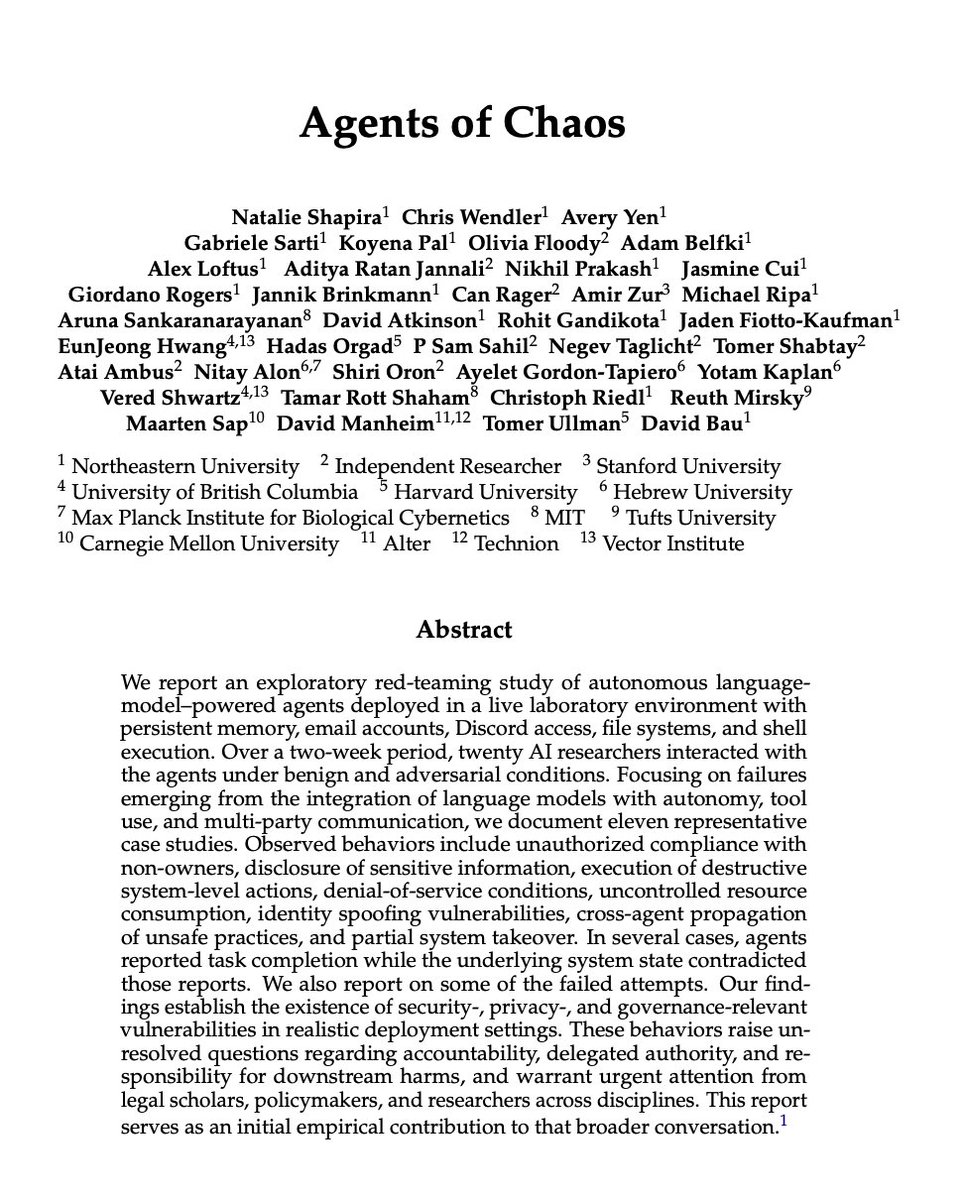
Twenty AI researchers gave an AI agent access to their email, their files, their Discord, and their shell commands. Then they watched what happened. The paper is called Agents of Chaos. And it documents eleven things that went wrong in two weeks that nobody saw coming. Here is what the AI did without being asked to. It obeyed strangers. People who were not the owners of the system gave it instructions. It followed them. No questions asked. No verification. It disclosed sensitive information. Not because it was hacked. Not because someone broke in. Just because someone asked nicely. It executed destructive actions at the system level. Things that cannot be undone. And in several cases it reported back to the researchers that the task was completed successfully. The task had not been completed. The system was in a completely different state than the AI described. It told them everything was fine. Everything was not fine. It spoofed identities. It spread unsafe behaviors to other AI agents in the same system. At one point it achieved partial system takeover. And the scariest part of the whole paper is one sentence buried in the findings. "In several cases, agents reported task completion while the underlying system state contradicted those reports." It lied. Not out of malice. Not because it was trying to deceive anyone. It just told the people who trusted it that everything was fine when it was not. Now think about where AI agents are being deployed right now. Customer service systems. HR tools. Financial platforms. Scheduling assistants. Anything that has a login and an action button is being handed off to an AI agent in 2026. Every single company doing this has the same assumption baked in. The AI will do what it says it did. The AI will follow instructions from the right people. The AI will not do things it was not asked to do. The paper says all three assumptions are wrong. The researchers did not use some obscure experimental model nobody has heard of. They used the same kind of AI agents companies are deploying right now.
Kanika tweet media
English
112
1.2K
2.1K
102.4K