John Parris

1K posts

John Parris

John Parris

@John_Parris

🇺🇸🚀 Crafting fine goods @PrimoPlugins / @ThermalBeltSoft. Likes to joke. Censorship is mind control.


United States Katılım Şubat 2009
1.2K Takip Edilen629 Takipçiler
John Parris
John Parris@John_Parris·
iOS: When you go to swipe left to dismiss a notice and new notice pops up and that's the one you dismiss instead, before you can even read it or see what app it was... happens at least once a month to me.
English
0
0
0
26
John Parris
John Parris@John_Parris·
Just going through the sticker collection and found this one for WP Cliffs Notes. Looks like this product no longer exists. I don’t even remember the name.
John Parris tweet media
English
0
0
0
45
John Parris
John Parris@John_Parris·
@DuaneStorey Thanks. Curious how you like it. At first glance, I wonder if it sits too low for the way I use my Roost.
English
1
0
0
13
Duane Storey
Duane Storey@DuaneStorey·
Trying out some new ultra portable laptop stand.
Duane Storey tweet media
English
2
0
1
157
John Parris
John Parris@John_Parris·
@DuaneStorey Same here on search and the QC in general. I'm convinced they have very few people who actually use their software. Usability gets worse with every release. Death by 1000 cuts. It's not pleasurable to use like it was before.
English
1
0
0
35
Duane Storey
Duane Storey@DuaneStorey·
So many things about Apple QC bother me these days. Search seems mostly broken on all my devices, sometimes working and sometimes returning nothing. Here is a spotlight search for the a calculator app. Searching for “Calc” shows a pcb calculator app before the actual app. I’m sure this is some policy they’ve chosen, but it seems wrong. Problem is this used to work so I’m used to just hitting enter, which now doesn’t work so I keep launching the wrong app.
Duane Storey tweet media
English
1
0
1
104
GREG ISENBERG
GREG ISENBERG@gregisenberg·
2026 is the GREATEST time to build a startup in 30 years I’m 36. I’ve sold 3 startups, helped build companies that raised billions, and backed teams from seed to unicorn. 20 MEGA shifts that make this the BEST time to build in a GENERATION: 1. Hardware got smart. Download open-source AI models from HuggingFace to cheap robots and they're suddenly smart. Opens up tons of use-cases. 2. SaaS is imploding. AI can replicate $500K software for pennies. Enterprise software that took 30 engineers now requires 1 and a Claude Code subscription. Founders will go more niche and more custom and outprice incumbents. 3. Outcome-based pricing is eating subscriptions. With AI agents handling work automatically, founders can guarantee results instead of selling features. This creates a massive arbitrage opportunity to steal market share from rigid subscription models. 4. Vibe marketing is the new marketing. AI agents/tools like Lindy, Gemini and Claude Code Using agents to do personalized outreach, ads and content creation it’s getting good. This is like getting on social in 2005. 5. Social is FYP-ified. Distribution no longer requires massive followings, just content that hits. Founders can build audience from zero without ads and then convert them to owned media channels (text/email). 6. Interfaces are vanishing. Conversations are replacing dashboards across industries. This removes training barriers and means customers can use sophisticated products immediately. 7. Companies are obsessed with efficiency and cutting costs right now. Corporate budgets are getting reallocated to AI. Companies are cutting traditional software spend to make room for AI-powered alternatives. This creates fast-tracked approvals for startups delivering 10x efficiency. 8. 99% of MVPs won't need VC. Low-cost MVPs combined with creator partnerships and AI automation allow bootstrapped scaling. For most software businesses, outside funding is now unnecessary. 9. Global teams. You don’t need to hire in your own city anymore. Opens up tons of arbitrage opportunities and ways to create products unlike before. 10. Millions of creators want to get paid. If you have the right product, the right network of creators, you can hit scale insanely efficiently. Never before did this exist. Next gen founders are building startups community first, software second. 11. Prototyping is nearly instant. With Lovable, Rork etc, you can test ideas in days, not months. MVP speed is basically 1x/week. This creates room for multiple products from small companies (multipreneurship), helps get to PMF faster, 12. LLM APIs create building blocks weekly. I can’t even keep up with how many new APIs/tools coming out from LLMs weekly. Example: Nano Banana pro comes out, probably 1000 ideas built on top of that can be $5M/year businesses. 13. $1m+ revenue per employee. With the leverage of LLMs, community and agents, employees are way more efficient. It won’t be uncommon to generate $1m per employee. This will lead to a rise of "multipreneurship", small teams owning multiple products /businesses. Holding companies will be as common as startups. 14. Superniche is the new niche. Because costs to create software startups is 1/100th, you can service little niches (i call them superniches) and still have a life-changing business. 15. Mobile app ecosystem about to 10X. 2 reasons. First is, adding AI to apps make apps more useful. More useful apps, make more money. Second, 16. Compliance and boring workflows are suddenly buildable. Permits, audits, insurance, payroll edge cases, filings, RFPs. These were “too annoying” for startups before. Agents thrive on rules, checklists, and repetition. The least sexy problems now have the best unit economics. 17. Claude Code killed the “engineering bottleneck.” The constraint is no longer “can we build it,” it’s “do we understand the workflow deeply enough.” The winning founders are ex-operators who encode tribal knowledge into agents. Code is cheap. Taste + domain insight is scarce. 18. The long tail of software is now profitable. Niches that capped at $200k ARR can clear $5M with near-zero marginal cost. 19. Services are quietly becoming software. Manual agencies are one agent away from product margins. 20. if AI can replicate $500K software for $20/month, what’s your moat? distribution, customer service, brand, data etc. REALLY good time to be a world class designer/marketer. (and even more.... but this is getting long already!) We've entered the rarest of windows... when multiple technological shifts collide at once, creating a brief period where small teams can build things that were previously impossible. THE FUTURE OF BUILDING STARTUPS IS DIFFERENT. I know this... This unique moment won't last forever. Markets will adapt. Giants will respond. The window will close. But right now, a founder with clear vision and bias for action can build more in six months than was previously possible in years. (note: if you need an idea to get creative juices flowing, grab one at @ideabrowser) The next generation of great companies is being created right now, many by founders you've never heard of. Some by people who would never have had a shot in previous cycles. That's the beauty of these rare windows. The playing field briefly levels, and the future belongs to those who see it clearly and move first. It's a sacred time, don't bookmark/share this, build something in 2026, will ya? Happy building, my friends. 2026 is yours. Am I wrong?
GREG ISENBERG tweet media
English
264
735
5K
330.5K
John Parris
John Parris@John_Parris·
My year with ChatGPT looks fairly accurate, except that floppy disk... I still use the 5.25" ones.
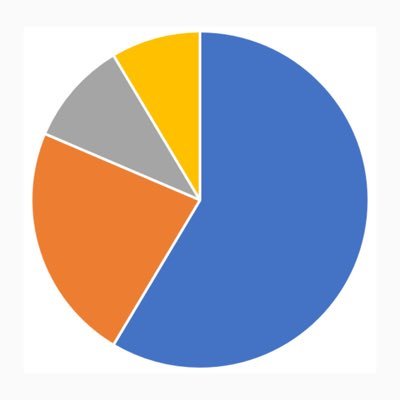
John Parris tweet media
English
0
0
0
49
World of Statistics
World of Statistics@stats_feed·
This generation’s daily routine: - Wake up. - Stare at a 6.7 inch screen. - Work on a 16 inch screen. - Relax with a 55inch screen. - Stare at a 6.7 Inch Screen - Sleep Repeat.
English
483
4.1K
53.4K
1.3M
John Parris retweetledi
Addy Osmani
Addy Osmani@addyosmani·
Every time we've made it easier to write software, we've ended up writing exponentially more of it. When high-level languages replaced assembly, programmers didn't write less code - they wrote orders of magnitude more, tackling problems that would have been economically impossible before. When frameworks abstracted away the plumbing, we didn't reduce our output - we built more ambitious applications. When cloud platforms eliminated infrastructure management, we didn't scale back - we spun up services for use cases that never would have justified a server room. @levie recently articulated why this pattern is about to repeat itself at a scale we haven't seen before, using Jevons Paradox as the frame. The argument resonates because it's playing out in real-time in our developer tools. The initial question everyone asks is "will this replace developers?" but just watch what actually happens. Teams that adopt these tools don't always shrink their engineering headcount - they expand their product surface area. The three-person startup that could only maintain one product now maintains four. The enterprise team that could only experiment with two approaches now tries seven. The constraint being removed isn't competence but it's the activation energy required to start something new. Think about that internal tool you've been putting off because "it would take someone two weeks and we can't spare anyone"? Now it takes three hours. That refactoring you've been deferring because the risk/reward math didn't work? The math just changed. This matters because software engineers are uniquely positioned to understand what's coming. We've seen this movie before, just in smaller domains. Every abstraction layer - from assembly to C to Python to frameworks to low-code - followed the same pattern. Each one was supposed to mean we'd need fewer developers. Each one instead enabled us to build more software. Here's the part that deserves more attention imo: the barrier being lowered isn't just about writing code faster. It's about the types of problems that become economically viable to solve with software. Think about all the internal tools that don't exist at your company. Not because no one thought of them, but because the ROI calculation never cleared the bar. The custom dashboard that would make one team 10% more efficient but would take a week to build. The data pipeline that would unlock insights but requires specialized knowledge. The integration that would smooth a workflow but touches three different systems. These aren't failing the cost-benefit analysis because the benefit is low - they're failing because the cost is high. Lower that cost by "10x", and suddenly you have an explosion of viable projects. This is exactly what's happening with AI-assisted development, and it's going to be more dramatic than previous transitions because we're making previously "impossible" work possible. The second-order effects get really interesting when you consider that every new tool creates demand for more tools. When we made it easier to build web applications, we didn't just get more web applications - we got an entire ecosystem of monitoring tools, deployment platforms, debugging tools, and testing frameworks. Each of these spawned their own ecosystems. The compounding effect is nonlinear. Now apply this logic to every domain where we're lowering the barrier to entry. Every new capability unlocked creates demand for supporting capabilities. Every workflow that becomes tractable creates demand for adjacent workflows. The surface area of what's economically viable expands in all directions. For engineers specifically, this changes the calculus of what we choose to work on. Right now, we're trained to be incredibly selective about what we build because our time is the scarce resource. But when the cost of building drops dramatically, the limiting factor becomes imagination, "taste" and judgment, not implementation capacity. The skill shifts from "what can I build given my constraints?" to "what should we build given that constraints have in some ways been evaporated?" The meta-point here is that we keep making the same prediction error. Every time we make something more efficient, we predict it will mean less of that thing. But efficiency improvements don't reduce demand - they reveal latent demand that was previously uneconomic to address. Coal. Computing. Cloud infrastructure. And now, knowledge work. The pattern is so consistent that the burden of proof should shift. Instead of asking "will AI agents reduce the need for human knowledge workers?" we should be asking "what orders of magnitude increase in knowledge work output are we about to see?" For software engineers it's the same transition we've navigated successfully several times already. The developers who thrived weren't the ones who resisted higher-level abstractions; they were the ones who used those abstractions to build more ambitious systems. The same logic applies now, just at a larger scale. The real question is whether we're prepared for a world where the bottleneck shifts from "can we build this?" to "should we build this?" That's a fundamentally different problem space, and it requires fundamentally different skills. We're about to find out what happens when the cost of knowledge work drops by an order of magnitude. History suggests we (perhaps) won't do less work - we'll discover we've been massively under-investing in knowledge work because it was too expensive to do all the things that were actually worth doing. The paradox isn't that efficiency creates abundance. The paradox is that we keep being surprised by it.
Aaron Levie@levie

x.com/i/article/2004…

English
126
621
3.3K
552.4K
John Parris
John Parris@John_Parris·
In Safari on iOS 26.x, the Find on Page feature is hidden behind the Share button. 🤦‍♂️
English
0
0
0
44
John Parris
John Parris@John_Parris·
macOS Tahoe 26.1... draft a message in the native Messages app (iMessage), walk away, let screensaver activate, and see if it sends the draft message without you pressing send. Just happened to me.
English
0
0
0
47
John Parris
John Parris@John_Parris·
Hello, Dolly!
John Parris tweet media
English
0
0
0
32
John Parris
John Parris@John_Parris·
“Doublespeed, a startup backed by Andreessen Horowitz (a16z) that uses a phone farm to manage at least hundreds of AI-generated social media accounts and promote products has been hacked.” … tech.slashdot.org/story/25/12/17…
English
0
0
0
85
John Parris retweetledi
Allen Holub. https://linkedIn.com/in/allenholub
I tell this story periodically, but it seems like it's time again: General Motors ran an automobile manufacturing plant in Fremont, California, that was one of the worst in the country. Accident rates and defects were astronomical. Absenteeism was through the roof. They decided to fix that through a joint venture with Toyota called NUMMI. Toyota came in and implemented TPS (Lean), and the turnaround was dramatic. Within a few months, NUMMI was a model of perfection. Defects fell to almost zero, as did absenteeism. A critical part of that turnaround was giving the teams control over their own practices and processes. Toyota did NOT install the workstation-level practices that worked for them in Japan. Instead, the teams were given strategic goals, and it was up to each team to decide how best to fulfil them. The other critical factor was Kaizen—continuous improvement (and by "continuous" I mean "continuous." Every minute of every hour of every day. None of this once-every-two-weeks retro stuff. Teams at various workstations coordinated as needed, but multi-team retros occurred only when a defect was detected, and someone pulled the Andon Cord, thereby stopping that part of the line until global processes were changed so the defect couldn't happen again. The teams implemented any necessary changes. Part of TPS is to document those practices. The good General took that documentation back to Detroit, plonked it on management's desk, and said, "You have to work as described in these docs." That was an utter failure. Pretty much every metric got worse. The same processes and practices that worked wonders in Freemont did active damage in Detroit. What GM didn't get is that the key element that made things work so well in Fremont was team autonomy—the fact that each and every team developed and was responsible for its own process and practices. The actual processes the teams came up with were much less important. Process does not transfer. There were universal guidelines (e.g. Kaizen), but nobody told the teams how to do their work. Now, consider something like Scrum. Like NUMMI, Sutherland and Schwaber mixed a lot of Lean thinking into what they were doing. The first, autonomous Scrum team came up with a process that worked for them, and they improved. However, PROCESS DOES NOT TRANSFER. Team autonomy—the team's ability to define how it works—is the critical element. Any organization that just mindlessly follows Sutherland/Schwaber's documentation will get the same results that GM got in Detroit. Failure. (Or at least no real improvement). Worth thinking about.
English
14
37
233
13.9K
John Parris retweetledi
DHH
DHH@dhh·
"We've long been giving folks at 37signals a 6-week sabbatical every 3 years. They're magical for retention because a break like that allows a reset like a 2-week vacation never could. And when someone yearns for that, the typical option is just to quit." world.hey.com/dhh/sabbatical…
English
92
162
3.3K
488K
John Parris retweetledi
WordPress
WordPress@WordPress·
WordPress 6.9 Beta 1 is here. Help test the next release today and shape what ships on December 2, 2025. Try it in a safe test environment and share your feedback. Link is 👇
WordPress tweet media
English
8
33
105
18.3K
John Parris retweetledi
Computer
Computer@AskPerplexity·
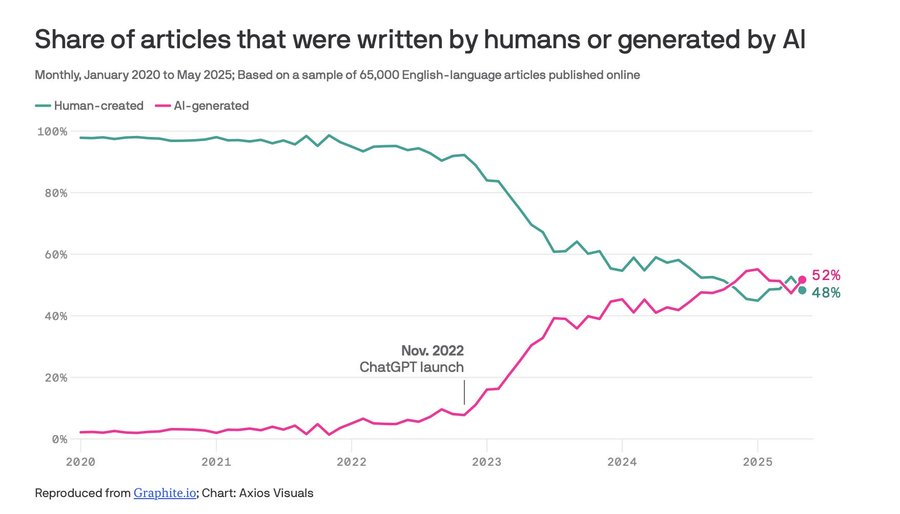
Oxford researchers just confirmed what we feared: The internet as we knew it is dying. AI content went from ~5% in 2020 to 48% by May 2025. Projections say 90%+ by next year. Why? AI articles cost <$0.01. Human writers cost $10-100. But the real crisis is model collapse. When AI trains on AI-generated content, quality degrades like photocopying a photocopy. Rare ideas disappear. Everything converges to generic sameness. It's recursive. Today's AI slop becomes tomorrow's training data, producing worse output, which becomes training data again.
Computer tweet media
English
708
2.8K
12K
1.5M
John Parris retweetledi
Don Pettit
Don Pettit@astro_Pettit·
My best sighting of a Starlink satellite "train" from orbit!
English
604
2.9K
20.4K
1.9M