Dr Jon K

3.5K posts

Dr Jon K banner
Dr Jon K

Dr Jon K

@JonKMD

Board Certified Plastic Surgeon @neuralink Surgery/AI/Longevity/ Breast implant Illness, explant, fat transfer

Los Angeles Katılım Eylül 2014
951 Takip Edilen3.1K Takipçiler
Dr Jon K retweetledi
Tanya
Tanya@Tanyaelisabeth·
I do not want to raise tamed boys. I want to raise moral boys. There is a difference. To mother boys is to be one of the first voices that tells them what their strength is for, and so I must learn. Every mother of sons faces a difficult decision: Do I shape them to fit the world as it is, or do I raise them to reshape the world as it ought to be? There is a wildness in boys that is not a flaw of creation but a part of it. A gift given by God Himself. A desire to run, to chase, to build, to break, to defend, to explore the unknown and come home covered in dust as if they had conquered the world. If we kill their spirits for the sake of convenience, for quiet classrooms and tidy living rooms, we may win temporary peace, but the cost is at the expense of a future man. And this truth is prevalent all around us.
Tanya tweet media
English
70
437
2.8K
48.4K
Dr Jon K retweetledi
Jesse Morse, M.D.
Jesse Morse, M.D.@DrJesseMorse·
DIRTY PEPTIDES This is one of the reasons why it is so important to properly regulate batch and purity testing, ensuring access to quality peptides. You DON’T want to be purposefully injecting lead, thallium, endotoxins and God knows what else. Once it’s in your body, the body will react accordingly and good luck trying to reverse that process. “Measure twice, cut once.” The future is bright and COMING SOON!!!
ThePeptideList@PeptideList

The New Yorker just lab-tested research peptides from a popular online vendor. BPC-157: contained lead. TB-500: contained endotoxins. CJC-1295: less than 42% of the labeled dose. This is what people are injecting into their bodies. The peptides aren't the problem. The supply chain is. This is exactly why the FDA reclassification matters moving these compounds into regulated compounding pharmacies with cGMP standards and real quality control.

English
16
6
168
68.6K
Dr Jon K retweetledi
𝓟 𝓮 𝓭 𝓻 𝓲 𝓷
Y un día te vas a dar cuenta de que ya no existe ese bullicio infantil que tanto desgasta; y ese caos armónico es silencio ruidoso porque las hojas del calendario no perdonan. Y es de repente... de repente caes en la cuenta de que la bañera ya no es un baúl desastre lleno de juguetes, y que no te han dejado en el lavabo ese balón de gomaespuma, ni hay muñecas en un sofá dormido, ni playmobils esparramados por la casa... Y un día te vas a dar cuenta de que no hay carreras por pasillos interminables; ni risas a hurtadillas en la cama para desafiar el sueño; ni cuentos a quien leer, ni sábanas a quien tapar a medianoche, ni almas respirando sueños... Y un día te vas a dar cuenta de que la despensa está llena de recuerdos y que sobran platos en la mesa; y que todo está en orden... sin mochilas en el suelo de la entrada, sin lápices desordenados en pupitres de colores, ni esa ropa que no entra en el cesto y que las camas no se deshacen... Y un día... serás huérfano de tus hijos que crecieron con el permiso de la vida. Y te sentarás en el sillón sabio del libro que echa de menos una voz inocente que le interrumpa. Y cada página que pases, léela con detenimiento porque esa... ya no vuelve. Es la vida. Emilio Leiva Visto en redes. #EstoyTriste #NidoVacio
𝓟 𝓮 𝓭 𝓻 𝓲 𝓷 tweet media
Español
59
937
4.8K
286.4K
Dr Jon K retweetledi
Damian Player
Damian Player@damianplayer·
THIS IS WILD! Peter Thiel’s company the “Enhanced Games” got valued at $1.2B before a single event. the first one is next month. here’s what the headlines aren’t telling you (share this): every athlete is monitored. every compound is clinically approved. every dose is tracked. two independent medical commissions oversee the whole thing. and if your bloodwork doesn’t pass, you don’t compete. the same investors behind the biggest peptide and longevity companies put $1.2B behind this. these aren’t sports guys… they’re taking a public bet that performance medicine becomes a real market. whether you’re into it or not, pay attention.
English
196
474
6.8K
3.3M
Dr Jon K retweetledi
Bryan Johnson
Bryan Johnson@bryan_johnson·
Results from my Feb 23 skin therapy: Improvements since treatment: > Brown spots: +71 percentile points (20th → 91st) ✅ > Pores: +25 percentile points ✅ > Spots: +25 percentile points✅ My skin age is 9 years younger than my chronological age (39 vs 48) and hasn't aged in five years since starting this project. Effectively a 9 year age reversal. Measured using VISIA multispectral clinical imaging, the most validated non-invasive skin analysis system available. Feb 23 treatment summary Technologies > Everesse RF > CoolPeel CO2 laser > BBL Each targeting a different skin depth so repair windows overlap without competing. Treatment details Everesse RF (200 pulses, Level 2.5 per cheek), CoolPeel CO2 laser (3.0W, 700 micron spacing), and BBL broadband light. Each targeting a different skin depth. Everesse drives heat into the dermis at 60-70°C, triggering fibroblast activation and collagen production that peaks 6-8 weeks later (about now), tightening the structural scaffolding that makes pores visible. CoolPeel ablates the surface layer of skin, physically removing melanin-loaded cells and forcing fresh keratinocytes to the surface. BBL destroys residual pigment one layer deeper through selective photothermolysis, where melanin absorbs light energy and self-destructs. Porphyrins dropped 13 points, which is expected. The treatments temporarily disrupt the follicular environment that bacteria need to thrive, and that recovers within 8-12 weeks. Goal was to do a triple-modality stack so the repair windows overlap without competing (dermis, epidermis, and chromophores).
Bryan Johnson tweet mediaBryan Johnson tweet media
English
82
59
1.5K
478.9K
Dr Jon K retweetledi
Max Lugavere
Max Lugavere@maxlugavere·
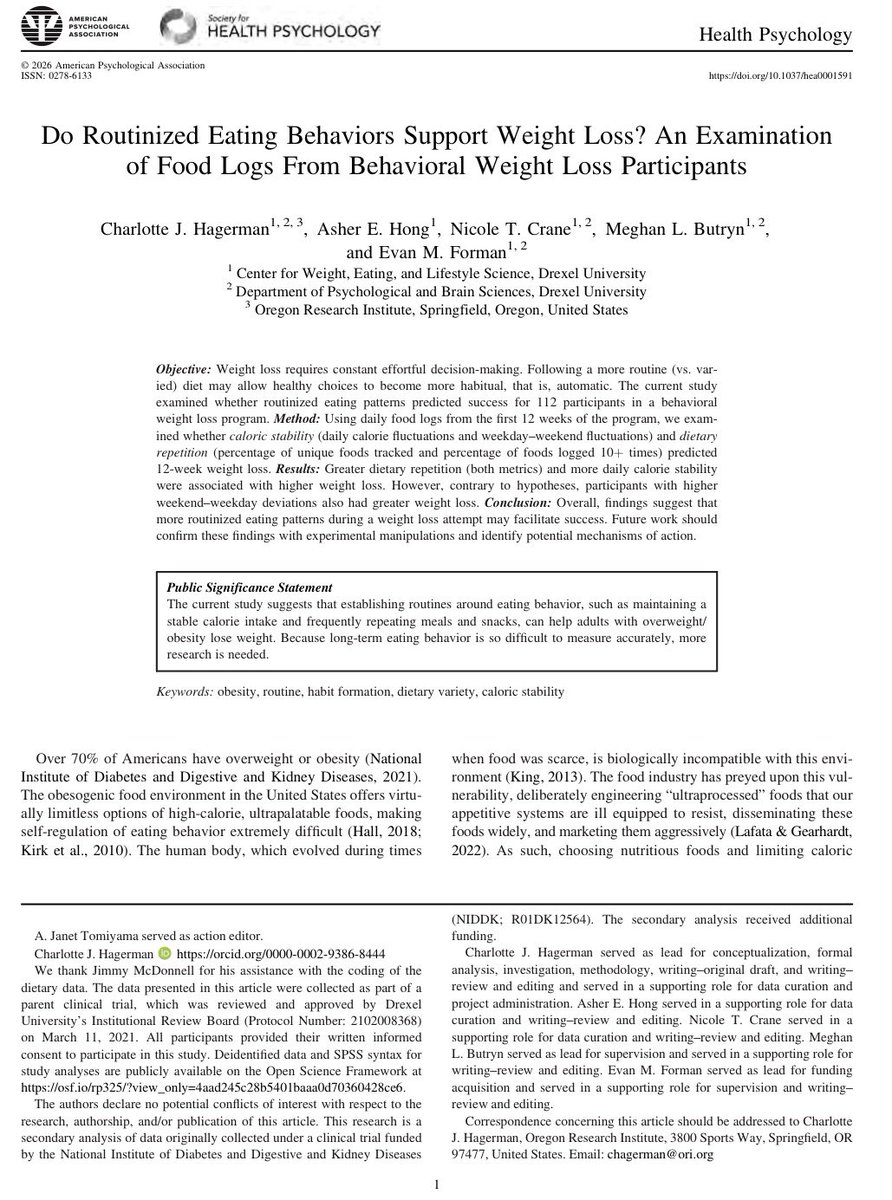
Eating the same meals on repeat was associated with 40% greater weight loss.
Max Lugavere tweet media
English
144
748
9.8K
1.9M
Dr Jon K
Dr Jon K@JonKMD·
Think about moving so your thinking moves
The Curious Tales@thecurioustales

🚨 Your brain shuts down in time intervals. New research tracked cerebral blood flow in desk workers using transcranial Doppler imaging. What they discovered changes how we should think about cognitive performance during work. Sitting for 30 minutes measurably reduces blood velocity to your middle cerebral artery. Your prefrontal cortex begins operating on restricted fuel. The decline happens predictably, like clockwork, every half hour. But walking for just 2 minutes every 30 minutes completely reversed the effect. Not walking for 8 minutes every 2 hours. Short, frequent interruptions. The timing reveals something crucial about how your cardiovascular system operates under sedentary stress. Blood doesn’t pool gradually. It pools in waves. Your circulation hits specific failure points at regular intervals when movement stops. The 30 minute mark appears to be a biological threshold where your calf muscle pumps lose their ability to maintain adequate venous return. Think about every important decision you’ve made sitting at a desk after 30 minutes of stillness. Every creative problem you’ve tried to solve. Every complex analysis you’ve attempted. You were operating with diminished blood flow to the exact brain regions responsible for higher order thinking. The implications extend beyond productivity. Prolonged periods of reduced cerebral blood flow accelerate cognitive decline. The same vascular mechanisms that impair thinking in real time contribute to neurodegeneration over decades. Office workers aren’t just experiencing temporary mental fatigue. They’re participating in a daily pattern that systematically starves neural tissue. What makes this particularly disturbing is how perfectly our work culture aligns with the worst possible timing. Meetings scheduled for an hour. Focus blocks planned for 90 minutes. Deep work sessions extending for multiple hours. We’ve organized professional life around intervals that guarantee cognitive impairment. The solution sounds absurd until you understand the physiology. Stand up and walk for 2 minutes every 30 minutes. Not stretch. Not shift in your chair. Walk. Activate the muscle pumps in your calves. Force blood back toward your brain. Every knowledge worker should treat this like a medical prescription. Your cognitive capacity depends on maintaining cerebral blood flow. Your long term brain health depends on preventing chronic vascular stress. Movement every 30 minutes isn’t a productivity hack. It’s basic cardiovascular maintenance for an organ system that requires constant circulation to function. Your brain runs on blood flow, not willpower. Starve it for 30 minutes and watch your intelligence evaporate in real time.

English
0
0
0
90
Dr Jon K retweetledi
Andrej Karpathy
Andrej Karpathy@karpathy·
Wow, this tweet went very viral! I wanted share a possibly slightly improved version of the tweet in an "idea file". The idea of the idea file is that in this era of LLM agents, there is less of a point/need of sharing the specific code/app, you just share the idea, then the other person's agent customizes & builds it for your specific needs. So here's the idea in a gist format: gist.github.com/karpathy/442a6… You can give this to your agent and it can build you your own LLM wiki and guide you on how to use it etc. It's intentionally kept a little bit abstract/vague because there are so many directions to take this in. And ofc, people can adjust the idea or contribute their own in the Discussion which is cool.
Andrej Karpathy@karpathy

LLM Knowledge Bases Something I'm finding very useful recently: using LLMs to build personal knowledge bases for various topics of research interest. In this way, a large fraction of my recent token throughput is going less into manipulating code, and more into manipulating knowledge (stored as markdown and images). The latest LLMs are quite good at it. So: Data ingest: I index source documents (articles, papers, repos, datasets, images, etc.) into a raw/ directory, then I use an LLM to incrementally "compile" a wiki, which is just a collection of .md files in a directory structure. The wiki includes summaries of all the data in raw/, backlinks, and then it categorizes data into concepts, writes articles for them, and links them all. To convert web articles into .md files I like to use the Obsidian Web Clipper extension, and then I also use a hotkey to download all the related images to local so that my LLM can easily reference them. IDE: I use Obsidian as the IDE "frontend" where I can view the raw data, the the compiled wiki, and the derived visualizations. Important to note that the LLM writes and maintains all of the data of the wiki, I rarely touch it directly. I've played with a few Obsidian plugins to render and view data in other ways (e.g. Marp for slides). Q&A: Where things get interesting is that once your wiki is big enough (e.g. mine on some recent research is ~100 articles and ~400K words), you can ask your LLM agent all kinds of complex questions against the wiki, and it will go off, research the answers, etc. I thought I had to reach for fancy RAG, but the LLM has been pretty good about auto-maintaining index files and brief summaries of all the documents and it reads all the important related data fairly easily at this ~small scale. Output: Instead of getting answers in text/terminal, I like to have it render markdown files for me, or slide shows (Marp format), or matplotlib images, all of which I then view again in Obsidian. You can imagine many other visual output formats depending on the query. Often, I end up "filing" the outputs back into the wiki to enhance it for further queries. So my own explorations and queries always "add up" in the knowledge base. Linting: I've run some LLM "health checks" over the wiki to e.g. find inconsistent data, impute missing data (with web searchers), find interesting connections for new article candidates, etc., to incrementally clean up the wiki and enhance its overall data integrity. The LLMs are quite good at suggesting further questions to ask and look into. Extra tools: I find myself developing additional tools to process the data, e.g. I vibe coded a small and naive search engine over the wiki, which I both use directly (in a web ui), but more often I want to hand it off to an LLM via CLI as a tool for larger queries. Further explorations: As the repo grows, the natural desire is to also think about synthetic data generation + finetuning to have your LLM "know" the data in its weights instead of just context windows. TLDR: raw data from a given number of sources is collected, then compiled by an LLM into a .md wiki, then operated on by various CLIs by the LLM to do Q&A and to incrementally enhance the wiki, and all of it viewable in Obsidian. You rarely ever write or edit the wiki manually, it's the domain of the LLM. I think there is room here for an incredible new product instead of a hacky collection of scripts.


English
1K
2.7K
25.6K
6.4M
Dr Jon K
Dr Jon K@JonKMD·
Over leveraged risk = opportunity
Anish Moonka@anishmoonka

Every cherry blossom in this photo is genetically identical to every other one. They’re all copies of a single tree. Japan’s most popular cherry, the Somei-Yoshino, was created by gardeners in Tokyo around the 1720s. Every one planted since has been grown by snipping a branch off an existing tree and fusing it onto new roots. In 2019, Japanese scientists tested the DNA of 46 Yoshino trees across the country, including one in Washington DC that Japan gifted in 1912. All 46 traced back to the same parent. That’s why they bloom at the exact same time. Same DNA, same internal clock. Each summer, the tree builds tiny pre-made flowers inside its buds, then the whole system shuts off for winter. To restart, two things have to happen in order. The tree needs about 61 days of cold (below 10 degrees Celsius) to unlock its dormancy, a biological off-switch that only winter can flip. Then it needs enough warm days in spring to push the flowers open. If either step gets skipped, the tree just sits there. No bloom. This process has been tracked in Kyoto since 812 AD. Emperors, monks, and aristocrats wrote the bloom dates in their diaries for over 1,200 years, making it the longest continuous biological record anywhere on Earth. For the first thousand years, the dates barely moved, hovering around April 17. Then starting in the 1800s, they begin sliding earlier. By the 2020s the average had landed on April 5, almost two weeks ahead of where it sat for a millennium. In 2021, Kyoto hit March 26, the earliest bloom in the entire 1,200-year record. The old record was March 27, in 1409. This is the Meguro River in Tokyo. 800 of these cloned trees line both sides of the water for about 4 kilometers. Last year’s cherry blossom season brought in $9 billion to Japan’s economy, up 22% from the year before, with over a quarter of viewers coming from overseas for the first time ever. That’s ten times the economic impact of Shohei Ohtani’s entire 2024 baseball season. Warming springs pull the bloom date earlier, but warming winters might eventually stop the bloom completely. Without enough cold days, the off-switch never resets. A Kyushu University study from 2024 found the trees are already waking up 2.3 days later per decade since 1990 because winters aren’t cold enough to properly reset them. In the warm winter of 2023-24, cherry trees at Japan’s southern tip bloomed on the same date as trees 860 kilometers to the north because the southern trees barely got enough cold to function. Japan’s weather agency now predicts the Somei-Yoshino could stop blooming entirely in three southern regions by 2100. One tree, cloned before the American Revolution, now powers a $9 billion economy and holds the longest biological climate record on Earth in its petals.

English
0
0
1
77
Dr Jon K retweetledi
Peter H. Diamandis, MD
Peter H. Diamandis, MD@PeterDiamandis·
The peptide revolution will require a small (reservoir enabled) auto syringe that doses at intervals with multiple peptides throughout the day. Basically a parallel exo-somatic signaling system.
English
45
31
595
72.6K
Dr Jon K retweetledi
Aakash Gupta
Aakash Gupta@aakashgupta·
A single protein is the difference between hearing your mother's voice and total silence. And we just learned how to give it back. Otoferlin is a protein your inner ear hair cells need to convert sound vibrations into electrical signals. Without it, sound waves hit the cochlea and just... stop. The hair cells physically vibrate but can't tell the brain anything. A perfectly functional microphone plugged into nothing. People born with OTOF mutations have never produced this protein. For decades, the only option was a cochlear implant: a $30,000-$50,000 surgically installed device that bypasses the entire biological hearing system and electrically stimulates the auditory nerve directly. It works, but it's a workaround. And the sound quality is nothing like natural hearing. What this team did: they loaded a working copy of the OTOF gene into a synthetic virus, injected it through a membrane at the base of the cochlea, and let the virus deliver the gene to the hair cells. One injection. The cells started producing otoferlin on their own. The speed is the part that gets you. Most patients showed measurable hearing improvement within one month. Average detection threshold went from 106 decibels (a chainsaw) to 52 decibels (a quiet conversation). A seven-year-old girl was having normal conversations with her mother four months after treatment. Ten for ten. Ages 1 to 24. Published in Nature Medicine. And OTOF is one of the rarer genetic deafness mutations. The researchers are already working on GJB2 and TMC1, which cause far more common forms. 430 million people worldwide have disabling hearing loss. We just watched a single injection teach deaf ears to hear by giving cells the protein recipe they were missing from birth.
Chubby♨️@kimmonismus

1/ Insane: A single injection into the inner ear reversed deafness in all ten patients. Some started hearing again within weeks. Gene therapy just crossed a threshold we thought was still years away. Lets dig into this breakthrough and how it works 🧵

English
9
182
569
34K
Dr Jon K retweetledi
Michael Strong
Michael Strong@flowidealism·
The fastest way to undermine a child's thinking is to praise them for the right answer. When you say Good job, you are training your child to think about your approval. You are training them to perform for you. A Socratic parent asks: Why do you think that? They do not announce whether the answer is correct. They ask follow-up questions. They present evidence that contradicts the claim. They create the conditions for the child to discover the weakness in their own reasoning. Getting a child to pause and think is the entire victory. In a conventional classroom, Good job means compliance with the teacher's version of knowledge. In a Socratic environment, independent judgment is the goal.
English
81
371
3.6K
214.5K
Dr Jon K retweetledi
Elon Musk
Elon Musk@elonmusk·
@deaflibertarian I am confident that Neuralink will restore hearing one day, just as we will restore vision with our Blindsight implant
English
1.4K
1.4K
17.5K
734.1K
Bryan Johnson
Bryan Johnson@bryan_johnson·
Guys, I’m an idiot. All this time I’ve spent trying not to die, I had toxic turf in my backyard. Artificial turf contains crumb rubber infill made from recycled tires, which leaches chemicals including PFAS, heavy metals, and polycyclic aromatic hydrocarbons. These compounds are linked to hormone disruption, carcinogenicity, and systemic inflammation. I don’t know how I missed it. It makes me question my basic competence in life. What gets me is that I try so hard to survey the world of potential idiocy. Then I find out there’s a monument to idiocy sitting right in front of my face that I was blind to. I’m removing the turf, yet I’m still stuck with this seemingly unsolvable problem of how to not be an idiot.
English
3K
580
28.6K
3.4M