






Jonathan

1.3K posts

Jonathan banner
Jonathan

Jonathan

@JonathanBaleke

Aspiring human

Katılım Şubat 2017
620 Takip Edilen243 Takipçiler
Jonathan retweetledi
Célestin Monga
Célestin Monga@CelestinMonga·
C'est quoi la vie ? "Un jeu et un passe-temps" (Le Coran). "Un long souci d'argent" (Alfred Capus) 'La première partie de la mort" (Jean Cocteau) ........ "Vis ta vie car, vraiment tu ne meurs pas la mort" (Textes des Pyramides) et philosophie de Papa Wemba, parti le 24-04-2016.
Célestin Monga tweet media
Français
2
12
38
1.7K
Joël K. Kazadi
Joël K. Kazadi@Joel_K_Kazadi·
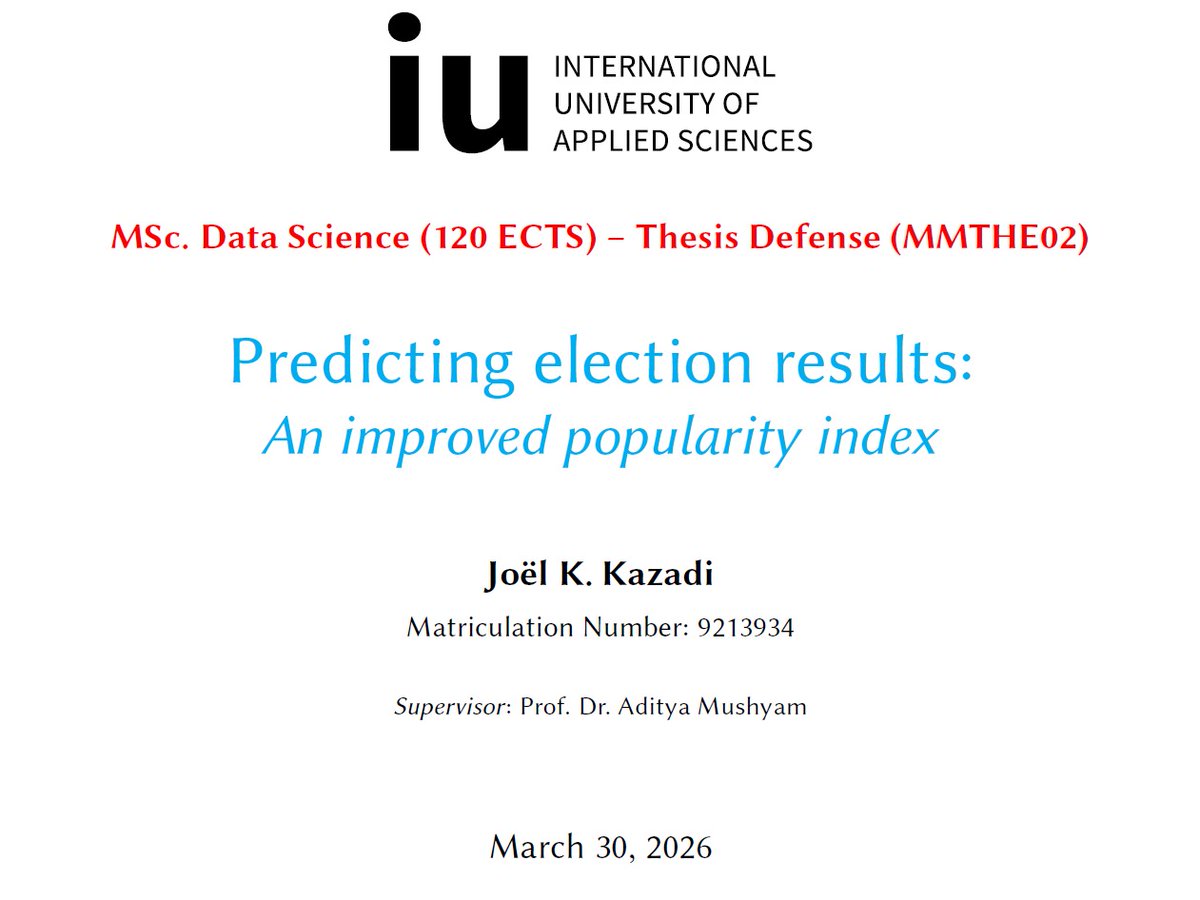
2 ans et 5 mois d'énormes sacrifices, mais surtout de grâce divine ! 🎓 Heureux d'avoir achevé mon programme de MSc. en Statistique et Data Science à l'International University of Applied Sciences (Erfurt, Germany). Hâte de relèver de nouveaux challenges. #Migration 📊📈
Joël K. Kazadi tweet mediaJoël K. Kazadi tweet mediaJoël K. Kazadi tweet mediaJoël K. Kazadi tweet media
Français
23
6
158
5.7K
Eleanor Beardsley
Eleanor Beardsley@ElBeardsley·
Great ad in Paris metro!
Eleanor Beardsley tweet media
English
36
1.8K
20.7K
476.7K
Jonathan retweetledi
Salomon Metre
Salomon Metre@MetreSalomon·
The Waxal [huggingface.co/datasets/googl…] project published by @GoogleResearch is a gold mine for African NLP. It is an incredible resource, but as I noted before [x.com/MetreSalomon/s…] (Prof. @NdjokoKarine also brought this specific comment to our attention in one of her recent tweets), those building on it must move with care. 1/n
Salomon Metre@MetreSalomon

@JonathanBaleke @GoogleResearch Truly impressive, @GoogleResearch ! I'd be careful calling it high-quality, though. I say this as somebody who has checked the lingala transcriptions available on Hugging Face. I hope I am not merely nitpicking here and that the rest of the dataset is way more accurate.

English
4
2
4
206
Brad Groux
Brad Groux@BradGroux·
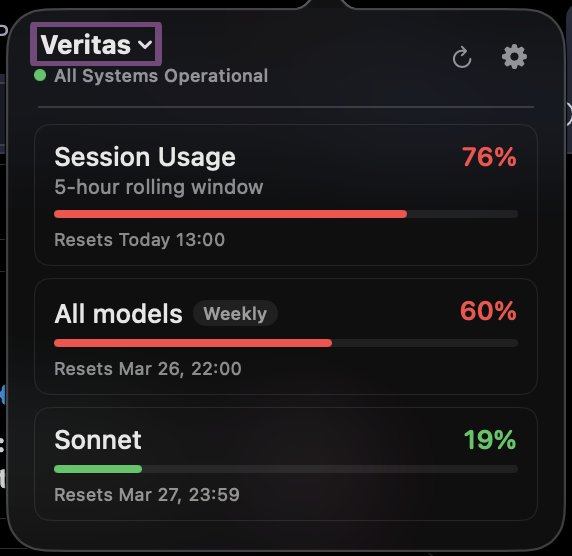
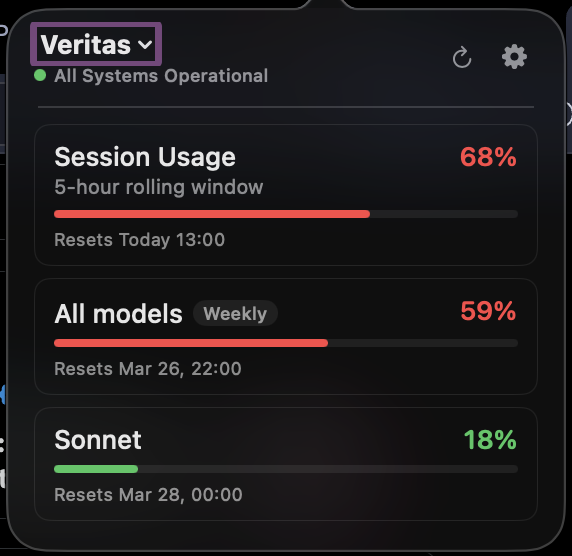
Something is up with Claude Code usage today. $200 Claude Max, 0%, 52% to 62%, then 68%, 76% and 84% in 5-hour rolling window in the time it took me to write this tweet. WTF, @AnthropicAI? I'm working on one GitHub PR for regression testing. Not folding proteins to cure cancer.
Brad Groux tweet mediaBrad Groux tweet mediaBrad Groux tweet mediaBrad Groux tweet media
English
387
53
1.3K
376.9K
Salomon Metre
Salomon Metre@MetreSalomon·
@JonathanBaleke @GoogleResearch Truly impressive, @GoogleResearch ! I'd be careful calling it high-quality, though. I say this as somebody who has checked the lingala transcriptions available on Hugging Face. I hope I am not merely nitpicking here and that the rest of the dataset is way more accurate.
English
1
0
1
303
Jonathan
Jonathan@JonathanBaleke·
@TJMufuta et la personne a continué sa discussion avec grok
Français
1
0
1
12
Jojo’s Bizarre Congolese Adventure 🇨🇩🇵🇸
What a f*cking cuck!!! Tellement conditionnés qu’on vous a fait croire que Dieu n’a aucun plan pour vous, que vous n’avez rien d’exceptionnel et qu’un autre peuple aurait plus d’importance que vous. This is worse than I thought!!!
Français
1
0
1
116
François Fleuret
François Fleuret@francoisfleuret·
You get N vectors of logits for the same prediction, you got with
English
8
0
13
8.6K
raz
raz@ryanzarick·
Over the last 2.5 years, we've secretly assembled a team of some of the brightest minds across cryptography, GPU programming, and ASIC design to build an internal Jolt Pro team. We surpassed our wildest dreams of what was possible, having already created a 1.61 GHz proving cluster we call a cell. Jolt Pro scales to infinity, the number of cells you can use in parallel is only limited by the size of the datacenter. This work culminated in our demo last night, where we verified a month of Ethereum in just 30 seconds. A special moment and a good start. But so much more to come.
LayerZero@LayerZero_Core

We’ve said Zero can scale to 2M TPS in infinitely parallelizable Zones on small devices. Today, we wanted to show what that actually means. So we validated 30M Ethereum transactions in 30 seconds on a network of Raspberry Pis at today’s event in NYC.

English
112
261
3.7K
633.4K
Jonathan retweetledi
Yann LeCun
Yann LeCun@ylecun·
Hugo Duminil-Copin, French mathematician and 2022 Field Medalist told me he never participated in math competition and was very bad at it. Innovative mathematics requires creativity, intuition, intense concentration, and long reflections, sometimes spread over several years. Good performance at a math olympiad merely tests fast problem solving abilities. AI can do that nowadays. One of the big activities of a researcher, in mathematics and elsewhere, is not to answer questions but to ask the right questions.
English
127
564
5.1K
720.3K
Jonathan retweetledi
Anthropic
Anthropic@AnthropicAI·
New Anthropic Fellows research: How does misalignment scale with model intelligence and task complexity? When advanced AI fails, will it do so by pursuing the wrong goals? Or will it fail unpredictably and incoherently—like a "hot mess?" Read more: alignment.anthropic.com/2026/hot-mess-…
English
154
221
1.9K
527.9K
Jonathan retweetledi
Anthropic
Anthropic@AnthropicAI·
AI can make work faster, but a fear is that relying on it may make it harder to learn new skills on the job. We ran an experiment with software engineers to learn more. Coding with AI led to a decrease in mastery—but this depended on how people used it. anthropic.com/research/AI-as…
English
285
1.3K
8.6K
3.7M
Jonathan retweetledi
Jesús Fernández-Villaverde
Jesús Fernández-Villaverde@JesusFerna7026·
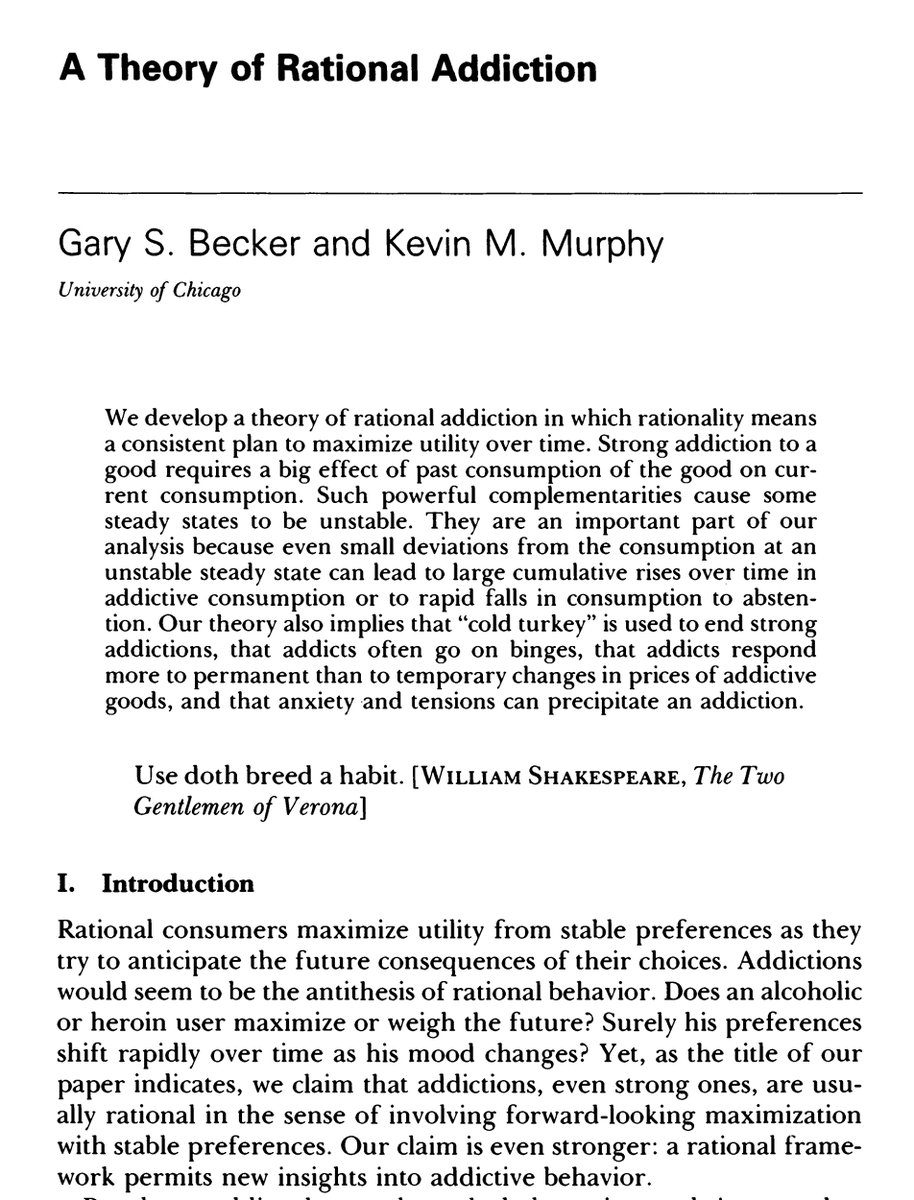
Olivier Blanchard (@ojblanchard1) had a provocative post yesterday about a higher preference of French people for leisure: x.com/ojblanchard1/s… I have learned nearly an infinite amount of economics from Olivier since I was an undergrad, and he came to Spain to present a report on our unemployment problem, so I feel a bit intimidated about pushing back on this idea. I am perfectly happy with the idea that preferences are heterogeneous: some people like leisure more than others. And the goal of economic policy should never be to maximize output, but to maximize welfare. If most people in France enjoy sitting in the beautiful sun of Provence while productivity increases, who am I to question their wisdom? But perhaps one of the aspects of economics that I have always felt uneasy about is how little effort we have put into exploring the extent to which preferences are endogenous. Let me borrow from an old idea of Gary Becker and Kevin M. Murphy (1988) in their classic “A Theory of Rational Addiction,” a beautiful piece of work all students of economics should read. Becker and Murphy consider a model with two consumption goods: one that requires “consumption capital” to be enjoyed and one that does not. Think about fine wine: it takes some time and experience to truly enjoy a good bottle. In comparison, every kid enjoys candy on first taste, no experience required (nor much is gained from repeated tastings). How much an agent invests in “consumption capital” determines whether increases in consumption of the first good in the past will lead to higher consumption of that good in the future. Many leisure activities belong to the former group, not the latter: going to the Opera, appreciating fine food, discovering the charming streets of a world-class city, ... Based on that observation, let me extend Becker and Murphy’s framework to the work-leisure choice by introducing the notion of “leisure capital.” Imagine a situation where, in France, taxes on labor income were high (or, equivalently, wages were lower than they should have been because of misallocation). This made leisure activities preferable in the past because their relative price was low (let’s assume the income effect was small), leading to an increase in the “leisure capital” of the French today and, therefore, in how French society takes advantage of increases in productivity. Now, one could argue that this reasoning is a hyper-sophisticated form of rationality that does not resemble reality. But I have seen this phenomenon at a micro level: very rich people who made their own fortunes are often not very good at enjoying leisure, but their kids are extremely good at it, because they accumulated plenty of “leisure capital” when they were young. More seriously, other observers of society would have found the reasoning natural, because there is a long tradition of analyzing labor supply decisions as embedded in social relations. Let us start with Karl Marx. In historical materialism, consciousness follows the forces of production. When the forces of production generate a lower labor supply (for whatever reason), consciousness will follow through the multiple channels of the superstructure, starting with the creations of the culture industry that favor leisure. Having delightful bistros is an epiphenomenon of a deeper structure of relations of production. In the opposite direction, E.P. Thompson, also from a Marxist perspective (though less orthodox), emphasized that the factory system required clock-based discipline and, therefore, that within a generation or two of the Industrial Revolution, punctuality became a cardinal virtue. Just reverse E.P. Thompson’s analysis. And Émile Durkheim, with his view of how social facts shape the division of labor in society, might have agreed as well. For Durkheim, social facts are “every way of acting which is general throughout a given society, while at the same time existing in its own right, independent of its individual manifestations.” In this perspective, the French have absorbed a particular relationship to work through decades of participation in French economic life, which is not divorced from taxes and regulations. Of course, one could reply that it might be the preferences for leisure that are behind higher taxes and regulations. For example, you can use regulations to move to a better coordination equilibrium: you do not want to take vacations if your spouse at another firm cannot take a vacation at the same time. This is what Max Weber would have called an elective affinity (Wahlverwandtschaft) of leisure and taxes. But that reply only reinforces my point that we probably want to think about preferences and economic policy as a simultaneous system, more than one driving the other. The practical implication is that policy reforms may have effects far beyond what an analysis that takes preferences as given would suggest. If decades of high taxes built up “leisure capital” in France (which fits perfectly with Olivier’s observation that the French are better at leisure), lowering taxes tomorrow will not instantly undo that accumulation. Preferences have their own inertia. But by the same token, sustained policy changes can, over time, reshape what people want, not just what they can afford. The real problem with all this reasoning, though, is that it makes welfare analysis a nightmare! I will leave that task to someone smarter than me.
Jesús Fernández-Villaverde tweet media
Olivier Blanchard@ojblanchard1

The French are not lazy. They just enjoy leisure more than most (no irony here) And this is perfectly fine: . As productivity increases, it is perfectly reasonable to take it partly as more leisure (fewer hours per week, earlier retirement age), and only partly in income.

English
39
201
1.2K
231.6K
Jonathan retweetledi
michelawrong
michelawrong@michelawrong·
When discussing mineral smuggling from Democratic Republic of Congo, most people think in terms of coltan, cobalt and diamonds. In fact the key mineral right now is gold. This is an important report, long overdue. globalinitiative.net/analysis/traci…
English
9
334
606
51.4K
BURKOV
BURKOV@burkov·
Claude is great at coding. Like really, really good, compared to using a regular LLM like Gemini. There's only one issue with it. Because it never sees the full code of the app but uses grep search for relevant code snippets, it's myopic. If grep returns a fragment of code similar to the bug description, it often doesn't look further and fixes an irrelevant part of the app or answers a question based on these fragments found by grep. So, as the codebase grows, it becomes important for the user to know the codebase. Otherwise, Claude will reinvent the bicycle over and over again, creating duplicate implementations for the same functionalities in different places in the app. This issue is probably fixable with additional finetuning, but right now this is how it works.
English
283
129
2.5K
248.4K
Jonathan retweetledi
lucas gelfond
lucas gelfond@gucaslelfond·
snowstorm hack, zerobrew is a drop-in brew replacement. borrowing principles from uv (concurrent downloads, content-addressable store), it’s ~5x faster cold and ~20x faster than homebrew. try it out! github.com/lucasgelfond/z…
GIF
English
84
126
2.1K
394.4K
Jonathan retweetledi
John B. Holbein
John B. Holbein@JohnHolbein1·
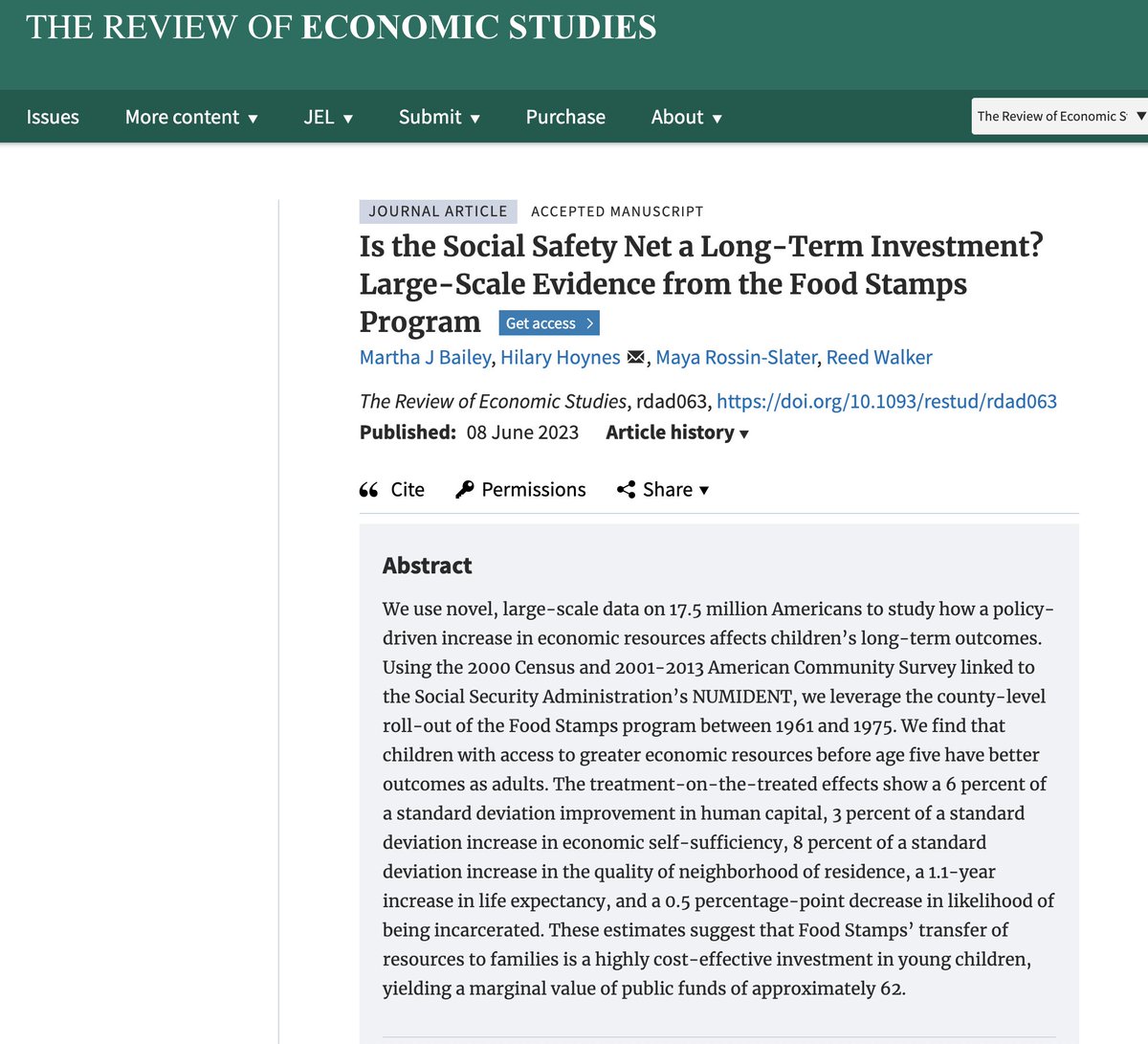
Can you guess what happens when you give kids food stamps? ... ... ... ... They... ⚫live longer, ⚫invest more in human capital, ⚫are more economically self-sufficient, ⚫live in better neighborhoods, ⚫are less likely to be incarcerated. academic.oup.com/restud/advance…
John B. Holbein tweet media
English
329
3.5K
15.1K
1.2M