Jorge M. Uribe

3.6K posts

Jorge M. Uribe banner
Jorge M. Uribe

Jorge M. Uribe

@JorgeMarioUribe

Energy, Finance, Macro

Barcelona, Spain Katılım Nisan 2010
82 Takip Edilen442 Takipçiler
Jorge M. Uribe retweetledi
Pope Leo XIV
Pope Leo XIV@Pontifex·
When simulation becomes the norm, it weakens the human capacity for discernment. As a result, our social bonds close in upon themselves, forming self-referential circuits that no longer expose us to reality. We thus come to live within bubbles, impermeable to one another. Feeling threatened by anyone who is different, we grow unaccustomed to encounter and dialogue. In this way, polarization, conflict, fear and violence spread. What is at stake is not merely the risk of error, but a transformation in our very relationship with truth.
English
1.6K
14K
82.2K
8.7M
Jorge M. Uribe retweetledi
Orkestra - IVC
Orkestra - IVC@orkestra·
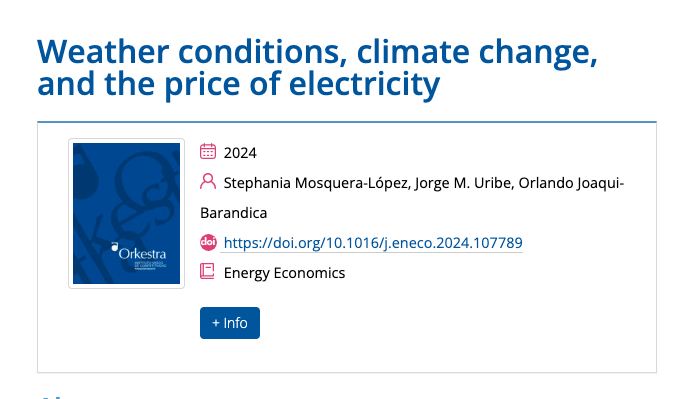
🆕The authors of this paper estimate the effect of temperature, wind speed, solar radiation, and precipitation on wholesale electricity prices for 6 European countries, analyzing the full distribution of the weather variables🔗labur.eus/Q5DE1 @smosqueral @JorgeMarioUribe
Orkestra - IVC tweet media
English
0
3
6
449
Jorge M. Uribe retweetledi
Rutger Bregman
Rutger Bregman@rcbregman·
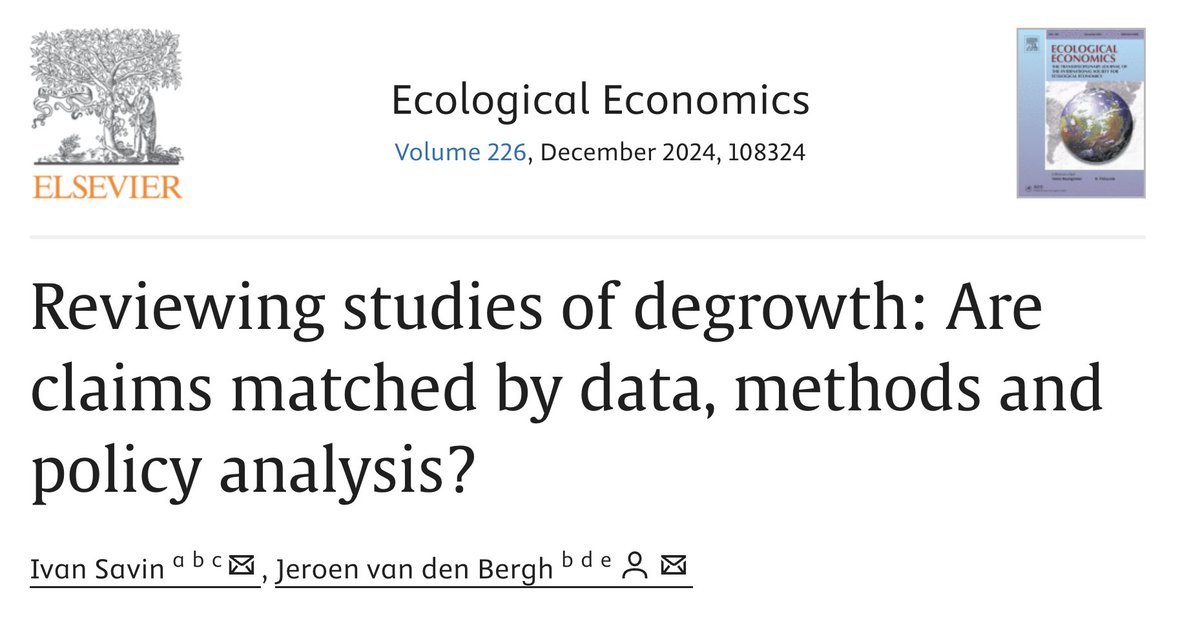
Devastating review of the degrowth literature (561 studies): --> 'few studies use quantitative or qualitative data...' --> [those that do] 'tend to include small samples or focus on non-representative cases' -->'large majority (almost 90%) are opinions rather than analysis'
Rutger Bregman tweet media
English
93
853
3.7K
1.4M
Jorge M. Uribe retweetledi
Mariana Mazzucato
Mariana Mazzucato@MazzucatoM·
The big consultants haven't just benefited from a weakened state - they've championed an ideology of short-termism and risk aversion in the public sector. Ending this 'consultancy cult' is crucial for transforming our economy. Full article by me and @RosieCollingto for @NewStatesman ⬇️ newstatesman.com/comment/2024/0…
Mariana Mazzucato tweet media
English
28
369
1K
63.7K
Jorge M. Uribe retweetledi
Gabriel Zucman
Gabriel Zucman@gabriel_zucman·
Delighted to release this paper on Auten & Splinter’s work, painstakingly going through their code & assumptions gabriel-zucman.eu/files/PSZ2024.… We uncover key mistakes—and show that once fixed, their methodology implies the same rise of inequality as in Piketty-Saez-Zucman 🧵
Gabriel Zucman tweet media
English
10
350
1.3K
275.5K
Jorge M. Uribe retweetledi
André Loez (en veille, sur bluesky)
Why economists should refrain from making sweeping historical arguments, based on sophisticated calculations, when using statistics or data that rely on flawed, false, or misunderstood evidence from the past : a thread (1) 🧶
English
24
229
788
375.5K
Jorge M. Uribe
Jorge M. Uribe@JorgeMarioUribe·
Los invito a leer una entrada sobre uno de mis trabajos más recientes de investigación con H.Chuliá y G.Martínez, en el que construimos indicadores de integración financiera y contrastamos el efecto de la misma sobre la probabilidad de crisis en 150 años de historia financiera.
Nada es Gratis@nadaesgratis

Una mirada de largo recorrido a la integración global de los mercados de capitales. Vía @nadaesgratis #Economía nadaesgratis.es/admin/una-mira…

Español
0
3
9
2.3K
Jorge M. Uribe retweetledi
Philipp Heimberger
Philipp Heimberger@heimbergecon·
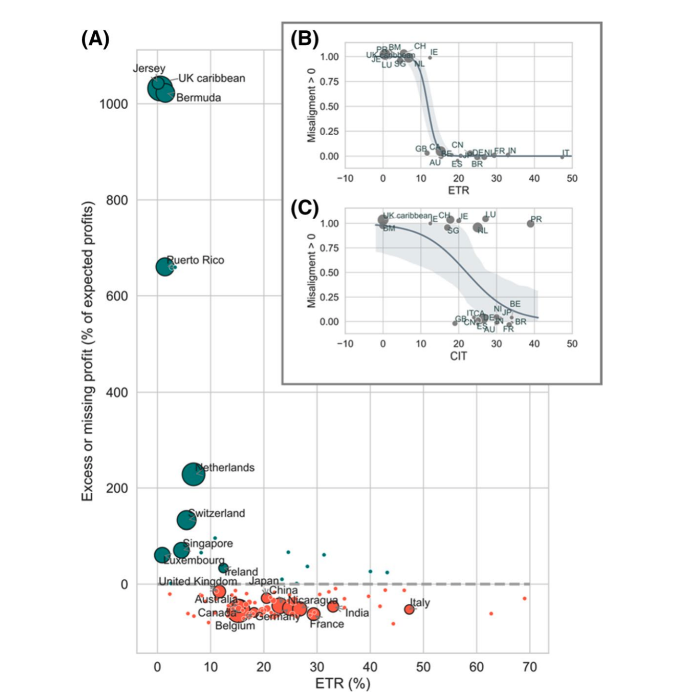
Ireland and Netherlands are major EU tax havens. This paper shows that they are among the most important tax havens for US multinational corporations, allowing them to shift profits. Interesting paper
Philipp Heimberger tweet media
English
14
200
553
50.4K
Jorge M. Uribe retweetledi
César A. Hidalgo
César A. Hidalgo@cesifoti·
**New DataViz Project** Curious about academic impact? Tired of rankings? Today we are introducing Rankless (rankless.org) a new data exploration platform that can help you explore the academic impact of thousands of universities. All universities produce impact that is specific to certain topics and geographies, but rankings flatten that information. Rankless wants to change that. Consider a comparison between the University of Utah and the University of Vienna, two universities ranked similarly in the Shanghai ranking. These universities differ in their geographical and topical footprint. The University of Utah specializes in Neuroscience and Medicine whereas the University of Vienna specializes in Physics, Astronomy, and Environmental Sciences. Their geographic impact is also quite different. Utah receives a large fraction of citations from medical centers in the U.S., Canada, and Israel, whereas Vienna receives many citations from technical institutes in Austria, Germany, and Hungary. These differences are easy to explore in Rankless but hard to see in rankings. Rankless was developed by a talented team at the Center for Collective Learning at Corvinus University (@uni_corvinus). It was brought to life by Endre Mark Borza (@endremborza), a Hungarian economist and data engineer at CCL with the help of Máté Barkóczi, a Hungarian designer form MOME, and Veronika Hamar executive director at CCL. By moving beyond rankings, Rankless offers a fresh perspective on how universities influence each geography and topic, emphasizing diverse forms of impact and providing a richer understanding of academic influence. To learn more visit Rankless.org
English
20
211
694
124.7K
Jorge M. Uribe retweetledi
Brad Setser
Brad Setser@Brad_Setser·
In all honesty, the world doesn't need to worry about "deglobalization" if all that is happening is a consolidation of the tax structures of US multinationals in Ireland. Folks tend to forget just how much of the FDI side of global capital flows is nothing but tax avoidance 4/
English
3
43
225
18.1K
Jorge M. Uribe retweetledi
Michael Pettis
Michael Pettis@michaelxpettis·
1/10 Interesting study suggesting that there is no evidence that higher public debt levels are associated with lower economic growth. I am not especially surprised because there are so many different conditions under which debt can emerge.
Philipp Heimberger@heimbergecon

Do higher public debt levels reduce economic growth? My meta-analysis is out in the September issue of Journal of Economic Surveys. By analysing 816 estimates, I find - publication bias in favour of negative growth effects - no uniform public-debt-to-GDP threshold Summary 🧵

English
20
161
633
152.7K
Jorge M. Uribe retweetledi
Michael Pettis
Michael Pettis@michaelxpettis·
11/12 They are just too general to be true. What economists should be doing, rather than encouraging the faithful, is to examine and explain the conditions under which such policies are likely to lead to development and growth and the conditions under which they aren't.
English
2
15
185
19.8K