
JoshMax retweetledi

Is Ore money, is it a Store of Value, or is it a utility asset?
To evaluate this, I will be using the recent Glassnode x Keyrock report that looked at 5 main factors:
- Dormancy
- Turnover
- Productive Float
- Anchored Float
- Exchange Supply
Dormancy
Dormancy is the degree to which coins stay in a wallet against those moved. This is a key indicator according to the report as it signals hoarding and low turnover, which are core traits of a SoV profile.
To provide context, BTC's ≥1y dormancy rate is currently around ~61.1% whereas ETH's ≥1y rate is ~51.7%. Now comparing this to Ore, currently has a ≥1y rate of around ~22.9% when including the never moved Ore in this calculation.
Turnover
This is the measure of percentage of circulating supply that is transferred daily.
For Ore, we will be taking into account the last 4 weeks daily volume divided by the Daily closing price which provides an approximated number of tokens traded daily. Using data from Coingecko, this came to 42,695 tokens traded per day on average for the last 30 days.
Taken as a percentage of the 411k circulating supply, this represents a turnover of 9.62% per day. As a comparison, BTC has ~0.61% of free float per day whereas ETH has ~1.34% of free float per day.
This is a sign that Ore in the turnover category would lean more to being a medium of exchange rather than a Store of Value or Utility asset.
Anchored Float
Anchored float in the report is defined as supply of the asset that is difficult to mobilise quickly.
Since Ore does not have a lock up time in its staking mechanism, and there is no unlock period when it comes to its usage in DeFi, it can be assumed that the Anchored float is near 0%.
However, due to the buyback mechanism, there is a percentage of Ore that never gets to touch the market. We will take this as anchored float for this evaluation since it is hard to mobilize something that never enters the market.
With an average of -808 Ore emitted according to Dune, this creates an anchored float of ~0.19% compared to BTC's ~6.7% and ETH's ~25.1%.
Productive Float
This builds on anchored float and can be seen as a % of supply that is deployed to DeFi applications as collateral such as liquidity provision.
In the case of Ore, there are only two main use cases; one is native staking (the refining mechanism and plain staking), the other liquidity provision in apps such as Meteora.
Currently there is ~291,370 Ore staked in both of the staking mechanisms as well as ~11,381 Ore in public liquidity pools. Combined this is 302,751 Ore in anchored float which is ~73.6% excluding DATs compared to BTC's ~4.66% and ETH's ~16.05%.
Exchange Supply
Exchange supply is the supply of circulating coins held in Central Exchanges which represent the fastest path to transact back to fiat, meaning a lower share generally signals SoV holding behaviour.
When it comes to Ore, this is extremely low according to Arkham with just over 0.3% in Swissborg's hot Wallet, ~0.09% in Flash Trade's and negligible amounts in Mexc, Lbank and BingX combining to just over ~0.4%.
In comparison, BTC has around ~14.3% on exchanges whilst ETH has ~11.3% supply on exchanges.
Bringing it all together
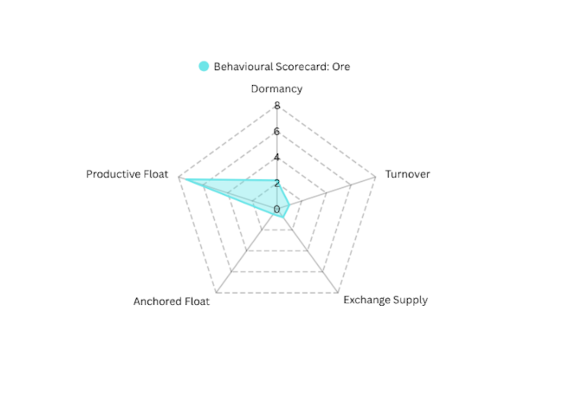
Using the original reports Behavioural Scorecard, the findings might suggest that @toly was on the money when he stated ''Ore is money'' but it also be argued that it is currently a utility asset due to the high productive float.
For Ore to gain more SoV standing, we would need to see lower turnover and higher dormancy rates which would also reduce the productive float rate. It will be interesting to see how this develops over time as Ore has only reintroduced itself about a month ago.
But for now, the hardhat stays on and I will see you in the mines👷⛏️



English