Joyce Coronel

584 posts

Joyce Coronel banner
Joyce Coronel

Joyce Coronel

@JoyceCoronel

Follower of Christ; contributor, https://t.co/phAqRAqyL6; blogger at https://t.co/JWM1F5BpT1

Chandler, Arizona Katılım Mayıs 2009
451 Takip Edilen307 Takipçiler
Joyce Coronel retweetledi
Deacon Richard
Deacon Richard@CatholicDeacon·
Most Catholics know St. Maximilian Kolbe died in Auschwitz. Fewer know the Marian secret behind his courage. The Immaculata. CCC 491 says Mary was redeemed from the moment of her conception. CCC 492 says her unique holiness came wholly from Christ. So the Immaculate Conception is not Mary competing with Jesus. It is Jesus saving Mary perfectly. Kolbe understood this. He gave himself totally to the Immaculata because Mary belongs totally to Christ. And when Auschwitz demanded self-preservation, Kolbe chose sacrifice. That is Marian devotion at its highest: Not reassurance. Not filler. Total surrender to Jesus through Mary. The Immaculata forms saints. My Queen and my Mother, I give myself entirely to you; and to show my devotion to you, I consecrate to you this day my eyes, my ears, my mouth, my heart, my whole being without reserve. Wherefore, good Mother, as I am your own, keep me, guard me, as your property and possession. Amen.🌹🌹🌹 St. Maximilian Kolbe pray for us. I am just a poor sinner working in the Lord's vineyard. Help me share the beauty of our Catholic faith. 🔁
Deacon Richard tweet media
English
9
76
319
6.2K
Joyce Coronel retweetledi
Father Joseph DeMarzo
Father Joseph DeMarzo@Joseph_DeMarzo·
There are two main camps of philosophical thought which emerge out of human history, and within those camps there is a diversity of thinkers. Those two main camps can be described as the objective and the subjective camps. The objective camp would argue that truth is determined by a conformity between the subjective and the objective, between the intellect and reality (St. Thomas Aquinas, De Ver., q.1, a.1). The subjective camp would argue that truth is not necessarily bound to what is outside of my mind. This camp, in varying degrees, centers truth more on historical development, personal perception, human consciousness, and experience. Granted, some may admit to some form of objective reality “out there,” there is still a primacy placed on, and subordinated to, the subjective. If the objective is our starting place, then we admit that there are universal and unchanging truths about the human person, human sexuality, God, and the world, which remain unchanged despite changes of time, place, and culture (Mal. 3:6; Heb. 13:8; CCC 1954–1960). If we accept the latter, then universal truths become subject to change, since they change with history. This is extremely dangerous to assert; this is the essence of modernism, of which Pope Pius X warned in Pascendi Dominici Gregis. It is one thing to, for pastoral purposes, adjust or change the language used. It is another to use language that would either explicitly or implicitly alter the meaning we wish to convey in matters of faith or morals (Gal. 1:8; Jude 1:3). Furthermore, to reject terminology or definitions, in the name of pastoral sensitivity, risks communicating acceptance of sin or alteration of Church doctrine (Isa. 5:20). Truth and love must go together (Eph. 4:15), and if we wish to help souls, we must speak in such a way as to aid these same souls in getting to heaven. Otherwise, our mission becomes solely about inclusion while neglecting the fact that people will, in fact, be excluded from heaven if they do not repent (Luke 13:3; 1 Cor. 6:9–10). Love of the person and calling them to repentance need not be in contradiction. If you only wish to express to them their dignity and how much God loves them, while at the same time never helping them to change, it is a false Gospel (John 8:11). It is the Gospel of modernism and not of Christ.
English
0
1
4
208
Joyce Coronel retweetledi
Sachin Jose
Sachin Jose@Sachinettiyil·
“The first Christian service on our soil was a Catholic mass.” US Secretary of State Marco Rubio deliveres a powerful speech reminding America of its deep Catholic heritage
English
365
2.8K
16.6K
455.6K
Joyce Coronel retweetledi
𝔊𝔯á𝔦𝔫𝔫𝔢 🕊️☘️
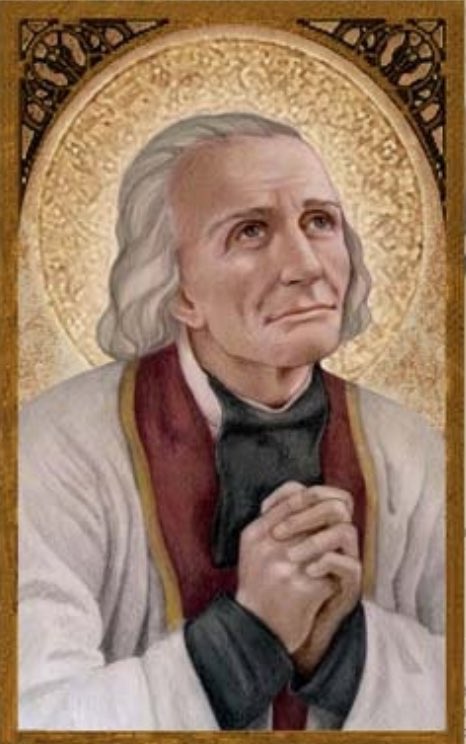
“God, at the moment of absolution, throws our sins over his shoulder. He forgets them, he annihilates them, they shall never reappear.” St. John Vianney 🕊️
𝔊𝔯á𝔦𝔫𝔫𝔢 🕊️☘️ tweet media
English
8
174
945
8K
Joyce Coronel retweetledi
Tod Worner
Tod Worner@ThinkerCatholic·
What people don’t realize is how much religion costs. They think faith is a big electric blanket, when of course it is the cross. —Flannery O’Connor
Tod Worner tweet media
English
18
360
1.9K
43.3K
Joyce Coronel retweetledi
Father V
Father V@father_rmv·
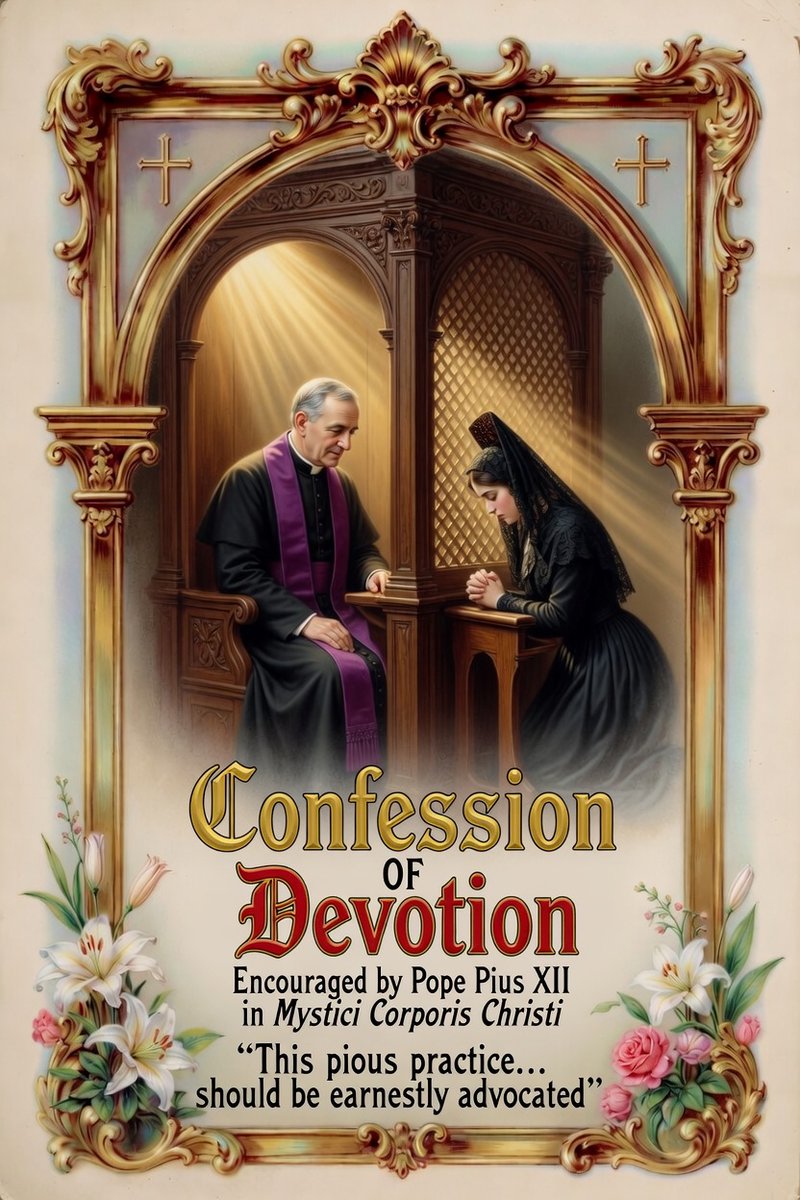
In the Catholic tradition, the confession of devotion refers to the frequent reception of the Sacrament of Penance even when a person has committed no mortal sins, confessing only venial faults or imperfections out of a desire for greater spiritual growth rather than out of strict necessity. This practice has deep roots in the Church's life but received strong papal encouragement in the twentieth century, most notably from Pope Pius XII. Pius XII addressed the topic directly in his 1943 encyclical Mystici Corporis Christi (On the Mystical Body of Christ). He warned against opinions that downplayed the value of confessing venial sins frequently, noting that while such sins can be forgiven in many other ways, the sacrament offers unique benefits for advancing in virtue. He wrote that this pious practice, introduced into the Church under the inspiration of the Holy Spirit, should be earnestly advocated. Through it, "genuine self-knowledge increases, Christian humility grows, bad habits are corrected, spiritual neglect and tepidity are resisted, the conscience is purified, the will is strengthened, salutary self-control is attained, and grace is increased" by the power of the sacrament itself. The pope's words responded to a climate in which some voices suggested that frequent confession of minor faults was unnecessary or even discouraged in favor of a more general, liturgical acknowledgment of sin. Pius XII rejected this view, affirming that devotional confession serves as a powerful aid for souls striving for holiness. It is not required that every venial sin be confessed in detail; a generic or partial accusation suffices as long as there is sincere contrition and a purpose of amendment. The focus lies less on exhaustive enumeration than on opening the soul to God's healing mercy and drawing closer to Christ, the Head of the Mystical Body. This encouragement fits within a broader pattern of papal teaching. Earlier popes such as St. Pius X had promoted frequent communion and the sacraments as means of spiritual renewal, and later figures like St. John Paul II continued to echo the value of regular confession. For Pius XII, the confession of devotion was not a burden but a gift, helping the faithful to overcome small faults before they harden into vices, to receive spiritual direction, and to grow in union with the Church. Priests were urged to welcome such penitents rather than dismiss them, recognizing the practice as a sign of authentic piety. Today the confession of devotion remains a recommended path for those seeking deeper conversion. It reminds Catholics that the Sacrament of Penance is not merely a courtroom for grave offenses but a meeting place with divine mercy that refines the soul day by day. In our age when awareness of personal sin is diminished, Pius XII's teaching stands as a gentle yet firm invitation: approach the confessional often, not out of fear, but out of loving devotion, and there receive the grace that makes steady progress in holiness possible.
Father V tweet media
English
0
107
335
7.2K
Joyce Coronel retweetledi
Bishop
Bishop@BishopJaxi·
Catholics confess directly to God. Protestants attack the priest as a "middleman" because sacramental confession requires what their private version avoids: contrition, accountability, and the humiliation of actually naming your sin. The Bible says to confess your sins to one another. Christ gave His apostles authority to forgive and retain sins. It does not teach "go hide alone, say a quick prayer, and call that repentance." A quick "God forgive me" costs nothing. Real confession humbles you, exposes your sin, and demands that you actually turn away from it. Something the majority of Protestants simply do not want.
𝕊𝕠𝕝𝕒 ℂ𝕙𝕒𝕕 🎚️@sola_chad

The Catholic Church doesn’t want you to know this, but you can confess your sins directly to God without their middleman. x.com/breesolstad/st…

English
154
595
5.6K
164.4K
Joyce Coronel retweetledi
Chris Stefanick
Chris Stefanick@ChrisStefanick·
No one was walking around saying, “the purpose of life—the whole universe—is all about love”…until Jesus Christ. The idea that after death, something good might happen and be waiting for us…that came from Easter Sunday. Guys, the only reason that we enjoy this general optimism about life, that there's a trajectory of life that is set by this divine force that actually likes us and wants us to be happy, and that something good is waiting for us at the end, is because two thousand years ago, Jesus went through something horrible and destroyed your enemy. You and I are living in the aftermath of Jesus’ victory. Happy Easter! (yeah, it’s still the Easter season!)
English
4
31
180
3.9K
Joyce Coronel retweetledi
Matthew Marsden
Matthew Marsden@matthewdmarsden·
It’s amazing when people reject the authority of the Catholic Church, then go on to become their own little Popes by claiming THEY have the correct interpretation of scripture. This is what the early church fathers had to say about this. St. Ignatius of Antioch (c. A.D. 110) Letter to the Smyrnaeans 6:2–7:1 “They abstain from the Eucharist and from prayer because they do not confess that the Eucharist is the flesh of our Savior Jesus Christ, flesh which suffered for our sins and which that Father, in his goodness, raised up again. They who deny the gift of God are perishing in their disputes.” St. Ignatius of Antioch (c. A.D. 110) Letter to the Smyrnaeans “Be careful, therefore, to take part only in the one Eucharist; for there is only one Flesh of our Lord Jesus Christ and one cup to unite us with His Blood.” St. Justin Martyr (c. A.D. 151) First Apology 66 “For not as common bread nor common drink do we receive these; but since Jesus Christ our Savior was made incarnate by the word of God and had both flesh and blood for our salvation, so too, as we have been taught, the food which has been made into the Eucharist by the Eucharistic prayer set down by him, and by the change of which our blood and flesh is nurtured, is both the flesh and the blood of that incarnated Jesus.” St. Irenaeus of Lyons (c. A.D. 180–189) Against Heresies 5.2.2–3 “He has declared the cup, a part of creation, to be his own blood, from which he causes our blood to flow; and the bread, a part of creation, he has established as his own body, from which he gives increase unto our bodies. When, therefore, the mixed cup [wine and water] and the baked bread receives the Word of God and becomes the Eucharist, the body of Christ, and from these the substance of our flesh is increased and supported, how can they say that the flesh is not capable of receiving the gift of God, which is eternal life—flesh which is nourished by the body and blood of the Lord, and is in fact a member of him?” St. Irenaeus of Lyons (c. A.D. 180–189) Against Heresies “The mingled cup and the manufactured bread receives the Word of God and the Eucharist of the blood and the body of Christ is made… our bodies, being nourished by it… shall rise at their appointed time.” x.com/BibleInContext…
English
117
56
268
8.5K
Joyce Coronel retweetledi
Sean
Sean@findveritasx·
One of the biggest differences I’ve noticed between being an evangelical and a Catholic is that evangelicals strangely seem to reject that God is present in the material world. As an evangelical, the world is almost implicitly a gnostic situation where material things are essentially worthless and separate from God. All that seems to matter is the spiritual and while material things may be vessels of the devil, they are never truly vessels of God. For instance holy water, relics, a church building, even the water of baptism, these are all seen as materially worthless. All that counts is the spiritual. Even an institutional church is seen as largely unimportant as long as you are spiritually in a relationship with God. Because of this, they miss out on the fullness of faith and God. The incarnation was God stepping into our material world and redeeming it. The heavens, AND the earth are His. God can make a language, water, a building, a handkerchief, and even a human body sacred. I think this is largely why Catholic art reigns supreme. As a Catholic you see the redemption and holiness of the material world before you.
English
186
179
1.6K
65.7K
Joyce Coronel retweetledi
Catholic Arena
Catholic Arena@CatholicArena·
Joseph Ratzinger was elected as pope on 19th April 2005 A day before his election, he delivered one of his most famous and prophetic speeches Coining the phrase 'Dictatorship of Relativism', he predicted how the West would see relativists imposing their will on those who had traditional beliefs It is a compelling and very powerful read, especially in light of recent events in the West: 'How many winds of doctrine have we known in recent decades, how many ideological currents, how many ways of thinking. The small boat of the thought of many Christians has often been tossed about by these waves - flung from one extreme to another: from Marxism to liberalism, even to libertinism; from collectivism to radical individualism; from atheism to a vague religious mysticism; from agnosticism to syncretism and so forth. Every day new sects spring up, and what St Paul says about human deception and the trickery that strives to entice people into error (cf. Eph 4: 14) comes true. Today, having a clear faith based on the Creed of the Church is often labeled as fundamentalism. Whereas relativism, that is, letting oneself be "tossed here and there, carried about by every wind of doctrine", seems the only attitude that can cope with modern times. We are building a dictatorship of relativism that does not recognize anything as definitive and whose ultimate goal consists solely of one's own ego and desires. We, however, have a different goal: the Son of God, the true man. He is the measure of true humanism. An "adult" faith is not a faith that follows the trends of fashion and the latest novelty; a mature adult faith is deeply rooted in friendship with Christ. It is this friendship that opens us up to all that is good and gives us a criterion by which to distinguish the true from the false, and deceit from truth. We must develop this adult faith; we must guide the flock of Christ to this faith. And it is this faith - only faith - that creates unity and is fulfilled in love. On this theme, St Paul offers us as a fundamental formula for Christian existence some beautiful words, in contrast to the continual vicissitudes of those who, like children, are tossed about by the waves: make truth in love. Truth and love coincide in Christ. To the extent that we draw close to Christ, in our own lives too, truth and love are blended. Love without truth would be blind; truth without love would be like "a clanging cymbal" (I Cor 13: 1). Let us now look at the Gospel, from whose riches I would like to draw only two small observations. The Lord addresses these wonderful words to us: "I no longer speak of you as slaves.... Instead, I call you friends" (Jn 15: 15). We so often feel, and it is true, that we are only useless servants (cf. Lk 17: 10). Yet, in spite of this, the Lord calls us friends, he makes us his friends, he gives us his friendship. The Lord gives friendship a dual definition. There are no secrets between friends: Christ tells us all that he hears from the Father; he gives us his full trust and with trust, also knowledge. He reveals his face and his heart to us. He shows us the tenderness he feels for us, his passionate love that goes even as far as the folly of the Cross. He entrusts himself to us, he gives us the power to speak in his name: "this is my body...", "I forgive you...". He entrusts his Body, the Church, to us'
Catholic Arena tweet media
English
59
1.1K
3.8K
105.5K
Joyce Coronel retweetledi
Uche is a girl
Uche is a girl@UcheMaryOkoli·
They told me, “Why do you Catholics love Mary so much?” But behind that question… I could hear something deeper. One evening, I sat across from a Protestant friend. His voice wasn’t calm it was filled with frustration. “Why do you worship Mary? Why statues? Why prayers to her?” I didn’t argue. I didn’t attack. I simply said, “Let’s talk.”😊 For hours… I answered every question. The Bible was open between us. Verse after verse. From the angel’s greeting, “Hail, full of grace”… to Elizabeth’s cry, “Blessed are you among women”… to the prophecy, “All generations will call me blessed.” He became quiet.😮 Not convinced… but shaken. Then he whispered something unexpected: “I was taught… to hate anything about Mary.” That moment changed everything.🥹 Because it wasn’t about answers. It wasn’t about arguments. It was about what he had been taught since childhood. You see… sometimes it’s not truth people reject. It’s what they’ve been told about the truth. Days passed.🙃 One night, he messaged me: “I tried something… I asked Mary to pray for me. Just once.” No thunder. No fear. No condemnation. Only… peace.🕊️ A peace he couldn’t explain. Weeks later, he said: “I don’t hate her anymore… I don’t fully understand everything… but I don’t feel that anger.” And that’s when I realized something powerful— You don’t win hearts by shouting. You don’t change minds by mocking. You plant a seed… And let God do the rest.✨ Because Mary doesn’t take us away from Christ… She quietly leads us closer to Him. Not everyone who questions hates. Some were simply never shown the full picture. So next time someone asks you, “Why do you love Mary?” Don’t fight.😊 Tell them the truth… with patience… with love… Because even the hardest hearts can soften when they finally meet the Mother they were told to fear. ✨ “Do whatever He tells you.” ✨ #copied
Uche is a girl tweet media
English
9
40
115
2.2K
Joyce Coronel retweetledi
Tanya
Tanya@Tanyaelisabeth·
It used to be that marriage was the starting point. Two people came together with almost nothing but each other, and they built everything side by side: careers, homes, families, dreams. The process of building wasn’t just something practical, it was bonding. It forged loyalty. It required sacrifice. It taught interdependence. Today, we’re told to have it all before we marry. A stable career. A house. A good savings account. independence. But by the time two people finally come together, they’ve spent years learning how to do life alone, how to protect themselves, prioritize themselves, rely only on themselves, and somehow we wonder why it’s so hard to build a life with someone? Marriage is no longer a beginning. It’s an accessory to an already-built life, but two self-contained, self-sufficient lives do not easily merge. There is no “ours”, now there is only “yours” and “mine.” Individualism didn’t just redefine marriage. Individualism is its death.
Tanya tweet media
English
146
830
4K
145.2K
Joyce Coronel retweetledi
Athenaeum Book Club
Athenaeum Book Club@athenaeumbc·
Did you know C.S. Lewis predicted the modern obsession with “being nice” would destroy the soul? In The Abolition of Man, Lewis argues that when a society stops believing in objective virtue, it doesn’t become tolerant… it becomes manipulable. He calls the result “men without chests.” People with appetites and intellects, but no courage, no honor, no trained moral instincts. They can calculate everything and defend nothing. Lewis saw that once we reject inherited moral law, we don’t become free. We become raw material… easily shaped by propaganda, pleasure, and fear. Modern man prides himself on compassion while quietly surrendering every standard that once gave compassion meaning. Lewis’s insight is brutal: a civilization that educates clever cowards will eventually be ruled by tyrants or technicians. Because when nothing is worth dying for, everything becomes negotiable… including human dignity.
Athenaeum Book Club tweet media
English
790
9.2K
27.1K
1.2M
Joyce Coronel retweetledi
Family Policy Alliance
Family Policy Alliance@family_policy·
✨When fertilization occurs, scientists observe a “zinc spark” — a burst of light caused by the release of billions of zinc ions as a new human life begins. When God said, “Let there be light,” life began — and it still does. 👉 Read more: ow.ly/19Vc50Y7l3B? #AfterRoe #Life
Family Policy Alliance tweet media
English
1
1
0
69
Alex at Hallow
Alex at Hallow@alexathallow·
Fun times. Apparently people are upset with us for choosing Brothers Karamazov for our Lent challenge on the app because in doing so they argue we are somehow endorsing the current Russian government... Reading Dostoevsky - the same man imprisoned by the Russian government, nearly executed, and sentenced to a labor camp in Siberia - is now an endorsement of the government in Russia 150 years later.
English
162
88
1.9K
115.3K
Joyce Coronel retweetledi
T.E. Jentzen
T.E. Jentzen@Faithful2Pray·
“Here is a rule for everyday life: Do not do anything which you cannot offer to God.” -St. John Vianney
T.E. Jentzen tweet media
English
17
105
741
5.8K
Joyce Coronel retweetledi
𝚕𝚒𝚝𝚝𝚕𝚎 𝚘𝚗𝚎 ♱🇻🇦
𝗪𝗵𝗲𝗻 𝗙𝗿𝗮𝗻𝗸 𝗧𝘂𝗿𝗲𝗸 𝗿𝗲𝗱𝘂𝗰𝗲𝘀 𝘁𝗵𝗲 𝗘𝘂𝗰𝗵𝗮𝗿𝗶𝘀𝘁 𝘁𝗼 𝗶𝗻𝘁𝗲𝗿𝗽𝗿𝗲𝘁𝗮𝘁𝗶𝗼𝗻, 𝗵𝗶𝘀𝘁𝗼𝗿𝘆 𝗯𝗲𝗰𝗼𝗺𝗲𝘀 𝘁𝗵𝗲 𝗽𝗿𝗼𝗯𝗹𝗲𝗺. 📜 Frank Turek is asked a simple question about the Eucharist and answers no because he does not think that is what Jesus was talking about. And that response sounds sufficient until Church history enters the conversation. Because the earliest Christians did not treat the Eucharist as a metaphor, a teaching aid, or a symbol open to reinterpretation. They treated it as the Body and Blood of Christ. Bishops guarded it. Martyrs died for it. The question is not what modern Christians think Jesus meant. The question is why the first Christians unanimously understood Him differently. @DrFrankTurek
English
36
47
283
5K