Justice Duncan

132 posts

Justice Duncan

Justice Duncan

@JusticeDuncan4

College of Charleston Graduate | Bachelor’s in Geology and Biology| He/Him |

Katılım Ekim 2019
63 Takip Edilen514 Takipçiler
Justice Duncan
Justice Duncan@JusticeDuncan4·
@gO2j0piyEw10408 Peter Galton has no less than 3 papers that have a bunch of pictures of the material (Galton 1985, Galton 1990 and Galton 2016) if you want to see what all I used in these reconstructions
English
0
0
1
15
風神翼竜
風神翼竜@gO2j0piyEw10408·
@JusticeDuncan4 凄くイカしたデザイン! 色々彼について調べてみたいですね
日本語
1
0
1
161
Justice Duncan
Justice Duncan@JusticeDuncan4·
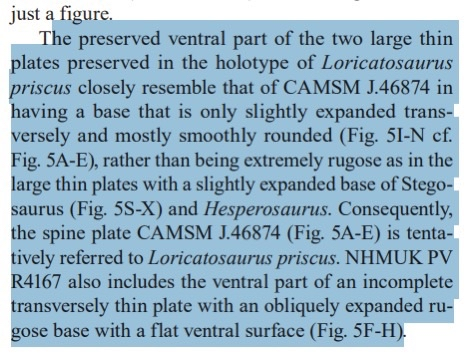
@A_Dank_Normie That are not present in Stegosaurus and Hesperosaurus, namely the lack of deep rugose pattern seen in the plates of Stegosaurus and Hesperosaurus. Here is a screenshot of the referral by Galton. (2/2)
Justice Duncan tweet media
English
0
0
1
84
Justice Duncan
Justice Duncan@JusticeDuncan4·
@A_Dank_Normie In one of the other posts in my string of Loricatosaurus priscus skeletals shows what the plate is based on, which is CAMSM J.46874, a nearly complete plate found in the same locality as the holotype. Galton 2016 refers it to L. priscus based on characters they share (1/2)
English
1
0
3
149
Justice Duncan
Justice Duncan@JusticeDuncan4·
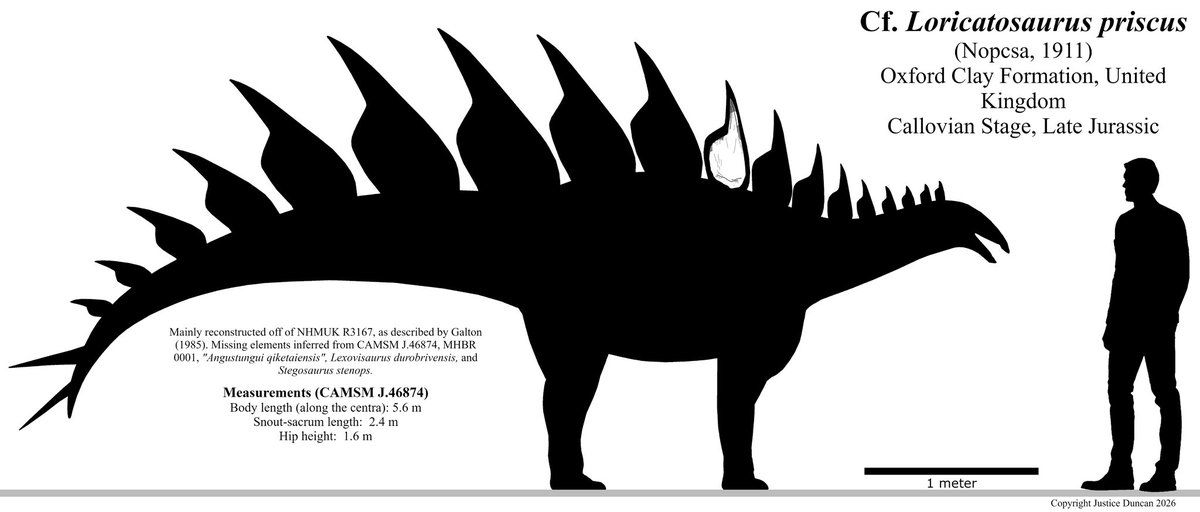
Loricatosaurus priscus was originally discovered by Franz Nopcsa in 1911 as Stegosaurus priscus, and since then has had a rather fun taxonomic history. In 1957 Hoffstetter referred the material to Lexovisaurus durobrivensis, and in 1964 it was renamed Lexovisaurus priscus. (1/3)
Justice Duncan tweet media
English
3
65
427
13K
Justice Duncan
Justice Duncan@JusticeDuncan4·
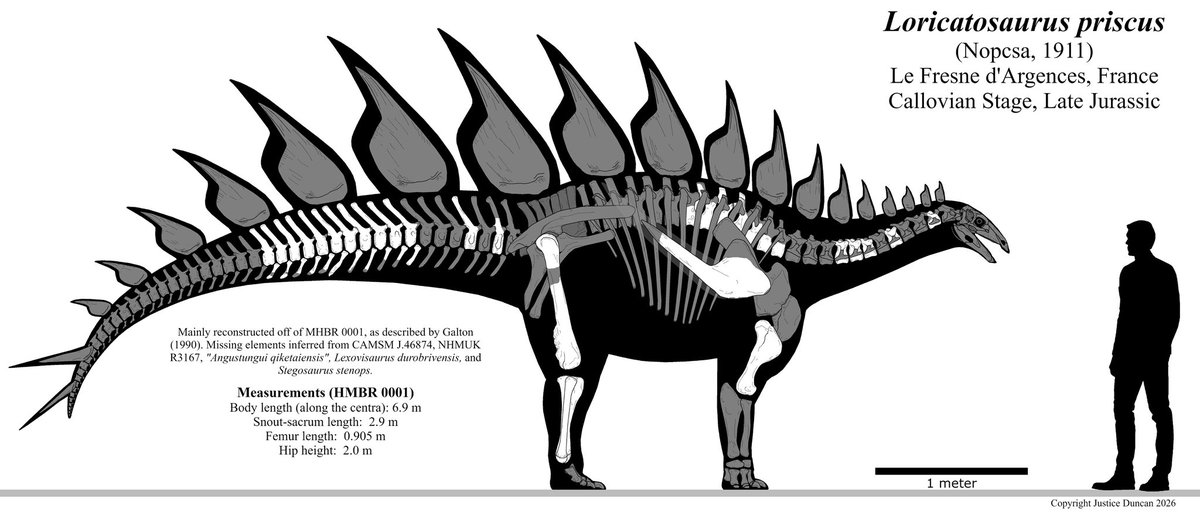
But what happened to Lexovisaurus? It remains a unique taxon, however in 2008 Maidment determined the type of Lexovisaurus was undiagnostic, and authors since have gone back and forth on the matter.
Justice Duncan tweet media
English
0
13
60
1.2K
Justice Duncan
Justice Duncan@JusticeDuncan4·
The plates of my Loricatosaurus are based on an isolated plate that was unearthed a decade prior in the same locality as the Loricatosaurus type, and was originally described as Omosaurus leedsi. It was formally sunk into Loricatosaurus in 2016 by Galton. (3/3)
Justice Duncan tweet media
English
0
20
117
2.7K
Justice Duncan
Justice Duncan@JusticeDuncan4·
In 2008, Susannah Maidment assigned the S. priscus material and the french Lexovisaurus material to a new genus, Loricatosaurus, retaining priscus as the species name. The name means Ancient Armored Reptile, a fitting name for the animal. (2/3)
Justice Duncan tweet media
English
0
15
97
1.5K
Justice Duncan
Justice Duncan@JusticeDuncan4·
@KrzysztofS86r I have no plans on doing Ankylosaurs at all for a multitude of reasons, most notably being the osteoderms seem abysmal to do right. As for Balaur I would but last I checked there was nothing especially great that could be used to reconstruct the unknown material from.
English
0
0
0
42
Prehistorica
Prehistorica@KrzysztofS86r·
@JusticeDuncan4 Could you in the near future reconstruct and estimate for Zuul and Balaur.
English
1
0
1
47
Justice Duncan
Justice Duncan@JusticeDuncan4·
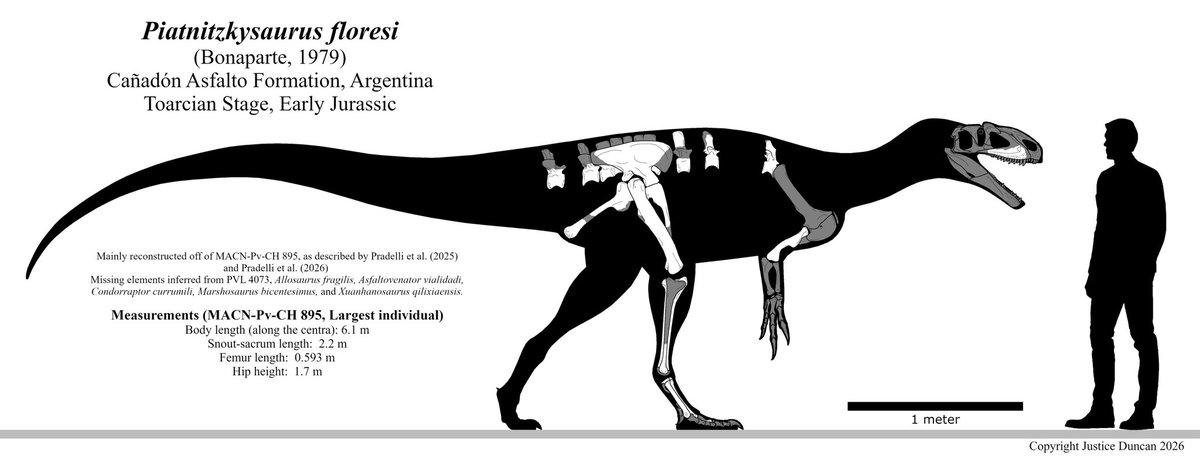
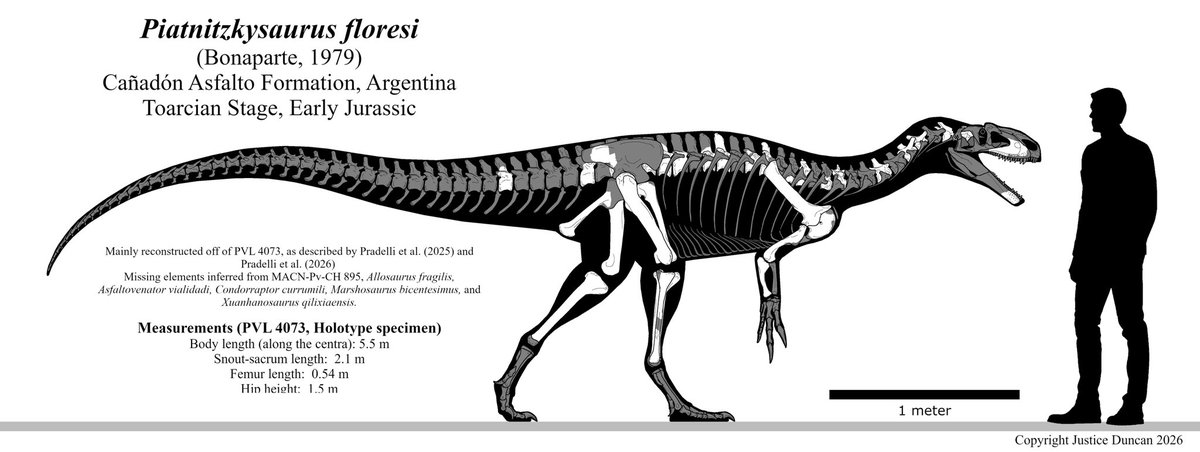
Piatnitzkysaurus was described initially by José Bonaparte in 1979 and is from the Early Jurassic of Argentina. It’s named after Alejandro Matveievich Piatnitzky, who was a Russian Born Argentinian Paleontologist who started the Cañadon Asfalto Formation where it was found. (2/2)
Justice Duncan tweet media
English
3
26
174
2.6K
Justice Duncan
Justice Duncan@JusticeDuncan4·
Piatnitzkysaurus floresi recently got an osteology of it’s axial skeleton to go with the 2025 osteology of it’s appendicular skeleton. It gives a great look at an Early Jurassic Carnosaur, as reconstructed here by me. This specimen is of the Holotype. (1/2)
Justice Duncan tweet media
English
1
58
361
6.7K
Justice Duncan
Justice Duncan@JusticeDuncan4·
Concavenator corcovatus was an animal I made a couple years ago that I was never totally happy with. It remains the most complete Carcharodontosaur, including skin impressions. From the Las Hoyas Lagerstätte, it’s the largest predator known from the locality.
Justice Duncan tweet media
English
3
54
343
6K
Justice Duncan
Justice Duncan@JusticeDuncan4·
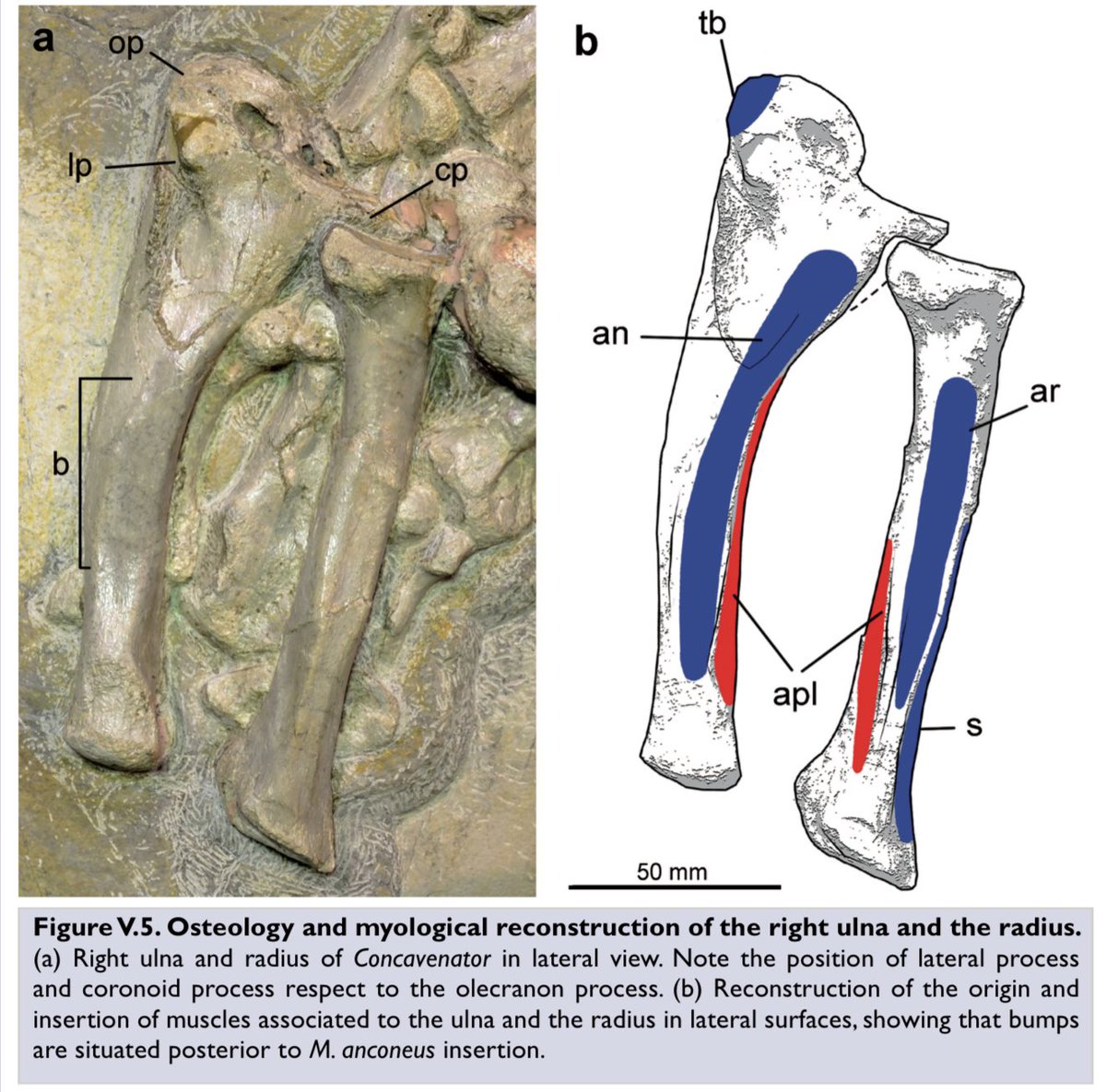
@origamiPete Nothing really further has been published on it, but Fidalgo in her papers on Concavenator (her thesis is what I used but I know it was broken into smaller papers) does do a myology and found that no major muscles would anchor to those knobs, leading her to conclude quill knobs.
English
1
0
2
128
OrigamiPete
OrigamiPete@origamiPete·
@JusticeDuncan4 This is cool! Have there been any more studies done or a shift in consensus on the quill knobs or not quill knobs on its arms?
English
1
0
1
140
Justice Duncan
Justice Duncan@JusticeDuncan4·
@PaleoLogica Thank you! I don’t tend to add things like feathers to my skeletals, but I am of the mind the nubs on Concavenator’s ulna are quill knobs, but acknowledge it’s not settled.
English
0
0
1
117
Asociación Paleo-Lógica
Asociación Paleo-Lógica@PaleoLogica·
@JusticeDuncan4 Muy buen trabajo con el skeletal, especialmente me alegra que no le has puesto esas "cosas raras" en los antebrazos que muchos "fans" le ponen al pobre Concavenator 😅🙏🏼
Español
1
0
1
166
Justice Duncan
Justice Duncan@JusticeDuncan4·
To go along with my Concavenator, I made a highly tentative reconstruction of its maybe sorta kinda larger cousin from the UK, Altispinax dunkeri. This animal is a rework of one I did a long time ago. My old reconstruction might have even been the basis for the JWCT Becklespinax!
Justice Duncan tweet media
English
1
26
188
3.7K