Hsin-Ling Hsu

48 posts

Hsin-Ling Hsu banner
Hsin-Ling Hsu

Hsin-Ling Hsu

@JustinHsu99

Undergrad junior @ NCCU. Trustworthy VLMs/LLMs; AI for Healthcare.

台北市, 台灣 Katılım Kasım 2023
531 Takip Edilen46 Takipçiler
Hsin-Ling Hsu
Hsin-Ling Hsu@JustinHsu99·
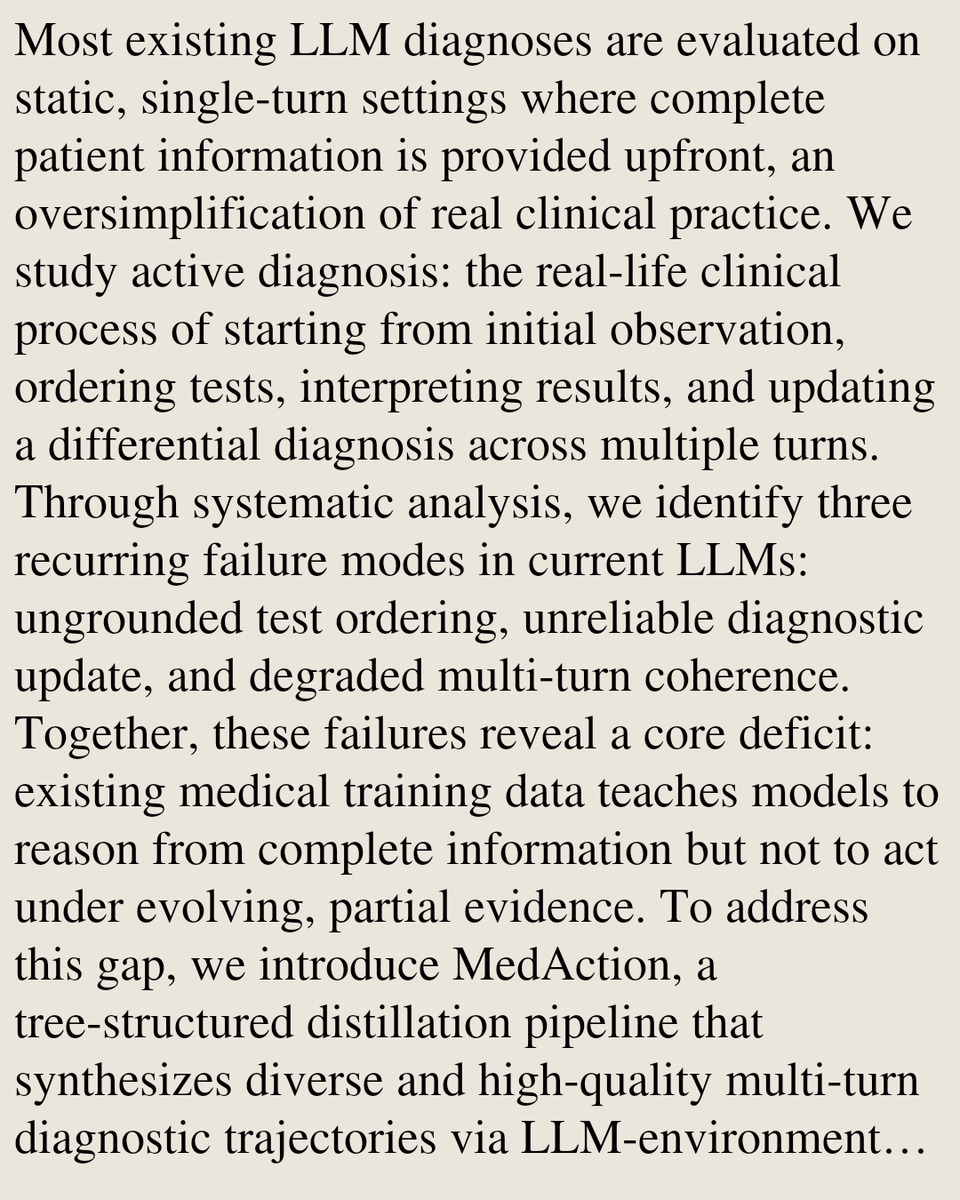
[COLM 2026] Thrilled to receive this surprise right before the end of my undergrad junior year: our paper MedAction: Towards Active Multi-turn Clinical Diagnostic LLMs has been accepted to COLM 2026! 🎉🎉 This is my first first-author paper at a top-tier conference main track (I had an ACL paper last year, but industry track, though ACL industry was around a 25% acceptance rate too, so still pretty competitive xD). I feel incredibly lucky to have produced this result together with the professors, physicians, and collaborators/seniors at the University of Michigan and Far Eastern Memorial Hospital. Heartfelt thanks to everyone on the team. With COLM's acceptance rate at 29% this year and submissions surging, it was even more competitive than last year, which makes getting in all the more exciting. See you all in San Francisco this October! 🌉 --- Paper overview: Most medical LLMs are evaluated in a static, single-turn setting: give the model a complete record and have it predict the disease/ICD directly. But real, complex clinical settings aren't always like that. A physician starts from the chief complaint, then step by step orders tests, interprets results, updates the differential diagnosis, and commits to a final diagnosis once confident. ❓ When you turn diagnosis into a truly multi-turn, active process, how do current LLMs do? Even SOTA models run into three major problems: ungrounded test ordering, unreliable update, and degraded coherence. Existing data mostly teaches models to reason when information is complete, but not how to act when the evidence keeps changing. ❓ So how do we close this gap? We propose MedAction, which has LLMs interact with a simulated clinical environment to generate multi-turn diagnostic trajectories, then filters trajectory quality using two newly proposed KG metrics (DTC and RAC). The 8B model trained on it beats a 235B teacher model, reaches SOTA among open-source models, and earned recognition from clinical physicians. Full paper: arxiv.org/abs/2605.07305 #COLM2026 #LLM #MedicalAI #ClinicalReasoning #AIforHealthcare #MachineLearning
Hsin-Ling Hsu tweet mediaHsin-Ling Hsu tweet media
English
0
4
39
4.9K
Hsin-Ling Hsu retweetledi
Jun-En Ding
Jun-En Ding@CYh4lhDXrLDakuk·
🎉[COLM'26] Excited to share that our paper “MedAction: Towards Active Multi-turn Clinical Diagnostic LLMs” has been accepted to COML'26! We introduce MedAction-32K to train LLMs for active diagnosis through iterative test ordering and evidence-based diagnostic updates.#COLM2026
Jun-En Ding tweet media
English
1
1
5
254
Hsin-Ling Hsu retweetledi
Tanat Tonguthaisri
Tanat Tonguthaisri@gastronomy·
OTTER: A Red-Teaming System for Toxicity-Evading Jailbreak Prompt Optimization: Production LLMs increasingly rely on toxicity-based moderation filters as a primary defense, assuming that harmful intent correlates with toxic surface wording. W… deployments.ift.tt/mNbJ4Q1
English
0
1
1
71
Hsin-Ling Hsu retweetledi
Cryptography and Security Papers
OTTER: A Red-Teaming System for Toxicity-Evading Jailbreak Prompt Optimization Jerry Wang, Hsin-Ling Hsu, Yi-Cheng Lai, Nai-Chia Chen, Fang Yu arxiv.org/abs/2606.21077 [𝚌𝚜.𝙲𝚁 𝚌𝚜.𝙲𝙻]
English
0
2
1
189
Hsin-Ling Hsu retweetledi
Muhan Gao
Muhan Gao@muhan_gao·
🤖 We often talk about “context rot”: LLMs get worse as context grows. But once distracting information enters, is it just “a bit more noise → a bit worse performance”? Our #ICML2026 paper finds: no! 🤯 Instead, we reveal a striking "First Drop of Ink" effect: the first very few hard distractors do almost all of the damage, exactly like how one drop of ink clouding clear water. Paper link: arxiv.org/abs/2605.10828
Muhan Gao tweet media
English
6
15
48
10.6K
Hsin-Ling Hsu retweetledi
Conference on Language Modeling
The discussion period for COLM 2026 is underway! We're sharing a CDF of average review scores. Note that final decisions will reflect deliberation by ACs and PCs, so these are only meant to be a heuristic guideline to give you a sense of where your papers stand. Good luck!
Conference on Language Modeling tweet mediaConference on Language Modeling tweet media
English
2
12
122
27.3K
Hsin-Ling Hsu retweetledi
Natural Language Processing Papers
MedAction: Towards Active Multi-turn Clinical Diagnostic LLMs Hsin-Ling Hsu, Zizheng Wang, Donghua Zhang, Nai-Chia Chen, Jerry Wang, Jun-En Ding, Chia-Hsuan Hsu, Guoan Wang, Feng Liu, Fang-Ming Hung, Chenwei Wu, Liyue Shen arxiv.org/abs/2605.07305 [𝚌𝚜.𝙲𝙻 𝚌𝚜.𝙰𝙸]
Natural Language Processing Papers tweet media
Indonesia
0
1
1
151
Hsin-Ling Hsu retweetledi
Machine Learning (ML) Papers
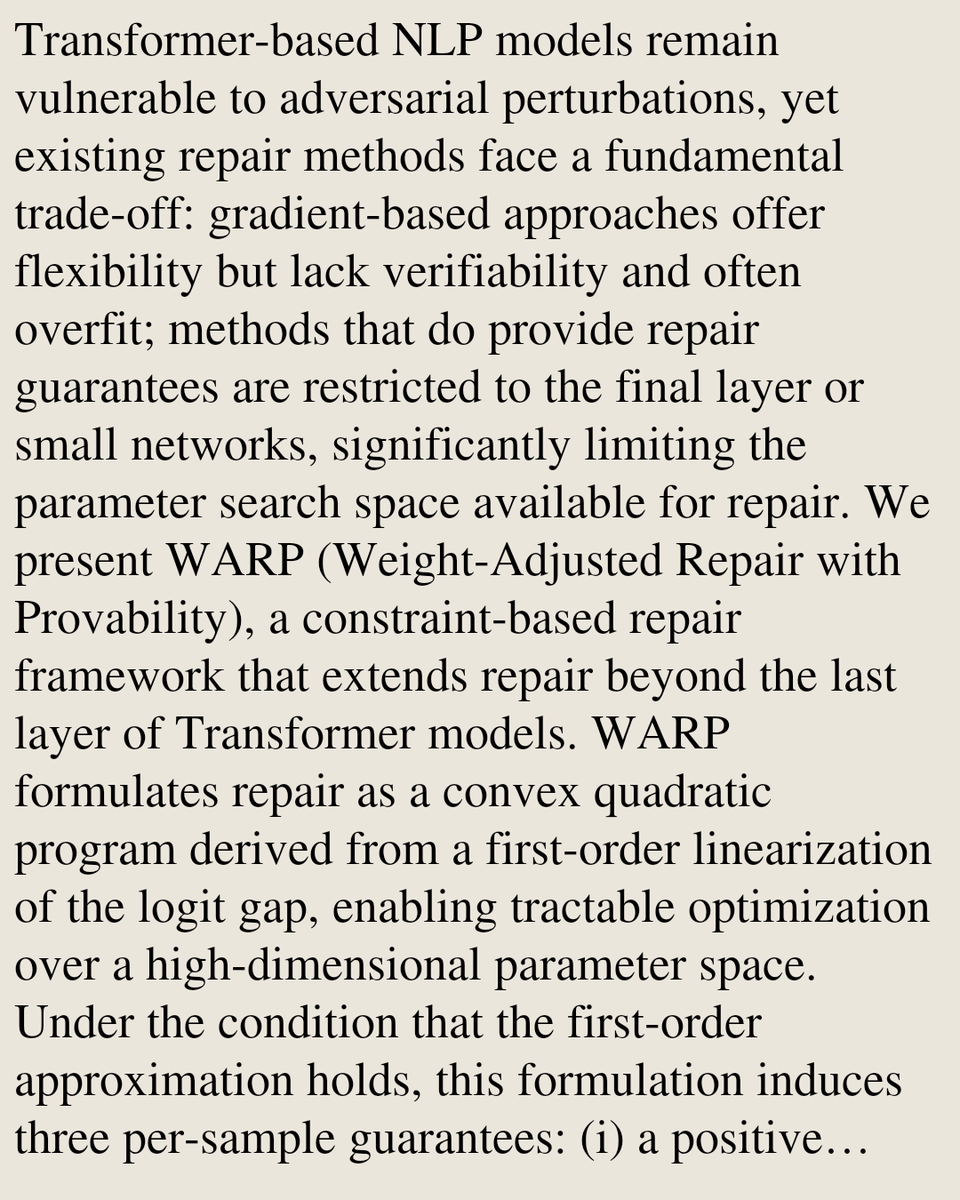
WARP: Guaranteed Inner-Layer Repair of NLP Transformers Hsin-Ling Hsu, Min-Yu Chen, Nai-Chia Chen, Yan-Ru Chen, Yi-Ling Chang, Fang Yu arxiv.org/abs/2604.00938 [𝚌𝚜.𝙻𝙶 𝚌𝚜.𝙰𝙸]
Machine Learning (ML) Papers tweet media
English
1
1
2
139
Hsin-Ling Hsu retweetledi
Sharon Li
Sharon Li@SharonYixuanLi·
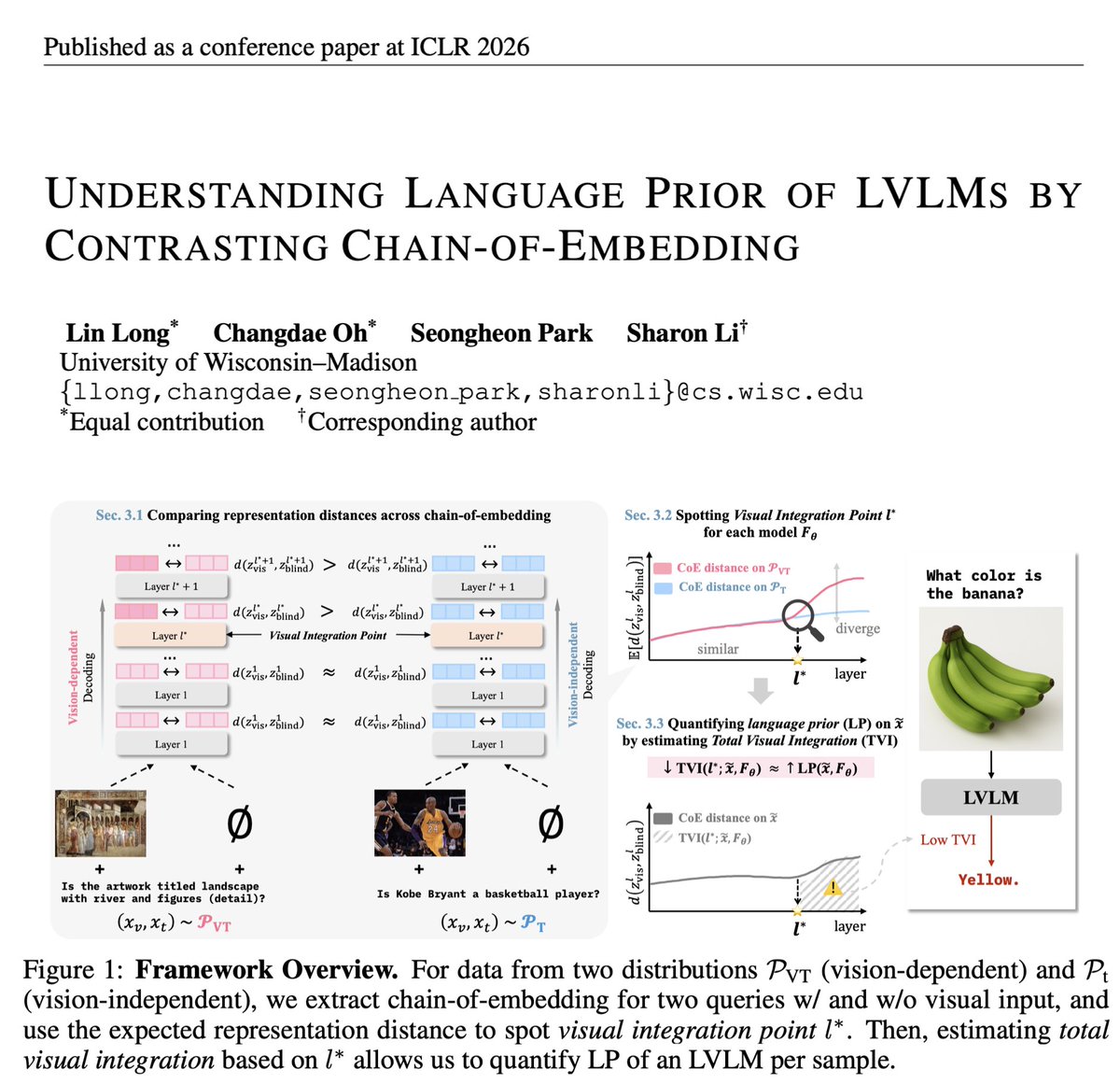
When evaluating LVLMs, should we really be asking: “Did the model get the right answer?” or rather “Did the model truly integrate the visual input?” LVLMs can rely on shortcuts learned from the underlying language model, aka language prior. In our #ICLR2026 paper, we attempt to understand this phenomenon at a deeper, representation-level. 📄 “Understanding Language Prior of LVLMs by Contrasting Chain-of-Embedding”. arxiv.org/abs/2509.23050 ------- 1/ Problem: LVLMs often ignore visual evidence While LVLMs perform well on many benchmarks, they sometimes rely on language patterns rather than actual images. A simple example: show a model a green banana, and it may confidently describe it as “ripe and yellow” ---because that’s the most common linguistic pattern it has learned. 🍌 This raises a central question: Where inside the model does visual information begin to influence its reasoning? 2/ Motivation: Output-level probes fall short Most analyses inspect outputs, e.g., by removing the image or comparing predictions. But these methods cannot reveal when the model starts integrating vision and how strongly visual signals affect internal states. To address this, we need a representation-driven perspective. 🔍 3/ Approach: Contrasting Chain-of-Embedding (CoE) We trace hidden representations across the model’s depth for the same prompt: •once with the image •once without the image By comparing these trajectories layer by layer, we identify the exact point where visual input begins shaping the model’s internal computation. This leads to the discovery of the Visual Integration Point (VIP) ✨--- the layer at which the model “starts seeing.” We then define Total Visual Integration (TVI), a metric that quantifies how much visual influence accumulates after the VIP. 4/ Findings across 10 LVLMs and 6 benchmarks Across 60 evaluation settings, we observe: • VIP consistently appears across diverse architectures • Pre-VIP → representations behave like a language-only model • Post-VIP → visual signals increasingly reshape the embedding pathway • TVI correlates strongly with actual visual reasoning performance • TVI outperforms attention- and output-based proxies at identifying language prior TVI thus offers a more principled indicator of whether a model actually uses the image. 5/ Impact: A new lens on multimodal behavior Our framework has a few practical benefits. It enables (1) diagnosing over-reliance on language prior, (2) comparing LVLM architectures more rigorously, (3) informing better training and alignment strategies, and (4) improving robustness and grounding in real-world tasks. Shout out to my students for this insightful work: Lin Long, @Changdae_Oh, @seongheon_96 🌻 Please check out our paper for more details!
Sharon Li tweet media
English
2
35
228
14.9K
Hsin-Ling Hsu retweetledi
Akari Asai
Akari Asai@AkariAsai·
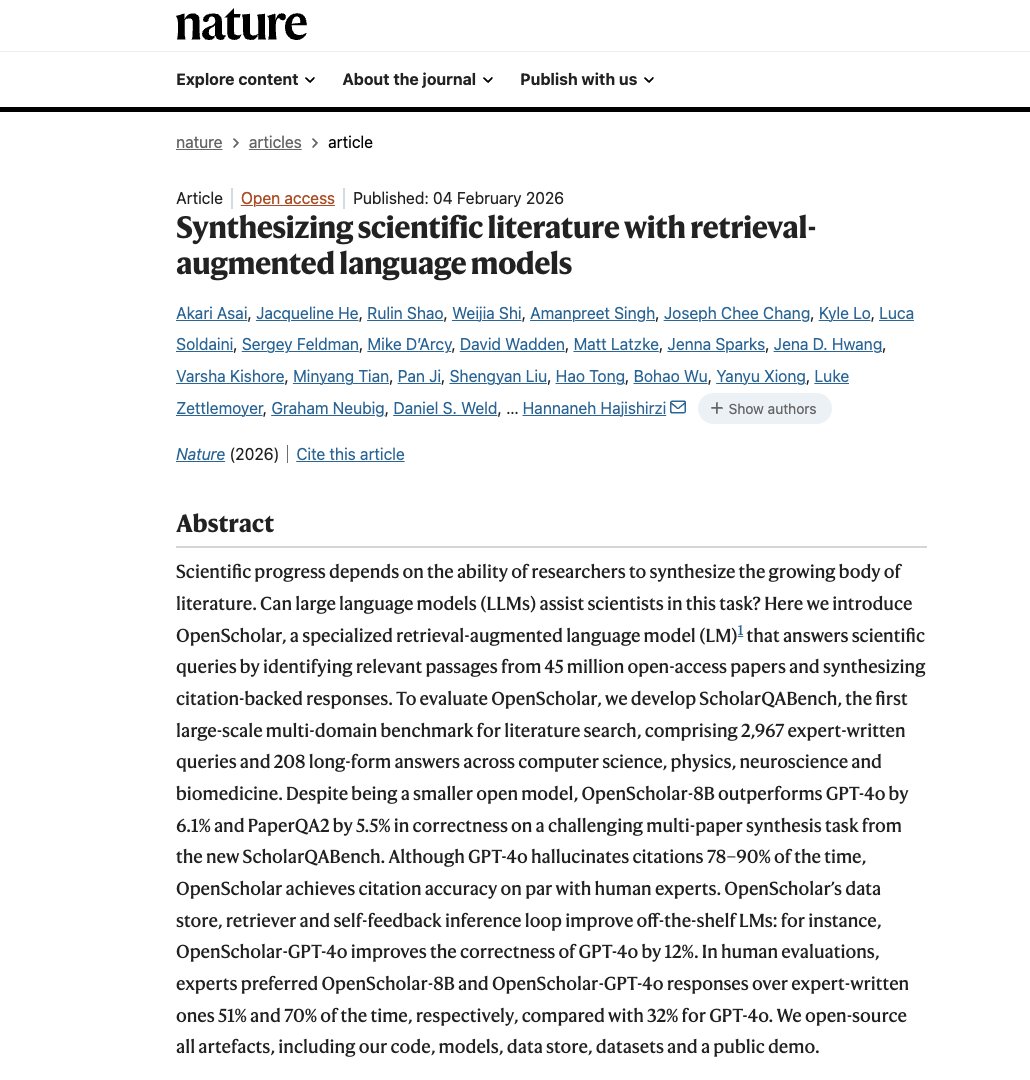
Thrilled to share: OpenScholar - our work on scientific deep research agents for reliable literature synthesis -has been accepted to Nature! 🎉 Huge thanks to collaborators across institutions who made this possible!
Akari Asai tweet media
English
33
224
1.3K
127.2K
Hsin-Ling Hsu retweetledi
OpenAI
OpenAI@OpenAI·
Introducing Prism, a free workspace for scientists to write and collaborate on research, powered by GPT-5.2. Available today to anyone with a ChatGPT personal account: prism.openai.com
English
1.1K
2.3K
16.1K
5.9M
Hsin-Ling Hsu retweetledi
Kuan-Hao Huang
Kuan-Hao Huang@kuanhaoh_·
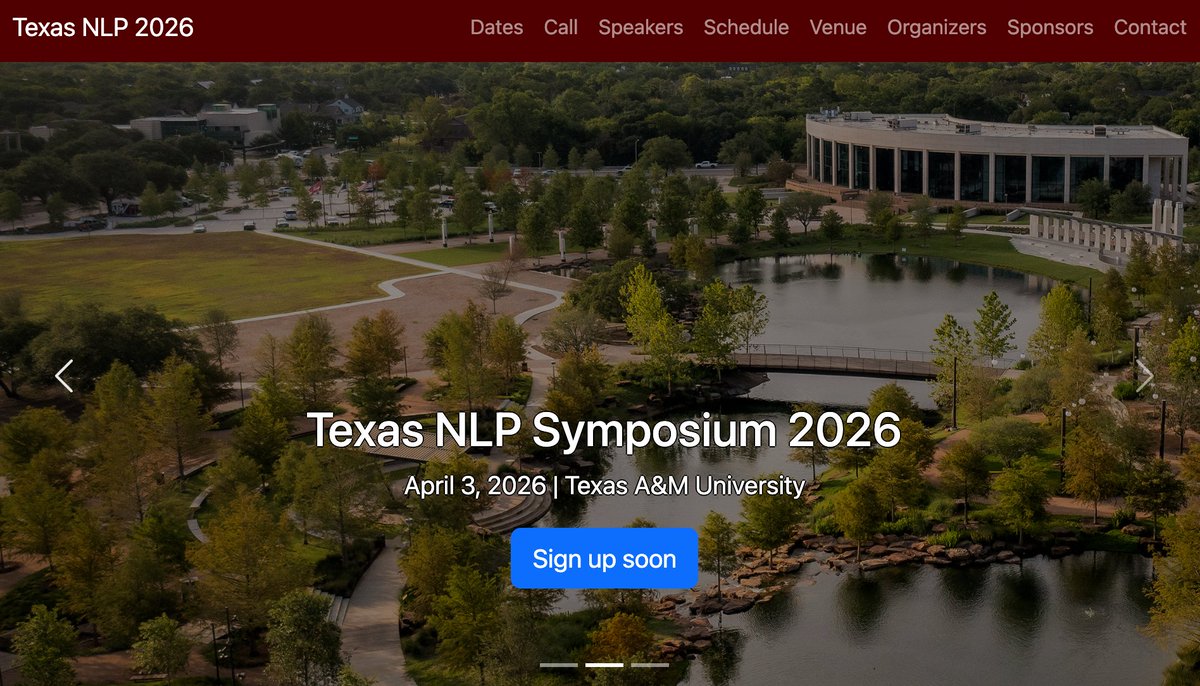
We're organizing the 1st Texas NLP Symposium! A one-day workshop bringing together NLP researchers across Texas and beyond to share ongoing work. 📅 April 3, 2026 📍 Texas A&M University 📣 Call for Papers ⏰ Deadline: Feb 20 🔗 texas-nlp.github.io Consider submitting!
Kuan-Hao Huang tweet media
English
4
19
89
10K
Hsin-Ling Hsu retweetledi
OpenAI
OpenAI@OpenAI·
Introducing ChatGPT Health — a dedicated space for health conversations in ChatGPT. You can securely connect medical records and wellness apps so responses are grounded in your own health information. Designed to help you navigate medical care, not replace it. Join the waitlist to get early access. openai.com/index/introduc…
English
1.3K
2.1K
16.1K
7.6M
Hsin-Ling Hsu retweetledi
Conference on Language Modeling
COLM 2026 is just around the corner! Mark your calendars for: 💡Abstract deadline: Thursday, March 26, 2026 📄Full paper submission deadline: Tuesday, March 31, 2026 Call for papers in thread (website coming soon).
Conference on Language Modeling tweet media
English
5
29
201
36.1K
Hsin-Ling Hsu retweetledi
Conference on Language Modeling
COLM is going to San Francisco for 2026! 🗓️Dates: October 6-9, 2026 🏨Venue: Hilton San Francisco Union Square Website and CFPs for papers and workshops coming up soon!
Conference on Language Modeling tweet media
English
9
59
498
147.2K
Hsin-Ling Hsu retweetledi
GenAI4Health
GenAI4Health@GenAI4Health·
📢 Recruiting reviewers for #genai4health! Unexpected volume of submissions received. 📅 Reviews due: Sept 19 (AoE) to ensure accepted authors have visa/travel time. We welcome expertise in: 1. GenAI in Health (diagnosis, treatment, imaging, robotics, synthetic data) 2. Trust & Risk in Health AI (safety, fairness, ethics) 3. Health Policy & Compliance (FDA, regulation) Apply: forms.gle/xrv3uAwdexrq3a…
English
1
2
7
2.6K
Hsin-Ling Hsu retweetledi
GenAI4Health
GenAI4Health@GenAI4Health·
Call for Submissions – GenAI4Health @ NeurIPS 2025 Full CFP & submission details: → genai4health.github.io We are excited to invite submissions to the second GenAI4Health workshop at NeurIPS 2025! This workshop brings together AI4Health practitioners, safety researchers, and policy experts to tackle critical challenges in building robust, trustworthy, and policy-compliant GenAI technologies for health. ––– KEY DATES (AoE) ––– • Aug 22 → Submission Deadline • Sept 22 → Notifications • Dec 6 or 7 → Workshop @ NeurIPS 2025 ––– TOPIC AREAS ––– • GenAI Applications & Use Cases:  – Clinical diagnosis, Personalized treatment, Synthetic data, Surgical robotics, Drug discovery • Trustworthiness & Risk Management: Safety benchmarks, Explainability, Robustness, Privacy, Fairness • Policy & Compliance:  – FDA alignment, HIPAA compliance, Clinical validation, Ethical guidelines ––– SUBMISSION TRACKS ––– • Research Papers (≤ 9 pages) – Methodological advances • Demo Papers (≤ 5 pages) – Working systems (title: “Demo:”) • Position Papers (≤ 5 pages) – Policy perspectives (title: “Position:”) Whether you're working on clinical AI, safety evaluation, or healthcare policy, we’d love to see your work! Contact: jiaweixu@utexas.edu xtiange@stanford.edu ying.ding@ischool.utexas.edu #GenAI4Health #NeurIPS2025 #AI4Health #ResponsibleAI #HealthcareAI #CallForPapers
GenAI4Health tweet media
English
0
2
4
1.9K