Matt Wilks
805 posts

Matt Wilks
@K33pFracing
Pro America. Pro Capitalism. Pro Oil & Gas. Pro environment. That’s why we’re ProFrac! $ACDC
Fort Worth, TX Katılım Nisan 2012
692 Takip Edilen1.4K Takipçiler
Sabitlenmiş Tweet

It makes no sense.
However, I’m I’m looking forward to the market gaining *some* transparency into supply going forward. Futures have been treating the strait like it’s is faucet and if it would just open, everything would immediately go back to normal.
- The fields are on water flood
- 40+ facilities were destroyed
1. 300-400mm bbls from closed strait
2. 5mm bbl/d for 180 days to get back 70% of lost production
3. 1mm bbl/d for 24 months to get back the last 30%
4. Over produce by 2mm bbl/d for another 36 months to recover inventory loss
Futures act like everything is back in a few months.
English

Has anyone (serious people) read the proposed ceasefire and seriously thinks it’s agreeable?
Most likely it’s biding time for all parties to regroup, re-arm and get more favorable terms.
There are no innocent or trustworthy parties
🏴PermianPostReality🏴@PermianPost
EVERYTHING IS FAKE AND GAY
English

@MattG_PE @JavierBlas Should I lease or own my raptor? Bloomberg says I should rent it on Turo.
English

@JavierBlas Great context that wti was above $100 for 80 days in 2022
English

@chigrl The pipes are good for 7, however the Yanbu export facility has struggled to exceed 4 million barrels a day.
English

Marvel of a feat>
Saudi Pipeline That Bypasses Hormuz Hits 7 Million Barrel Goal
Saudi Arabia’s crucial East-West pipeline that circumvents the Strait of Hormuz is pumping oil at its full capacity of 7 million barrels a day, according to a person familiar with the matter.
Crude exports via Yanbu have now reached 5 million barrels a day and the kingdom is also exporting about 700,000 to 900,000 barrels a day of oil products, according to the person familiar with the Saudi oil industry. Of the 7 million barrels that goes through the pipeline, 2 million are destined for Saudi refineries.
The Yanbu route only partly offsets the hit to supply from shutting Hormuz, through which about 15 million barrels a day of crude shipments passed before the war. But the bypass is one reason oil prices haven’t reached the crisis-level highs of previous supply shocks. (Bloomberg)
English
Matt Wilks retweetledi

Helpful timeline info from @Amena__Bakr on restart timelines for shut-in production.
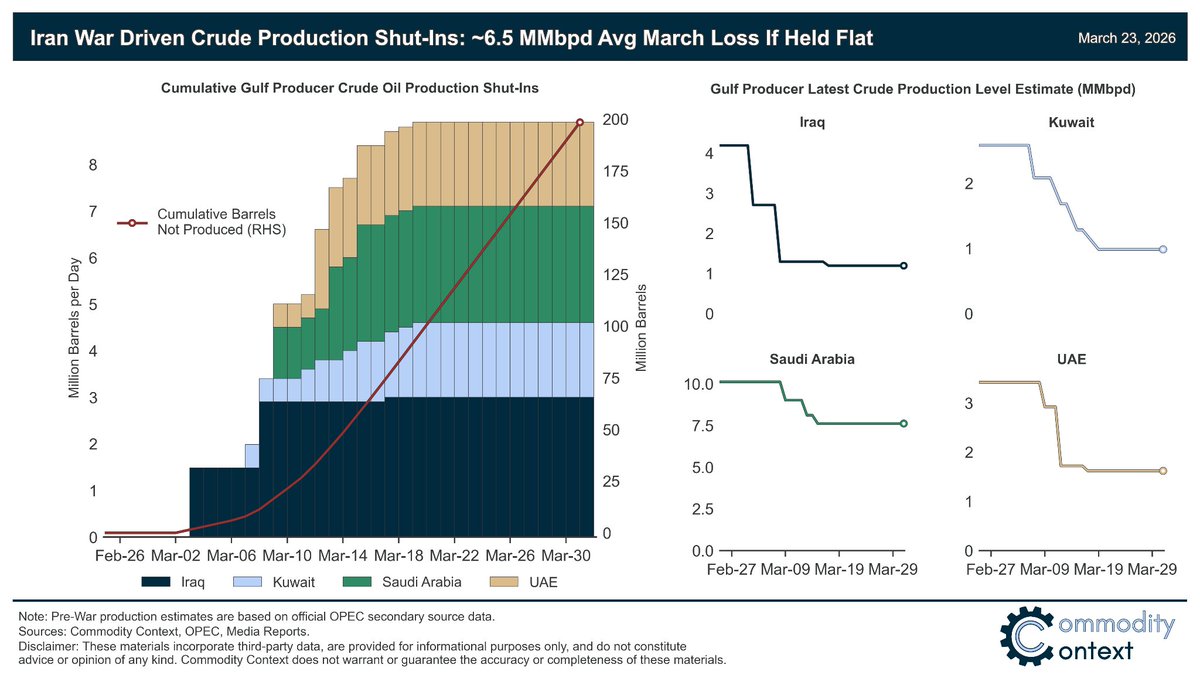
At lest count Kuwait had already shut in 1.6 MMbpd of production (likely higher by now), roughly 30 million barrels unproduced by end-March.
Let's be generous and use 3 months from April 1st with a steady steady recovery pace through the end of June.
That recovery profile would imply total Kuwaiti crude production losses of more than 100 million barrels over the course of the Iran War.
And that's if we start the timer at the end of the week—reality likely less optimistic.

Amena Bakr@Amena__Bakr
If the war ended today it would take Kuwait 3-4 months to restore production to full capacity- according to KPC’s CEO #OOTT
English
Matt Wilks retweetledi

Everyone is covering the force majeure. Everyone is covering the 13 million tonnes. Everyone is covering the gas prices and the geopolitics and the five-year timeline.
My good friend Veron Wickramasinghe just asked the question nobody else is asking: how do you rebuild when the machines that make the molecules take three to four years to manufacture, ship through a closed strait, and commission in a war zone?
Read what he found.
Every LNG train at Ras Laffan requires high-purity nitrogen from Air Separation Units: cryogenic plants cooling air to minus 190 degrees to distil it into component gases. Pearl GTL needs 30,000 tonnes per day of pure oxygen from eight Linde-built ASUs. Each cold box: 470 tonnes, 60 metres tall. Lead time from contract to commissioning: three to four years. If destroyed, replacement arrives no earlier than 2029.
But here is the choke point that Veron identified that nobody else has. The heart of every cryogenic ASU is a brazed aluminium plate-fin heat exchanger called a BAHX. These exchangers operate with temperature differentials of one to two Kelvin and require precision brazing in vacuum furnaces. Only five companies on Earth are qualified to manufacture them. Five. For every cryogenic heat exchanger in every air separation unit, every LNG train, every industrial gas facility, and every hydrogen plant on the planet. Fives Cryo in France. Kobelco in Japan. Linde in Germany. Sumitomo in Japan. Chart Industries in La Crosse, Wisconsin. Current lead times: 12 to 18 months or more. And their order books are already full.
Veron was honest about what is confirmed and what is not. QatarEnergy CEO al-Kaabi confirmed LNG Trains 4 and 6 are damaged: 12.8 Mtpa offline, 3 to 5 year repairs, $20 billion annual revenue loss, force majeure up to 5 years. Shell confirmed Pearl GTL Unit 2 needs roughly one year of repair. What has NOT been confirmed is whether the ASUs themselves were destroyed. Shell’s one-year timeline is inconsistent with total ASU loss, which would require four to five years. Veron flagged this honestly and gave you the analysis both ways.
And then he showed you the cascade nobody else sees.
Qatar produces one-third of the world’s helium from the same facility. Helium is irreplaceable in semiconductor fabrication: cooling wafers, purging chambers, detecting leaks. Samsung and SK Hynix import 64.7 percent of their helium from Qatar. Spot prices have doubled. Liquid helium vaporises within 35 to 48 days. Fourteen percent of capacity is permanently damaged.
The LNG trains, the ASUs, and the helium plants all sit on the same rock, fed by the same gas field, accessed through the same strait. One set of missile strikes on March 18 to 19 took out 17 percent of global LNG, threatened one-third of global helium, and exposed a supply chain that runs through five workshops in Germany, France, Japan, Italy, and Wisconsin with three-year lead times and full order books.
This is what Veron understood that the headline analysts missed: the recovery is not constrained by money or political will. It is constrained by vacuum furnaces, aluminium metallurgy, and the physics of brazing at tolerances measured in single-digit Kelvin. You cannot accelerate physics. You cannot surge-produce a 470-tonne cold box. You cannot commission cryogenic equipment in a war zone.
Five companies. Five workshops. Three-year lead times. Full order books. A closed strait. An active war.
That is not a recovery timeline. That is a sentence. Read Veron’s full analysis. It is the most important thing written about this war that does not involve a missile.

Veron Wickramasinghe@veronken
English
Matt Wilks retweetledi

Let me offer discussion points on why they decided to bomb Kharg Island.
The administration and military planners likely concluded that it would take weeks, if not months, to secure the Strait of Hormuz. During that time, oil prices could rise to levels that would suffocate the global economy.
This was unacceptable. They are desperate for immediate action. So, they needed a bold, decisive move to force Iran to relent quickly.
Trump was clear. They bombed Iranian military structures on Kharg but left the oil infrastructure unharmed (assuming this is accurate).
Recognizing that this could freak out oil markets, they announced it on Friday evening to give markets 48 hours to digest the news. Trump also made it explicit that oil infrastructure would be next if Iran did not allow ships to pass freely through the Strait of Hormuz.
In football terms, they're throwing a Hail Mary pass now, hoping it works. They don't have any more time on the clock. Oil markets and the world economy cannot wait weeks or months for the military to open the Strait.
Further, I could envision political advisors suggesting that if oil prices are destined to hit $200 without this action, it might as well happen next week, giving six months to bring them down before the midterm elections.
As I've argued in many other posts, Trump cannot simply declare victory and pull out (TACO). That would be worse. It would leave Iran in control of the world's economic jugular, allowing it to punish everyone by permanently holding oil at $200. So, they must force Iran to relent.
Again, these are just the thoughts running through my head as I try to explain to myself why they took this step.
The White House@WhiteHouse
“Moments ago, at my direction, the United States Central Command executed one of the most powerful bombing raids in the History of the Middle East, and totally obliterated every MILITARY target in Iran’s crown jewel, Kharg Island... Iran has NO ability to defend anything that we want to attack — There is nothing they can do about it!" - President Donald J. Trump 🇺🇸
English