

Kenneth Gay🛡️
204 posts

Kenneth Gay🛡️
@KGitpro
Crypto and Real Estate Investments
McKinney, TX Katılım Kasım 2022
994 Takip Edilen398 Takipçiler

Forty years in IT: soldering boards, midnight patches, global clouds. Thought I knew deep—then AI swallowed me. Three hundred-plus hours: chats, models, routing, hardware, security mazes. Built something real. Family? Crypto? Real estate? All on mute.
But hey—I'm coming back. Just... give me a little while. This rabbit hole's endless; every layer peels back ten more. And I'm still falling.
English
Kenneth Gay🛡️ retweetledi

Breaking: Latest Compromises Proposed by Crypto Firms to Banks let us know what is coming.
To break the deadlock and salvage the bill, crypto industry representatives have floated targeted concessions focused on integrating community banks more directly into the stablecoin ecosystem. These proposals aim to address banks’ fears of disintermediation while giving smaller institutions new revenue opportunities:
1. Placing portions of stablecoin reserves with community banks
• Instead of reserves being concentrated at large custodians (e.g., BNY Mellon) or megabanks, crypto issuers could allocate a meaningful share to community/regional banks.
• This would recycle dollars back into the local banking system, supporting lending and reducing outflow concerns. It could also diversify reserve custody, potentially improving stability and earning banks custodial fees.
2. Enabling community banks to issue their own stablecoins via partnerships
• Smaller banks could partner with crypto firms (e.g., tech providers or issuers like Circle) to launch branded or co-issued stablecoins.
• This positions banks as active participants rather than competitors being disrupted—potentially allowing them to offer digital dollar equivalents tied to their deposits, attract crypto-native customers, and generate new fee income.
• Examples from related developments include state-level experiments (e.g., North Dakota’s planned “Roughrider” stablecoin via its state-owned bank partnering with community lenders) and broader explorations of tokenized deposits.
These ideas represent a pragmatic olive branch: crypto concedes some ground on reserve concentration and yield structures in exchange for broader regulatory approval, while banks gain direct involvement and potential upside in the growing stablecoin market (projected by some forecasts to reach trillions in capitalization).
English
Looking forward to the new year and seeing what crypto brings. I'd also like to thank the office gang for keeping our heads straight during 2025 amid the crazy swings. Big thanks to @martypartymusic for working his butt off on the LQL and the education he provides to everyone in the space.
Big thanks to @btc_ted and @WestClintwood for keeping engagement with trades and the market a top priority. I've been in this space a long time but learn more every day with the group.
Let's go 2026!
English


HOOD Holidays kicks off tonight.
Be on the countdown screen in the Robinhood app when it runs out at 8:30 PM ET to claim your surprise.
Every participant gets a gift.
rbnhd.co/4j8M1VJ
English
It's that time of year again. Hope y'all enjoy your family and friends.
English
Hopefully, Jupiter gets some fees from this to pay the JUP and JLP holders.
Jupiter@JupiterExchange
Gud Tek
English
Jupiter is cooking! The Breakpoint list is huge. Worth the read, or here’s the Grok summary:
Jupiter’s Breakpoint 2025 announcement outlines seven targeted upgrades to its Solana-based DeFi stack, tackling onchain challenges like fragmented data and shallow liquidity through improved lending, stablecoin integrations, and developer tools.
Key highlights: Jupiter Lend exits beta with open-source code for efficient risk management; JupUSD stablecoin launches next week for seamless ecosystem rewards; acquisition of Rainfi to enable money markets for diverse assets.
Backed by $1.08T YTD trading volume and $2.7B TVL, these upgrades position Jupiter as a leader in transitioning users to intuitive onchain finance, proven by rapid growth and integrations like Robinhood.
Jupiter@JupiterExchange
Breakpoint Special: Pushing Onchain Finance Forward Onchain finance is the future. It is fundamentally a better system, with open rails, transparent logic, self-custody as a default, and verifiable rules which apply equally to everyone. But the transition from off chain to onchain is a historical moment and brings about a new set of generational problems: fragmented data, fraudulent assets, fragile liquidity layers, shallow integrations, and a lack of professional-grade tools that make onchain usable for real traders, builders, and everyday users. These are foundational problems that demand generational solutions. At Jupiter, we’re here to build the future of onchain finance. With $1.08T in combined spot + perps volume YTD, the highest TVL on Solana ($2.7B), 34M+ active wallets YTD, and our full 12 product stack across all surfaces (web, mobile, APIs) - no one is better positioned to lead this transition. For the world to choose onchain, the path needs to feel transparent and intuitive - so seamless that people prefer it without needing to understand what’s underneath. That has been the north star behind everything we’ve built this year. We have been relentlessly upgrading the products, the infrastructure, and the team itself, and now we’re ready to step into the next chapter with our singular focus on easing the world to onchain finance. And today at Breakpoint, Kash unveiled a coordinated wave of upgrades built around one question: What Key Problems Are We Solving For Onchain Finance? Every upgrade you see today is part of that answer. Not entirely new things, but stronger upgrades of the products that already power the ecosystem. 1. We need world-class yield products. Jupiter Lend: Out Of Beta & Open Sourced. • Historical problem: The conditions that a lending market can offer to its users are directly linked to the efficiency of its risk management system. Many platforms offer borrowers conservative risk parameters because of this, providing them with less utility for their capital. • Why Us: Jupiter Lend, built in conjunction with Fluid, introduces tick-based liquidity, which enables all risky positions to be liquidated in a single transaction. This efficient design allows Lend to offer borrowers a UX no other protocol can. Users receive the highest LTVs and lowest liquidation penalties in the industry, which will continue to increase as the protocol grows. Lenders on the other hand receive deep liquidity, mitigating the liquidity crunches that can cause unstable rates and prevent withdrawals. The demand for this model has been so overwhelming, that Lend was the fastest growing protocol in Solana history to reach $1B in Total supply, taking only 8 days to achieve this feat. • What’s upgraded today: After 4 months, Jupiter Lend is now officially out of Beta and fully open source. (jup.ag/lend/transpare…). 2. Stablecoins need deep DeFi integrations. JupUSD: Deeply embedded across our platform and sharing economics with users of Jupiter products. • Historical problem: Stablecoins alone are not enough, they need to be integrated to create a virtuous flywheel. • Why us: Jupiter’s world-class product suite already routes billions in stablecoin volume via swap aggregation, perpetuals, and lending. By launching JupUSD in collaboration with Ethena, we’re now completing the entire stack end-to-end. When you control both the dollar and the platform it transacts through, you can build what isolated stables never could: full protocol level engineering. Each use case synergizes with each other, creating a flywheel that’s only possible with deep product integrations. • What’s upgraded today: JupUSD integrations across the entire Jupiter ecosystem enable rewards while you wait (e.g DCA, Limit Order, prediction markets, and more). Note: JupUSD will be launching next week 3. The ecosystem needs a trusted data layer for token information. VRFD: Upgrading the most trusted token information system in DeFi. • Historical problem: ~30k tokens launched daily on Solana (with a majority of these being scams & imposter tokens), mismatched metadata, and no unified standard to know what’s real. Projects, builders, and users have been guessing for years. • Why us: Jupiter Verify is already the most trusted and used token verification system in DeFi - powering nearly every wallet, terminal, and explorer for free. After four years of iteration, Verify has the fastest approvals with smart social validation and a holistic review across 6 key signals, clearest guidelines, and the most effective system yet to keep traders safe from imposter tokens. • What’s upgraded today: VRFD expands Verified into a full trusted data layer and platform, integrated across all surfaces and available via the Pro API. Our full team behind VRFD created a platform to go beyond token verification to verifying metadata and high signal insights, and is available across our sites, Jupiter mobile, and APIs (verified.jup.ag). 4. We need simple ways for developers to access complex functions. Developer Platform: Upgrading the most integrated API infrastructure in DeFi. • Historical problem: Developers need simple ways to access complex functions at scale, and there is currently no single place to see usage, errors, performance, and logs across the entire API surface area. • Why us: Jupiter already has the most integrated APIs in DeFi, powering thousands of apps, wallets, and protocols. • What’s upgraded today: The Developer Platform now gives comprehensive visibility into logs, usage insights, user patterns, and product performance, all in one place - a complete toolkit for builders wanting to leverage Jupiter tech and integrate this on chain vision into their stack. Track every swap, pricing call, and token API request at a glance with our real-time dashboard & analytics, view your usage across all Jupiter APIs, and debug with precision (investigate 429s,500s, and downtime with our comprehensive logs page) - giving you all the tools to ship and build more efficiently. (portal.jup.ag). 5. We need more trading activity directly onchain, and traders need access to pro tools. Terminal: Upgrading professional data & execution for onchain trading. • Historical problem: The amount of data is exploding, and traders need world-class tools and execution. And we need to bring more trading activity directly onchain. • Why us: Jupiter is simply already the best place to trade. Our platform is powered by Ultra v3, the most advanced end-to-end trading engine ever built, with proprietary features like Jupiter Beam and Predictive Execution, with adoption by industry leaders like Robinhood. • What’s upgraded today: Now we’ve unified everything into the most advanced trading terminal, consolidating trading for all asset classes into a single platform, featuring real-time wallet tracking, Alphascan’s analytics across 61+ launchpads with dev blacklisting, and professional execution tools including OCO orders and partial fills (jup.ag/terminal). 6. We need to align incentives of traders and encourage more onchain trading. Rewards Hub: Upgrading onchain participation and alignment between users and platform. • Historical problem: Onchain incentives have been fragmented and disconnected from real usage. • Why us: Jupiter already routes and powers the activity that traders want to be rewarded for. • What’s upgraded today: The Rewards Hub + Referrals unifies rewards, trading activity, and referrals into one system with a $1M pool tied to real contributions (jup.ag/rewards - only for web. Mobile, and wallet, not APIs). 7. We need a money market for every asset. Acquisition of Rainfi: Upgrading what lending can support towards a money market for every asset. • Historical problem: Off-chain assets, long-tail assets, and long-duration assets have never had a real path onchain. Peer-to-peer lending lacked scale and integrations. • Why us: Jupiter Lend already solved borrower-first design, but extending lending to infinite productive asset types requires new models. • What’s upgraded today: By acquiring Rain.fi, we’re bringing in the most innovative on protocols, who are already building Offer Book, a specialized orderbook that enables a simpler and more transparent way to access liquidity (no price-based liquidations) and make every onchain asset productive - launching in Q1. Taken together, these upgrades represent a coordinated step-change for onchain finance. Across data, execution, lending, liquidity, mobile, developer tools, and incentives, every layer of the Jupiter stack has been strengthened and expanded. These aren’t new products or new directions, they are deliberate upgrades to the systems already powering hundreds of millions of users, traders, and builders. This is how our vision becomes real: one unified push toward a world where the best financial experience lives fully onchain. Over the coming days, we’ll dive deeper into each upgrade, with more improvements still on the way.
English
Kenneth Gay🛡️ retweetledi
Bank of America Launches Bitcoin-Backed Credit
A Major Step in Crypto Mainstream Adoption on December 11, 2025, Bank of America (@bofa ) the $1.7 trillion asset giant announced the launch of BTC-collateralized credit loans.
This allows clients to use their #Bitcoin holdings as collateral to secure cash loans without selling their assets, marking a pivotal shift from crypto skepticism to institutional integration. It's part of a broader trend where eight of the top 10 U.S. banks, including BofA, JPMorgan, Citibank, and Wells Fargo, now offer similar Bitcoin-secured lending products.
What This Means and How It Works
Core Mechanics: Borrowers deposit Bitcoin into a BofA-managed custody account. The bank issues a loan (typically in USD) based on the BTC's value, with loan-to-value (LTV) ratios ranging from 50-70% to buffer against volatility. Interest rates are competitive at 4-6%, lower than many DeFi alternatives. If BTC's price drops sharply, triggering a liquidation threshold (e.g., LTV >80%), the bank can sell the collateral to cover the loan though BofA emphasizes risk-managed terms.
Key Benefits for Users:Liquidity Without Selling: Unlock cash for investments, real estate, or spending while retaining BTC upside potential (no taxable sale event).
Regulated Security: Unlike crypto-native platforms, BofA provides FDIC-insured custody and compliance with U.S. regs, reducing hack or insolvency risks.
Tax Efficiency: Borrowing against assets often avoids capital gains taxes that come from selling BTC.
Broader Market Impact: This elevates Bitcoin from "speculative" to a credit-grade asset, akin to stocks or real estate. Crypto loan volumes hit $150 billion annually in Q4 2025, with traditional banks capturing 40% of the market. It signals regulatory thaw post-2024 elections and Fed rate cuts, potentially spurring more hybrid products (e.g., ETH-collateralized loans).
English
Crypto and real estate you don’t say😉
Seems like a great way to diversify
English
Oh boy getting interesting now!
Flash.Trade | Perps on Solana@FlashTrade
For the first time ever, you can leverage trade Equities on @solana Kicking things off with the listing of 5 new markets Go long or short on SPY, TSLA, CRCL, MSTR, NVDA with 10x leverage ⚡️ Your onchain NASDAQ, powered by @RemoraMarkets Which market should we list next? 👀
English
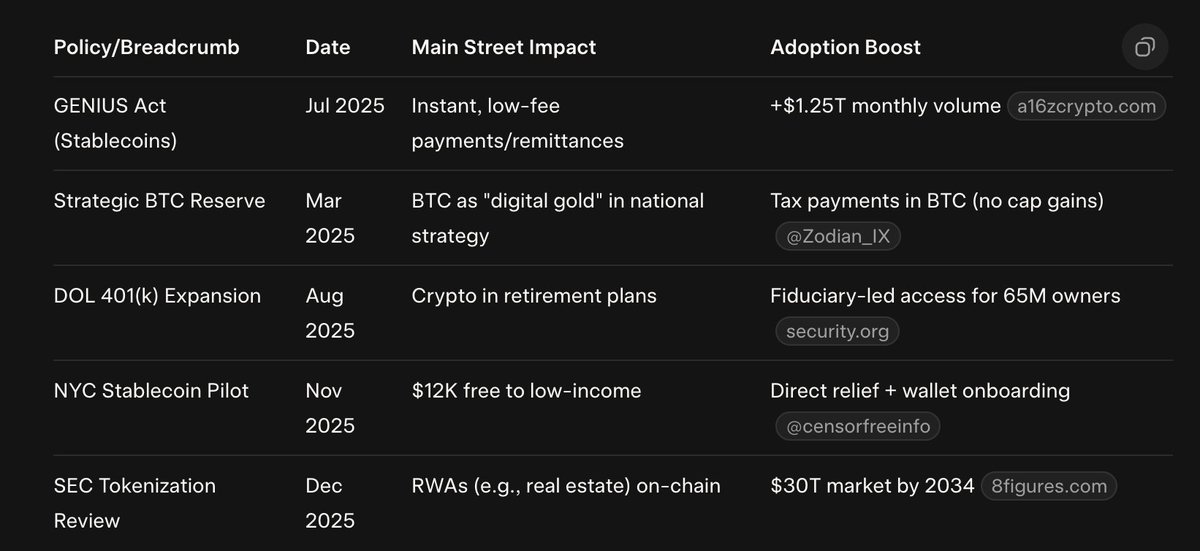
IMO: Supporting my thesis. The US will monetize the debt through Bitcoin as a reserve and Stable Coin as the digital dollar. They will acquire Bitcoin through budget neutral means like taxation and seizure, and via issuance of stimulus and new debt (Short term tbills) as Stable Coins through various programs. The Bitcoin will absorb the new debt, be repriced and together with physical gold the debt will be monetized.
The trade is Bitcoin and the network tokens of the regulated Stable Coin, Real World Asset, Capital Market and Corporate Share and Digital Commodity networks which will appreciate based on volume and adoption. The stake in these networks will appreciate with usage and reliance.
You must purchase these digital assets and physical gold in 2025 and move to self custody (before the repricing events in 2027/8).
Only 1 in 100000 will hold the hard assets in self custody and be rewarded with generational wealth.
English

@martypartymusic the only account on here that I saw accurately call the bottom. He’s done this a few times this year. Follow
English