
Sabitlenmiş Tweet
btcTed
3.9K posts


btcTed
@btc_ted
Building @HummingbirdFLY_ II 2016 Bitcoiner II Macro and Fintech 🧡BTC/SOL
Katılım Kasım 2021
2.6K Takip Edilen4.8K Takipçiler
Tether has announced that it has formally engaged a “Big Four” accounting firm (Deloitte, EY, PwC, or KPMG) to conduct its first-ever full independent audit of the reserves backing its USDT stablecoin.
English
Winning. Everything is good for Bitcoin.
Sui@SuiNetwork
Introducing Hashi: a new era of Bitcoin finance on Sui. Bitcoin's market cap exceeds $1 trillion. < 0.5% of it is used in DeFi. Hashi is here to change that, with commitments from industry leaders including BitGo, Bullish, Erebor Bank, FalconX, Fordefi, Ledger, and more.
English
@HummingbirdFLY_ Stacking scarce assets that benefit from energy demand accelerating…
English

Ask yourself, what building blocks are you laying each day so that eventually you don't have lay anymore blocks?
English

I can’t believe how many people are still picking up the Hyperwave Theory book! Just checked in with our publisher and it’s still getting purchased each month 🤯
Tyler Jenks developed Hyperwave Theory in 1979 and spent his entire career refining it. Tyler C, Tyler J and I were writing the book together when he passed, and finishing it without him was one of the hardest things I’ve ever done. He poured decades into understanding what happens when markets refuse to let the numbers add up, when human emotion overrides reality and prices accelerate through phases that become unsustainable. Hyperwave isn’t just a chart pattern; it’s a model for collective human psychology that tells you what happens when people chase dreams and trip over reality.
For the record, Tyler never saw BTC wick to ~$3,850 on Black Thursday, March 12, 2020, when it dropped nearly 50% in a single day and $1.4 billion in positions were liquidated on BitMEX alone. But it didn’t dip and hold below $1k, so the BTC hyperwave he thought was active was negated into funky territory. He would’ve been the first to say that’s exactly how the theory works. It tells you what it tells you, no ego, no narrative, just the pattern. And you better keep your eyes open and triggers ready for when lines are negated.
What I think matters most right now is that he examined and taught about a plethora of historical hyperwaves across asset classes, the phases of how bubbles form and collapse, and a TA framework for reading what markets are actually doing beneath the noise. That stuff doesn’t expire. And we’re in one of the strangest markets we’ve ever seen: the S&P closed Friday at ~6,910, hovering near ATHs, while BTC is sitting around $65K after a nearly 50% drawdown from its $126K peak in October. Bitcoin ETFs have bled almost $4 billion across five straight weeks of outflows. The disconnect between traditional equities and crypto right now is real, and it’s exactly the kind of environment where people get hurt if they’re not paying attention.
If there’s one thing Tyler drilled into me, it’s that bear markets are where the real damage happens, not because of the drawdown itself but because people refuse to accept the reality of one. They hold onto hope past the point of reason, mistake a Phase 6 bounce for a new bull, and let ideology override the chart. BTC is in a weird phase, semper paratus.
Take care of yourselves out there. Respect the trends. The system always cleanses itself, and the survivors of vol are the ones who stayed humble and let the numbers add up. Tyler Jenks would be absolutely blown away that people are still learning from his life’s work. I know @Sawcruhteez and I are. 🤍🤍


English
btcTed retweetledi

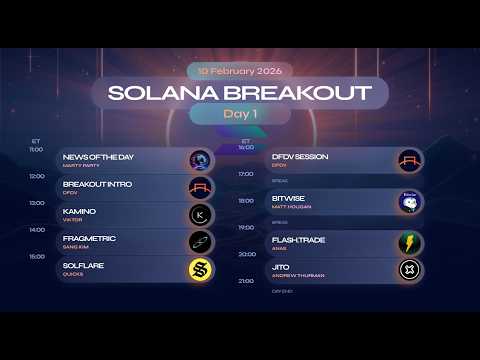
Day 1 of Solana Breakout is now LIVE! 🎥
6+ hours of high-signal convos with the teams building the future of $SOL, including:
@kamino
@fragmetric
@solflare
$DFDV
@bitwise
@FlashTrade
@jito_labs
Care about where $SOL is headed? 👇
youtube.com/watch?v=2zN-CA…
YouTube
English
btcTed retweetledi
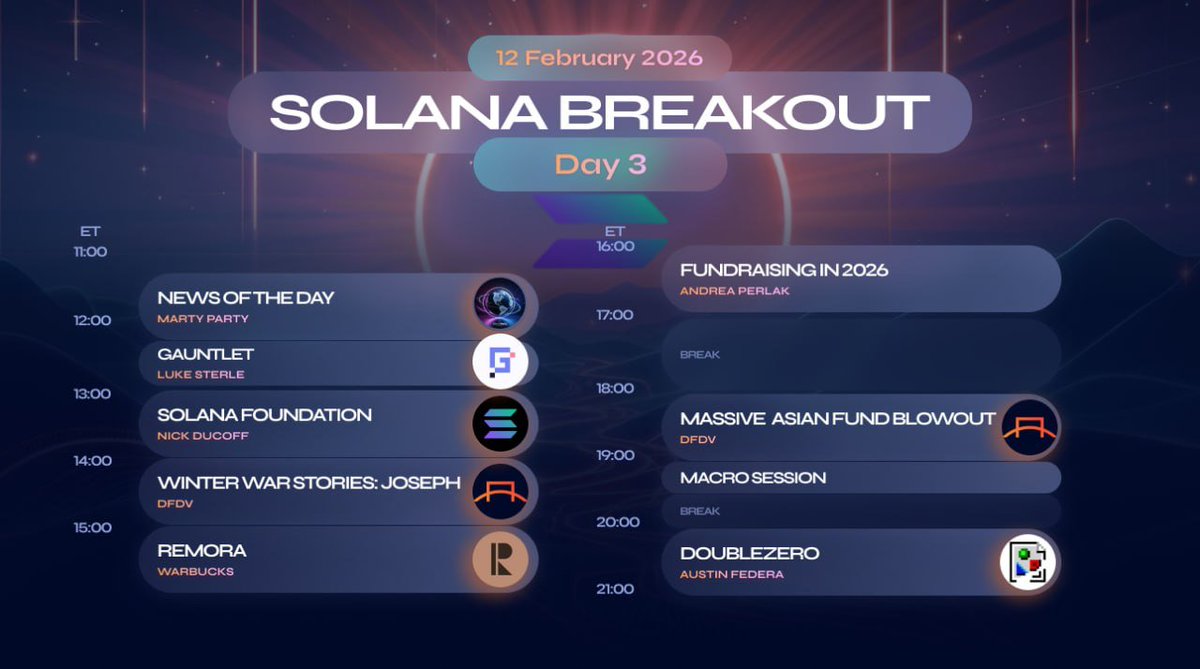
Solana Breakout Space Day 3 starts in 1 hr - 9:30 PST 11:30 EST
Todays lineup on the Space 👇
Luke Sterle - @gauntlet_xyz (added for 10:30am)
@nickducoff - @SolanaFndn
@0xinliberty, @cryptoirguy - @defidevcorp
@daddywarbucks - @RemoraMarkets
@andiperlak_cag - Crypto Accounting Group
@Austin_Federa - @doublezero
Feb 12 - x.com/i/spaces/1ypKd…
Free and public globally.
English
RT @martypartymusic: Solana Breakout Day 2 starts at 10am PST 11am ST 12pm EST
Speakers: Host @martypartymusic
Co-Hosts: @btc_ted @WestC…
English
@martypartymusic @kamino @fragmatic_gg @solflare @defidevcorp @bitwise @FlashTrade @jito_labs Let’s go!!!
English
btcTed retweetledi

Bitcoin’s Transition to Pristine Collateral. (The Thesis the Market Hasn't Priced In).
Bitcoin is being established as the hard collateral that underwrites digital finance.
The Mispricing
The market still prices Bitcoin as a speculative risk asset.
The financial system is beginning to use it as pristine collateral.
Markets price Bitcoin off trading flows: who is buying or selling today. The system is about to price it off balance sheet capacity: how much credit it can underwrite.
Mismatch
Modern finance issues liabilities that move 24/7 (stablecoins, tokenized deposits, automated credit). They settle instantly, globally, and without downtime. The collateral backing them does not.
Gold is physically slow.
Treasuries settle on Fed time (T+1, closed weekends).
Real estate is illiquid and jurisdiction-bound.
You cannot safely back a second by second liability with an asset that settles in days. The digital economy requires collateral that moves at digital speed.
The Solution:
Bitcoin uniquely resolves this mismatch.
Finite: No dilution to patch balance sheets.
Teleportable: Global final settlement in ~10 minutes.
Trustless: Bearer asset, no issuer or counterparty.
It is not a "store of value" in the passive sense. It is high-velocity collateral for a high-velocity financial system.
This is the critical supply shift.
Old Regime: Bitcoin was bought to be sold. Supply stayed liquid.
New Regime: Bitcoin is bought to be pledged.
When BTC backs a stable coin, loan, or structured product, it is encumbered locked in vaults or smart contracts and removed from effective circulation for the life of the obligation. This is not voluntary holding; it is mandatory locking. Supply is no longer just scarce; it is unavailable.
The Catalyst: Regulatory Operationalization (2025–2026)
The transition from prohibition to standardization is complete.
The Vault Unlock (SAB 121 Repeal, Jan 2025): Banks can now custody Bitcoin without destroying capital ratios. The institutional vault is viable.
The Accounting Cleanup (FASB Fair Value): Corporate treasuries can hold BTC without structurally penalizing earnings.
The Price of Admission (Basel III, Jan 2026): Bitcoin is classified as a Group 2 asset (1250% risk weight). It moves from a regulatory gray zone to a defined exposure. Banks can now price, structure, and lend against it with known capital costs.
End Game
Price discovery is shifting from trading flows to credit creation.
As digital dollars expand, the system must lock more Bitcoin to underwrite them. Market cap will expand to supply balance sheet capacity, not just to satisfy speculation.
Bitcoin is not a tech stock.
Bitcoin is being established as the hard collateral that underwrites digital finance.

English
Need your application tested?
Utilize the diverse Hummingbird community to provide valuable insights:
> Product market fit
> UI/UX
> Accessibility
With users spanning 36 countries, you get insights into many markets in one ecosystem.
English
Ive been telling you this for over a year. Just ask @grok
Yes, the concern about Layer 2 (L2) sequencers potentially requiring registration as exchanges under U.S. securities laws could indeed be a contributing factor to Coinbase's strong opposition to the current draft of the Digital Asset Market Clarity Act (often called the CLARITY Act or Clarity Act), though it's not the only or even the primary reason cited publicly.
Coinbase operates Base, one of the prominent L2s with a centralized sequencer (though with plans toward decentralization). If the CLARITY Act's market structure provisions—intended to clarify SEC vs. CFTC jurisdiction, define digital commodities, and set rules for tokenized assets—were interpreted or drafted in a way that reinforced or failed to shield against such sequencer-based registration risks, it could threaten Base's model and Coinbase's broader ecosystem.The bill aims to provide clarity on when tokens are securities (SEC oversight) vs. commodities (CFTC), with pathways for "mature" decentralized blockchains to escape heavy SEC rules. But the Senate draft (as amended) appears to have tilted in ways Coinbase sees as favoring SEC power, restricting tokenized equities/DeFi, and not adequately protecting innovation—potentially including L2 designs. In short: While Coinbase's public statements emphasize tokenized equities bans, DeFi limits, and stablecoin reward restrictions as the deal-breakers, the L2 sequencer issue (highlighted by Peirce months earlier) likely amplifies their concerns about centralized components in an increasingly tokenized future. It's a plausible "key reason" in the bigger picture of regulatory uncertainty for L2s, even if not the headline one in Armstrong's announcement. Projects pushing decentralized sequencers (e.g., some mentions of Metis) are positioning themselves to sidestep this scrutiny, underscoring the tension you noted.
English
For the nerds. #Bitcoin #Wyckoff #Accumulation with Fibonaccis and Global Liquidity in real time. Jan 13th 11:17am
Note: See how we fell with the blue global liquidity line - we will catch back up.

English
btcTed retweetledi
Hummingbird is a network.
It connects companies to users.
It connects projects to vendors.
It connects investors to opportunities.
It connects users to income.
But most important of all, it connects us all to each other!

English
btcTed retweetledi

Bitcoin is a self-organizing intelligence embedded in mathematics, where economic will is transmuted into irreversible history, sovereignty emerges without permission, and truth is relentlessly accumulated block by block through energy, time, and consensus.
English

Looking forward to the new year and seeing what crypto brings. I'd also like to thank the office gang for keeping our heads straight during 2025 amid the crazy swings. Big thanks to @martypartymusic for working his butt off on the LQL and the education he provides to everyone in the space.
Big thanks to @btc_ted and @WestClintwood for keeping engagement with trades and the market a top priority. I've been in this space a long time but learn more every day with the group.
Let's go 2026!
English