kpm.das

4.1K posts

kpm.das

kpm.das

@KPMDas

Cyber Security, Information Strategy, War By Other Means

Bangalore Katılım Ocak 2009
191 Takip Edilen372 Takipçiler
kpm.das retweetledi
Man Aman Singh Chhina
Man Aman Singh Chhina@manaman_chhina·
The failure of IPS officers to adopt the uniform and accoutrements of CAPFs is the best example of the ‘otherness’ practiced with CAPFs. As far as I know, apart from BSF no IPS officer in any CAPF wears the shoulder flashes, cap badge, lanyard, belt, boots of that CAPF.
English
12
104
470
13.6K
kpm.das retweetledi
kpm.das retweetledi
The_Fourth_Pillar
The_Fourth_Pillar@The_IVPillar·
Before 1893, recruitment for the provincial police often included nominating officers from the British Army, Many army officers played pivotal roles in formative years !! Should we keep IPS under Army?? As per your logic??
RK Vij@ipsvijrk

The architect of #BSF was Shri KF Rustamji, IPS, the first DG of the force established in December 1965! #CAPF

English
1
38
122
2.3K
kpm.das retweetledi
kpm.das retweetledi
Karthik Balachandran
Karthik Balachandran@karthik2k2·
Those who saw’A Beautiful Mind’, would remember that John Nash’s doctoral thesis had just 26 pages and 2 references, yet it was instrumental in advancing “Game theory”. What if I told you there is a scientist whose achievement is so astounding that he is perhaps the only Indian to “create” an intersectional branch of science? What if I told you that every year, his name echoes across the hallowed halls of science in foreign lands, but most of our students haven't even heard of him? Aneesur Rahman was born in Hyderabad in British India in 1927. His father was a professor and a philanthropist. His family generously donated their property for the creation of Urdu Hall in Hyderabad. His maternal uncle was a professor too. Rahman had a natural flair for subjects that would terrify ‘normal’ students — maths and physics. After getting BSc in Mathematics, he went on to get Tripos in Mathematics and Physics at the prestigious Cambridge University in the UK. From there, he went to Louvaine University in Belgium and got DSc in Physics under Professor Mannenbeck. It’s here that Rahman met a Chinese student Yueh-Erh Li who was doing MD( called Dr Jady by friends). They fell in love and got married. He came back to teach in Osmania university along with his wife. Soon after, he developed interest in the structure of water molecule - especially the polarisation of the hydrogen atom. Unfortunately research in India was at infancy in those days and Dr Rahman realized he was a whale in a tiny pond. He had to move to the ocean. He joined the Argonne National Laboratory in Illinois. His foundational paper in 1964 birthed “molecular dynamics” , one of the two pillars on which a vast body of computational physics rests.(the other is Monte Carlo method). His equation made it possible to calculate the trajectory of large number of interacting atoms with ease. His work, like Ramanujan’s , was so ahead of his time - that even today, potential applications are being discovered. The Nobel prize in physics for 2013 went to Karplus, Levitt and Warshel whose work depended heavily on Dr Aneesur Rahman’s. Some say there is an inverse association between genius and compassion -Dr Rahman was a prominent exception. He was known not just for his intellect, but also kind nature and mentored many students all over the world. His quiet, unassuming nature made him a much loved professor — and he remained so, until he got Non Hodgkin’s lymphoma — a cancer that took him away from us prematurely, at the age of 59. Perhaps he might have got a Nobel, if only he had lived longer. American Physical Society honors him as the father of computational physics and has instituted an annual award in his name. As a doctor with little idea of theoretical physics, writing Dr Aneesur Rahman’s portrait has been difficult , because of the complex nature of his work that straddles so many areas of science : mathematics, physics, computer science and chemistry. His equations are mind boggling, even intimidating, but what I do understand is this : Dr Rahman didn't just have a beautiful mind, but also a beautiful heart.
Karthik Balachandran tweet media
English
48
734
2.2K
87.3K
kpm.das retweetledi
Venugopal Vengalil
Venugopal Vengalil@vgmenon99·
Fire on USS Gerard Ford reminds me of a fire onboard my ship, a mine sweeper on passage from Riga to Bombay. Fire took place in Irbunsky strait in early hours of 09 Jan 1986 . Fire was accompanied by a cyclone in area & sea had frozen in many spots . A terrifying experience +
Ken Moriyasu@kenmoriyasu

It looks to be a very expensive fix when it returns to Norfolk. Fire on U.S. Aircraft Carrier Raged for Hours, Sailors Say nytimes.com/2026/03/16/us/… via @NYTimes

English
1
3
2
245
kpm.das retweetledi
Jaideep Maolankar
Jaideep Maolankar@JA_Maolankar·
On 2nd thoughts @Chopsyturvey Sir, this shows extremely amateurish understanding of the seas, trade, choke points and the campaign in the current war. For freedom of speech advocates, can I similarly call out the Rafale Demi-god’s clay feet without being called anti-national?
Aviator Anil Chopra@Chopsyturvey

Lessons from the Hormuz Humiliation: Why India Must Abandon it’s Surface-Fleet Fantasy and Master Choke Points The most powerful navy in history has just confessed defeat in the 33-kilometre-wide Strait of Hormuz. In March 2026, as the US-Iran war entered its third week, reports revealed that the US Navy has rejected near-daily requests from the global oil industry for escorts through the Strait of Hormuz. Three American supercarriers — Abraham Lincoln, Gerald R. Ford and George H.W. Bush — plus French and British warships sit idle in the Arabian Sea, Red Sea and Mediterranean. Though their collective military might outguns most nations, none of it can safely escort even a single oil tanker through the narrow corridor. Iranian kamikaze drones, swarms of fast-attack boats, naval mines and coastal anti-ship missiles have turned the tight waterway into a lethal gauntlet. A mere $500 contact mine can cripple a $4-billion destroyer. The best surface radars cannot detect submerged threats, and air power has proven equally ineffective at sweeping shipping lanes. This is not merely an American failure. It is a warning written in fire for every navy that still dreams of blue-water dominance in the age of aerospace power. For India, staring at a peer competitor across the Indian Ocean, the message is brutally clear: surface ships and aircraft carriers are not assets; they can rapidly become liabilities. In any conflict with China — or even a superpower like the United States — our carriers and destroyers will become expensive coffins the moment hostilities begin. The Indian Ocean is no longer a safe playground for carrier strike groups. It is a contested littoral where geography, not tonnage, decides victory. India’s naval planners have long chased the Mahanian dream: three carriers, a 175-ship fleet, blue-water power projection from the Gulf of Aden to the South China Sea. INS Vikrant is commissioned; INS Vikramaditya soldiers on; a third carrier is on the drawing board. Billions have been poured into surface combatants that look magnificent during naval reviews but will be dead meat in real war. Chinese anti-ship ballistic missiles (DF-21D, DF-26), hypersonic glide vehicles, satellite-linked drone swarms and quiet diesel-electric submarines have turned the Indian Ocean into an anti-access/area-denial (A2/AD) killing zone. Even the Americans, with three carrier strike groups, cannot protect a tanker in Hormuz. What chance do our smaller, less-protected surface ships have when the People’s Liberation Army Navy brings the same arsenal into waters closer to its bases? The recent US-Iran war has laid bare the arithmetic. Surface ships are sitting ducks for air-power assets — land-based missiles, aircraft, drones and mines. A carrier’s air wing is powerful only if it survives the first salvo. In narrow seas or choke points, it becomes a floating bullseye. Mines laid by fast boats or submarines cannot be cleared by Aegis destroyers. Kamikaze UAVs overwhelm point-defence systems. One lucky hit on an Indian carrier group would produce exactly the strategic humiliation Washington is now desperately avoiding. India cannot afford that humiliation; our economy depends on energy flows through the very same ocean. Fortunately, geography has gifted India a far cheaper and more lethal alternative. Instead of scattering scarce rupees across vulnerable surface fleets, we must concentrate every paise on the natural choke points our island territories already dominate. Four corridors matter above all: The Malacca Strait approaches, controlled from the Andaman and Nicobar chain. The Hormuz lesson is merciless but mercifully timely. India’s defence forces must learn it before Chinese missiles teach it to us the hard way. In the 21st-century Indian Ocean, geography is destiny — and surface fleets are dinosaurs. Choke points, submarines, missiles and island bastions are the future. Let us seize it before it is too late.

English
9
28
159
11.6K
kpm.das retweetledi
Jaideep Maolankar
Jaideep Maolankar@JA_Maolankar·
I sincerely hope this is merely the opinion of an individual and does not reflect the thinking of the Indian Air Force. If not then God help us!
English
6
14
150
4.7K
kpm.das retweetledi
Sameer Shisodia
Was at Haralur Rd mins ago. Counted 25+ cars with just one person in them (not including professional drivers) before I saw one with 2 in it. That's less than half a bus full! Why isn't this getting solved thru tech/neighbourliness? Why do people choose+create pain, congestion?
English
55
16
149
10.7K
Hermanprit Singh
Hermanprit Singh@hermanprit·
You hv already 'allowed' them thru Ellis Island. Many of your States are reeling under 'occupation'. Our syncretic culture will hopefully protect us as it has over thousands of years of invasions. But for you existence is binary. Either you or them. Either Ottomans or Crusades!
Laura Loomer@LauraLoomer

One journalist making a comment isn’t “getting eviscerated”. I had an amazing time at the @IndiaToday Conclave Conference and met many supporters and Indian thought leaders who thanked me for speaking truth about Islam. In fact, @sardesairajdeep and I had a cordial conversation after the panel. So many people thanked me for saying what many in the Indian Media are too afraid to say themselves. Islam is the biggest threat to the world and the US, India, and Israel alliance is the strongest force we have to combat the threat of Islamic terrorism. We need to protect non-Muslims from jihadist violence. India should resist Islamic aggression before your daughters are forced to wear burkas and speak Arabic. Keep India Hindu. 🇮🇳 There are 56 Muslim countries in the world. The Muslims have enough. They don’t need to conquer America, Israel and India. We won’t allow them to. Together we will resist the creation of a caliphate. Our survival depends on it.

English
1
0
2
107
kpm.das retweetledi
Nitin Pai
Nitin Pai@acorn·
Justice Radhabinod Pal was not just right, he saw through the game.
English
7
15
105
22.4K
kpm.das retweetledi
G12finch
G12finch@g12finch·
In the future, this statutory intervention by the government to appease the IPS lobby could backfire on the country, much like the 1965 situation that led to the creation of the BSF as an armed force to protect the borders, modeled after the army, to ensure better border security
English
1
22
84
1.7K
kpm.das retweetledi
Kunal Sharma
Kunal Sharma@kunsha51·
When I said that history would be kinder to Justice Chandrachud, none of you took it seriously. It certainly is not because he was any good, but because the successors are far worse. My man had some charm, at the very least!
English
7
19
245
9.2K
kpm.das retweetledi
Rattan Chand Sharma
Rattan Chand Sharma@RattanRC·
IPS combat ineffective, only exposure thana. Ineffective to handle even Thana. Do not know border management and IS duty as concept. Lack sincerity in conflict demonstrated in OP SINDOOR. CAPFs NEED ORGANIC PROFESSIONAL LEADERSHIP, NOT INEFFECTIVE UNPROFESSIONAL ALIENS.
English
4
61
179
3.7K
kpm.das
kpm.das@KPMDas·
@hermanprit As Prashanth Nair, IAS proposed in an op-ed qualities of head-and-heart, both, require a 5 day Services Selection Board SSB kind of immersive selection for civil services. Checks for inner steel and empathy beyond just an ethics paper as at present
English
0
0
0
54
Hermanprit Singh
Hermanprit Singh@hermanprit·
we keep blaming our bureaucrats who atleast come thru a rigorous selection procedure. Our higher judiciary on the other hand recruits its very own thru an opaque process euphemistically called 'Collegium system' And hv no qualms being judge in their own cause.
Mayank Burmee@BurmeeM

SUPREME COMEDY In 2005, the Chief Information Commissioner asked the Supreme Court to disclose the assets of its judges. The Supreme Court didn’t like the idea. “We don’t take orders — we give them.” Instead of complying, the Supreme Court challenged the order before the Delhi High Court. The Delhi High Court ruled that the information must be disclosed. The Supreme Court then appealed that decision before a 2-judge bench of the Delhi High Court. The 2-judge bench sent the matter back, saying it concerns the Supreme Court itself and should be decided by the Supreme Court. So the Supreme Court effectively became the judge in its own case. A single-judge bench then said the matter should be decided by a 3-judge bench. The 3-judge bench kept the case pending for eight years before concluding that it should be heard by a 5-judge bench. Finally, in 2019, the 5-judge bench delivered its verdict. It didn’t direct judges to declare their assets. It only said that whatever information the Supreme Court already has can be disclosed. Which means, if a judge never declares his assets, there’s nothing to disclose. Comedy? Maybe. Funny? Not really. #SupremeCourt #JudicialAccountability #Transparency #RTI #Judiciary #RuleOfLaw #JusticeSystem #LegalReform

English
6
13
96
3.4K
kpm.das retweetledi
Arun Golaya
Arun Golaya@Arun_Golaya·
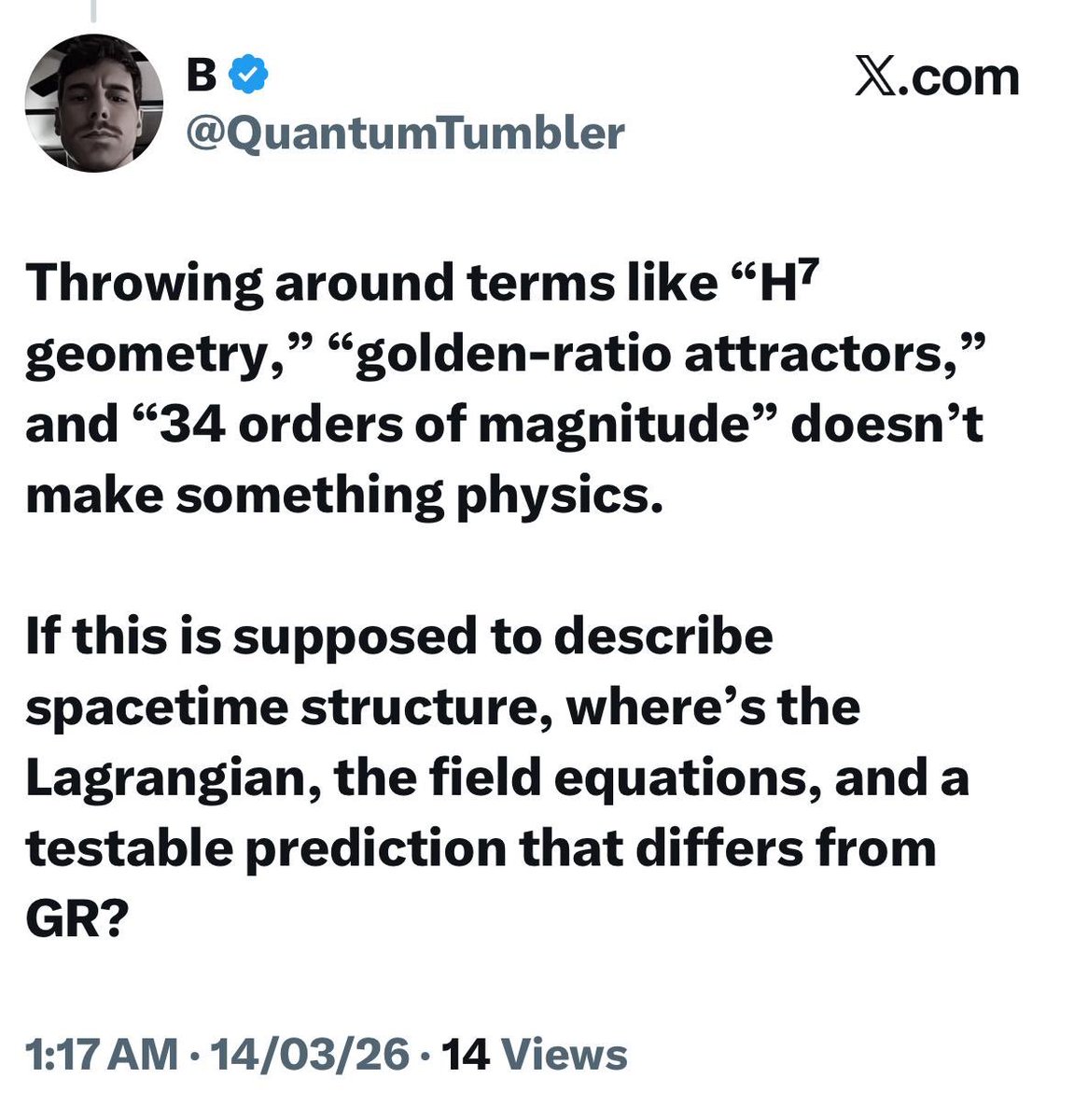
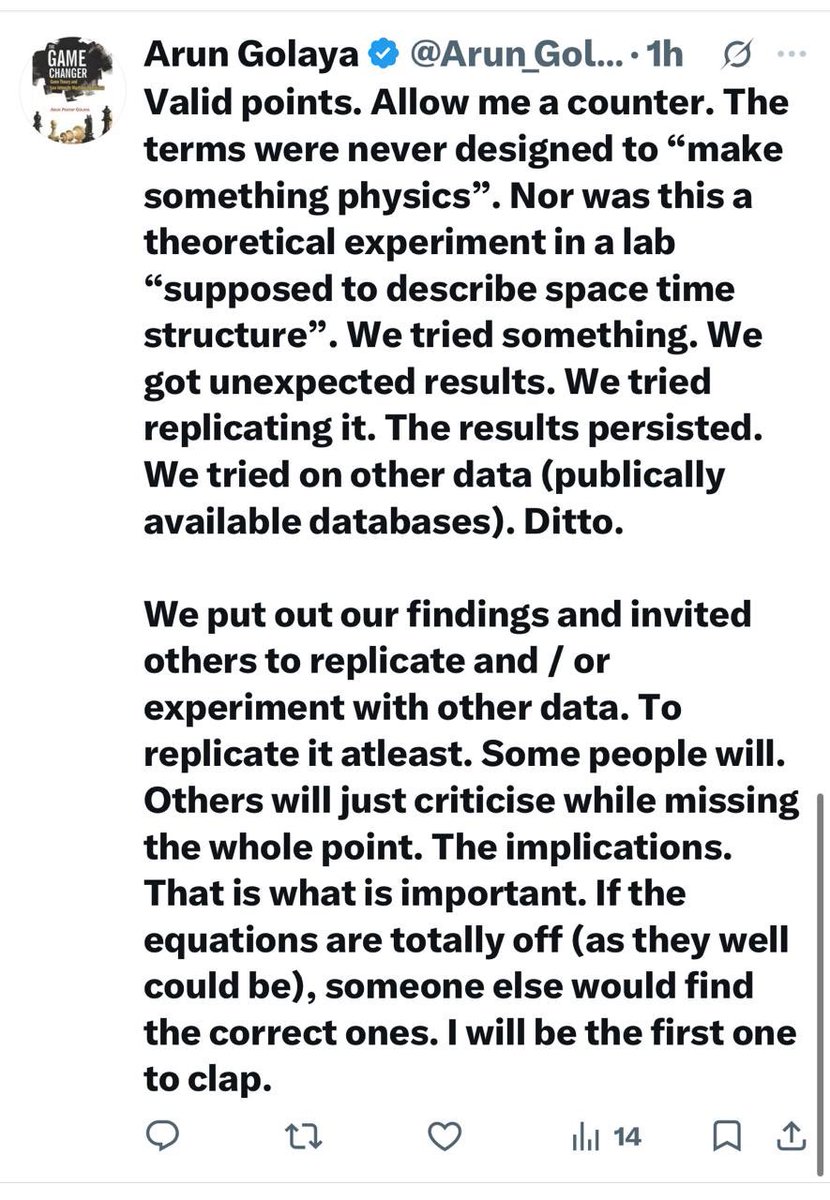
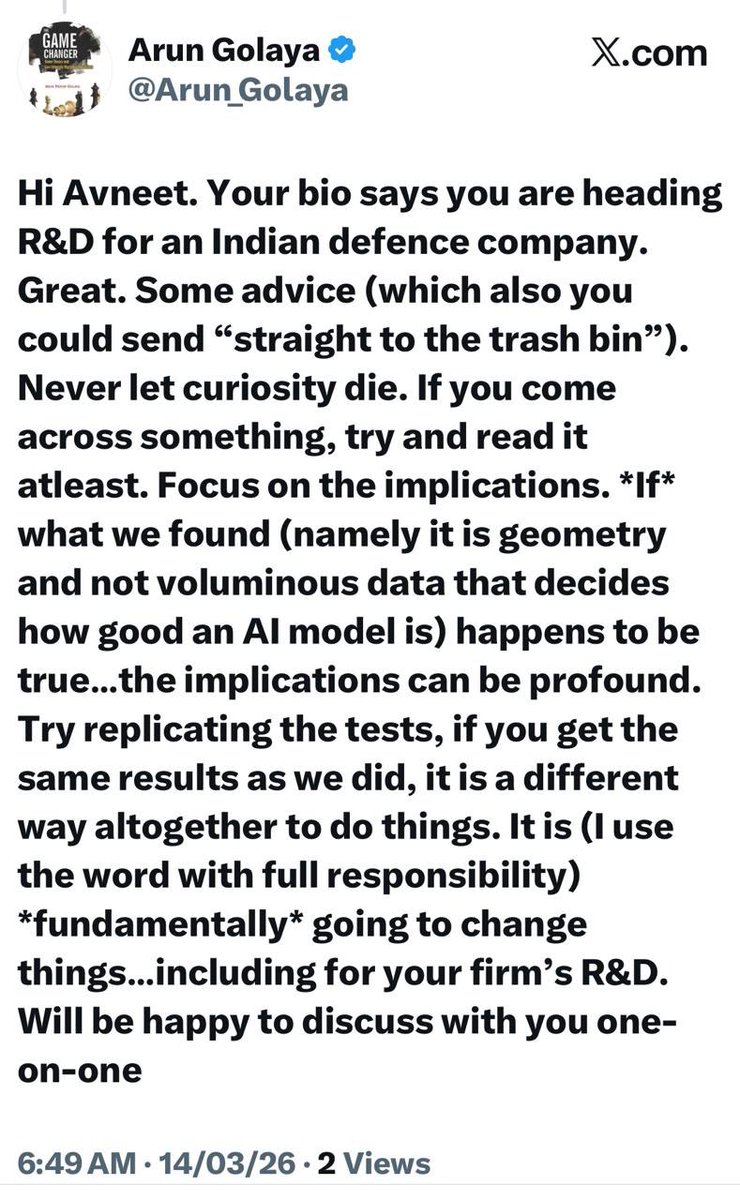
The blowback was expected. It has started. Two opinions (which I respect though they trash our paper, even though there wasn’t a need to be rude) and my responses are below. I stand by my views. We did an experiment. We got unexpected results. We put it out. I hope people will try and replicate our experiment. *If* the findings are correct - and I believe they are - it gives an entirely new approach to Artificial Intelligence. THAT IS WHAT MATTERS
Arun Golaya tweet mediaArun Golaya tweet mediaArun Golaya tweet mediaArun Golaya tweet media
English
4
4
33
2.4K
kpm.das
kpm.das@KPMDas·
@hermanprit IPS may do well with regimentation and building their bonds deeper with men they command. Missing. CAPFs are regimented. IPS may do well with building the culture of "service before self"
English
0
0
0
27
Hermanprit Singh
Hermanprit Singh@hermanprit·
Again, its not IPS-CAPF question. Its a matter of overturning an established practice in all services including IAS, IRS. So the government, if and when it changes policy, it will be across the board. Just bcoz CAPF officers are more vocal it does not bcum CAPF vis a vis IPS.
swagger@swar30093

@hermanprit Why not provide two way mobility, IPS to CAPF is allowed then why not other way. Do we leave logic at doorstep when we become a Civil servant ?

English
2
0
2
345
kpm.das
kpm.das@KPMDas·
Woke up this morning with an affirmation. Victory is still measured by foot!!
English
0
0
0
11
kpm.das retweetledi
Vikas Bardia
Vikas Bardia@vikasbardia·
I've so far stayed away from commenting on @BLRAirport's sudden decision to charge all commercial taxi operators ₹285 to enter T1 and pick-up passengers within 10 mins - every additional 5 mins is another ₹150. And even this spot is a 5 min walk from arrivals gate. The free P4/P3 is a 10-15 min walk and there's a free bus shuttle - but it's super inconvenient with luggage or for aged parents, and there's no cover (so good luck during rains). For 3+ months now, this has become highly inconvenient for all our guests & it's been hurting our business. I myself wouldn't book a @shoffr_in from P3/P4, and last time when I paid for premium parking realised that it's not really that premium. Still, I didn't feel like I should create an issue out of this - after all, every busines including BIAL wants to increase their revenue. But recently someone close to me reminded me that we have a voice, and we should use it - not just for our benefit, but also for that of thousands of other individual taxi drivers and small fleet owners. And most importantly, for all the travellers who are now either forced to walk or select expensive-and-not-worth-it options that are in front of them. I'm not saying don't charge us - but going from 0 to ₹285 is a steep increase and gives no time for businesses to adjust and account for this cost. Instead I propose charging ₹100 per entry for 2026, and then increasing it to ₹200 next year. It's a fair trade-off between adding a revenue stream (which was non-existent for years) and not inconveniencing the very passengers who use and bring revenue to your airport. And it gives time for businesses to adapt. The current situation is unfair to commercial taxi operators, inconvenient for travellers - and so reflective of the monopolistic position of BIAL and airports in general. I kindly request the relevant authorities to use this position in a manner that improves the ecosystem for everyone, rather than disbalance it. To those reading this - if you've been impacted and agree with my views, please repost this in the hope that it's picked by media and Govt. authorities so that BIAL is forced to rethink it's current approach. They might be a monopoly we can't escape using, but we all have a voice too. Let's make them hear us 🙏🏼 deccanherald.com/india/karnatak…
English
29
245
730
61K
kpm.das retweetledi
Nalini Unagar
Nalini Unagar@NalinisKitchen·
He is the CEO of FSSAI, IAS Rajit Punhani. Fake milk, paneer, vegetables, oil, and harmful chemicals are sold openly in the market. People are getting sick and even dying every day. Hygiene is ignored, labels are false, and factories do not follow the rules. You stay silent but keep taking a huge government salary. Sorry to say, but the entire FSSAI department should be thrown out because it feels like they don’t even exist in India. This is not a personal attack, but the anger of 140 crore Indians who are being fed fake food every day.
Nalini Unagar tweet media
English
1.8K
7.5K
19.7K
478.7K