KPSS

1.4K posts

KPSS banner
KPSS

KPSS

@KPSSamiti

Kashmiri Pandit Sangarsh Samiti is an organization which primarily addresses the concerns of resident Kashmiri Pandits / Hindus who stayed back in the Valley.

Kashmir Katılım Haziran 2014
402 Takip Edilen6.3K Takipçiler
Sabitlenmiş Tweet
KPSS
KPSS@KPSSamiti·
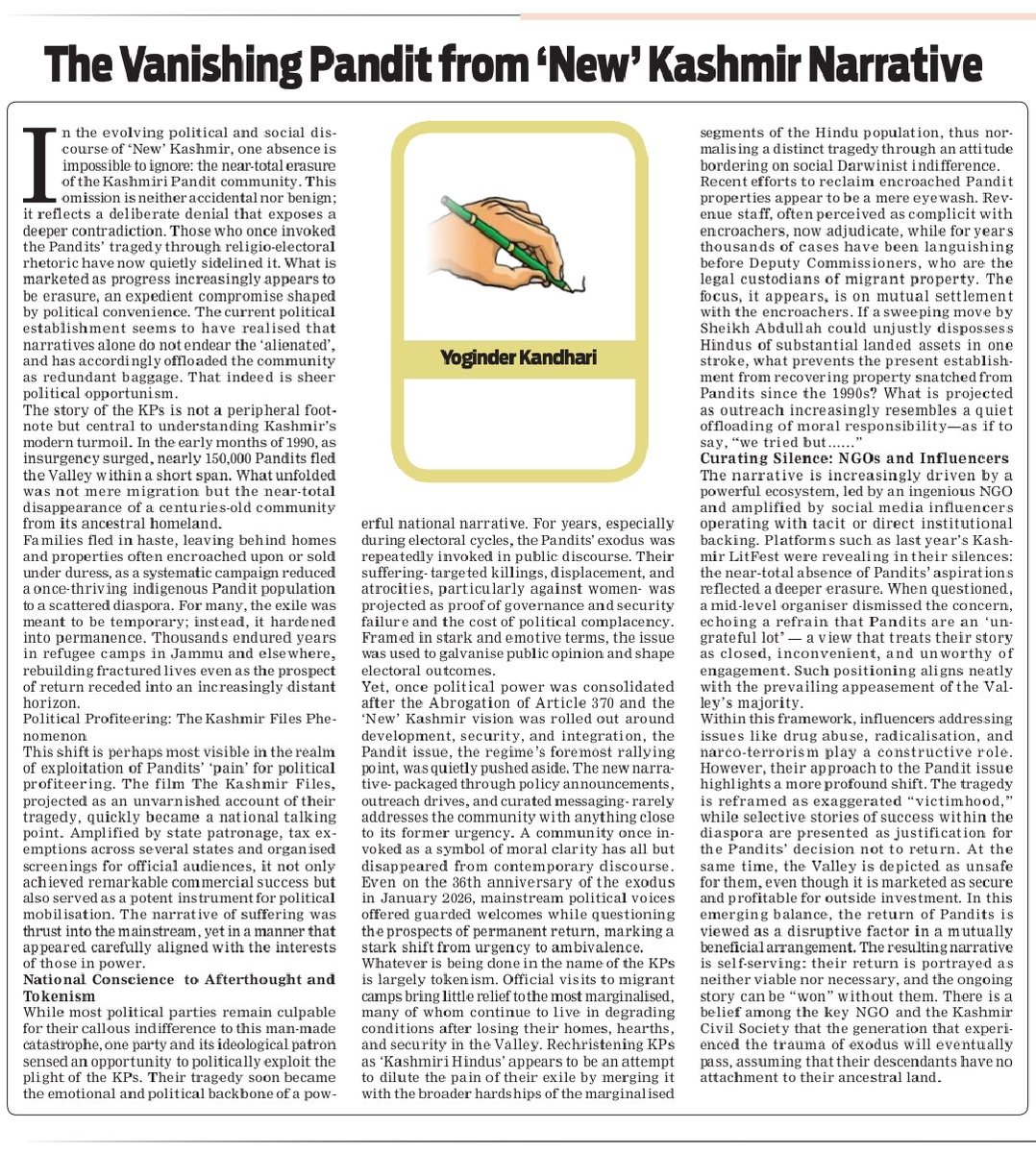
#vanishingpandits THE VANISHING PANDIT FROM 'NEW, KASHMIR NARRATIVE
KPSS tweet media
English
0
3
4
182
KPSS
KPSS@KPSSamiti·
Description: This work shows a sacred mandala of the eight forms of Bhairava, placed in a circle around the holy hill of Hari Parbat. It is inspired by the wisdom of Kashmir Shaivism, where Bhairava is not seen as only a form, but as the living awareness that is present in everything. Each Bhairava around the circle shows a different feeling of this awareness. Some are fierce and powerful. Some are calm and silent. Some guide, some protect, and some dissolve all that we hold on to. Together they show the many ways in which life moves within us. At the center stands Hari Parbat. It is not only a hill. It is the heart of Srinagar. For generations, people have felt a deep spiritual presence here. It is a place where devotion, memory, and faith come together. In this mandala, it becomes the still center from which everything rises and to which everything returns. The Bhairavas around it do not stand apart. They form a living circle. A circle that protects, transforms, and reminds us that every experience is part of a deeper truth. The land, the sky, and the forms all belong to one presence. When you look at this, you are not outside it. You are part of it. Brief Note: This work is a careful reconstruction inspired by the sacred traditions of Kashmir. The idea of Aṣṭa Bhairava is found in texts such as the Svacchanda Tantra, where Bhairava appears in many forms connected with direction and function. In Kashmir, these forms have never been fixed in one rigid way. They have lived through memory, practice, and devotion. In the teachings of Abhinavagupta, especially in the Tantrāloka, Bhairava is understood as the highest reality. It is the same awareness that sees, feels, and exists in all things. It is both within and beyond everything. Because of this, the eight Bhairavas are not just separate deities. They can be understood as states of awareness. Through them, one experiences fear, strength, stillness, knowledge, and finally freedom. These are not outside journeys. They are movements within the self. Hari Parbat holds a special place in this vision. It has long been a center of spiritual life in Srinagar. In this work, it becomes both a real place and a symbol of inner stillness. The mandala grows around it, just as life grows around a silent center within us. This work does not claim to be final or complete. It is an offering. It brings together tradition, memory, and reflection in one form. Its purpose is to preserve, to remind, and to quietly awaken a sense of connection with a living spiritual heritage. Closing Reflection: When you stand before this mandala, do not only look. Stay for a moment. Let it settle within you. You may begin to see that what appears outside has always been within. © Vijay Sas, 2026 All rights reserved. This work is part of an ongoing effort to preserve the sacred visual traditions of Kashmir. 2/2 @highlight
English
0
1
2
166
KPSS
KPSS@KPSSamiti·
#AṢṬA BHAIRAVA MANDALA OF Hari Parbat #Kashmir Medium: Digital Restoration and Reinterpretation Style: Kashmiri–Pahari Inspired Miniature Dimensions: Scalable, designed for 10 × 10 ft archival display 1/2
KPSS tweet media
Română
2
8
29
1.1K
KPSS
KPSS@KPSSamiti·
And when the journey completes itself, one realizes that the path, the doorway, and the destination were never separate - for Ganesha, Bhairava, and the seeker were always one in the same infinite Consciousness. Vijay Sas @followers
KPSS tweet media
English
0
0
0
49
KPSS
KPSS@KPSSamiti·
was a civilization where metaphysical insight coexisted with temple worship, ritual practice, and localized devotional forms. Two streams flowed together across centuries: the philosophical stream of non-dual Shaivism, and the lived stream of temples, asthāpans, and community rituals. Ganesha asthāpans emerged from this second stream, yet they were never disconnected from the first. They became the practical expression of a deeper metaphysical truth. As Shaiva and Shakta Tantras evolved in the region, a universal principle shaped spiritual practice: no entry into the sacred is possible without preparation. Ganesha, recognized across Tantric traditions as the primordial gatekeeper, naturally assumed this role. Before any Bhairava sādhana, before any Śakti worship, before any mantra initiation, Ganesha is invoked. This is not a matter of ritual habit alone; it is a reflection of an inner necessity. The mind, burdened with vikalpa - fragmented thought - must first be cleared. Only then can it encounter the intensity of Bhairava. Over time, this gave rise to a subtle but powerful experiential sequence: Ganesha, then entry, then Bhairava, and finally dissolution into pure Consciousness. This sequence is not merely liturgical; it mirrors the inner journey of the seeker. Ganesha represents the clearing of obstacles, Bhairava the confrontation with the infinite, and Śiva the realization of complete unity. This philosophical and ritual evolution is beautifully reflected in the sacred geography of Srinagar. The city itself unfolds as a living mandala, where temples are not randomly placed but form an interconnected spiritual grid. In the region around Ganpatyar, one finds the Ganpatyar Ganesh Temple, the Shitaleshwar Bhairav Asthāpan, and the Gauri Shankar Temple within close proximity. Together, they form a triadic field: Ganesha as the beginning, Bhairava as the threshold, and Shiva as the ultimate realization. This is not coincidence; it is philosophy expressed through space. A similar pattern emerges at Hari Parbat, the sacred hill that houses the shrine of Sharika Devi. Here, Ganesha is positioned at the base, marking the entry into the sacred circuit. As one ascends or circumambulates, the journey becomes an act of purification, culminating in the realization of Śakti at the summit. Across the city, Bhairava Asthāpans - such as Anandishwar Bhairav Asthāpan, Mangleshwar Bhairav Asthāpan, Bhairav Asthāpan Hawal, and Bhairav Asthāpan Nalbandpora - form a protective network, anchoring spiritual energy and guarding the sacred landscape. What becomes evident through this mapping is a consistent pattern. Ganesha is almost always found at points of entry - physical, psychological, and spiritual. He stands at the beginning of paths, at the thresholds of sacred zones, and within the heart of habitation. Bhairava, in contrast, occupies spaces of power and boundary - places where transformation occurs. Together, they define not a hierarchy, but a journey. In the final analysis, the evolution of Ganesha asthāpans in Kashmir is not a doctrinal development but an experiential necessity. There is no explicit scriptural statement declaring Ganesha to be part of Bhairava Paramparā. Yet, in the lived Shaiva-Tantric tradition of Kashmir, Ganesha becomes the indispensable doorway through which Bhairava is approached. Bhairava remains the ultimate reality, the destination beyond all duality, while Ganesha becomes the compassionate beginning - the point where the journey becomes possible. Thus, the truth reveals itself with quiet simplicity and profound depth: in Kashmir Shaivism, Ganesha is not linked to Bhairava as a separate entity. He is already within Bhairava, functioning as the opening through which the seeker moves toward the realization of the Absolute. And in the sacred landscape of Srinagar, every Ganesh asthāpan stands as a silent invitation - a threshold, a beginning, a step into the infinite presence of Bhairava. 3/2
English
1
0
0
116
KPSS
KPSS@KPSSamiti·
Do not approach this as a mere description of temples or an abstract discussion of philosophy. Receive it instead as a sacred invitation, an entry into a living mandala, where in Kashmir every step quietly guides the seeker from Ganesha to Bhairava, and from visible form into the boundless Infinite. There are ideas that one simply reads and understands at the level of the mind. And then there are truths that are not read, but entered, slowly and reverentially, like stepping into a sanctified space that reveals itself layer by layer. The relationship between Bhairava and Ganesha in Kashmir belongs to this deeper realm of experience. It is not confined to rigid doctrines or linear theological structures. Rather, it unfolds as a living journey where philosophy is not separate from ritual, and ritual is not separate from the land itself. In this sacred confluence, thought, practice, and geography dissolve into one continuous, living reality, meant not just to be understood, but to be experienced. At the heart of this understanding lies the profound vision of Kashmir Shaivism. In this tradition, Bhairava is not merely a deity among many; He is the very essence of existence itself - Paramaśiva, the Absolute Consciousness. Bhairava is not confined to form, image, or temple. He is the source from which all manifestation arises and into which all dissolves. Every thought, every perception, every form of divinity is an expression of this one undivided Consciousness. The great Tantric works such as Tantrāloka and Vijñāna Bhairava Tantra articulate this vision with remarkable clarity: there is no real separation between the worshipper, the act of worship, and the deity. All is Bhairava. Within such a non-dual framework, the question of where Ganesha stands becomes both subtle and illuminating. In the philosophical core of Kashmir Shaivism, no deity exists outside Bhairava, and yet no individual form is singled out as independently supreme. Ganesha is therefore neither excluded nor centrally elevated in doctrinal texts. He is understood as a manifestation within the vast spectrum of Consciousness, a functional expression rather than a hierarchical figure. He participates in the cosmic play of awareness, not as an external power, but as a specific mode through which Consciousness operates. However, where philosophical texts remain silent on a direct doctrinal link, the lived reality of Tantra reveals a deeper and more intimate connection. In Shaiva Tantric practice, Ganesha is invoked at the very beginning of all spiritual undertakings. He is Vighnaharta, the remover of obstacles, and the dvārapāla, the guardian of thresholds. Before one enters the domain of higher awareness, before one approaches the intensity of Bhairava, the mind must be steadied, purified, and made receptive. This is the role Ganesha fulfills. Bhairava, on the other hand, stands as the Kṣetrapāla, the guardian of the sacred field, the force that dissolves fear, ego, and limitation. The relationship between the two is not one of lineage, but of function. Ganesha prepares the ground; Bhairava transforms it. This understanding deepens further when viewed through the philosophical lens of Abhinavagupta. In his vision, reality unfolds through Śakti, the dynamic energy of Consciousness, and every deity represents a specific function within this unfolding. Bhairava represents the state of undivided awareness, while Ganesha embodies the power that removes mental fragmentation and opens the gateway to that awareness. In this sense, Ganesha is not separate from Bhairava, nor is He subordinate. He is the very moment of entry - the opening through which the seeker moves from distraction to clarity, from multiplicity to unity. To understand how this relationship took root in Kashmir, one must move beyond philosophy into history and lived tradition. Kashmir was never a land of abstract thought alone. 3/1
English
1
0
0
162
KPSS
KPSS@KPSSamiti·
Sometimes, the loudest defeats are not the ones fought on battlefields, but the ones quietly repeated in our own decisions. This is not just a story about a war long gone, or a general once debated. It is about a pattern that refuses to die. If you listen closely, you will realise this is as much about 1962 as it is about us today. History has a simple way of teaching hard lessons, but only if we are willing to understand them. The story of Lieutenant General Brij Mohan Kaul during the Indo–Sino War of 1962 is not just about one man. It is about what happens when power is mistaken for wisdom. He was called a “Political General” because he was close to Jawaharlal Nehru and aligned with V. K. Krishna Menon. This closeness gave him influence, but influence cannot replace ground reality. Mountains do not listen to politics, and war does not respect connections. Many experienced officers had already warned about the dangers. Lieutenant General S. P. P. Thorat clearly said that India was not ready for war with China. His warnings were simple and practical, but they were not taken seriously. Later, the Henderson Brooks–Bhagat Report pointed out serious mistakes like poor planning, unrealistic orders, and lack of preparation. Kaul was not the only one responsible, but he was closely connected to these decisions. His lack of field experience and overconfidence made things worse on the ground. At the same time, it would be wrong to blame only one person. The failure of 1962 happened because of many reasons like political interference, weak preparation, and intelligence failures. But one thing stands out clearly. When leaders stop listening to honest voices and start believing only what suits them, the system begins to fail. Even strong officers like Sam Manekshaw faced pressure in that environment. When truth becomes uncomfortable, institutions begin to lose their strength. Now, if we look at our own situation, the similarity is hard to ignore. In the matter of protecting temples and shrines in Kashmir, many people are behaving in the same way. There is too much talk of control and too little work on the ground. The Temple Bill is slowly becoming more about power than protection. People want to lead from a distance instead of standing together and working as one unit. The reality is already visible. The condition of Kashmiri Pandit properties tells the full story. Laws were made to protect them, but instead they created space for misuse. Files lying in government offices show how little has actually been achieved. A simple and stronger legal protection could have made a difference, but instead, complicated systems were created that failed the very people they were meant to protect. Every time we hear that a temple has been encroached, we react with anger. But a simple question remains. What has been done by those who claim to be responsible? Ownership is not about making statements. It is about taking action. It is about being present when it truly matters. The real problem is not lack of knowledge. It is the misuse of knowledge. Sometimes people know so much that they forget what is right and what needs to be done at the right time. They become confused between showing power and doing what is right. The lesson is very clear. Systems do not fail suddenly. They fail slowly when people become more focused on position than purpose. In 1962, India did not lose only because of the enemy. It also lost because of wrong decisions and misplaced confidence. If we do not learn from that, we risk repeating the same mistake in a different form. Not on a battlefield, but within ourselves. Sometimes, the past is not there to be remembered. It is there to warn us. Vijay Sas @highlight
English
0
0
1
156
KPSS
KPSS@KPSSamiti·
#Srinagar #HealthcareFailure @HospitalParas @DivComKash @CMOJK Absolutely unacceptable mismanagement at Paras Hospital. A facility that claims to handle critical care cannot even manage basic parking for patients and attendants. Visitors are forced to park outside on congested roads, risking safety, inconvenience, and chaos — especially in emergencies. Worse, attendants are forced to remain in vehicles outside just to safeguard them, leaving patients inside to fend for themselves when they actually need support. Healthcare is not just about treatment inside the building; it includes responsibility outside as well. Fix this immediately. Lives and dignity are not secondary.
English
0
0
0
191
KPSS
KPSS@KPSSamiti·
The vision of constructing a Yatri Niwas within its premises is not merely an infrastructural development. It is an invitation, an opening of doors for pilgrims, scholars, and spiritual travelers to come, stay, and immerse themselves in the profound energy of this sacred space. It is an effort to transform the Asthapan into a vibrant spiritual and cultural center, where ancient wisdom meets contemporary accessibility. Situated near the heart of Srinagar, close to Lal Chowk, this sacred complex holds immense potential, not only as a place of worship but as a center of cultural revival, spiritual learning, and civilizational continuity. There are temples that one visits, and then there are places that call out to the soul. The Shri Anandishwar Bhairav Nath Ji Maharaj Asthapan belongs to the latter. It is not just a shrine, it is a doorway. a) A doorway where the noise of the world dissolves into silence. b) A doorway where the illusion of separation fades into unity. c) A doorway where life and death are no longer opposites, but expressions of the same eternal truth. To stand here is to feel history beneath your feet, devotion in the air, and a quiet awakening within. To bow here is not merely to perform a ritual, it is to surrender, to listen, and to remember. To preserve this Asthapan is not only a religious duty; it is a sacred responsibility toward heritage, philosophy, and humanity itself. For within its silent and watchful presence lies a message that transcends time, that truth cannot be destroyed, that faith cannot be erased, and that what is deeply rooted in consciousness will always endure. And in the silent, all-seeing gaze of Bhairava, one realizes something profoundly transformative: This is not merely a place you visit. This is a place that awakens you. VVijay Sas @@highlight
English
0
0
0
62
KPSS
KPSS@KPSSamiti·
Tradition reverently holds that on the sacred birth anniversary of Shri Anandishwar Bhairav Nath Ji Maharaj, Shivacharya Abhinavagupta composed the profound “Bhairav Stuti” at this very site, around 991 – 992 C.E. (4068 Saptarishi Samvat). This was no ordinary composition; it was not poetry crafted by intellect, but realization poured into sound. In it, philosophy did not remain abstract, it blossomed into devotion, and devotion, in its purest intensity, dissolved into liberation. It is also believed that the revered Shivling enshrined within the sacred water “Kund” of the Asthapan was consecrated by Shivacharya Abhinavagupta himself. This belief does not merely add historical significance; it transforms the shrine into a direct continuation of the living stream of realized Shaiva wisdom. At the very heart of the Asthapan lies it’s most mystical and experiential element, the sacred water Kund. This is not merely a structure containing water; it is a living presence. Invisibly yet intrinsically connected to the flow of the Vitasta, the waters of this “Kund” rise and fall in harmony with the river’s rhythm. This phenomenon is not merely physical, it is profoundly symbolic. It reflects the unity between the shrine and the larger cosmic order, between the individual and the universal, between the finite and the infinite. To stand before this “Kund" is to witness a silent miracle. There is stillness, yet within that stillness, a subtle movement, a pulsation that seems to echo the rhythm of existence itself. Devotees often speak of an unexplainable calm, a quiet elevation of thought, a sense that time has paused, if only for a moment, to allow the soul to remember its origin. In that silence, one does not merely observe; one experiences. Like every sacred space in Kashmir, this Asthapan has witnessed the full arc of history, its glory, its disruption, and its resilience. Empires rose and fell, invasions altered landscapes, and time tested its physical form. Structures weakened, traditions were challenged, and continuity appeared fragile. Yet, what remained untouched was faith, silent, steadfast, and indestructible. In the year 1820 (Samvat 1877), under the patronage of the Governor of Kashmir, Dewan Moti Ram, during the Sikh rule, the shrine was reconstructed. This was not merely an act of architectural restoration; it was a civilizational reaffirmation. It echoed a deeper and enduring truth that faith does not perish. It renews itself, it rises again, and it finds new expression without ever losing its eternal essence. Since 1958, the responsibility of preserving this sacred legacy has been carried by a dedicated Trust, which has safeguarded the Asthapan through decades of social and political transformation. Their role is not merely administrative; it is custodial in the truest sense, protecting not just a structure, but a living tradition. The events of 1990, which led to the displacement of the Kashmiri Pandit community, marked one of the most painful chapters in the history of Kashmir. Yet, even during those turbulent times, the Asthapan endured. It remained a silent witness, a point of continuity, a beacon of unbroken faith amidst uncertainty and loss. The devastating floods of 2014 brought another profound blow, washing away invaluable manuscripts, scriptures, and historical records preserved within the shrine. This loss was not merely material, it was civilizational. It was the disappearance of accumulated wisdom, of voices from the past that had spoken through ink and paper. And yet, even in loss, the spirit of the Asthapan did not falter. Because what truly sustains a sacred place is not what is written in books, but what is inscribed in the hearts of those who believe. Today, the Asthapan stands not as a relic of the past, but as a living, breathing center of faith. It continues to draw seekers, devotees, and those who feel an unexplainable pull toward its presence. 3/3
English
1
0
0
104
KPSS
KPSS@KPSSamiti·
Historical, Sacred, and Living Legacy of Shri Anandishwar Bhairav Nath Ji Maharaj Asthapan, Bhairav Mandir Marg, Maisuma, Srinagar, Kashmir, UT of J&K – 190001 (India) There are places in this world that transcend geography, places that are not merely marked by coordinates, but by consciousness. They do not simply exist; they resonate. They breathe with memory, echo with devotion, and awaken something deeply ancient within the human soul. Such spaces are not built by human hands alone; they are shaped by time, sanctified by faith, and sustained by an unbroken current of spiritual awareness. The sacred abode of Shri Anandishwar Bhairav Nath Ji Maharaj Asthapan stands as one such rare and luminous threshold, a place where the visible and the invisible meet, where time softens into eternity, and where the seeker, knowingly or unknowingly, steps closer to the eternal essence of existence. It is not merely a shrine that one visits; it is a living experience that one enters. To approach this Asthapan is not simply to arrive at a destination. It is to step into a continuum, a living current of Kashmir’s civilizational soul, where every stone, every breath of air, and every ripple of water carries the weight of centuries of devotion and realization. Long before this region came to be known as Maisuma, it was revered in ancient tradition as “Mashika Swamin”, a name that resonates with antiquity, sanctity, and profound spiritual significance. In the sacred geography of Kashmir, “Mashika Swamin” was not an ordinary locality. It was understood as an isolated and consciously energized spiritual enclave, almost like an island of divine awareness, where the physical world and the realm of consciousness coexisted in perfect harmony. Within the subtle and profound traditions of Kashmir Shaivism, certain places are not chosen by human will; they are recognized through spiritual insight. They are identified as points where cosmic energies converge, where the rhythms of creation, preservation, and dissolution become perceptible to those who are receptive. “Mashika Swamin” was one such sacred point, a place where the universe seemed to reveal its inner workings in silence. Flowing eternally through this sacred landscape is the revered Vitasta River, known today as the Jhelum. More than a river, Vitasta is a living scripture, a flowing embodiment of memory, devotion, and continuity. Revered in the ancient Nilamata Purana, she is not merely a body of water but a divine presence, carrying within her currents the spiritual aspirations of countless generations. Every ripple whispers history; every current carries an unspoken prayer. Into this sacred flow merges a subtler yet spiritually potent channel, traditionally known as “Mahasarit” or “Chandra Kul”, now identified with “Tsooth Kul”, whose waters are connected to the serene expanse of Dal Lake. This confluence is not accidental, it is deeply symbolic. It represents the merging of the visible and the invisible, the manifest and the subtle, the tangible and the transcendental. At the edge of this sacred confluence once stood a revered and majestic “Gauri Temple” near Gowkadal, close to present-day Dubchi. Though the physical structure of the temple no longer stands today, its spiritual imprint remains indelibly etched into the very identity of the place. The name Gowkadal itself is believed to have originated from this ancient shrine of Gauri, serving as a living reminder that while structures may fade, sacred memory never dissolves. 1/3
English
1
0
1
199
KPSS
KPSS@KPSSamiti·
#uncertaintyofgasandptroproducts Is it deliberate to keep citizens of India busy with LPG and petrol diesel to achieve something big to keep political supermacy alive for longer-term. Are we citizens face something bigger than the LPG SHORTAGE
English
0
1
4
152