

Tatenda Kajau
5.5K posts

@jimNjue_ His is a trap to foreigners 😂now we need to be war ready they think we playing games We about to appear at BBC and be painted as cruel but guess what we don't care we fighting for our country.
English


UAE is making a very dangerous gamble that has the potential of threatening its own existence especially since there is no more expectations of regime change in Iran.
English

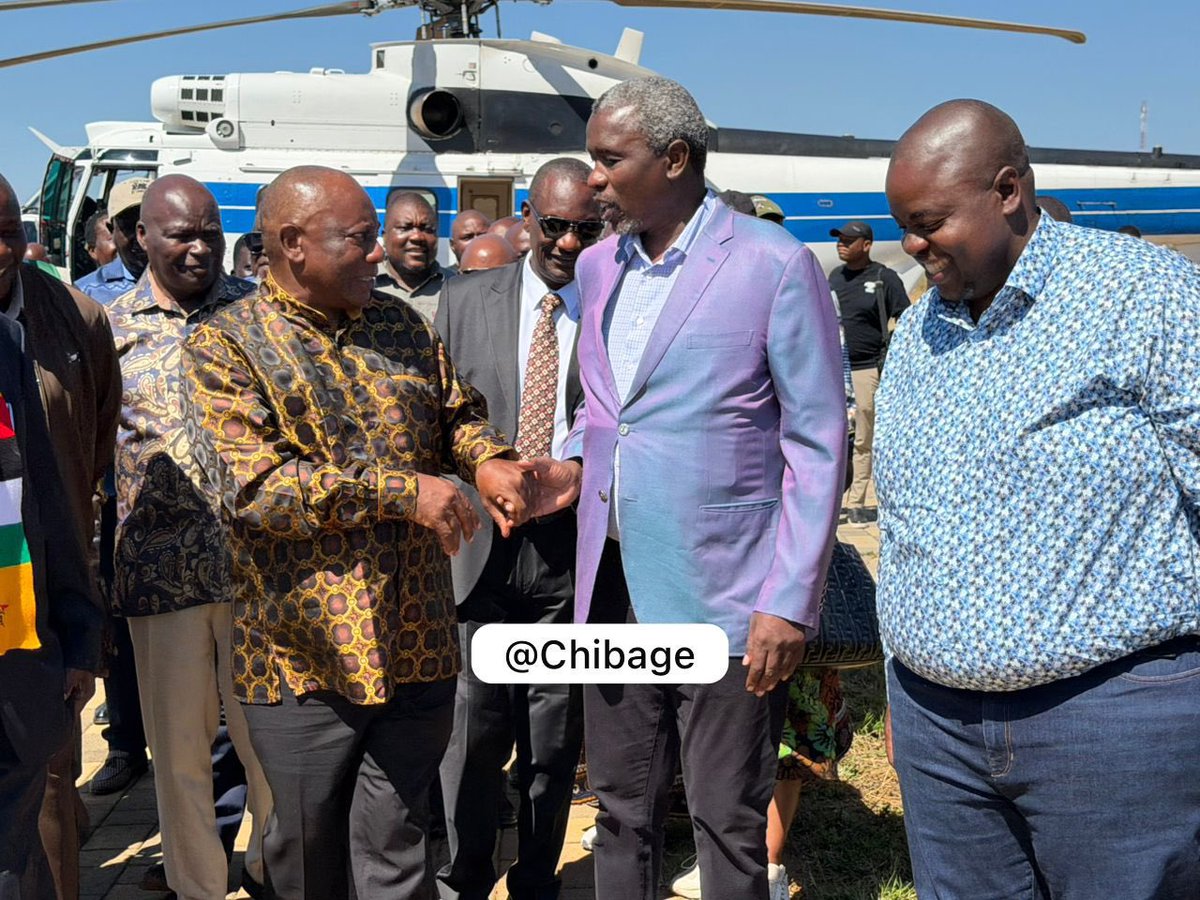
📸 Millionaire tenderpreneurs Wicknell Chivayo, Paul Tungwarara and Kudakwashe Tagwirei - all increasingly influential in Zimbabwe’s political direction - were present in a private meeting between South African president Cyril Ramaphosa and President Emmerson Mnangagwa today. Ramaphosa made an unannounced trip to Zimbabwe for what the South African government now says was an engagement on “issues of mutual interest.” Vice President Constantino Chiwenga has accused Tagwirei and Chivayo of “capturing the state.” A plan to amend the constitution to extend Mnangagwa’s term, opposed by Chiwenga, is threatening to cause a rapture in Zanu PF - which could explain Ramaphosa’s trip to Mnangagwa’s Kwekwe farm

English
@EdyMulaudzi @centralnewsza No mention on nationality = Not black foreigners
English


🔴JUST IN: Justice In Motion: Three Arrested, Kidnapping Victim Rescued in Kagiso🔴
Kagiso – Gauteng police have arrested three suspects aged between 23 and 25 and successfully rescued a 30-year-old victim in Kagiso, on the West Rand.
Read more⬇️⬇️⬇️
centralnews.co.za/just-in-justic…
#Justice #centralnewsza

English
@daddyhope @GrandZacharia People would rather be happy with lies than sad with the truth. Sad.
English
@GrandZacharia You want me to create things? Let those quoted say I am lying.
English
Hopes of a military coup against President Emmerson Mnangagwa, led by his vice president, General Constantino Chiwenga and his associates, have reportedly been quashed after sources say that South African President Cyril Ramaphosa assured his Zimbabwean counterpart that South Africa will not countenance any unconstitutional removal of a president in Zimbabwe.
Today, President Emmerson Mnangagwa met with Ramaphosa in Harare, where he was received by Mnangagwa alongside businessmen Wicknell Chivayo and Kudakwashe Tagwirei, before the two leaders and the two businessmen flew on a one hour helicopter trip together to Mnangagwa’s farm, Precabe, in Kwekwe.
They toured the farm, where the South African president was shown Mnangagwa’s Ankoli cattle and fish breeding pools. When they reached the ostriches, Ramaphosa is said to have remarked, in a pointed and politically loaded statement, that “nothing and nobody will remove my elder brother from power unconstitutionally.”
The remark was made in the presence of members of the delegation accompanying the two leaders.
“The owner of these ostriches will be president until 2030 if Parliament says so,” Ramaphosa is further reported to have said, reinforcing his assurance to Mnangagwa and those present.
The two leaders then went into a four-hour closed-door meeting, where they were joined by Tagwirei and Chivayo. The meeting was described as highly personal and private, with even the president’s spokesperson, George Charamba, excluded from the delegation for today’s visit.
Sources familiar with the discussions say Ramaphosa made it clear that South Africa would neither support nor recognise a military coup against Mnangagwa.
Those within Mnangagwa’s inner circle were reportedly buoyant after the engagement, interpreting Ramaphosa’s position as a significant reinforcement of regional backing.
They believe that, with South Africa’s stance now aligned with that of countries such as Tanzania, Mozambique, Zambia, and, more recently, Botswana, where Chivayo travelled in recent days, Mnangagwa has effectively strengthened his position and insulated his presidency within the region against any potential coup attempt.
What was significant today is that South African President Cyril Ramaphosa’s trip to Zimbabwe, which I broke last night, was not an official bilateral state engagement conducted at the level of heads of state.
It was a private trip, and sources in Pretoria say that many people in the president’s office, and indeed within DIRCO, the foreign affairs department of South Africa, were not aware of it.
President Cyril Ramaphosa is now back in South Africa after the short visit to Zimbabwe.



English
Today is the final day of #CAB3 Roadshows. These have been a massive success stimulating public interest and engagement. This is Nyabira today. Vanhu vanoda CAB3 yavo
English
@nickmangwana Chitanhatu musi we basa saka kuzara kwevanhu kune zvakunoratidza panyika
Suomi


Zim creates half a million jobs in the past two years
heraldonline.co.zw/zim-creates-ha…
English
@ProfJNMoyo What lunacy is this? How do you draw any parallel to support CAB3 here?
English

Professor Lovemore Madhuku in his Own Words Making the Case for Parliament to Indirectly Elect the President as an Electoral College: “We must not put in the Constitution of the country a provision that is dependant on what happens in a political party. That’s the point I’m making.
We must never say in our Constitution of Zimbabwe that if a sitting President dies or resigns, we will wait to hear what the political party of that President is saying. No. That is not the best way of running a country.
Political parties remain the preserve of those people who are in those political parties. But the country is run on the basis of either an election by the people—direct election—or you have Parliament as an institution sitting as an electoral college. Where parties have influence, they must do the influence within Parliament, but never to allow the political party to sit there to say I’m giving you this President, and so forth.
That’s the point I’m making. And on that point, I’m making it right across the world; that’s what they do.” -
Professor Madhuku, addressing a “Heal Zimbabwe Trust” public meeting in Harare on 22 February 2020.
COMMENT:
Professor Lovemore Madhuku’s 2020 remarks make a clear, powerful and enduring case for Clause 3 of the Constitution of Zimbabwe (Amendment No. 3) H.B.I. Bill, 2026. This clause replaces the direct election of the President with an indirect election by Parliament sitting jointly as an electoral college; both after every general election and, when necessary, to fill any vacancy in the office of President.
The current direct election of the President was first introduced in anticipation of a legislated one-party-one-man rule through Constitution Amendment No. 7, Act 1987 in the old Lancaster Constitution repealed in 2013.
Professor Madhuku put it plainly: The Constitution should not—as it currently does— depend on the internal decisions of a political party to select a successor to the President of the country. When a sitting President dies, resigns or is removed, the nation should not have to wait and hear what that President’s political party “is saying.”
That is not a constitutionally proper way to run a country. Political parties exist for their own members. The country, however, belongs to all Zimbabweans. The proper solution is straightforward: Parliament—the institution chosen by the people—should act as the electoral college. Inside that open forum, parties may exercise their influence transparently and accountably. No party should ever stand outside the Constitution and simply “give” the nation its next leader.
This principle is not abstract. Worldwide, presidential by-elections to fill mid-term vacancies are extremely rare. Most stable presidential systems instead use automatic succession by a deputy or, increasingly, allow the legislature to elect a successor who serves out the remainder of the term.
These arrangements place national continuity and stability above partisan interests. Clause 3 of the Bill follows exactly this proven path. By giving Parliament the clear duty to elect the President—whether at the start of a new term or in an unforeseen vacancy—Zimbabwe will secure stronger democratic stability, and keep the highest office firmly within the people’s constitutional framework rather than the private control of any single party.
In short, Clause 3 is a mature, practical and principled reform that directly honours Professor Madhuku’s wise 2020 counsel. As such, it deserves the full support of every well-meaning Zimbabwean who values good governance, democratic constitutionalism, institutional integrity and the long-term strength of the country’s democracy in the national interest!
English
@qhamelaphakathi @cecild84 That is the first question you ask when someone is killed? Crazy!
Anyway for your information, not all foreign business people are required by law to invest the minimum R7.5 m to start a business. Learn the law first!
English


Two legitimate AFRICAN traders were shut dead by a Xenophobic mob who went to their shops, took their belongings and shut them at point blank range. All recorded on CCTV.
The government and police are doing nothing
English


@bla_bidza @ProfMadhuku Have you heard of something called conflict of interest?
English

I am not among Mnangagwa’s top supporters @ProfMadhuku, but the suggestion that, as Commander-in-Chief, he is somehow prohibited from promoting his son Sean is, in my view, misguided. If the law were interpreted to forbid such an action, then one could reasonably argue that the law itself is poorly framed.
While concerns about nepotism in his son’s rise may be open to debate, relying solely on a strict legal argument in this instance risks being overly rigid. Not every issue begins and ends with the letter of the law. In Zimbabwe, there is often an excessive tendency towards legalism, even in areas that require a measure of executive discretion.
In matters of national security and defence, the Commander-in-Chief must retain the authority to appoint key command and control personnel. Perhaps the more appropriate point of scrutiny is whether the relevant minister should be required to appear before Parliament to account for senior departmental and military appointments. Even in such a scenario, matters of national security and defence would inevitably remain subject to confidentiality and classified considerations.
The real issue is not the validity of the promotion itself, but rather a style of leadership that appears to be primitively greedy and authoritarian; one that lacks emotional intelligence and fails to appreciate the central role of ethics in effective leadership.

English
@nickmangwana An amendment that is not of the people or from the people will not benefit the people. No to CABbage 3
English
@ProfJNMoyo Isn't it nonsensical that a limit be defined in two ways, cycle length and term numbers? The same limit defined as length of time. So time is now something which can be defined in two. Lunacy.
English
QUESTION: What is the relationship between section 91(2)—the term limit provision—and section 95(2)—the term length provision in the Constitution of Zimbabwe (2013)?
ANSWER: Section 91(2) is the term-limit provision. It regulates the President’s tenure by limiting the length of time that he or she may hold or occupy the Presidency as a public officer to a maximum of two terms—whether consecutive or not—where three or more years’ service is deemed a full term. By contrast, section 95(2) is the term-length provision. It regulates the electoral cycle of the Presidency as an office or institution by defining a single term as five years (now proposed to be seven years under Clause 4 of the Constitution of Zimbabwe (Amendment No. 3) H.B. 1 Bill, 2026).
The relationship between sections 91(2) and 95(2) is therefore as clear and straightforward as that between a truck driver and a 500 km highway: section 91(2) limits the driver, while section 95(2) defines the length of the highway. Section 91(2) caps the time any individual may occupy the Presidency; section 95(2) sets the institutional length or duration of each presidential term or electoral cycle.
This distinction matters because a persistent misconception claims that section 91(2) is not the presidential term-limit provision but merely a qualification rule for election as President, asserts that section 95(2) is the actual term-limit clause. Many who advance this incorrect view rely on one sentence in the obiter dictum by Patel JCC at paragraph 50 of the precedent-setting judgment in Marx Mupungu v Minister of Justice, Legal and Parliamentary Affairs & 6 Ors (CCZ 7/21, 2021) [see: x.com/ProfJNMoyo/sta…], which includes section 95(2) among examples of term-limit provisions.
That misconception overlooks a fundamental constitutional imperative: a presidential term-limit provision is, by definition, a disqualifier for election as President. Term limits on presidents are necessarily about elections. They limit qualification for election. Where there is no presidential term limit, re-election is unlimited.
In a recent discussion with @DavidHofisi on 23 April 2026 [x.com/TSatNewslive/s…] on the Constitution of Zimbabwe (Amendment No. 3) Bill hosted by @TSatNewslive, I explained the relationship between the two sections. Below is the verbatim text of the attached clip extracted from the discussion addressing the import of section 91(2) and its relationship with section 95(2):
ME:
“It’s a clear term limit provision; is similar to term limit provisions in other jurisdictions that are comparable to Zimbabwe. And when you say it doesn’t have time, it doesn’t make reference to time, I’m at a loss as to what that means, and where that is coming from, with respect to Dr Hofisi, because it says a person is disqualified for election as President or appointment as Vice President if he or she has already held office as President under this constitution for two terms.
This is the only section which tells us how many terms a President is limited to. Section 95 doesn’t even tell us that he’s limited to one term. There’s no limit.
This one limits the President to two terms. And the two terms, the last time I checked, was a reference to time. And in this case, the section doesn’t leave us doubting or not knowing what a term is or what sort of time a term is. Because it continues to say these two terms are counted whether they follow each other or not.
But most significantly, for the purpose of the limit on the President, the term limit on the President, which is provided in this section: three or more years. That’s time. You said there’s no time here. Three years is time. The length of time is three years minimum, and the maximum is more. It’s not defined here. It’s three or more years.
It’s more because that is subject to what the relevant law about electoral cycles says is the electoral cycle of the institution that the President occupies”. [verbatim text of clip from x.com/i/status/20483…]
The 500 km Highway Metaphor: Distinguishing Sections 91(2) and 95(2) of the Constitution
To clearly understand the relationship between sections 91(2) and 95(2), imagine the Presidency as a magnificent 500-kilometre highway built and maintained by section 95(2) of the Constitution. This provision creates the presidential highway itself: it defines the office of the President as a permanent public institution and sets the exact length of each single term — currently five years, now proposed under the Bill to be seven years. It establishes a structured, recurring electoral cycle that belongs to the people of Zimbabwe, ensuring regular, orderly renewal of leadership. Without section 95(2), there would be no defined road — only an open plain of indefinite power.
Section 91(2) governs the individual truck driver on that highway. It imposes an absolute lifetime limit: no person may complete more than two full trips along this 500 km highway, whether those trips are taken back-to-back or years apart. Any segment of 300 kilometres or more — that is, three or more years in office — counts as one complete trip. There are no partial credits or exceptions. After two full trips, the driver is permanently disqualified from driving on that highway, again.
The distinction is sharp and deliberate: Section 95(2) builds the highway and determines the length of each journey. Section 91(2) limits how many times any single individual is permitted to travel it. One structures the office; the other limits the person who occupies it. Together, they form the Constitution’s twin safeguards — working in perfect harmony to keep power temporary, accountable, and subordinate to the will of the people. To conflate their distinct roles is to weaken these vital safeguards and to invite the very tyranny the Constitution was written to prevent.
The Profound and Protective Meaning of “Three or More Years” in Section 91(2) of the Constitution
At the heart of section 91(2) lies one of the Constitution’s most brilliant safeguards: “for the purpose of this subsection, three or more years’ service is deemed to be a full term.”
The word “more” is no mere drafting flourish—it is deliberate constitutional genius. It declares that section 91(2), as the personal lifetime term-limit provision, imposes no rigid numerical ceiling.
Subject to what is reasonable and justifiable in a constitutional democracy under section 95(2), service of four years, five years, six years, seven years, or even longer—once it exceeds the three-year threshold—is unequivocally deemed a complete term for the purpose of lifetime disqualification. This flexibility is not a loophole; it is a wise design that refuses to let the term-limit clause under section 91(2) become brittle or easily evaded.
This open-ended “more” is anchored in section 91(2)’s harmonious relationship with section 95(2)(b), which defines the official electoral cycle of the Presidency as a permanent public institution whose five-year lifespan is inextricably intertwined with that of Parliament.
Section 91(2) places an iron-clad personal disqualification on the individual; section 95(2) defines the dimensions of the highway itself. Crucially, section 95(2) is not a term-limit provision under subsections (1) and (7) of section 328. Unlike the referendum-protected personal term limit in section 91(2), it may be amended by Parliament under section 328(5) without a national referendum.
This distinction is no accident; it is constitutional wisdom. It allows the institutional framework of the Presidency to evolve with the nation’s needs while the unbreakable personal lifetime bar on any single individual remains forever sacrosanct.
All told, sections 91(2) and 95(2) differ in character and purpose—one limits the President, the other structures the public office or institution of the Presidency—yet they stand together as the Constitution’s twin guardians.
This elegant complementarity keeps presidential power temporary, accountable, and forever subordinate to the sovereign will of the people through the institution or office of the Presidency. To respect and defend this relationship is to honour the very soul of the Constitution: ensuring that no individual can ever turn the highway into their driveway—turning the public office into a personal fiefdom—and that the highway of governance remains open, regularly renewed, and eternally in faithful service to the people of Zimbabwe. This is the promise the Constitution makes!
English
@nickmangwana The same parliament set to get the extension. Silly
English
“PARLIAMENT says it is satisfied with the public consultation process on Constitution of Zimbabwe Amendment (No. 3) Bill, which saw a nationwide outreach programme.”
heraldonline.co.zw/amendment-bill…
English
@daddyhope Idiocy at its peak. Ruto is a victim of colonialisation.
English
This is Kenyan President William Ruto boasting that Kenyans speak better English than Nigerians 🤣🤣🤣
He is confusing accent with diction.
When African presidents boast that their citizens speak “better English” than others, they are not demonstrating a strong education system, as Ruto claims, they are showcasing a deep inferiority complex rooted in colonial conditioning.
English is a colonial language, not a measure of intelligence, capability, or national progress.
You can be fully fluent in a language and still have an accent that is difficult for some listeners to understand, as Nigerians do. Fluency means you have a strong command of vocabulary, grammar, and the ability to express ideas.
Accent, on the other hand, relates to pronunciation, rhythm, and intonation, which are shaped by your first language and speech environment, which is what Ruto is confusing with good English. Has he ever had someone from Scotland, Liverpool, or Birmingham speak?
Accents are a natural linguistic outcome, not a measure of education. They emerge from the influence of a person’s first language, the sounds and speech patterns they grow up with, and the environment in which they learn and use another language.
Every language has its own phonetic structure, and when people speak a second language like English, those underlying patterns shape pronunciation, rhythm, and tone. That is why accents vary across regions and countries. They reflect history, identity, and exposure, not intellectual or educational superiority.
I know that there is some kind of tension between Nigeria and Kenya, but such misleading statements undermine the confidence of young people. When they hear a president speak like that about how they speak, it erodes their self-belief, and that is not a good thing to come from a president.
English

Cooked eggs are much more beneficial than raw eggs even for bodybuilders. Wazvinzwa here monya usativhunditsire nekudya mazai mambishi, ini ndokurova😃
English
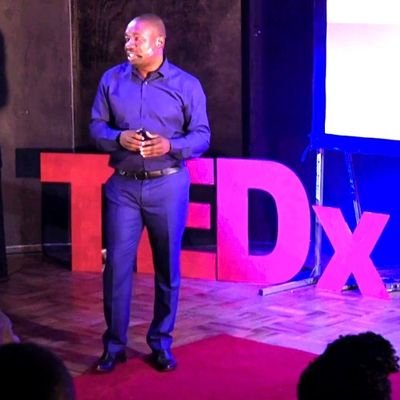
Do not accept a counteroffer. When you secure a new job, leave.
Most managers do not fully trust employees who use outside offers to negotiate higher pay. Even if nothing happens immediately, it can change how you are viewed. You may be seen as a retention risk or someone who is already halfway out.
The consequences are not always obvious upfront. You might be overlooked for opportunities, quietly sidelined, transferred, or included in a retrenchment list months later. It does not happen in every case, but it happens often enough to take seriously.
If you had reasons to leave in the first place, a counteroffer rarely fixes them.
@ipcconsultants
English
@DMatarutse One needs to have been in lab to do stuff to appreciate. STEM is not for everyone
English
MAPHISA
This is a Rural Laboratory in Maphisa. A Legacy of the Independence Commemoration being conducted there. A child in rural areas should have the same opportunities as the one in urban areas. That’s leaving no one and no place behind. This is the ideal promoted by President @edmnangagwa. @SiceloSTEMLADY
English