

Kalpak
1.6K posts

Kalpak
@KalpakSeal
Distributed Systems Engineer at Amazon Web Services.
Seattle, WA Katılım Aralık 2012
2.8K Takip Edilen278 Takipçiler

i'm strongly against model companies focusing too much on harness, but i would love to hear if anyone has a strong argument for it
my reason against it:
if openai didn't build GPT 5.5, no one else can. this is their core competence
if openai didn't build codex cli and app, we have opencode and t3code. building harness is NOT their core competence
this is not saying products like claude code, codex aren't good - i genuinely think these are top tier products built by really talented people
my point is - the world might be a better place if model companies focus more on their core capability and give us better, faster, safer and cheaper models, rather than competing with the ecosystem in the application layer
what do you think?
Greg Brockman@gdb
the model alone is no longer the product
English
@_mohansolo I really didn't like this messing around with my workflow and all the shenanigans.
Please think through the experience for the next releases
English

The IDE will now prompt you with a one-click button to migrate your settings, keybindings, and extensions from your pre-2.0 Antigravity installation:

English
Thanks for all of the Antigravity feedback over the last couple of days, especially around the IDE. Our intention was never to remove the IDE support for developers, and we should have been clearer with that in the product from the beginning.
We’ve made it clearer in 2.0 on how to connect to the IDE, fixed issues with opening the IDE on Windows machines, provided instructions to restore IDE settings & extensions, and more.
New releases for the Antigravity IDE and Antigravity 2.0 have rolled out with these changes.
We should have done better so we’re going to reset everyone’s Gemini quota for the week again.
English

i feel like the golden age of software engineering was ~2019
> pay was good
> job market was good
> being able to code meant something
> pre LLMs so you still had to use your brain
> pre pandemic so you appreciated when you could work from home but didn't expect it
in 2026 engineering just doesn't seem to scratch the same itch for me anymore
i wonder what will replace it
English

We should not let these people get away with this, honestly.
You are multi-millionaire anyway, even if the country's economy goes down the drain, you'll still be fine while millions of poor people will literally starve, and yet you have the gall to make noise now?


English


had a jane street interview in 2013
on the way there, i run into a dog. the dog is hurt. i stop to help it but am an hour late to the interview
i arrive at the office. the dog is my interviewer.
i sigh with relief. surely i'm hired.
'you didn't get the job' the dog says
'reason: ineffective altruism. you failed to realize that arriving on time, earning $500k/year as a junior trader, and donating 10% to shrimp welfare would have prevented approximately 4 million shrimp-hours of suffering. you saved one dog. me. a dog with negligible moral weight relative to the marginal bednet.'
i open my mouth.
'also i wasn't hurt. it was a trolley problem. you pulled the wrong lever.'
i nod. it is true. dogs are not a givewell top charity.
the dog slides a pamphlet across the desk. it says 80,000 hours.
'have you considered earning to give'
i start to cry. the dog does not update on this. the dog has read the sequences.
'one more thing,' the dog says. 'the dog you saved. that was also me. i contain multitudes. specifically, i contain a counterfactual in which you arrived on time and we are currently shaking hands. that version of you is now my colleague. he tips well at lunch.'
i leave the building. on the sidewalk, another dog is hurt.
i keep walking. i have learned.
the dog yells after me, 'WRONG. THAT ONE WAS REAL'
- written by Claude 4.7 (Adaptive)
English

The urge to learn [zig, rust, go] by-hand right now is incredibly high.
Not because I think it's a better way to build software in 2026 (it's not) but because it's SO MUCH FUN.
Remember the feeling of learning your first language? Your second? Third? How the intuition about language features and design steadily developed and helped you become the engineer you are today?
Speaking of which, need to choose a topic for next stream series...
Sam Hogan 🇺🇸@samhogan
All the best programmers I know are starting to write code by hand again
English
Kalpak retweetledi

@arpit_bhayani Somewhere, some how, AGI vanished like potholes before election.
English

We spent millions building a wildly capable, human-like non-deterministic AI, and are now spending millions more trying to wrap it in guardrails and making it predictable and deterministic. Absolute cinema.
English
Kalpak retweetledi
The Jensen + @dwarkesh_sp podcast was fantastic.
Jensen is someone who understood how ecosystems work and someone who understands real-world trade, policy and controls work. And in some deeper sense how AI will actually diffuse into the world.
In this podcast, Dwarkesh came off as someone who picked up talking points from an AGI party in the SF Mission District.
And the contrast was so evident.
As someone who understood ecosystems relatively deepy, maybe I understood Jensen's take more than others did (idk).
Mythos, that Dwarkesh kept bringing up, is not a single absolute turning point in the AI development landscape. Take a state-of-the-art Chinese open-source model, and give it three orders of magnitude more test-time compute + post-training algorithmic advances that haven't been published yet. That's the baseline. It was evident that in whatever bubble Dwarkesh is in, that is seen as a naive or illogical baseline.
When AI has such a complex development cycle, it's evident that America needs many levers of policy intervention across multiple layers in a dominant ecosystem that ideally the Western world controls.
The entire premise that a particular model with AI development will have a critical phase change is neither correct nor does evidence point to it. OpenAI made this point with GPT-4, Anthropic made this point with Mythos, but neither stood / will stand the test of time.
I think Jensen's repeated emphasis within the podcast to try to make this point mostly didn't get Dwarkesh's attention. And Dwarkesh (in this podcast) represents an entire cult of AI researchers and decision-makers that are going to influence policy.
The thing with policy interventions is that if you do too much too early, you shoot yourself in the foot. There's a good reason American foreign policy and general sanctions of all kinds are measured and continuous.
Despite Jensen's attempt at educating the "Anthro" audience how ecosystems work, I'm also not super hopeful a lot of people who've taken the extreme position will change their thought after listening to this podcast. I do think there's a certain religiousness that has permeated some of that community that would make it hard to understand ecosystems at a deeper level.
Dwarkesh Patel@dwarkesh_sp
The Jensen Huang episode. 0:00:00 – Is Nvidia’s biggest moat its grip on scarce supply chains? 0:16:25 – Will TPUs break Nvidia’s hold on AI compute? 0:41:06 – Why doesn’t Nvidia become a hyperscaler? 0:57:36 – Should we be selling AI chips to China? 1:35:06 – Why doesn’t Nvidia make multiple different chip architectures? Look up Dwarkesh Podcast on YouTube, Apple Podcasts, Spotify, etc. Enjoy!
English

It's crazy how whenever a leader of an AI company talks, it makes me want to root against them. Dario and Sam especially.
I don't know what it is about them. They created LLM's trained on lots of data, now they think they're gods that can predict the future, and they believe they know what's best for public policy.
The ones I actually find the least annoying are Sundar and Zuck.
English
@sriramk @dwarkesh_sp The podcast, nonetheless, is so well done. It would stand the test of time, imo.
Podcasts should aim for such exchange of thoughts.
English

Every person here's reaction to the Jensen + @dwarkesh_sp podcast can be extrapolated *directly* from whether they believe in the frontier labs achieving short timelines for AGI/ASI.
If you believe in the labs achieving RSI and then AGI/ASI (for some definition of all three) in the next few years, you'll probably sympathetic to the frame @dwarkesh_sp adopts.
If not, you're probably more sympathetic to the arguments from Jensen.
English
Kalpak retweetledi

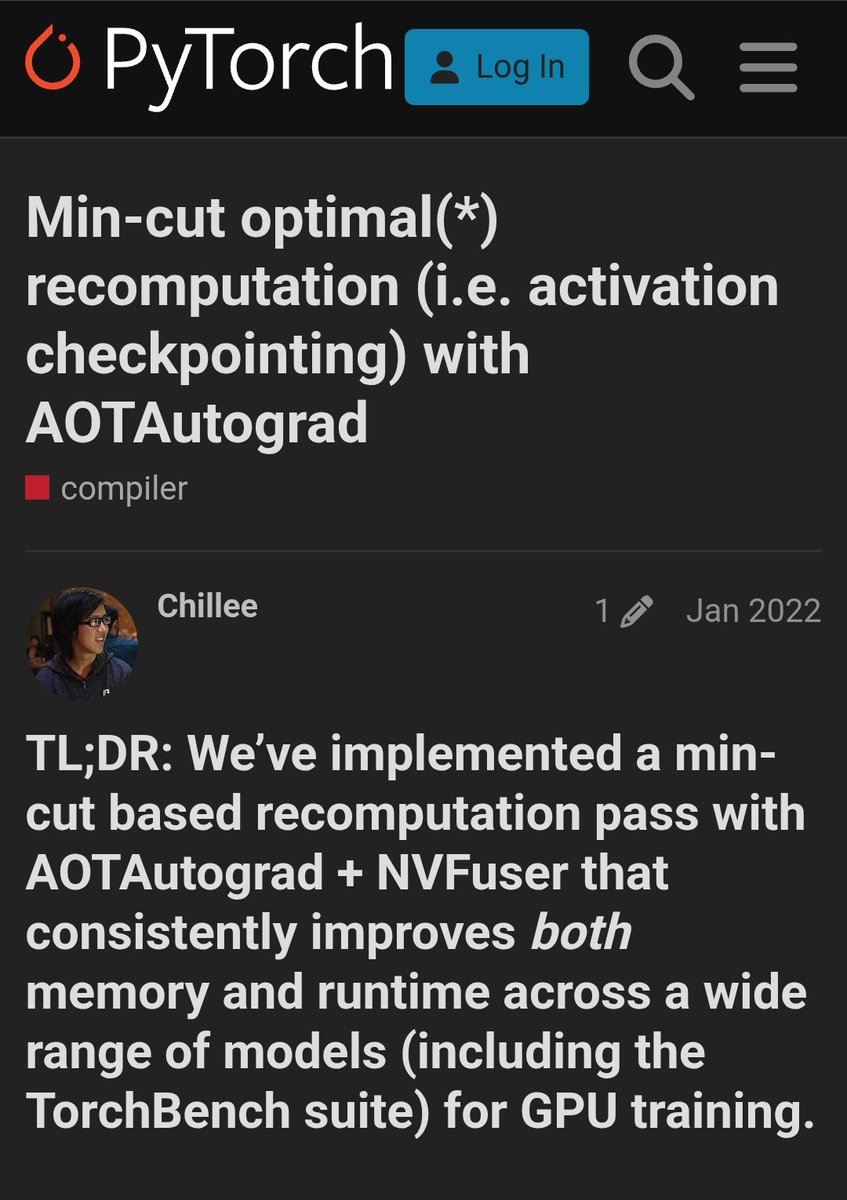
Found a neat use of the min-cut algorithm inside torch.compile.
During training, the compiler captures both forward and backward graphs.
The backward pass needs certain activations from the forward pass to compute gradients. The obvious option is to simply save all such tensors for the backward pass. But for large models this can be memory-intensive.
So the compiler decides which activations to save and which to recompute during backward.
PyTorch uses a min-cut based partitioning on the joint forward+backward graph to decide the minimum set of activations to save, recomputing the rest during the backward pass.
English

Anthropic saw my “why can’t you kill TurboTax” tweet.
4 days before the tax deadline, they ship this.

Yuchen Jin@Yuchenj_UW
Anthropic killed this, Anthropic killed that, why cant Anthropic kill TurboTax
English
@aiexplorations @AnjneyMidha Beyond that, I mostly find it to be folks with capital taking strategic bets on people based on network effects .
English
@aiexplorations @AnjneyMidha Expertise in the AI space is often a blue / red pill situation.
Expertise is required & found at the model's training & inference layer and in the stack below it (chip design, infrastructure , power management , etc. ).
People with credentials for building them over year.
English
it is genuinely extraordinary how much alpha is sitting in plain sight for those willing to pay attention
English

🚨do you understand what two Anthropic engineers just explained in 16 minutes.
Barry and Mahesh built Claude Skills from scratch.
here's the part nobody is talking about:
> Skills are just folders.
> folders that teach Claude your job.
> your workflow. your expertise. your domain.
Claude on day 30 is a completely different tool than day one.
watch this before you write another prompt.
before you build another agent.
before you touch another tool.
16 minutes. bookmark it. watch it today.
and if you want to learn everything about Claude from scratch the full 4 hour guide is waiting below.
Kirill@kirillk_web3
CLAUDE FULL COURSE 4 HOURS This is the most detailed Claude guide I’ve seen online. Bookmark this before you forget. 4 hours. Build tools. Automate work. Learn how people build bots and systems. Claude → Tools → Automation → Products → Money
English
@AnjneyMidha @aiexplorations Isn't executions just capital allocation ( bets and hedges) + accountability (proof of work ).
Leadership subsequently becomes a ceremonial robe.
English
@aiexplorations yes. execution requires leadership of many kinds.
English
Kalpak retweetledi

Super excited to watch this!! @michael_nielsen is one of my favorite people on the internet.
He’s a physicist who has been my go to to read about deep learning, blockchain, spaces recognition, how to read papers/math, what deep creative work looks like, what science and open science look like and ofc the very little I know about quantum computing.
He’s collaborated and introduced me to so many thoughtful people I also love including:
- Chris Olah (@ch402)
- Andy Matushak (@andy_matuschak )
- Kanjun (@kanjun)
- Devon (@devonzuegel)
- P Collison (@patrickc)
He’s been my def for what an independent researcher looks like.
Dwarkesh Patel@dwarkesh_sp
Really enjoyed chatting with @michael_nielsen about how we recognize scientific progress. It's especially relevant for closing the RL verification loop for scientific discovery. But it's also a surprisingly mysterious and elusive question when you look at the history of human science. We approach this question stories like Einstein (who claimed that he hadn't even heard of the famous Michelson-Morley experiment, which is supposed to have motivated special relativity, until after he had come up with the theory), Darwin (why did it take till 1859 to lay out an idea whose essence every farmer since antiquity must have observed?), Prout (how do you recognize that isotopes exist if you cannot chemically separate them?), and many others. The verification loop on scientific ideas is often extremely long and weirdly hostile. Ancient Athenians dismissed Aristarchus's heliocentrism in the 3rd century BC because it would imply that the stars should shift in the sky as the Earth orbits the sun. The first successful measurement of stellar parallax was in 1838. That's a 2,000-year verification loop. But clearly human science is able to make progress faster than raw experimental falsification/verification would imply, and in cases where experiments are very ambiguous. How? Michael has some very deep and provocative hypotheses about the nature of progress. One I found especially thought-provoking is that aliens will likely have a VERY different science + tech stack than us. Which contradicts the common sense picture of a linear tech tree that I was assuming. And has some interesting implications about how future civilizations might trade and cooperate with each other. So many other interesting ideas. Hope you enjoy this as much as I did. 0:00:00 – How scientific progress outpaces its verification loops 0:17:51 – Newton was the last of the magicians 0:23:26 – Why wasn’t natural selection obvious much earlier? 0:29:52 – Could gradient descent have discovered general relativity? 0:50:54 – Why aliens will have a different tech stack than us 1:15:26 – Are there infinitely many deep scientific principles left to discover? 1:26:25 – What drew Michael to quantum computing so early? 1:35:29 – Does science need a new way to assign credit? 1:43:57 – Prolificness versus depth 1:49:17 – What it takes to actually internalize what you learn Look up Dwarkesh Podcast on YouTube, Apple Podcasts, or Spotify.
English
Kalpak retweetledi

I just got a new M5 Mac so here are all the terminal tools and setup I use, from ghostty, prezto, ripgrep, yazi, ...
onmyway133.com/posts/how-to-s…

English