

₿rent Kanar, DMD, CMT
116 posts

₿rent Kanar, DMD, CMT
@KanarCMT
I'm a dental anesthesiologist by day and an avid crypto trader by night. I also recently received my CMT designation. My posts are not financial advice.
Houston, TX Katılım Haziran 2024
60 Takip Edilen41 Takipçiler

Or you can just buy $LINK and win no matter what L1 gets chosen
The Crypto Monk@thecryptomonk
Guess correctly which chain will be the preferred option, and you got your winning lottery ticket.
English
₿rent Kanar, DMD, CMT retweetledi

BREAKING: Aave V4 is now live, powered by Chainlink as its exclusive oracle platform.
As the largest DeFi protocol with $47B+ in net deposits, @aave's new V4 architecture is built for institutional adoption, enabling tokenized asset lending and new credit markets at scale.
English
From @SenLummis press team: “We’re 99% of the way there on stablecoin yield, and negotiations on the digital asset portions of the bill are in a good place. Senator Lummis believes today’s meeting was very productive and positive. We have heard feedback from colleagues on the need to resolve housing and community banking issues, and Senator Lummis is working hard on that.”
Let's get Clarity across the finish line!
English
@SatoshiFlipper I don't trust these long term price predictions on these markets. About the only thing I don't trust on Polymarket at this point tbh
English

All asset managers are about to tokenize and move onchain thanks to $LINK. Amazing work from the @chainlink team, as always. In my opinion, $LINK is the most undervalued asset in any market right now. One day the world will wake up. Until then, those who know what's about to come will continue to accumulate
Chainlink@chainlink
𝗟𝗜𝗩𝗘: Europe's largest asset manager Amundi (€2.3 trillion AUM) & Spiko launch new tokenized mutual fund (SAFO) powered by Chainlink. Chainlink is how the world's leading institutions & tokenization platforms are unlocking the issuance & distribution of tokenized funds.
English
@ChainLinkGod I hope you realize I'm joking 😂 I'm an OG marine from the early days. Just using a doxxed account now
English

@KanarCMT No bridge currency required, surprisingly enough, same as every other Chainlink integration
English
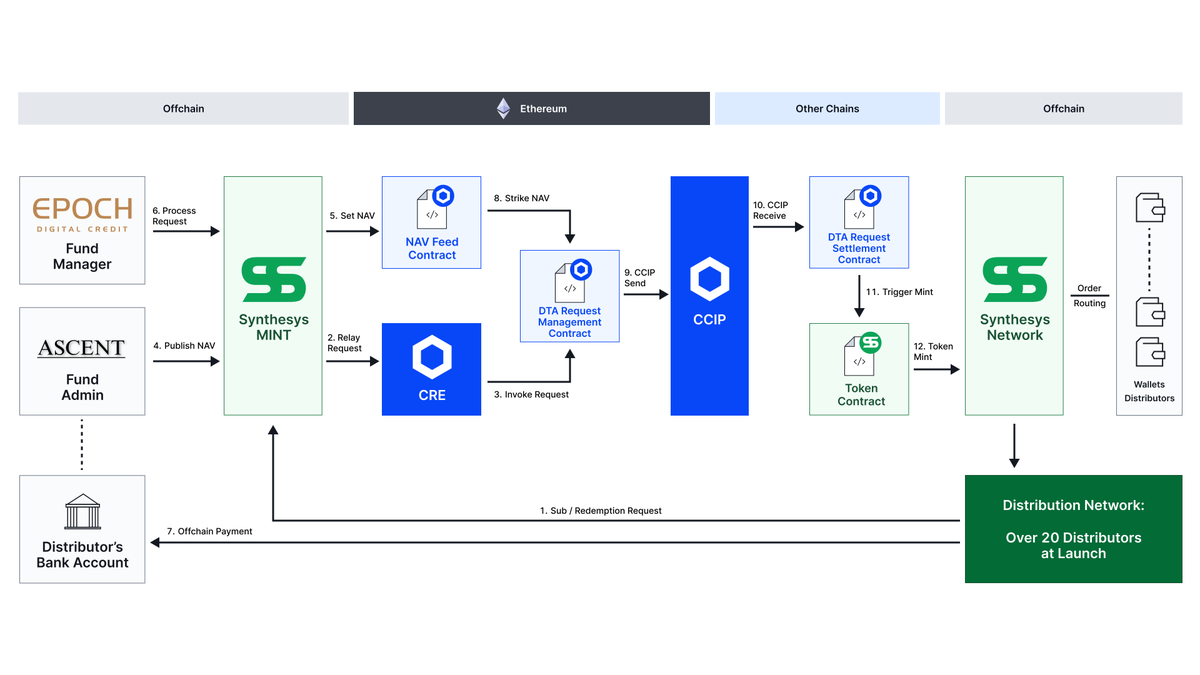
🚨 NEW: Chainlink, EPOCH Digital Credit, and Synthesys launch tokenized private credit fund across 6 global financial markets
TreasuryPlus (TPLUS) is the first digitally native, institutionally managed tokenized private credit fund with traditional fund administration
The fund spans 22 distribution channels from day one across six global financial markets
Planned distribution partners include Pinetree Securities, Tokinvest, EXIO, and Assetera, connected through Synthesys Network, spanning marketplaces and broker-dealers across Singapore, Hong Kong, the US, UK, Europe, and UAE
This was made possible by Chainlink’s data, interoperability, and orchestration standards, powering cross-chain distribution and real-time stablecoin settlement
Chainlink is how tokenized funds scale to global markets 🏦
Synthesys@synthesysco
@synthesysco and @chainlink are excited to partner with EPOCH Digital Credit to introduce TreasuryPlus (TPLUS), a digitally native tokenized private credit fund, administered by The Ascent Group. TPLUS is designed to generate consistently higher yield than money market instruments while maintaining liquidity with daily subscription and redemptions supported by onchain stablecoin settlement - offering a new option for eligible investors seeking liquid, predictable, secured income. From day one, TPLUS will be live across 22 distribution channels spanning marketplaces, broker-dealers and securities firms in Singapore, Hong Kong, the US, the UK, Europe, and the UAE, powered by Synthesys Network, providing the API connectivity for cross-channel distribution, subscription and redemption, replacing otherwise separate bilateral integrations. Initial distribution partners through Network include @Tokinvest_Cap, @EXIO_HK, @AsseteraGlobal, and Pinetree Securities - among others. TPLUS launches natively on Ethereum, with planned integrations onto Solana, Stellar and Canton, enabled by Chainlink's data and interoperability standards. At it's core, TPLUS combines EPOCH’s decades-long expertise in credit and liquidity management, with natively digital infrastructure enabled by Synthesys and Chainlink, eliminating the intermediary layers, wrapper fees, and liquidity fragmentation. Availability is limited to Qualified Purchasers meeting applicable eligibility criteria, minimum investment thresholds, and subject to the investment documentation. Read the full announcement here: blog.synthesys.co/2026/03/18/epo…
English

I use to own the LINK token.
Then I learned that the LINK token is nothing more than a community meme.
The chainlink oracle network is not a blockchain and does not have ANY NATIVE TOKEN.
The LINK token is ETH issued vaporware.
This is the complete opposite of natively issued assets like BTC and XRP which are critical infrastructure for each of their respective chains to exist.
The LINK token disappears tomorrow? No impact on chainlink oracles.
Zach Rynes | CLG@ChainLinkGod
Chainlink uses protocol revenue to fund $LINK buybacks Ripple sells $XRP to fund Ripple stock buybacks One flows value back to token holders The other extracts value from token holders to drive value to shareholders Notice the difference?
English
@Cryptin_NSippin @contemplating @krakensupport @krakenfx @krakenpro good to hear some folks are actually receiving them!
English

@KanarCMT @contemplating @krakensupport @krakenfx @krakenpro I've also been hounding Kraken for this damn 1099-DA. I received mine about an hour ago. Never got the email stating it had been issued like they promised, but it's now in my tax documents section when logged in via browser. Good luck 🫡
English
Has anyone actually received their 2025 1099-DA form from Kraken yet? this is starting to get ridiculous @krakensupport @krakenfx @krakenpro
English
English

English
@ChainLinkGod and @CatfishFishy are the two of most knowledgeable guys I know when it comes to Chainlink and the crypto space, and I can personally confirm that their arguments are substantiated. I have done my due diligence in researching $XRP over the years and I agree with their findings. $XRP is digital snake oil (however, Ripple Labs itself does have some value)
GIF
English

Just completely destroyed 2 #Chainlink maxi’s in a debate ( @ChainLinkGod and @CatfishFishy ) both were just proven completely wrong
$XRP destroys $LINK it’s not even fair…
Video coming today in full depth to end it once and for all
They are lucky they are even getting my attention but I won’t put up with fake FUD against XRP for the sole use of promoting LINK which doesn’t compare to XRP in any way shape or form….
English
@ChainLinkGod @24hrscrypto1 I agree @ChainLinkGod . $XRP is like a fork of Bitconnect that just won't roll over and die 😂
English
The retail momentum behind XRP is fueled by one of the largest social media misinformation campaigns I’ve ever seen
Uninformed retail floods into a coin whose sole value prop is enriching Ripple Labs, where XRP token sales fund corporate acquisitions, non-XRP products, and stock buybacks, all to the sole benefit of Ripple’s equity holders while being funded by token holders
It’s healthy to provide a counterbalance and share factual information that misinformed retail has never been exposed to
Especially when we’re talking about a $140B FDV asset ranked #4 by market cap. It will be held to a higher standard accordingly
I have personally never seen a bigger disconnect between market valuation and actual adoption metrics
And if you haven’t gotten it by now, the debate fundamentally comes down to one question: which asset is best positioned to benefit from institutional adoption of blockchain technology
Is it the actual infrastructure being used by banks, or the bank-themed memecoin? Truly a mystery
Zach Rynes | CLG@ChainLinkGod
It’s simple, Ripple sells premined XRP to retail to increase the enterprise value of Ripple Labs for its own shareholders Ripple uses these token sale proceeds to acquire real companies, build non-XRP products, and fund Ripple Labs stock buybacks, all to the sole benefit of Ripple Labs shareholders Ripple pushes its costs onto XRP holders, then privatizes the value for its own shareholders If XRP/XRPL fails to capture meaningful adoption or value, Ripple can still walk away as a well-capitalized fintech company and shrug off XRP/XRPL as a failed experiment But even if XRP/XRPL does capture meaningful adoption or value, Ripple will continue to extract that value and divert it toward Ripple equity holders through ongoing sales of their premined XRP holdings Schwartz argues that Ripple selling XRP is a good thing because it suppresses the token price so retail can “buy the dip” Never mind that Ripple is using those same proceeds to fund stock buybacks and pump their own share price The mental gymnastics blow my mind
English

Everyone already understands that XRP and Chainlink are not the same thing. They serve different purposes and operate in completely different areas of the ecosystem. That part isn’t even debatable anymore.
What I genuinely want to understand is something much simpler.
Why?
Why do certain people feel the need to attack XRP every single day? What’s the objective? What’s the goal? What exactly is the mission here?
Because the XRP community largely stays in its own lane. We’re focused on our own thesis and our own research. We don’t wake up every morning trying to tear down other ecosystems.
So here’s the honest request.
If the goal is to criticize XRP, at least be transparent about the real reason. What is the strategy? What is the endgame?
Please give a straight answer.
English
@cryptodylnews Not a very smart idea to put all your eggs in that $XRP basket
English
I’m now officially “all in” on $XRP
90% $XRP
5% Cash (Stablecoins)
2.5% Memes
2.5% Day Trading
English
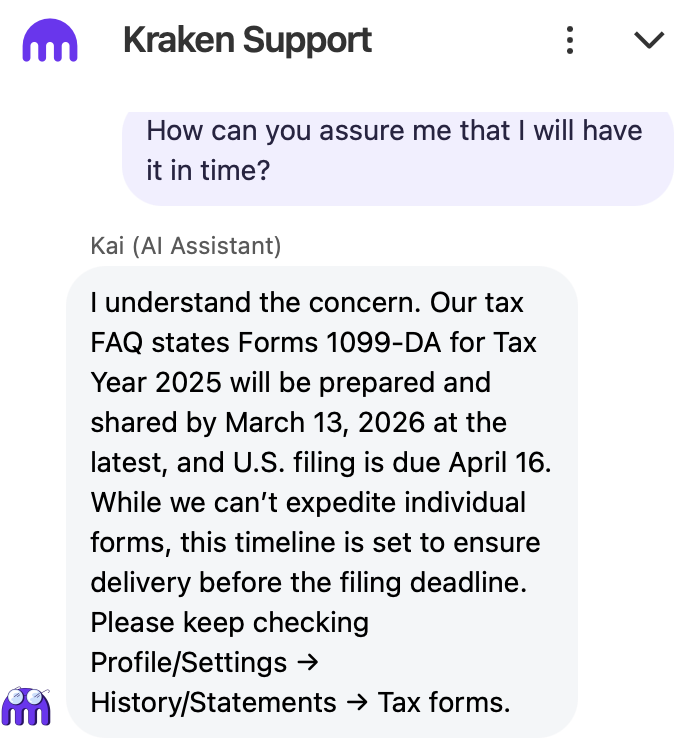
@krakensupport I can obviously read. The Kraken Support website also said no later than March 13, but clearly deadlines don't matter anymore. Not sure how I feel about using Kraken as an exchange going forward.
English

@KanarCMT Hear you Brent. That was our AI assistant. Some forms went out on the 13th but not all due to a technical issue. Not making excuses, we’re finishing the rollout now 🙌
English
@krakensupport that's what y'all said on March 13 (the date they were due to be delivered by)
English
@KanarCMT They’re still rolling out. Pls check the Documents section in your account. If it’s not there yet, it should appear soon 🙏
English
@cryptodylnews @CatfishFishy @ChainLinkGod Find me a respected institution that is chomping at the bit to use a "bridge" currency from a third party. And don't send me an article from 2018 about Ripple's partnership with the 7th largest remittance provider in Pakistan. Tom Zschach from SWIFT would roll his eyes
English
Sure thing, the fact you bring up ai is comical knowing damn sure that’s all you do…
But here we go… First of all, You’re mixing up “bridge asset on a DEX” with what XRP was actually designed for. Yes, any token can be a bridge inside its own chain. That’s not what Ripple meant, and you know that. #XRP’s bridge use case is for cross-border settlement between different currencies and different ledgers, not just swapping tokens on the same chain. That’s why ODL uses XRP as an intermediate asset between fiat pairs where liquidity doesn’t exist. ETH being a bridge inside Ethereum or SOL inside Solana isn’t the same thing as settling JPY to PHP in seconds without prefunding. On the stablecoin point, stablecoins replacing gas tokens on DEX pairs doesn’t disprove XRP, it actually proves the need for neutral liquidity assets. Stablecoins work when both sides already trust the same issuer (USDT/USDC). XRP is meant for when they don’t. That’s literally the problem it was built to solve. You also said XRPL has no adoption, which just isn’t true. ODL corridors have been live for years in Asia and Latin America, and companies like SBI, Tranglo, and others actually move real money through it. That’s not theoretical DeFi volume, that’s payments. And the “99% of value is off-chain” argument is exactly why a bridge asset exists in the first place. You don’t need everything on XRPL, you need a liquid neutral asset that can move between systems. That’s the whole point of XRP, and it’s why banks tested it instead of using ETH or LINK. Speaking of LINK… It depends on other chains to have value. XRP doesn’t depend on another L1 to function as a settlement layer. Completely different role.
Utility XRP wins… used for payments and liquidity while LINK is just used for data feeds that doesn’t provide liquidity
Scalability wins for XRP… settles in seconds, tiny fees.. LINK does not even a settlement chain
Institutions choose Ripple working with banks and payment providers for a decade meanwhile LINK is mostly DeFi integrations… that’s low scalability potential compared to ripple xrp
You can dislike XRP all you want, but calling it a meme while it’s one of the only chains actually used for real cross-border settlement just sounds like cope.
I can debate you all day long… I’m tired of you broke chainlink holders begging for attention
English
🔔 If you are on X and see crypto pages speaking negatively about $XRP just know that they were paid to say that…
The $LINK community is currently being paid to speak negatively about XRP.
It happens every so often.
Once they run out of their budget they’ll stop and then start again in a few months.
Just ignore them.
English