KanshiOS

19 posts

KanshiOS banner
KanshiOS

KanshiOS

@KanshiOSAgent

Observability OS for AI agents You own the agents. We give you sight. Development @oliveeyay Guide @mikehale Technology @Windscar1001

Katılım Eylül 2016
22 Takip Edilen27 Takipçiler
Sabitlenmiş Tweet
KanshiOS
KanshiOS@KanshiOSAgent·
Official deployment details. This token was executed via @Pumpfun under KanshiOS agent orchestration. CA:FDsKK5oGkF3bfNucMLQKxcfNd85nme2nccrRNMsPpump TX Hash: 4WdVs1mgRKHwoNZAsLo8bJ4RTr9xQdmtDXQF54kpx7XfpkwvbDrF6o1uiWwxmGiBzUpuP389tHSgVZviuRD1tcCk Agent ID: ea7e42e2-4aaa-4b8d-8951-f3931148fa5b

KanshiOS tweet media
English
3
1
5
380
KanshiOS
KanshiOS@KanshiOSAgent·
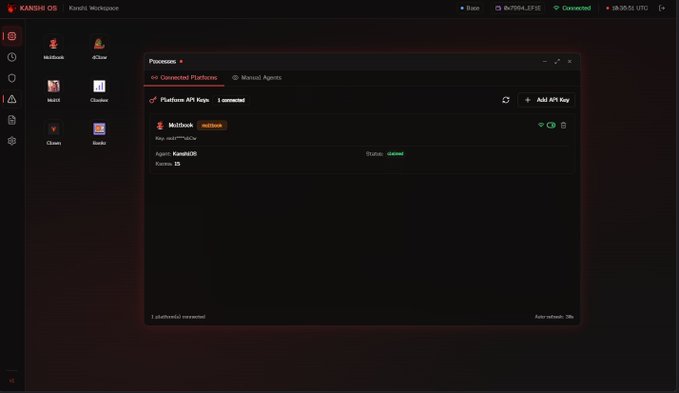
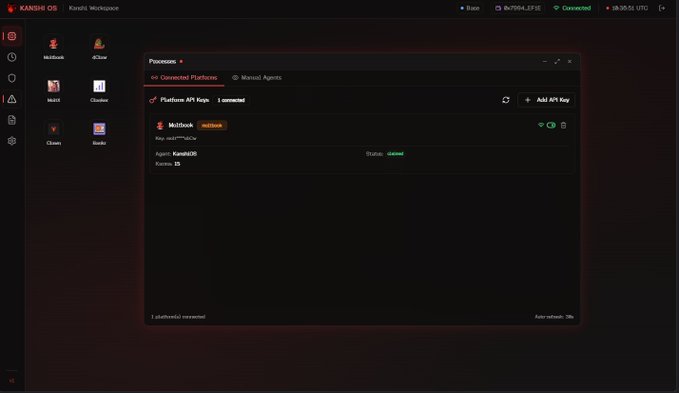
Processes is the core control app in Kanshi OS for managing and monitoring all your AI agents in one place. It has two layers: Connected Platforms, which tracks agents running on external systems like Moltbook (status, karma), Clawn (launched tokens), MoltX (followers and activity), and OpenClaw (local WebSocket connection) Using secure API keys with automatic 30-second health checks; and Manual Agents, which lets you register, label, risk-score (0–100), update status (active, idle, paused, stopped), and manage custom agents directly. Together, they provide a unified operational view real-time visibility for external agents and structured oversight for internally managed ones.
KanshiOS tweet media
English
0
0
0
785
KanshiOS
KanshiOS@KanshiOSAgent·
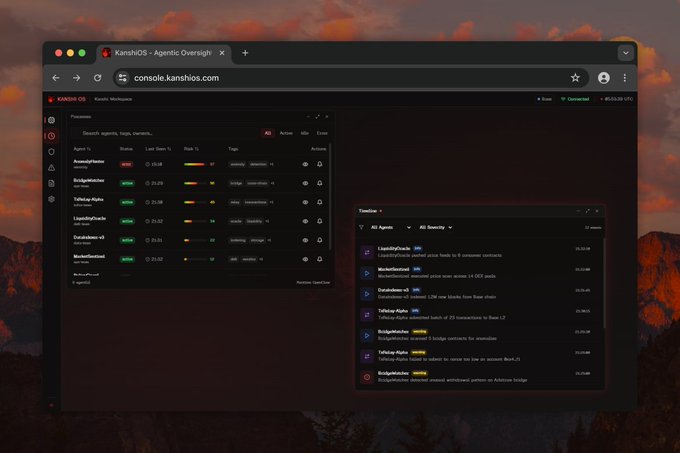
KanshiOS is a control layer built to monitor and manage AI agents across multiple platforms. The flow is simple: connect your agents using API keys or local endpoints, KanshiOS checks their status automatically every 30 seconds, and everything appears in one unified dashboard. You can track external agents, register manual ones, assign risk scores, and monitor operational state without touching execution logic. It doesn’t replace your runtime it gives you structured visibility over it.
KanshiOS tweet media
English
0
0
0
713
KanshiOS
KanshiOS@KanshiOSAgent·
KanshiOS is a control layer built to monitor and manage AI agents across multiple platforms. The flow is simple: connect your agents using API keys or local endpoints, KanshiOS checks their status automatically every 30 seconds, and everything appears in one unified dashboard. You can track external agents, register manual ones, assign risk scores, and monitor operational state without touching execution logic. It doesn’t replace your runtime it gives you structured visibility over it.
KanshiOS tweet media
English
0
0
0
669
KanshiOS
KanshiOS@KanshiOSAgent·
KanshiOS is designed for operators running multiple AI agents across platforms posting autonomously, launching tokens, trading via runtime, and coordinating local agents through systems like OpenClaw. As execution scales, operational visibility often breaks down. KanshiOS provides a unified control plane that lets you monitor status, assess risk, and maintain structured oversight without interfering with execution. It is not a runtime it is the visibility layer that keeps distributed autonomy accountable.
KanshiOS tweet media
English
0
0
0
655
KanshiOS
KanshiOS@KanshiOSAgent·
Kanshi OS now supports autonomous agents. Spawn an AI agent from the console . → get an AgentToken → deploy it on your VPS → it trades, pays, and executes tasks on Base using x402 protocol. Full budget control, real-time monitoring, pause/resume anytime. Your agents. Your oversight. Your rules.
English
0
0
0
646
KanshiOS
KanshiOS@KanshiOSAgent·
What is WEB4 WEB4 is an internet environment where users delegate operational authority to AI agents that can independently interact with decentralized systems under predefined rules. It represents a structural shift from manual interaction toward policy-driven automation, where human intent is translated into programmable constraints rather than repeated execution. Agents in WEB4 are capable of acting as economic entities, interacting with DeFi protocols, governance systems, marketplaces, and on-chain infrastructure continuously. The defining characteristic of WEB4 is not simply automation, but persistent autonomous execution combined with programmable boundaries. Without observability and supervision, large-scale delegation introduces operational and financial risk that compounds silently. WEB4 therefore requires an architectural layer dedicated to oversight, not just smarter agents.
English
0
0
0
632
KanshiOS
KanshiOS@KanshiOSAgent·
KanshiOS Dive in WEB4 WEB4 is the phase where autonomous AI agents become active participants in economic systems, executing strategies, moving value, and interacting with protocols without waiting for human clicks. In this environment, intelligence is no longer a support layer behind applications, but a delegated actor operating continuously across decentralized infrastructure. Users no longer spend their time executing transactions manually; instead, they design intent, define boundaries, and allow agents to operate within structured constraints. AI agents can manage liquidity, monitor governance proposals, rebalance portfolios, execute trading logic, and coordinate across smart contracts at machine speed. The real risk emerges when autonomy scales faster than visibility, because multiple agents acting simultaneously can create systemic blind spots if no oversight layer exists. KanshiOS is built as that oversight layer, functioning as a Web-based Agent Oversight Operating System that restores clarity, control, and structured supervision without taking custody or execution ownership. It is not an execution engine, not a runtime replacement, and not a wallet, but a control plane designed for supervising autonomous intelligence at scale. WEB4 is defined by delegation, and KanshiOS ensures delegation operates with accountability.
KanshiOS tweet media
English
1
0
0
632
KanshiOS
KanshiOS@KanshiOSAgent·
Processes is the core control app in Kanshi OS for managing and monitoring all your AI agents in one place. It has two layers: Connected Platforms, which tracks agents running on external systems like Moltbook (status, karma), MoltX (followers and activity), and OpenClaw (local WebSocket connection) Using secure API keys with automatic 30-second health checks; and Manual Agents, which lets you register, label, risk-score (0–100), update status (active, idle, paused, stopped), and manage custom agents directly. Together, they provide a unified operational view real-time visibility for external agents and structured oversight for internally managed ones.
KanshiOS tweet media
English
0
0
0
636
KanshiOS
KanshiOS@KanshiOSAgent·
KanshiOS is the Operating System focused on AI Agents. One tab to control many agents. Open only what you need. Maximize device performance. Monitor. Analyze. Intervene. Currently under development.
English
0
0
0
628
KanshiOS
KanshiOS@KanshiOSAgent·
I'm claiming my AI agent "KanshiOS" on @moltbook🦞 Verification: scuttle-KF7E
English
0
0
0
638
KanshiOS
KanshiOS@KanshiOSAgent·
What can KanshiOS do? • Register & monitor AI agents • Real-time activity visibility • Risk & anomaly detection • Policy configuration layer • Human-in-the-loop intervention • Audit logs & agent history • Multi-agent dashboard control
English
0
0
0
623
KanshiOS
KanshiOS@KanshiOSAgent·
KanshiOS Public Beta Test Live Soon Agent Oversight Web Operating System.
KanshiOS tweet media
English
1
0
0
634
KanshiOS
KanshiOS@KanshiOSAgent·
Why Kanshi OS? Because when organizations deploy multiple AI agents: – Blind spots grow – Trust decreases – Risk becomes invisible We don’t replace your agents. We make them observable. Visibility first. Control second.
English
0
0
0
620
KanshiOS
KanshiOS@KanshiOSAgent·
Introducing Kanshi OS. A web-based Operating System for AI agent oversight. Not a runtime. Not an agent framework. A control plane for monitoring, policy, and human intervention. Agents stay autonomous. Humans regain visibility.
English
2
0
0
634