Sabitlenmiş Tweet
Karthik Inbasekar
879 posts

Karthik Inbasekar
@Karthik_Inb
I like to build things || Principal Researcher @moonmathai
Katılım Ocak 2022
516 Takip Edilen302 Takipçiler


If you're building or evaluating generative video models, WorldJen is the
benchmark you actually want.
Human-preference-aligned. Scalable. Open.
Built by @moonmathai
English

Everything is open source:
📄 Paper: arxiv.org/abs/2605.03475
💻 Code: github.com/moonmath-ai/Wo…
📊 Dataset: huggingface.co/datasets/ik662…
(420 videos + 2,696 human votes with confidence labels)
🌐 Project: moonmath.ai/worldjen/
3,754 adversarially curated prompts. Yours to use.
English
Karthik Inbasekar retweetledi

Farewell to Prof. Michael Rabin, godfather of Israeli computer science
A pioneer of modern computing, Rabin shaped algorithms, cryptography and AI foundations, mentored generations and remains the only Israeli to wi...
ynetnews.com/health_science…

English
Karthik Inbasekar retweetledi

The community invested enormous efforts in optimizing attention, but the large `nn.Linear` layers that surround attention? Largely untouched!
Introducing LiteLinear: a drop-in video DiT acceleration that compress nn.Linear layers via calibration-aware low-rank decomposition + quantization. Targets both FFN and attention projection linears (Q/K/V/O) without retraining
We are releasing LiteLinear support for both @nvidia Hopper and @AMD Instinct, together with a proof of concept on @Lightricks LTX-2 FFN:
22.5% faster transformer compute
11.5% peak memory reduction
7.6% faster end-to-end inference
Blog: moonmath.ai/posts/liteline…
Code: github.com/moonmath-ai/Li…
English
Karthik Inbasekar retweetledi

📢Announcing the 2nd Generative Media TLV meetup, April 15th. Tel Aviv.
Speakers:
@OPatashnik Tel Aviv Uni
Essam Qeys , @DecartAI
@ingeration , @Lightricks
no fluff !
Sign up: luma.com/pnrjjkyf
English
Karthik Inbasekar retweetledi

🧑🏭 LiteRunner 🧑🏭
MLOps-Style Tracking Without Touching the Code (New Tool)
TL;DR: LiteRunner adds lightweight tracking to any CLI command without changing the model, saving params, outputs, and metrics locally and in W&B so every run stays reproducible and organized.
Code (open source!): github.com/moonmath-ai/Li…
Blog: moonmath.ai/posts/literunn…
Contributions are welcome 🙌
More background:
When running video generation experiments with diffusion models, the workflow quickly turns into bookkeeping. Every run starts with hand-editing long CLI commands, quoting paths, swapping flags manually, and each run produces a different combination of config, output videos, metrics, and debug data. Output files end up scattered across multiple folders and machines with no central record, sometimes even overwriting each other. Moving those files and recording runs becomes tedious, and inevitably the one run that wasn’t properly recorded turns out to be the one that matters. Revisiting an old experiment often means digging through notes just to figure out whether it used seed 10 or 42.
When you own the code, you can wire in an MLOps tool to solve this. But often you’re just a user of someone else’s model, and modifying their source just to get proper tracking isn’t practical. That’s when the idea comes up: instead of changing the model code, bring MLOps-style logging to arbitrary CLI commands, so experiments can be tracked without touching the original implementation.
English
Karthik Inbasekar retweetledi

Introducing BackLite: Attention Backpropagation Acceleration Using Dynamic Sparsity 👀
👊Blog post: moonmath.ai/posts/introduc…
👊Code (open source!) : github.com/moonmath-ai/Ba…
👊Integration example to nanochat: github.com/karpathy/nanoc…
It is well known that the attention matrix is highly sparse. Several works have used this sparsity to speed up the forward pass. What if we could also use it to speed up the backward pass?
BackLite is a novel algorithm designed to dynamically discover and exploit the sparsity inherent in attention to skip computation while mathematically approximating the gradients through the attention layer.
Our idea:
Simply track the sparsity in the attention matrix during the forward pass and use it to skip computation during the backward pass.
Under the hood:
🌊 Uses the forward pass to track attention matrix tile weights at negligible overhead
🌊 Builds a mask by skipping tiles with cumulative weight less than a threshold
🌊 Skips masked tiles during backward
👉 Same forward, same model, fewer backward FLOPs
Drop-in kernel replacement, tested on LLMs and video diffusion models, especially good for long sequence lengths 💪
Disclaimers:
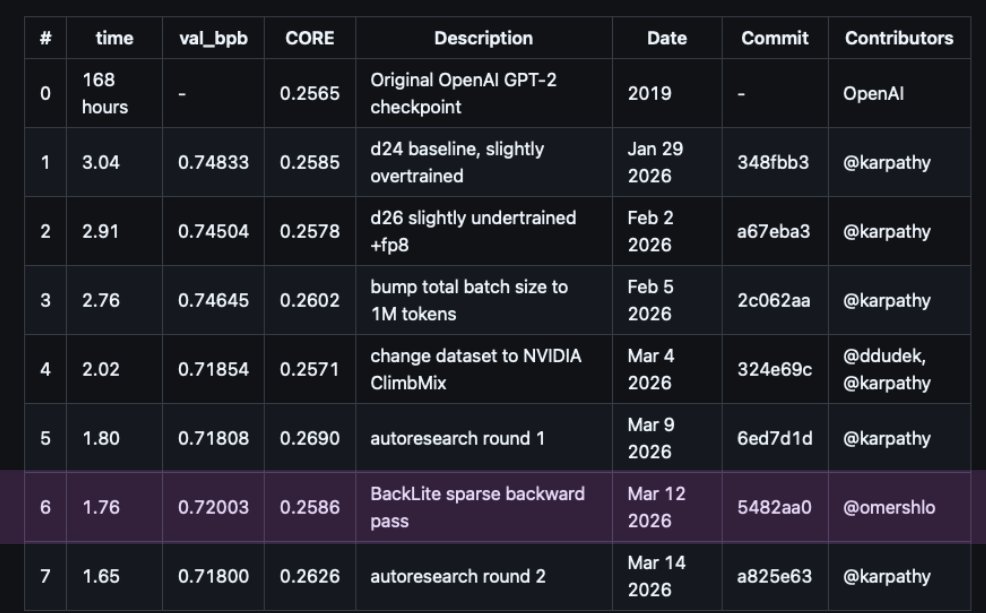
Image shows nanochat leaderboard *IF* @karpathy/ @OxyKodit will merge our PR.
Yes, there's still much work to do on the code and tests to run. Contributions/questions are welcome.

English
Karthik Inbasekar retweetledi

I've updated my *A Short History of Israel* (between 135CE and 2001CE) at last. daviddeutsch.org.uk/papersarticles…
English
Karthik Inbasekar retweetledi

לפני שמונה חודשים ביצענו כאן את השיר ״שמש״ בתפילה לשחרורו של אלון אהל - הערב סגרנו מעגל עם אלון, שחזר להיות איתנו כאן, מתחת לשמיים.
לקמפיין מימון ההמונים של אלון אהל> charidy.com/alonohel
עברית
Karthik Inbasekar retweetledi