
Rupinder Kaur, PhD

1.1K posts

Rupinder Kaur, PhD banner
Rupinder Kaur, PhD

Rupinder Kaur, PhD

@KaurTweets

Assistant Professor @thisisUIC Host-Symbiont-Virus interactions in 🪰 and 🦟 #Wolbachia #Spermatogenesis #Embryogenesis #Epigenetics #Imaging

University of Illinois Chicago Katılım Mart 2010
600 Takip Edilen647 Takipçiler
Rupinder Kaur, PhD
Rupinder Kaur, PhD@KaurTweets·
Grateful to be featured by the @VanderbiltU in their 'Beyond the Postdoc' series. If you're a postdoc and looking for some perspective, keep reading until the end - I share a few reflections and pieces of advice that helped me along the way. vanderbilt.edu/postdoc/rupind…
English
0
0
4
931
Rupinder Kaur, PhD retweetledi

Tanentzapf Lab
Tanentzapf Lab@TanentzapfLab·
1. For lots of people the hardest part of the paper to write is the discussion. Here is a a very brief guide: Paragraph 1: is a restatements of the two or three most important conclusions (starting with "here we showed", each conclusion gets 2-4 sentences).
English
3
35
328
39.2K
Rupinder Kaur, PhD retweetledi
Science Magazine
Science Magazine@ScienceMagazine·
New @SciSignal research reveals that a chemical widely used to inhibit enzymes called protein tyrosine phosphatases also activates different enzymes called protein tyrosine kinases, potentially confounding some experiments. scim.ag/467AlNC
Science Magazine tweet media
English
5
13
82
16.7K
Rupinder Kaur, PhD retweetledi
Prof. Nikolai Slavov
Prof. Nikolai Slavov@slavov_n·
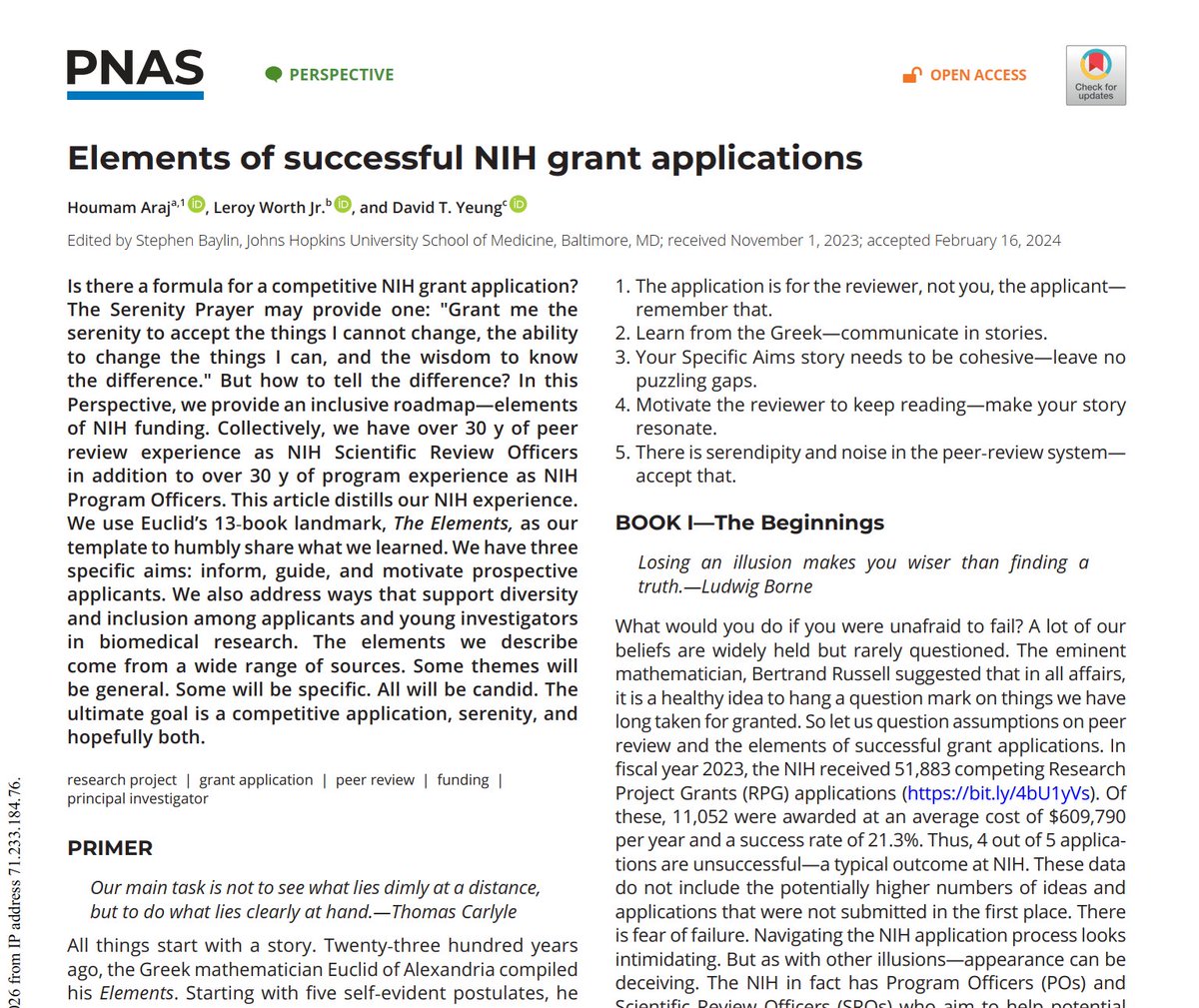
Is there a formula for a competitive NIH grant application? This Perspective aims to provide an inclusive roadmap on the elements of NIH funding. Elements of successful NIH grant applications
Prof. Nikolai Slavov tweet media
English
5
70
280
153K
Rupinder Kaur, PhD
Rupinder Kaur, PhD@KaurTweets·
🚨 New pub alert! Check out our latest one that showcases how chemical and genetic innovations can recreate complex host–symbiont interactions in the absence of the symbiont. cell.com/cell-reports/f…
English
0
2
15
688
Rupinder Kaur, PhD retweetledi
Seth Bordenstein
Seth Bordenstein@Symbionticism·
Science is generally wondrous. Yet the paper (out in a few weeks) that this Preview covers is one of the biggest WOW moments of my career. Illustrious credit to @KaurTweets who dreamed it and to the team. With the evidence, we end a debate on the nature of a key symbiotic trait.
Rupinder Kaur, PhD@KaurTweets

#Wolbachia has puzzled us with its power to rewire host reproduction. What if I tell you we found one of the keys Wolbachia use to rewire its host AND a small molecule can use this key to mimic what this microbe has mastered for millions of years. cell.com/cell-reports/f…

English
2
2
8
773
Rupinder Kaur, PhD
Rupinder Kaur, PhD@KaurTweets·
This project wouldn't have been possible w/o @Symbionticism and his unwavering support, my undergrad student Mahip Kalra for relentless troubleshooting efforts that brought the chemical experiments to life, and the incredible Lab team for their timely help every step of the way!
English
0
0
0
83
Rupinder Kaur, PhD
Rupinder Kaur, PhD@KaurTweets·
Why does it matter to mimic symbiotic trait? 👉 develops symbiont-independent toolkit for insect population control 👉 expands symbiont-based biocontrol method to species that can't be infected w the bacterium 👉 inspires ways to study how epigenetics shape host–symbiont biology
English
1
0
0
90
Rupinder Kaur, PhD
Rupinder Kaur, PhD@KaurTweets·
#Wolbachia has puzzled us with its power to rewire host reproduction. What if I tell you we found one of the keys Wolbachia use to rewire its host AND a small molecule can use this key to mimic what this microbe has mastered for millions of years. cell.com/cell-reports/f…
English
1
4
12
1.3K
Rupinder Kaur, PhD
Rupinder Kaur, PhD@KaurTweets·
Happy to share that I’ll be joining @thisisUIC as an Asst. Prof. in Jan 2026! My lab will explore the epi/genetic principles of host–microbe interactions, symbiosis, and vector biology. We’ll be hiring postdocs and techs—details & lab website coming soon! bios.uic.edu/news-stories/m…
English
2
0
11
1.6K
Rupinder Kaur, PhD
Rupinder Kaur, PhD@KaurTweets·
@owlstown Yeah, that's what I'm realizing. I see full image nicely placed on my phone screen, but on the laptop, it looks weird with an auto-adjusted view. Thought of asking, thanks though!
English
0
0
0
21
Owlstown
Owlstown@owlstown·
@KaurTweets Positioning in the banner is hard because the aspect ratio of the banner changes depending on the width of the screen, so even if you can nudge the position of the image in a particular screen width, the positioning may still not work in other screen widths.
English
1
0
0
14
Rupinder Kaur, PhD
Rupinder Kaur, PhD@KaurTweets·
@owlstown Hi! Is it possible to add an edit option to adjust the positioning of the banner image?
English
1
0
0
20
Rupinder Kaur, PhD retweetledi
Niko McCarty.
Niko McCarty.@NikoMcCarty·
The only rule in biology is that there are exceptions to every rule. This is what makes biology infinitely exciting; even when you think you’ve got the complete view, the floor can drop out from underneath you at any given moment. Case-in-point: The nucleus is the thing that makes eukaryotes...well, eukaryotes. It's the part of the cell that stores the genome, separating DNA from the cytoplasm and other organelles. (Bacteria do not have nuclei.) For decades, scientists thought that each nucleus contains one or more haploid sets of chromosomes. But there are exceptions. Red blood cells, for example, don’t have nuclei at all. (They expel their nuclei during maturation to maximize hemoglobin concentrations.) Cells in the eye lens, too, lose their nuclei and organelles during differentiation, thus becoming transparent. And so on. But now there is yet ANOTHER exception to this rule, and it’s one I hadn’t seen before. For a study in Science, researchers discovered that two types of pathogenic fungi that infect plants, called Sclerotinia sclerotiorum and Botrytis cinerea, have two different nuclei. And instead of storing a full set of chromosomes in each nuclei, they instead “distribute their chromosomes such that each of their nuclei contains only a subset of the haploid chromosomes.” The authors confirmed this by throwing a kitchen sink of methods at these cells; chromosome counting, DNA measurements using flow cytometry, single-nucleus PCR, and more. Nobody knows why the fungi do this, but the scientists claim (in their discussion) that it could enable them "to respond and adapt more effectively to local environmental stresses within their extensive mycelial networks. Nuclear shuffling may facilitate the rapid generation of new genotypes, enhancing adaptability to changing environments.” There is also evidence that the chromosomes within each nucleus may briefly collide during cell division, before going back into their separate nuclei. This is a great paper. It is simple, to the point, and challenges the status quo. It has serious potential to become a “classic” of the genre. Link: science.org/doi/10.1126/sc…
Niko McCarty. tweet media
English
27
271
1.2K
89.5K