Kay Jebelli 🇺🇦

12.2K posts

Kay Jebelli 🇺🇦 banner
Kay Jebelli 🇺🇦

Kay Jebelli 🇺🇦

@KayJebelli

🇧🇪🇺🇸 🇬🇧 ex-computer engineer/competition lawyer working on digital policy @progresschamber; pro-abundance; @lakers nation; https://t.co/UNCVItesXW

Brussels, Belgium Katılım Ocak 2015
676 Takip Edilen1K Takipçiler
Sabitlenmiş Tweet
Kay Jebelli 🇺🇦
Kay Jebelli 🇺🇦@KayJebelli·
Tech: where immigrants are industry leaders, workers are multi-millionaires, companies respond to employee concerns on social issues, and everyone competes to be the greenest. It's the most progressive industry in the world.
English

1
0
13
0
Kay Jebelli 🇺🇦 retweetledi
Chamber of Progress
Chamber of Progress@ProgressChamber·
“The Commission wants Google to give third-parties root level access to Android’s most intimate technical features. Such a far reaching intervention requires a much more calibrated feature-by-feature assessment. Unfortunately, this two-week consultation is far too short to get to the bottom of it,” says @KayJebelli Read our full statement here: progresschamber.org/news/european-…
English
0
1
1
140
Kay Jebelli 🇺🇦 retweetledi
alpha
alpha@omarsbigsister·
In every single country that passed age verification laws: 1) databases got leaked 2) innocent websites got censored 3) governments became more censorship heavy 4) protests became more criminalized 5) information got harder to find
English
163
22.7K
113.4K
980.8K
Kay Jebelli 🇺🇦 retweetledi
Luis Garicano 🇪🇺🇺🇦
We stopped everything to write an answer (link below) to Paul Krugman's two posts of today (one informal, one with a simple model) arguing that Europe is broadly not falling behind the United States. The change measured by the Draghi report, he argues, is mostly due to growth in the technology industry, which has distorted GDP numbers without actually leading to higher standards of living. We should believe our eyes when we walk around France and walk around Mississippi. Krugman is wrong. The measures he uses understate European stagnation. This matters enormously. Divergence with the United States is the strongest evidence for reform in Europe. 1. The growth numbers Krugman compares the United States, France, and Germany at purchasing power parity in current prices. On that measure, France's and Germany's position relative to America has been roughly constant since 2000. But current price comparisons miss productivity gains in sectors where prices fall. If America produces twice as much software while the price of each unit halves, the value of American software output looks unchanged even though the volume has doubled. Most economists therefore use constant prices, which fix the base-year PPP level and apply each country's real output growth on top of it. American output growth has concentrated in tech, where prices have fallen tremendously as productivity rises. In terms of the volume of things produced, America has pulled away from Europe. 2. Is it all the tech industry? Krugman concedes this tech divergence but says it is not welfare-relevant. The American growth lead is an accounting artefact of measuring more iPhones at base-year prices, not a sign that Americans are actually richer, because Europeans buy the same iPhones at the same world prices. This is not the right way to think about the world today, as an earlier Paul Krugman would have argued. His model assumes tradable goods, interchangeable workers, marginal-cost pricing, and no profits. Each assumption fails. Most of what households buy is non-tradable: housing, healthcare, childcare, education. When American tech firms bid workers from haircutting to coding, American haircut wages rise. Germany has no growing tech sector to do the bidding, so German wages stay flat. Technology is not priced at marginal cost. Apple's margins are around 40 percent. Anthropic's inference margins are at 70 percent. The major platforms enjoy network effects, switching costs, and lock-in that hold prices well above what a competitive market would deliver. A large share of the productivity gains in technology stays as profit. A lot of the value of American technology dominance shows up in equity, not in wages. Apple, Microsoft, Nvidia, Alphabet, Meta, and Amazon together are worth $21 trillion, more than the entire combined stock market value of all European stock markets. Around 60 percent of US equity is held by American households. The median French or Spanish household holds almost no equity. The median employee at Meta, a company with almost 80,000 employees, earned $388,000 in 2025. This advantage is not going to go away. Krugman's own 1991 paper, cited in his Nobel prize, showed that comparative advantage in modern industries is produced by increasing returns to scale, specialized labor markets, supplier networks and the agglomeration of suppliers, workers, and ideas in particular places. Once an industry concentrates somewhere, the concentration is self-reinforcing. Europe is being pushed away from the next round of technology industries (AI!). 3. What about inequality? Another retort is that GDP per capita hides substantial inequality, and so even if America is rich on average, this is mostly due to the super wealthy. But despite the US's high pre-tax income inequality, it also achieves higher median incomes than Europe, in part because of such a high base, and in part because it actually redistributes more than many European countries. The cleanest comparison is median equivalised disposable household income: income after cash taxes and transfers, adjusted for household size and purchasing power. According to the OECD's 2021 numbers, the median American earns 30 percent more than the median Dutchman, about 31 percent more than the median German, and about 52 percent more than the median Frenchman. 4. What about hours worked? Krugman points out that while American GDP per person is higher, most of this is because Americans work more. For this divergence to be an hours worked story, Americans must work more relative to Europeans now than they did in 2000. The opposite has happened. Birinci, Karabarbounis, and See in a 2026 NBER paper show that about half of the American-European hours gap that existed in the 1990s has reversed by the end of the 2010s. Americans work fewer hours per person than they did in 2000, while most Europeans work more. 5. Is America not a bad place to live? Walk around Alabama and France: surely the former cannot be substantially richer than the latter? American cities often have poorer centres and richer suburbs or exurbs. European cities preserve richer and more attractive historic cores. A visit to a city as a tourist in America compared with a city in France will leave one having seen different spots on the income distribution. Americans in Europe go to the nicest and richest European cities. Rather than a walking around test, do a driving around test. Go to the periphery of any modern American city and see a level of new-built material wealth that is extremely uncommon in Europe, with thousands of enormous four- or five-bedroom homes. In the South, in places like Nashville and Austin, drive around the downtowns to see hundreds of luxury apartment buildings springing from the ground. This construction boom is replicated virtually nowhere in Europe today. The other question is generational. Housing often costs more in Europe than in the United States, despite the quality of the housing stock generally being much better. Europe has nice city cores but these are inaccessible to young Europeans. Consider the salaries available to entry-level workers. The starting pay for a London police officer is $57,000. In Washington, DC, $75,000. The entry-level Deloitte consultant job in Madrid pays around €28,000, roughly $33,000 per year. In Charlotte, the entry-level Deloitte job pays $63,000. There are many things to dislike about life in America. But relative to 25 years ago, the gap in material wealth has shifted dramatically in America's favor. siliconcontinent.com/p/european-sta…
English
90
496
2.1K
981.3K
Kay Jebelli 🇺🇦 retweetledi
DG Progress
DG Progress@DGProgress·
✉️May’s edition of DG Progress is live! In this edition: 🏗️ European robots are on the move ⛽ Negotiations over the AI Act come to a close 🌉 Atomico’s Tom Wehmeier on Europe’s tech ecosystem 🛣️ Brussels awaits the Tech Sovereignty Package 🪟The European Commission wins meme of the month! open.substack.com/pub/dgprogress…
English
0
1
1
49
Kay Jebelli 🇺🇦 retweetledi
Egle Markeviciute 🇱🇹🌐
So let’s review the timeline on actions the EU took related to age verification & social media bans: 1. Better Internet for Kids Strategy 2022 2. Louvain-la-Neuve declaration (abstract) 2022 3. Public tender for age verification solution - launched in 2024 3. DSA Guidelines on protection of minors 2025 July 4. Unveiling the age verification app 2026 Q2, followed by recommendations to Member States to use it 5. Now the EU only needs political mandate to introduce pan-EU minimum age From operational point of view, I raise my hat, no one can challenge multiple layer instruments. From the democratic point of view, let’s not say that “the panel of experts will decide”. We know the outcome.
POLITICOEurope@POLITICOEurope

Ursula von der Leyen has said that raising the social media age limit across the EU is on the table, and a proposal could come as soon as this summer. politico.eu/article/eu-soc…

English
5
7
20
2K
Kay Jebelli 🇺🇦 retweetledi
Patrick Grady
Patrick Grady@patrickgrady_·
"Von der Leyen said she didn’t want to pre-empt the findings of a panel of experts currently deliberating on child safety online." Also Von der Leyen: "I believe we should give our children more time to become resilient" No pressure, panellists...
Patrick Grady tweet media
English
0
1
1
136
Kay Jebelli 🇺🇦
Kay Jebelli 🇺🇦@KayJebelli·
@JorgeLiboreiro @BertuzLuca Regulations including the DSA can make platforms safer for minors. If online spaces are harming kids, these laws should be properly enforced, instead of banning kids from social spaces online and forcing identity checks on all adults.
English
0
0
0
76
Kay Jebelli 🇺🇦
Kay Jebelli 🇺🇦@KayJebelli·
@DigitalEU If the DSA can make platforms safer for minors, please enforce it to do so, instead of banning kids from social spaces online and forcing identity checks on all adults.
English
2
3
15
704
Digital EU 🇪🇺
Digital EU 🇪🇺@DigitalEU·
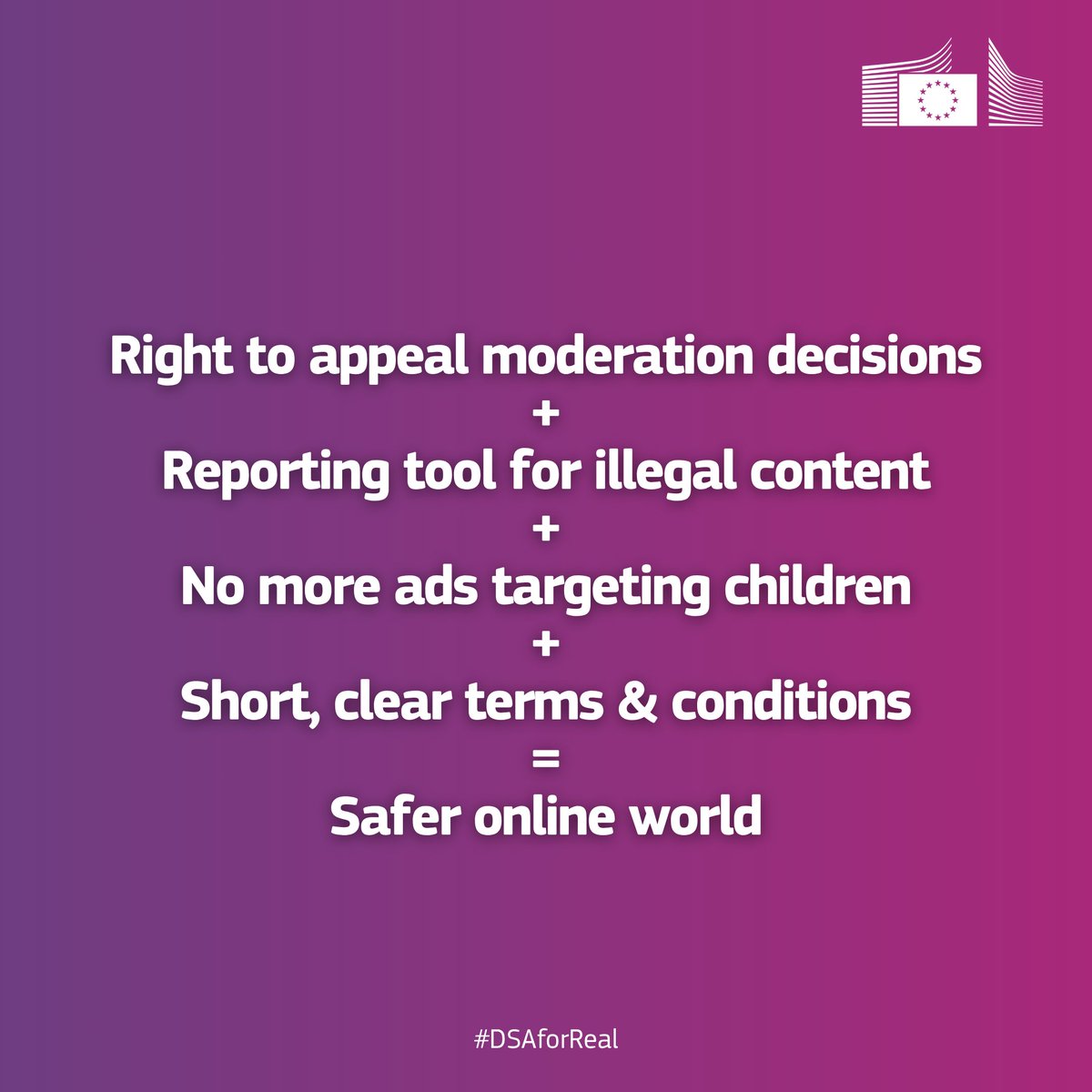
The internet isn’t becoming safer by accident. The Digital Services Act is reshaping how platforms operate in Europe, from tackling illegal products on marketplaces and protecting children online to improving algorithmic transparency. #DSAforReallink.europa.eu/jp8pqf
Digital EU 🇪🇺 tweet media
English
158
24
71
40.6K
Kay Jebelli 🇺🇦 retweetledi
Chamber of Progress
Chamber of Progress@ProgressChamber·
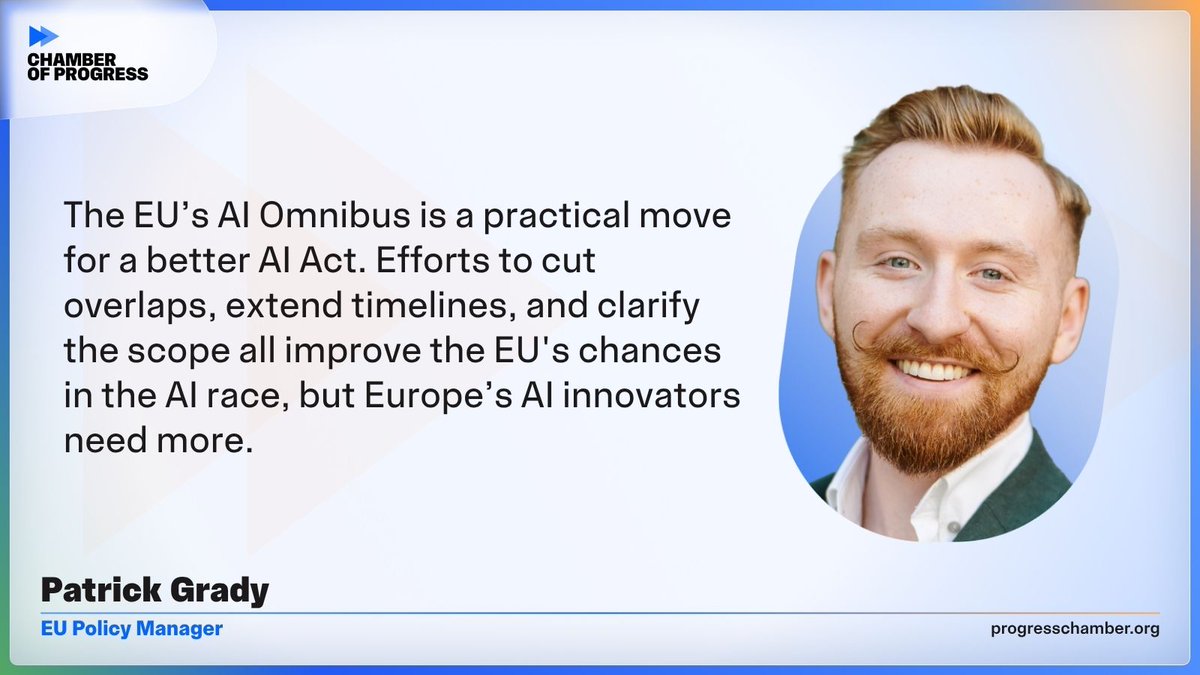
European policymakers today agreed on an AI Omnibus, which would extend compliance deadlines, simplify rules for SMEs, and simplify overlapping requirements. But existing uncertainty, particularly around AI training, remains a hurdle for AI companies in Europe.
Chamber of Progress tweet media
English
1
2
1
267
Kay Jebelli 🇺🇦 retweetledi
Simon Nixon
Simon Nixon@Simon_Nixon·
There it is at last, the admission that it was Ukraine’s wish to join the EU that led Putin to invade - nothing to do with NATO. Always blindingly obvious but denied for years by anti-European Putin apologists in Europe including Farage and Johnson in Britain
SPRAVDI — Stratcom Centre@StratcomCentre

Increasingly frantic statements from the Russian dictator following the humiliating parade experience – now admitting that he started the war in Ukraine to punish them for their desire to join the EU and that he intends to do the same to Armenia.

English
101
1.6K
3.7K
193.1K
Kay Jebelli 🇺🇦
Kay Jebelli 🇺🇦@KayJebelli·
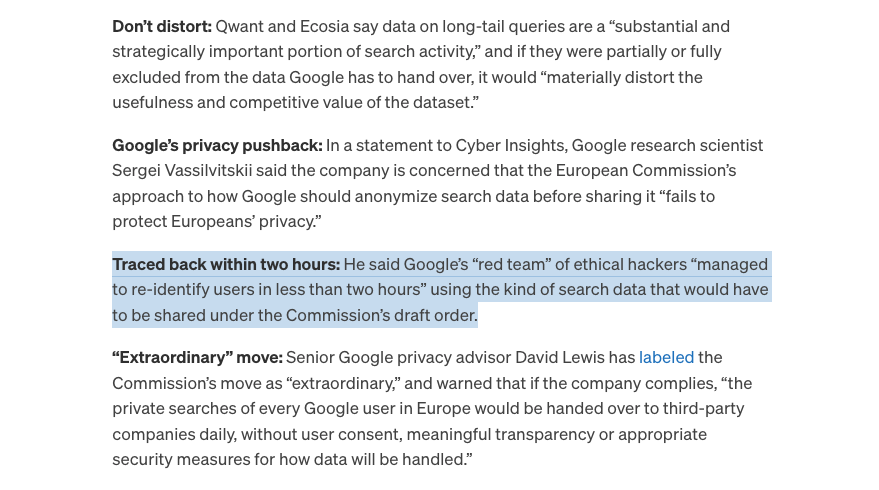
Every European user will be identified and tied to their search history, which third-parties can prey on, within 2 hours.
Kay Jebelli 🇺🇦 tweet media
English
0
0
0
21
Kay Jebelli 🇺🇦
Kay Jebelli 🇺🇦@KayJebelli·
Interesting to see that Google is still trying to be constructive on this. A massive data breach of their European users "poses privacy risks". Goes to show how beaten down they are by the myriad of investigations and enforcement actions.
Foo Yun Chee@FooYunChee

Exclusive: Top Google scientist says EU data measures pose privacy risk for users reuters.com/sustainability… @Reuters @EUReuters @ReutersBiz @ReutersTech @ReutersLegal @thomsonreuters

English
1
2
11
1.3K
Kay Jebelli 🇺🇦 retweetledi
Kay Jebelli 🇺🇦
Kay Jebelli 🇺🇦@KayJebelli·
The implication here, that European policymakers could end up banning VPNs, is rather chilling. Under the cover of targeting big tech, lots of our digital rights and protections in Europe are being eroded. It's a major problem and more people should be fighting against it.
European Parliamentary Research Service@EP_EPRS

Virtual private networks #VPN are increasingly used to bypass online age verification. Protecting children online is a priority, with new rules being implemented requiring a minimum age for access to some services Read👉 link.europa.eu/FGfr6C #DSA @EP_Justice @FZarzalejos

English
0
7
25
970