Kay

566 posts

Kay

Kay

@KaySchnd

Long-term investor, looking for great stock picks.

Katılım Nisan 2010
136 Takip Edilen117 Takipçiler
Kay
Kay@KaySchnd·
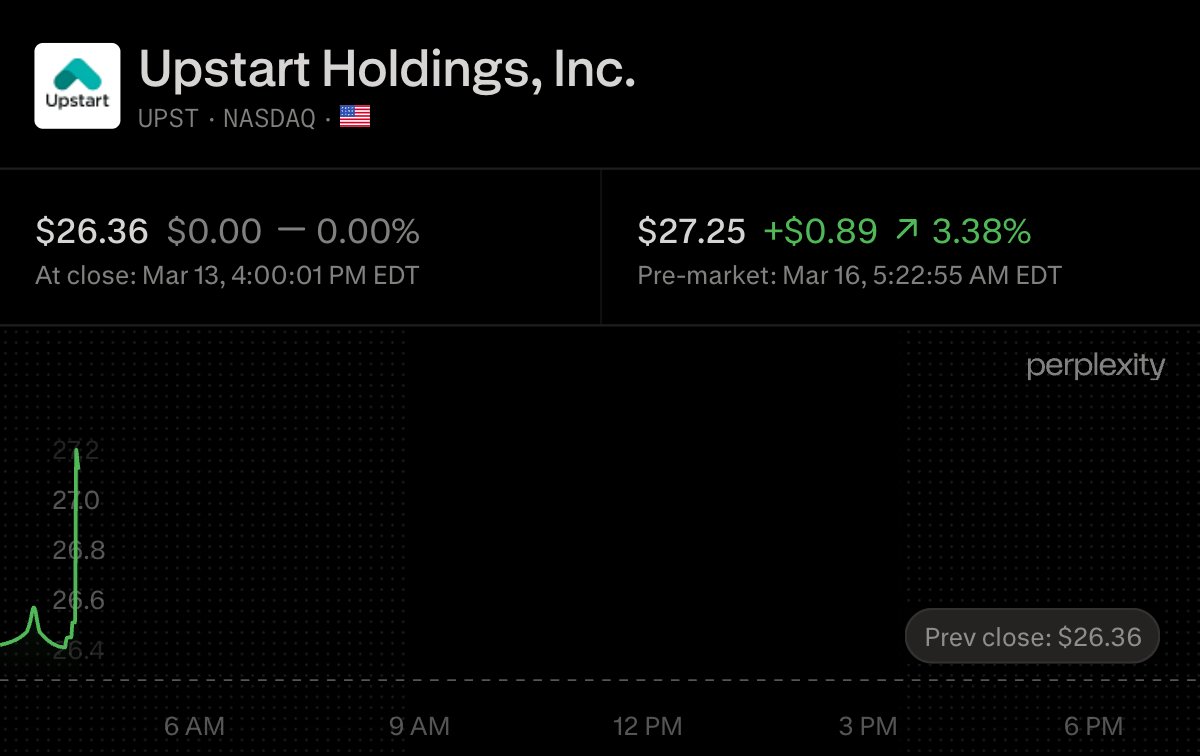
Almost 3M additional short shares added as of March 13th. Most likely averaging ~27.00-27.50 area. Once we break this, it will get interesting $UPST
English
3
0
9
3.2K
Kay
Kay@KaySchnd·
@HenryInvests Crazy, why are they doing this? I thought there is a credit crisis and nobody trusts $UPST `s AI model anymore??? 😱😱😱
English
1
0
3
929
Kay
Kay@KaySchnd·
$UPST the Fintech $COST. Building trust (in their AI model) will take time.
Kevin Carpenter@kejca

Mohnish Pabrai (@MohnishPabrai) on Costco. "Costco is not going to mark up anything more than 15% — and the end result of that is many of us are fanatical about Costco. We are fanatical because that trust is in there." "That trust doesn't get built in one days or two days. It's just cascading sets of actions which lead to that trust."

English
0
1
13
3.3K
Kay
Kay@KaySchnd·
$UPST closed near 26 as expected on witching day. This is despite market sell off which is a good sign. Dark pools activity >50% in recent days shows accumulation big times. Overall, I am bullish for next week. But we need to reclaim 26.36 early Monday.
English
0
0
6
1.1K
Kay retweetledi
Dave Girouard
Dave Girouard@davegirouard·
Excellent article. "Asset-backed finance remains our core allocation. Lending against identifiable assets — real property, equipment, receivables, and contracted cash flows, insulates portfolios from the enterprise value erosion that software-heavy direct lending is now experiencing."
English
2
2
47
7K
Kay retweetledi
Mike Yi
Mike Yi@InvestForAnna·
I don't really understand why some people taking shots at @davegirouard for not buying $upst on the market every chance they get. Dave has communicated that his trading window has closed and due to short-swing profit rule, he has to pay back multiple million dollars if he did buy. No one would do that especially he already owns 10% of the business. The upcoming CEO Paul Gu has bought 100,000 shares on market at $39, the company has purchased $100 million worth of shares on market @$31.3 The management has no control of the stock price. But they are trying their best to run the business. The execution has been brilliant since Q4. Focus on the business, not the stock.
English
5
5
65
7.3K
Henry
Henry@HenryInvests·
Upstart $UPST Announces a $1B Forward-Flow Agreement with Eltura Ventures and Aperture Investors
English
10
8
86
14.3K
Kay
Kay@KaySchnd·
@HenryInvests Credit crisis? Funding issues? Not at all! $UPST 😁👍
English
0
0
8
972
Kay retweetledi
Wall St Engine
Wall St Engine@wallstengine·
BTIG Upgrades $UPST to Buy from Neutral, PT $43 Analyst comments: "We upgrade UPST shares to Buy with a $43 target price. Our target is 6x 2027 EPS if our bank expense savings math is right, and 9x if our bank math is wrong. The market did not react at all to Upstart's bank application announcement on Tuesday, March 10. This surprised us, since a bank charter addresses what we consider to be a key downside risk of Upstart's private credit exposure, and one of the main reasons we had been Neutral-rated. While there is no guarantee that Upstart will successfully become a bank, we think UPST's current share price is both 1) not pricing in any potential upside from becoming a bank, and 2) pricing in significant liquidity risk from Upstart losing funding sources. We therefore take this opportunity to upgrade UPST shares to Buy. We calculate that Upstart's annual EPS could increase 60% by reducing transaction volume costs by 100 basis points. For example, on our 2026 transaction volume estimate of $19 billion, Upstart would save $190 million of expenses, which is significant compared with Upstart's pre-bank 2026 EBITDA guidance of $294 million. For 2025, Upstart quantified capital and regulatory infrastructure costs at $200 million, or 182 basis points of its $11 billion transaction volumes, which would be meaningfully reduced with a bank charter. Even without the savings, we would upgrade UPST to Buy on the bank downside protection alone, especially with UPST shares trading cheaply on fears of private credit appetite collapsing. We outline what a deposit-funded Upstart model would look like later in this note. Following Upstart's announcement of its intent to hold a national bank charter and our follow-up call with the management team, we are incrementally positive on UPST for three reasons: 1. Significant combined cost savings, which we peg at 100 basis points of transaction volumes, including the elimination of 'tens of basis points' of fees currently being paid to partner banks, and the operational costs of having hundreds of licenses across different states. 2. Downside protection in draconian scenarios where liquidity dries up for Upstart's current funding partners. 3. Expanding the customer base, with one consistent, unified regulatory framework across all 50 states. Since we do not yet know the timing of the Upstart bank close, we have not yet incorporated the 60% upside into our official published numbers. However, Figure 1 on page 3 shows what we think pro forma EPS will look like. We note that our existing estimates are already Street-high on 2027/2028 operating EPS, at 3% and 23% above consensus, and Street-high on total revenues for 2026/2027/2028, at 47% year over year, 40% year over year, and 24% year over year above consensus." Analyst: Vincent Caintic
Wall St Engine tweet media
English
4
13
90
36.6K
Kay
Kay@KaySchnd·
@HenryInvests Wow that’s great thanks Henry!
English
0
0
1
101
Henry
Henry@HenryInvests·
Claude Code can run some pretty impressive tasks just via a prompt. So for example, I simply asked CC to build a detailed financial model on Upstart, with its assumptions been driven by the transcripts of my two latest YouTube videos. Then I let it run for roughly 30 minutes and came back to a very astute financial model for Upstart where I could toggle the assumptions. Saves so much time and the use cases appear endless.
English
1
0
4
338
Henry
Henry@HenryInvests·
Claude Code is truly unbelievable. Just created an absolutely insane, in-depth financial model for me in about 30 minutes. Wow.
English
4
1
40
3.1K
Kay
Kay@KaySchnd·
Short volume ratio well above 40% while stock is defending the 25.60 level remarkably and outperforming the market. Might be the first positive sign in a while. $UPST
English
0
0
8
2.5K
Kay
Kay@KaySchnd·
Patiently waiting for the gamma squeeze. Let’s see if we can defend the 25.60 level as a first step. $UPST
English
0
0
3
336
Kay
Kay@KaySchnd·
2/ This must be somebody who wants to keep his shares and is just hedging against short term volatility.
English
0
0
1
221
Kay
Kay@KaySchnd·
Whale moved his Mar 27th 19K Bear Put Spreads from 29/27 to 26/22. expect short term volatility $UPST
English
1
0
8
1.2K
Kay retweetledi
Dave Girouard
Dave Girouard@davegirouard·
We don't expect to change our plans with regard to funding loans - vast majority go to 3rd parties in our marketplace. Still expect loans on the BS to continue to decline. We will be able to use (brokered) deposits instead of warehousing to finance R&D loans that we do have on our BS - which is inherently less expensive. But the real win/change is having one product in 50 states. Serving more consumers with radically less complexity & risk in our business and codebase.
English
4
8
87
4.2K
Kay retweetledi
Henry
Henry@HenryInvests·
A few thoughts on the $UPST bank charter: Upstart is pitching Upstart Bank as a sister company, meaning the structure would be something like Upstart Network (fintech platform) & Upstart Bank (a bank) put together equals Upstart. The pitch involves that one federal regulatory body eliminates a lot of state-by-state regulatory friction. With a charter, Upstart could abide by the rules of one regulator versus 50, allowing them to serve much more of the American population at lower costs. At first glance that makes sense to me. Also makes me believe that if regulatory friction is that high (UPST says regulatory costs accounted for $200M last year, 40,000 consumers unable to apply to Upstart in 2024, small dollar loans (SDL) not available in 1/5th of the USA) as these 'headwinds' rescind, CAC has the potential to drop enormously. My thinking there is that if it is so complex and complicated to operate on a state-by-state basis, with certain states having different regulations, blanket advertising at the federal level would lead to more efficient marketing. It's not guaranteed CAC drops but it's something I think is possible. So the bank charter in that regard makes logical sense to me. Gu clarified the change here occurred now as a result of a pro-growth administration and would allow them to serve a full economic spectrum of consumers across all states. Part of the press release involves Sanjay saying, "We are not seeking to compete with our depository partners for local customer deposits and checking accounts." So it appears that Upstart does not plan to operate as a consumer facing bank, or a bank in the traditional sense. Although Gu did confirm that Upstart will still accept some customer deposits. That makes it so incentives between Upstart and its capital partners are still aligned. Gu expects "the overwhelming majority of loans will still be funded by our partners. This is about efficiency, not a change in strategy." He also added that Upstart Bank will be the one originating the loans. It sounds like Upstart will originate with some cost advantages as a bank, before selling those loans immediately to capital partners / 3P funding. The savings Upstart generates from reduced regulatory friction & capital cost advantages can be passed to borrowers in the form of lower APRs, to the capital partners in the form of greater returns, or to Upstart in the form of greater margins. Options 1 and 2 seem most likely as they want to become "the most radically pro consumer finance company" Upstart's business as it stands today likely remains the same, but it is supplemented by a sister company, Upstart Bank, that eliminates regulatory overhead and provides greater access to cheaper capital. From that perspective, it seems as if Upstart is almost like a fintech with a bank wrapper. It makes the funding structure stronger. Now, of course there are puts and takes. In my interview with Gu, I asked about big bank partnerships because I was surprised more adoption had not taken place. Has that had an influence on their decision to seek a bank charter? I'm not sure - but it is something to consider. In Upstart's piece 'Building the Road: Why We’re Launching Upstart Bank' Annie Delgado talks about the Car and the Cobblestone path. In other words, Upstart no longer believes having the best technology is enough, they must also innovate on the regulatory path to implement it. I think that's fine and it makes sense, but it is without contention that Upstart has said several times they do not want to be a bank. This was said most recently at AI Day (May 2025), which means the decision to push forward with this appears to have been made within the last year. With Gu now CEO, Upstart appears to be moving / changing at tremendous velocity with no sunk costs. Once again, I believe Upstart has the 'goods' figured out (their models), but the go to market / distribution strategy continues to evolve as they scale. I have long said I believe if the product is truly superior, the rest of the pieces will fall into place. Right now management is demonstrating enormous confidence. They are guiding for a 35% revenue CAGR through FY28, rapidly scaling new products Auto & HELOC, launched Cash Line, are applying for a bank charter, and they recently bought back $100M in stock when the entire market thinks they are capital constrained. The broad market also has rather extreme fear / jitters about macro/credit in general. Private credit is of particular worry, which could impact Upstart's credit deal renewals, although Sanjay has said commitments here remain strong. While the regulatory provisions make sense, I do believe management is understating the value of cheap capital access as a driver in the decision as well. Their funding model has always been a bit wonky and this provides some stability, even if it's not the main focus. Okay on multiples, banks trade at lower multiples than technology companies - that is undeniably true. Partially because being a bank comes with some pretty enormous capital and regulatory requirements. Being up close and tight with the regulators has been a strength of Upstart's for a long time. They have been working with the CFPB since the beginning, so I am not worried about scrutiny over their models. But as we think about the stock, I think the multiple upside is probably compressed? Maybe? It depends on how they utilize the bank charter (if granted). If they truly don't hold a lot of loans and only use it to really facilitate greater credit access & reduced regulatory overhead (which is what they are saying), then the multiple compression would be much less extreme. The problem here is that's a strategy that we won't have clarity on at least a year. 2027 would be when Upstart Bank starts running. That uncertainty might weigh on the stock in the short-term. But I do think this enables Upstart to scale faster. TLDR: Upstart's bank charter was a surprise to me, but in retrospect perhaps foreseeable. IMO it represents a pivot in their go-to-market strategy. The regulatory impacts are logical and appear favorable. Management has been displaying enormous confidence and Upstart is undergoing rapid change at extreme velocity.
Henry@HenryInvests

Building the Road: Why We’re Launching Upstart Bank $UPST upstart.com/news/upstart-b…

English
8
7
71
11.6K