Ken Temple

36K posts

Ken Temple banner
Ken Temple

Ken Temple

@Kenneedsgrace

Saved by Christ; Gospel, Missions, Bible teacher; Apologetics, Theology, church history. Desiring that Muslims as people come to know the true Messiah المسیح

Katılım Ocak 2010
1.2K Takip Edilen796 Takipçiler
Ken Temple retweetledi
Pastor Rick Brennan
Pastor Rick Brennan@rickbrennanjr·
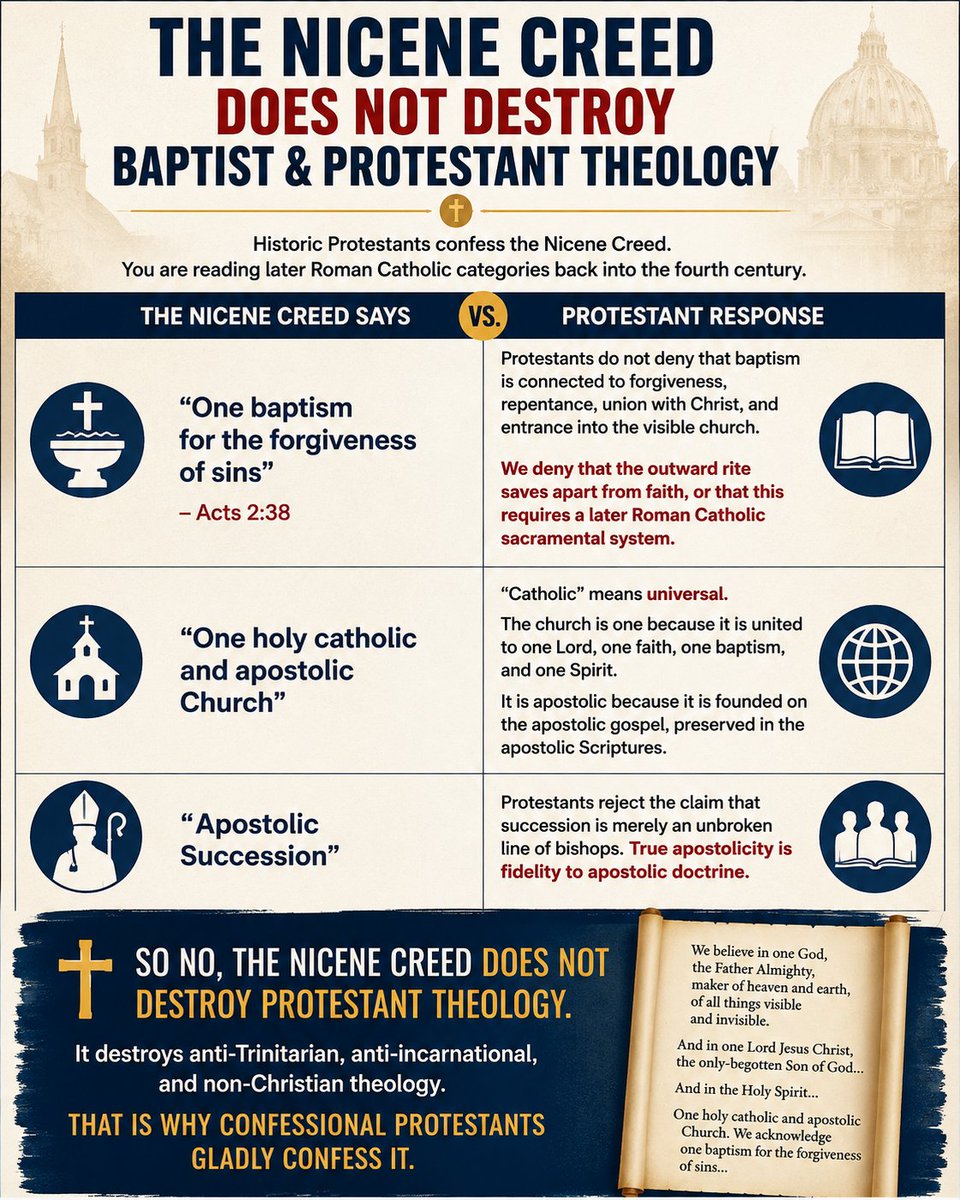
Roman Catholics often falsely claim that the Nicene Creed destroys Baptist or Protestant theology. However, historic Protestants confess the Nicene Creed in worship services. The fact is that this comment is reading later Roman Catholic categories back into the fourth century anachronistically. “One baptism for the forgiveness of sins” is biblical language. Protestants do not deny that baptism is connected to forgiveness, repentance, union with Christ, and entrance into the visible church. We deny that the outward rite saves apart from faith, or that the Nicene phrase requires the later Roman Catholic sacramental system. “One holy catholic and apostolic church” also does not mean “the modern Roman Catholic Church under the papacy.” The word catholic means universal. The church is one because it is united to one Lord, one faith, one baptism, and one Spirit. It is apostolic because it is founded on the apostolic gospel, preserved in the apostolic Scriptures. As for apostolic succession, Protestants reject the claim that succession is merely an unbroken line of bishops. True apostolicity is fidelity to apostolic doctrine; which all historic confessions accept as the word of God as contained in Holy Scripture. So no, the Nicene Creed does not destroy Protestant theology. It destroys anti-Trinitarian, anti-incarnational, and non-Christian theology. That is why confessional Protestants gladly confess it.
Pastor Rick Brennan tweet media
Uncle Bub 🇺🇲🇻🇦@independent1783

@rickbrennanjr The Nicene Creed destroys Baptist and Protestant theology. One Baptism for the forgiveness of sins Acts 2:38 - ONE (not thousands) holy Catholic and apostolic Church, not one Prot has apostolic succession. The "Catholic church" and the doctrines of this church are not prot.

English
27
7
37
3.6K
Ken Temple retweetledi
𝔚𝔥𝔦𝔱𝔢𝔅𝔢𝔞𝔯𝔡
"In the Bible" we see no such thing, actually. πρεσβύτερος is used interchangeably with ἐπίσκοπος (Acts 20:17/20:28) as they refer to the same office. It is NEVER used interchangeably with ἱερεύς as Robinson asserts here. This is later tradition, not Apostolic teaching. But, remember...this is an NXR official speaker, along with "Pastor" Webbon who, according to Robinson, isn't a pastor at all. Really makes me wonder how that mess holds together. I KNOW what one of the chief architects of NXR *used* to believe about people like Robinson. Must be chewing his tongue off not going after this kind of stuff.
Fr Calvin Robinson ©️®️@calvinrobinson

In the Bible we see diakonos (Deacons) as servant ministers, presbyteros (Presbyters/Priests) as ordained teachers who preside over the Sacraments, episkopos (Bishops) who excercise oversight (overseers) and the fullness of Holy Orders. Protestant “pastors” are somewhere between presbyteros and episkopos coopting the title of shepherd, but they are not ordained into Holy Orders. They have no Apostolic Succession. The deposit of faith is missing in its fullness. Therefore, when a Catholic or Orthodox Christian refers to a Protestant as “pastor” he is being polite, he is not recognising or submitting to any spiritual authority, as the Church teaches there is none there outside of that which all Christians have in the royal priesthood of all believes (i.e. all fathers are the spiritual leaders of their household.) but not the ministerial/sacerdotal priesthood.

18
21
179
14.9K
Ken Temple retweetledi
Pastor Rick Brennan
Pastor Rick Brennan@rickbrennanjr·
Respectfully, you are not accurately reflecting the New Testament nor the practice of the first or early second century church. The New Testament does not teach a medieval sacramental system of “Holy Orders” in which bishops, priests, and deacons form a sacerdotal hierarchy possessing a unique power to mediate grace through the sacraments. That is not apostolic Christianity. That is later ecclesiastical development read backward into the text. In the New Testament, presbyteros and episkopos are used in overlapping ways. Elders are overseers. Overseers shepherd the flock. Paul can call the Ephesian elders to himself and then tell them that the Holy Spirit has made them overseers to shepherd the church of God. That is not the later Roman structure of bishop, priest, and deacon as distinct grades of sacramental holy orders. Nor does the New Testament teach a ministerial priesthood that stands between Christ and his people. Christ is the one mediator. Christ is the great high priest. The church is a royal priesthood. Ministers preach the Word, administer baptism and the Lord’s Supper, shepherd souls, and exercise discipline under the authority of Christ and Scripture. Protestant pastors have spiritual authority because Christ gives pastors and teachers to his church. Their authority does not depend on an allegedly unbroken chain of episcopal hands. It depends on fidelity to the apostolic gospel. Apostolic succession, rightly understood, is succession in apostolic doctrine. A man may have hands laid on him by a hundred bishops and still be no true minister of Christ if he corrupts the gospel. So no, when you call a Protestant pastor “pastor,” you are not merely being polite. You are acknowledging, however unwillingly, that Christ continues to shepherd his church through men called to preach his Word and care for his flock. Rome did not create the ministry. Christ did.
English
2
7
29
241
Ken Temple retweetledi
AlgoOPC
AlgoOPC@AlgoOPCWPC·
Exactly. And as our friend Pastor King so masterfully exegetes all of these passages… #comment-78666" target="_blank" rel="nofollow noopener">greenbaggins.wordpress.com/2010/10/06/ora…
Ken Temple@Kenneedsgrace

@OrthodoxEthos - all the oral traditions Paul taught early (2 Thess. 2:15- 51-52 AD; & 1 Cor. 11:2- 55 AD) necessary for salvation, doctrine, & life were later written down in the entire corpus of the NT - "the faith was once for all delivered to the saints" Jude 3 by 96 AD.

English
0
1
2
86
Ken Temple
Ken Temple@Kenneedsgrace·
@OrthodoxEthos - all the oral traditions Paul taught early (2 Thess. 2:15- 51-52 AD; & 1 Cor. 11:2- 55 AD) necessary for salvation, doctrine, & life were later written down in the entire corpus of the NT - "the faith was once for all delivered to the saints" Jude 3 by 96 AD.
Ken Temple@Kenneedsgrace

Also, it is plural, "traditions"; & 1-2 Thess. were early letters (51-52 AD; only Galatians, Mark, & James are earlier); it follows that all the other oral traditions that are necessary were later written down in Romans, 1-2 Cor., Ephesians, Phil., Col., 1-2 Tim., Titus.

English
0
1
2
131
Ken Temple
Ken Temple@Kenneedsgrace·
Also, it is plural, "traditions"; & 1-2 Thess. were early letters (51-52 AD; only Galatians, Mark, & James are earlier); it follows that all the other oral traditions that are necessary were later written down in Romans, 1-2 Cor., Ephesians, Phil., Col., 1-2 Tim., Titus.
Gabriel Hughes@Pastor_Gabe

@OrthodoxEthos His short response contained a number of inaccuracies.
English
0
0
1
104
𝔚𝔥𝔦𝔱𝔢𝔅𝔢𝔞𝔯𝔡
So, take a while guess who said the following? It should be noted, of course, that he bore the sins of many, not of all: not all came to faith, so he removed the sins of the believers only. No Google/AI! :-)
English
65
2
137
33.8K
Ken Temple retweetledi
Pastor Rick Brennan
Pastor Rick Brennan@rickbrennanjr·
Yes. By “doctrinal and sacramental system,” I mean the way Roman Catholic theology places grace within a structure of sacraments, priestly mediation, infused righteousness, penance, merit, purgatory, and final justification. From a Protestant perspective, that system obscures the clarity of the gospel at several points. First, it obscures the sufficiency of Christ by adding layers of ecclesial mediation that Scripture does not require. second, it obscures justification by faith by making justification include inner transformation, sacramental grace, cooperation, and final increase in righteousness, rather than God’s forensic declaration that the sinner is righteous in Christ. Third, it obscures assurance by leaving the believer’s final standing dependent, in part, on continuing cooperation with grace rather than resting wholly on Christ’s finished work. Fourth, it obscures the sacraments by making them instruments that confer grace through the Church’s priestly system, rather than signs and seals that point believers to Christ and strengthen faith in him. That does not mean Catholics deny Christ, grace, faith, or forgiveness. Rather, it means those truths become less clear when placed inside a system that mixes Christ’s finished work with sacramental administration, ecclesial authority, and human cooperation as part of the ground, or instrument, of final justification.
English
4
1
4
106
Ken Temple retweetledi
Pastor Rick Brennan
Pastor Rick Brennan@rickbrennanjr·
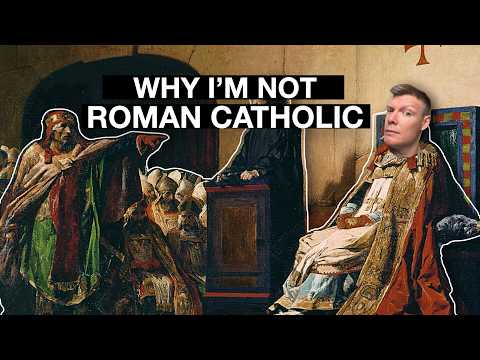
In the video released yesterday by @WesleyLHuff entitled, “Why I’m Not Catholic,” he says: “Being a biblically based faithful Christian will make you a bad Roman Catholic and vice versa. There will come a time for the mature believer to have to leave Rome as they realize the incongruity within its doctrines and dogmas with that of the true faith of biblical Christianity.” Wes and I both love Roman Catholics and respect much of what the Church of Rome has done historically to safeguard Scripture, defend orthodox Christology, and spread the gospel. However, I remain Protestant by conviction. In my judgment is that Rome’s doctrinal and sacramental system obscures key teachings of Scripture, especially the sufficiency of Christ, the final authority of Scripture, and justification by faith apart from works of the law. Here is a link to his 40-minute video. It’s well worth the time to listen. youtu.be/DpNgxsiNoOA?si…
YouTube video
YouTube
English
37
12
78
5.4K
Ken Temple
Ken Temple@Kenneedsgrace·
The flood of Noah’s day brought death & destruction. Meanwhile, the waters of baptism symbolize death & destruction as well. They point to the death of Jesus on the cross, the wrath of God poured out on sin, . . . thecripplegate.com/baptism-now-sa…
English
0
1
1
16
Ken Temple
Ken Temple@Kenneedsgrace·
1 Peter 3:21 - “corresponding” is antitypon, or “antitype.” It indicates something designed to correspond to a larger reality (see Heb 9:24 for another example of this). In this case, the salvation brought by the ark corresponds to baptism. thecripplegate.com/baptism-now-sa…
English
0
1
1
25
Ken Temple retweetledi
𝔚𝔥𝔦𝔱𝔢𝔅𝔢𝔞𝔯𝔡
Isn't it amazing how people wear filters when reading words? Here's the original: ὃ καὶ ⸁ὑμᾶς ἀντίτυπον νῦν σῴζει βάπτισμα, οὐ σαρκὸς ἀπόθεσις ῥύπου ἀλλὰ συνειδήσεως ἀγαθῆς ἐπερώτημα εἰς θεόν, δι’ ἀναστάσεως Ἰησοῦ Χριστοῦ What is the first word after baptism? "Not." And to what baptism do these folks refer when they quote only part of the verse? Well, a σαρκὸς ἀπόθεσις ῥύπου (funny how none of this fits sprinkling but only immersion) RATHER THAN (ἀλλὰ) a spiritual action (συνειδήσεως) which would only be relevant to adults, and all of that only δι’ ἀναστάσεως Ἰησοῦ Χριστοῦ. But, they just repeat partial verses, certain that means it is "right there in the Bible." Oh, and if you point this out, just watch. Despite my saying this, someone will go, "Ah, but you see, the early church...."
Dustin Ashe@DustinAshWrites

Baptized as an infant in the Trinitarian formula. Confirmed Presbyterian. Search for truth led me home to the Catholic Church. How was I saved? In baptism (1 Pet 3:21, “baptism now saves you”). How am I being saved? In sanctification (Phil 2:12). How will I be saved? At the last day (Rom 13:11). Past, present, future. All three are in Scripture. I confess the Nicene Creed, including “one baptism for the forgiveness of sins.”

59
12
137
34.3K
Ken Temple retweetledi
Tim Kauffman
Tim Kauffman@whpub·
In Roman Catholicism, you can use your fallible private interpretation to argue for why an ecumenical council was not ecumenical, why a formal excommunication was not valid, why an official canonization was not legitimate, why a papal statement was not really ex cathedra, why an unpublished papal decree can supersede a published papal statement or council, why a regional provincial council counts as ecumenical, why an apparition of Mary can add to the deposit of faith and help us understand apostolic tradition, why an infallible statement can be immoral but still infallibly true, why an ancient tradition is invalid while a late breaking tradition is apostolic, and why losing track of an oral apostolic tradition is proof of apostolicity. All while claiming to submit unreservedly to the magisterium.🤣😂
Dr Taylor Marshall™️@TaylorRMarshall

@DVerit38142 In my book Infiltration I give the argument for how and why the excommunication was not valid.

English
32
43
262
21.2K
Ken Temple retweetledi
Lizzie Marbach
Lizzie Marbach@LizzieMarbach·
Watching the stream with @JPuncut, @Acts17David, & @truthcartel816, and of course the EO guy is making the typical "the saints are alive in heaven" strawman. 🤦‍♀️ When protestants respond to praying to the saints with, "saints cannot hear you in heaven, they are dead," this is not a denial of them being alive in Christ in heaven. We ALL recognize that Christians are alive in heaven. I'll say it again: Protestants do not deny that we are alive in the afterlife. So, to respond to this rebuttal with "bUt GoD iS tHe GoD oF tHe LiViNg, NoT tHe DeAd" is a dishonest framing of the argument. It is a complete strawman. No one is arguing against this. When we say, "they are dead," we simply are speaking of their status here on earth. They are dead and gone from this earth, which is something that we all understand. Which is why Francis is no longer the pope, or why we have funerals for loved ones, or why we cry when someone dies. Death is real for christians and non-christians alike. We ALL understand the concept of death and understand that even Christians die from this earth. So please, PLEASE, stop making this strawman argument when defending the intercession of the saints. PLEASE engage with our actual positions and stop pretending that we deny eternal life in heaven.
English
105
10
86
11.7K
Ken Temple retweetledi
Wes Huff
Wes Huff@WesleyLHuff·
I'm often asked why -- given my study in both the Bible and church history -- I am not Roman Catholic. I recently sat down in front of my camera and outlined some of why that is. youtube.com/watch?v=DpNgxs…
YouTube video
YouTube
English
190
323
1.9K
152.8K