Kimandi Trading

8.3K posts

Kimandi Trading banner
Kimandi Trading

Kimandi Trading

@KimandiTrading

+Proprietary Currency,Index & Commodities Trading +Trading Strategies Research,Design & Dev //Stay Hungry,Stay Foolish//

Kenya Katılım Temmuz 2014
1.6K Takip Edilen207 Takipçiler
Kimandi Trading retweetledi
Global Markets Investor
Global Markets Investor@GlobalMktObserv·
🚨The Buffett Indicator has NEVER been higher: The US stock market cap-to-GDP ratio hit a record 228%. This ratio has surged by +60 percentage points over the last YEAR. This now stands ~80 percentage points above the 2000 Dot-Com Bubble peak. Since 2020, the US stock market has grown roughly TWICE as fast as the world’s largest economy. Is this one of the most OVERVALUED US stock markets in history?
Global Markets Investor tweet media
English
23
77
239
11.4K
Kimandi Trading retweetledi
EndGame Macro
EndGame Macro@onechancefreedm·
When Valuations Reach This Level The Correction Is Usually Brutal The market is not just expensive. It is expensive, concentrated, late cycle, and now exposed to a massive energy shock that has not fully worked through the economy yet. The Shiller PE compares the S&P 500 to the prior 10 years of inflation adjusted earnings. Around 41 today, it sits just below the dot com peak near 44, above the 2021 post covid extreme near 39, and far above the long term average near 17. That is not normal expensive. That is perfection pricing. The Historic Warning CAPE is not a crash timer. It does not mean the market has to fall tomorrow. It means future returns have already been pulled forward. The highest valuation periods usually come with powerful new era stories. In 1929, it was autos, electricity, radio, margin credit, and industrial scale. The Dow later fell almost 90%. In 1999, it was the internet. The S&P 500 later fell roughly 49% and the Nasdaq lost almost 78%. In 2021, it was zero rates, QE, stimulus, crypto, software, and pandemic liquidity. The 2022 reset followed. The lesson is not that every company was fake. It is that great stories can still become terrible prices. The Concentration Problem Today is more fragile because extreme valuation is paired with extreme concentration. The top 10 stocks are roughly 40% to 41% of the S&P 500 while producing a smaller share of total earnings. That means the index is less a broad measure of the economy and more a levered bet on a handful of mega cap AI and platform companies. That works until leadership breaks. Narrow leadership hides weakness. Passive flows reward the biggest names. Then, when the generals finally roll over, index strength turns into index fragility very quickly. The Underbelly Is Cracking The market still acts like the soft landing is intact, but the credit data is not clean. Bankruptcies are rising. Subchapter V and Chapter 11 filings are climbing. Household debt is stretched. Credit card, auto, and student loan delinquencies are worsening. CRE refinancing stress remains buried inside the banking system. That is classic late cycle behavior. The index stays strong because the top names stay strong, while weaker borrowers, employers, and consumers break first. The Energy Shock Is Not Finished The biggest mistake is confusing lower oil futures with economic relief. Oil can fall on a ceasefire headline, but the real economy still absorbs the damage through diesel, freight, fertilizer, food, insurance, shipping delays, and consumer cash flow. Energy shocks move in waves. • First prices • Then margins • Then earnings • Then credit • Then hiring • Then defaults That is why Q4 2026 into Q1 2027 is the danger window. The market is trading headlines. The economy is absorbing lagged damage. My Take I would not treat any single crash probability as scientific unless the model behind it is transparent. But directionally, the risk is clearly much higher than normal because the variables are stacking together. • 80% odds of a 15% to 20% correction • 65% odds of a 25% plus bear market • 45% odds of a 35% to 45% drawdown • 30% odds of a 45% plus crash if funding, Treasury, CRE, or Hormuz stress breaks open • 20% odds the market avoids a major drawdown through Q1 2027 If the energy shock keeps feeding through inventories, diesel, freight, fertilizer, and margins into late 2026, I would put the conditional odds of a 40% plus drawdown closer to 55% to 65%. This does not mean the market must crash tomorrow. It means perfection is priced as the world becomes less perfect. Valuations are near dot com levels. Concentration is beyond dot com levels. Credit deterioration is visible. The consumer is weaker than the headline data suggests. The energy shock is still moving through the system. Bubbles can melt up first. They often do. But bulls need perfection to continue. Bears only need one major assumption to break.
GIF
Barchart@Barchart

Stock Market closing in on its highest Shiller PE Ratio in history, now only slightly less than during the Dot Com Bubble 🚨🚨🚨

English
14
43
207
24.7K
WARÚHIÚ
WARÚHIÚ@kamauwaruhiu·
There is a mzee who is tired of his two sons both above 30 refusing to move out and marry . He has been nagging them at any chance he gets . One lost his patience and yelled back at him Infront of us ," ata sisi tukipata mabibi wanaweza tuweka kama venye umewekwa na mum tutaoa" 🤣🤣🤣 , non of us said anything because we know it's the truth , he has never worked a day in his life. This is very common in kiambu.
English
16
45
431
28.9K
Kimandi Trading retweetledi
Kenyan Wall Street
Kenyan Wall Street@kenyanwalstreet·
🚨 Dangote reveals a dedicated Kenya investment vehicle that will allow investors to buy into the group and exit at any time via a tradeable certificate. "In Kenya, we put up a vehicle, and all investment will be done there. When they want to sell down, they can always sell down because there is a certificate. You can take your capital out at any time."
Kenyan Wall Street@kenyanwalstreet

Dangote Petroleum Refinery and Petrochemicals Fze is planning a first-of-its-kind pan-African IPO across multiple stock exchanges, with Stanbic IBTC Capital, Vetiva Advisory Services, and FirstCap appointed as advisers. NSE CEO Frank Mwiti confirmed the plan after African exchange heads met Dangote in Lagos The 650,000-barrel-per-day refinery is targeting expansion to 1.4 million barrels within three years, part of a $40Bn five-year growth drive that also includes quadrupling fertilizer output [Bloomberg]

English
6
145
362
46.9K
Realness000 🇺🇸 🇳🇬
@Rizvana_Raza Iran thinks robotic dolphins will shift the balance at sea. Israel and America already control the sea, air, and space. This isn’t innovation. It’s desperation wrapped in sci-fi to look powerful.
English
109
0
34
14.9K
Rizvana Raza
Rizvana Raza@Rizvana_Raza·
Iran surprises the world with “suicidal artificial dolphins” that could change the rules of naval warfare! After more than 20 years of secret development, Iran has unveiled unmanned maritime systems designed in the shape of dolphins. These systems blend into the water like real creatures and carry out precise combat missions—similar to kamikaze drones, but underwater. #IranWar#Irán
Rizvana Raza tweet media
English
385
2.5K
9.6K
355.8K
Redd
Redd@ReddCinema·
Young mfs are never gonna know this feeling 😭
English
1.5K
8.4K
116.5K
10.8M
Kimandi Trading retweetledi
kristen shaughnessy
kristen shaughnessy@kshaughnessy2·
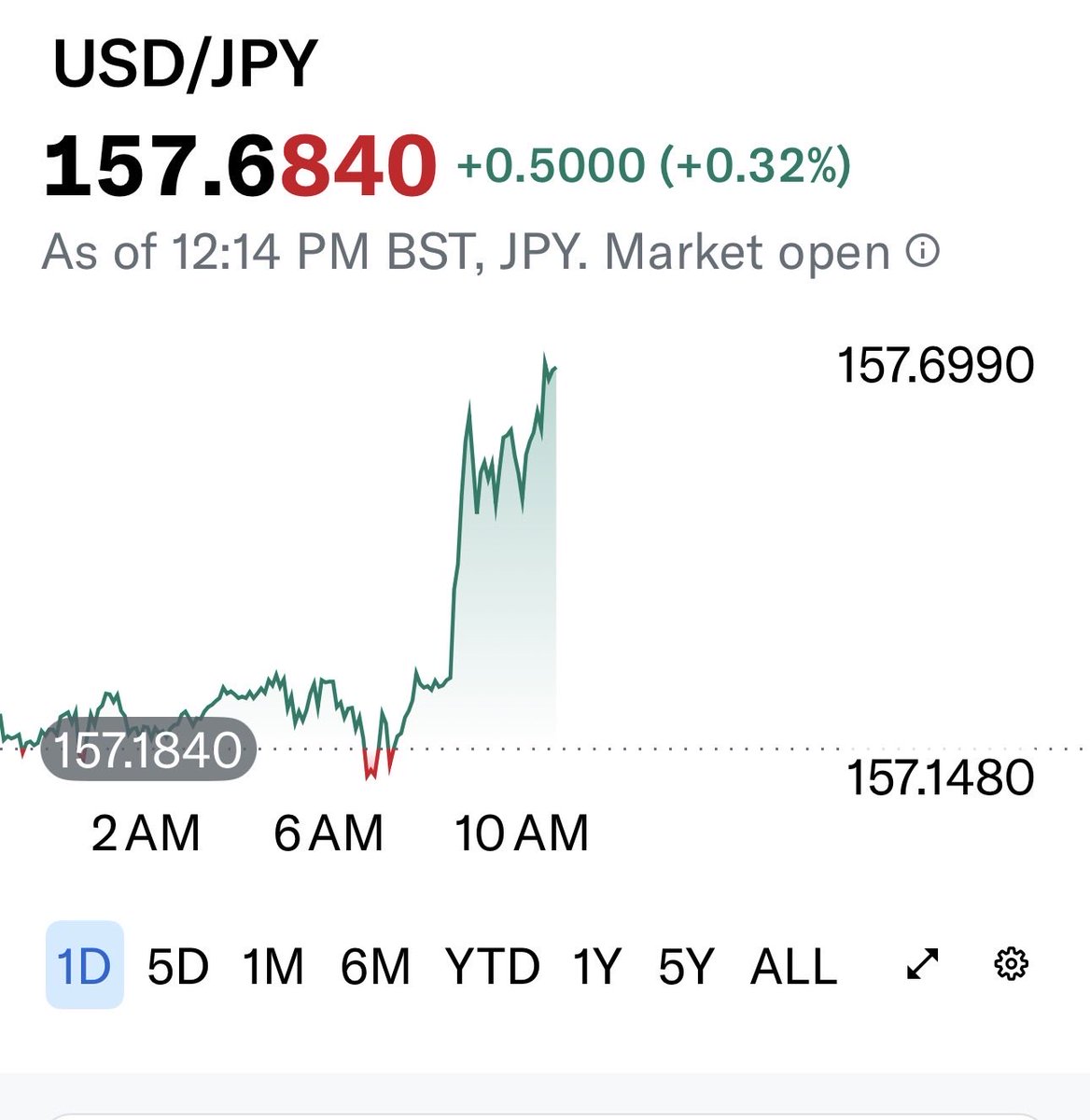
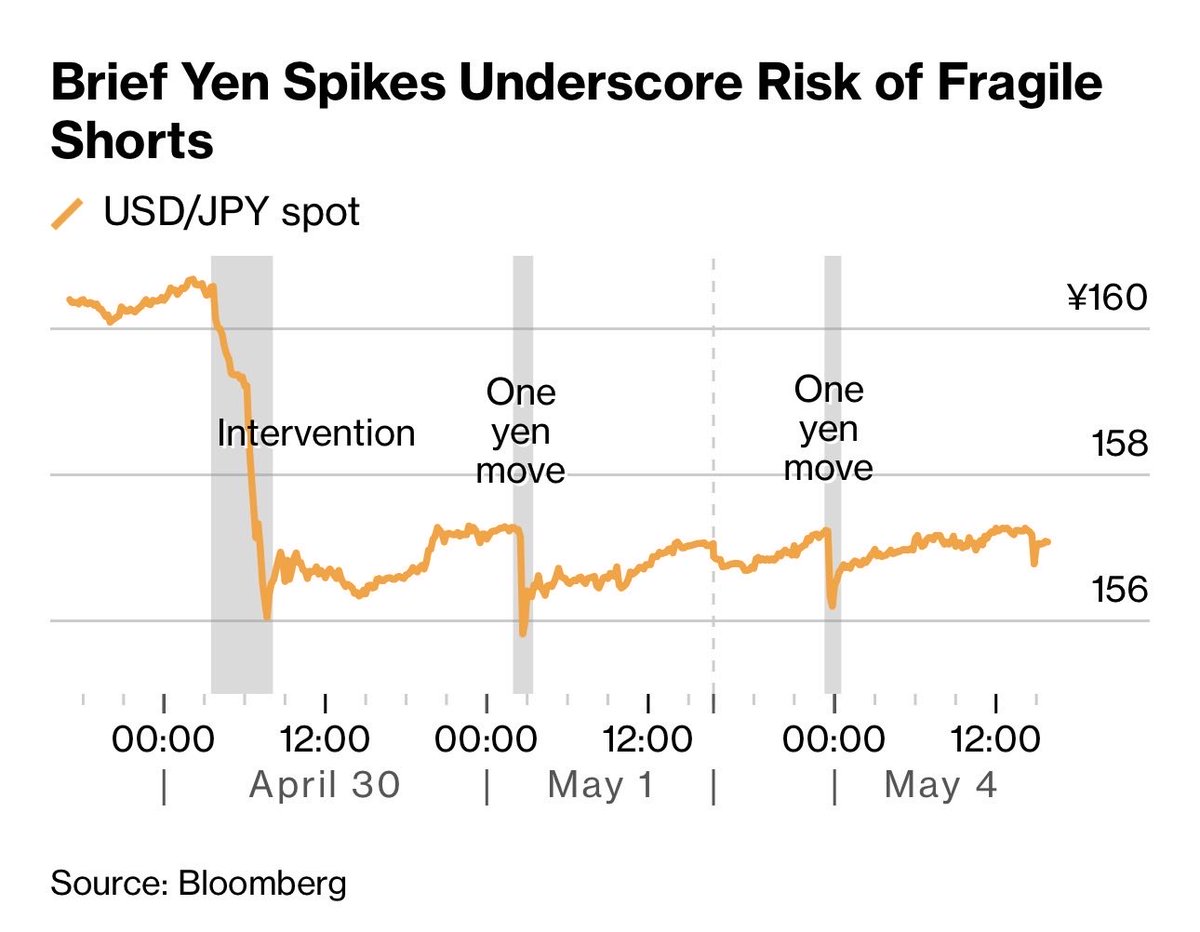
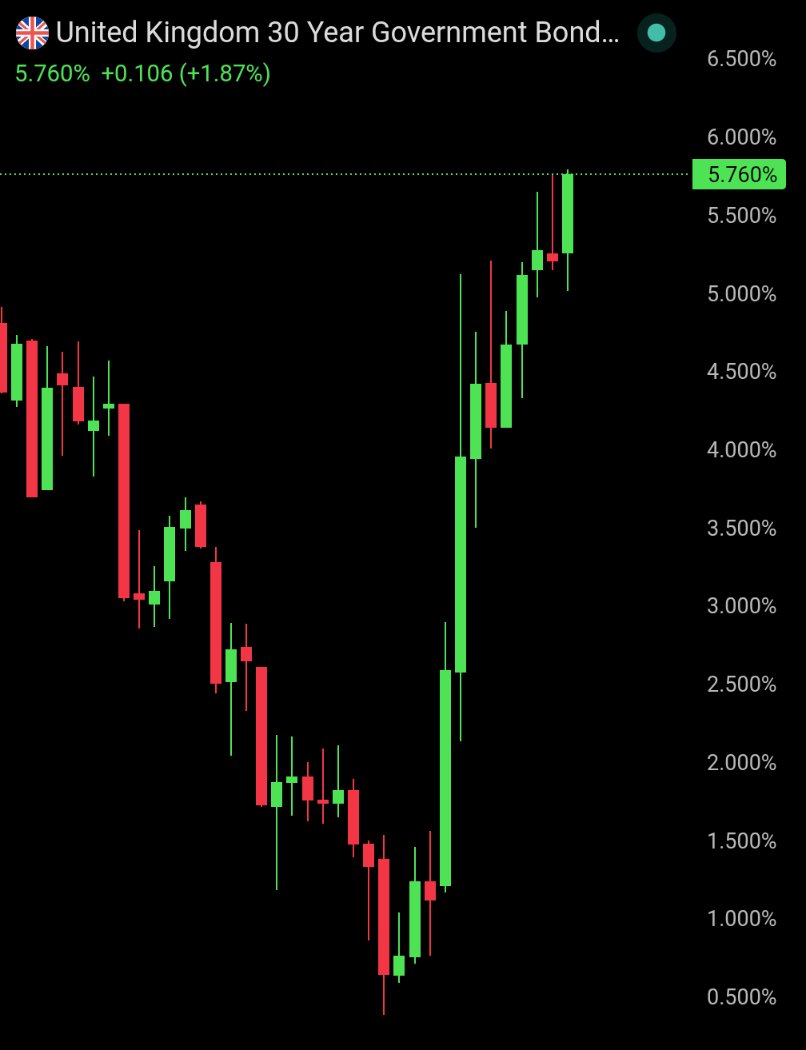
Japan Only Has 2 More Shots to Save the Weak Yen Japan has burned one of its limited “yen-saving” moves to stop the currency from getting too weak. Bloomberg reports that under IMF rules, it can only do two more big 3-day interventions by November or it risks losing its “free-floating” currency status and looking like it’s heavily managing the yen $USDJPY. USD/JPY
kristen shaughnessy tweet mediakristen shaughnessy tweet mediakristen shaughnessy tweet mediakristen shaughnessy tweet media
English
22
101
404
25.7K
Kimandi Trading retweetledi
Mohamed A. El-Erian
Mohamed A. El-Erian@elerianm·
Some may feel I’m dwelling on this, but I am concerned for the health of the UK economy. The yield on the 10-year gilt has climbed 12 basis points today (see the CNBC chart below), decoupling from both oil prices and yields in other advanced economies—both of which are currently lower. Meanwhile, the 30-year yield has just hit a 28-year high. #economy #markets #gilts #uk
Mohamed A. El-Erian tweet media
English
202
465
2K
368.8K
Kimandi Trading retweetledi
Crypto Tice
Crypto Tice@CryptoTice_·
I DON'T THINK YOU UNDERSTAND WHAT JUST HAPPENED. The entire US Treasury yield curve just broke simultaneously. 2yr. 5yr. 20yr. 30yr. All at the exact same moment. This is not a glitch. Only one type of seller moves like this. A sovereign. A central bank. A country. China holds $700B in US Treasuries. Japan holds $1.24T. UK holds $897B. If any of them started exiting today… This is exactly what it would look like. The bond market is the largest on earth. When it breaks like this something is fundamentally wrong. Stocks haven't reacted yet. But they will. Watch this week very closely.
English
119
459
2K
389.8K
Kimandi Trading retweetledi
Bull Theory
Bull Theory@BullTheoryio·
🚨 THE UK BOND MARKET IS IN TOTAL MELTDOWN. UK 30-year government bond yields have just exploded to 5.79%, a level not seen since 1998. UK’s long term borrowing costs are now significantly higher than they were during the 2022 "MINI BUDGET" crisis that forced the resignation of a Prime Minister.
Bull Theory tweet media
English
126
587
2K
167.2K
Kimandi Trading retweetledi
The Kobeissi Letter
The Kobeissi Letter@KobeissiLetter·
BREAKING: The UK's 30Y Government Bond Yield surges to 5.79%, the highest level since May 1998. Inflation is back and interest rates are surging.
The Kobeissi Letter tweet media
English
313
1.5K
7.4K
912.7K
Kimandi Trading retweetledi
Barchart
Barchart@Barchart·
JUST IN 🚨: Stock Market reaches most expensive valuation in history after the Warren Buffett Indicator hits 227%, surpassing the Dot Com Bubble and the Global Financial Crisis 🤯👀
Barchart tweet media
English
191
760
3.6K
1.2M
Kimandi Trading
Kimandi Trading@KimandiTrading·
@kenyanpundit correct..take it to governor level too..how did he not rope in ex governor mwangaza early enough as regards mt kenya east ?LM via orengo and osotsi came in and secured her..his think tank is either not upto scratch or non existent
English
0
0
2
265
Ory Okolloh-Mwangi
Ory Okolloh-Mwangi@kenyanpundit·
There’s a gap ODM is leaving at the local politics level (MP, county seats) that Wiper could work to fill, but Kalonzo is not serious
English
34
66
255
13.8K
Kimandi Trading retweetledi
Nostra, House of Gold
Nostra, House of Gold@Nostre_damus·
US Treasuries are dumping
English
27
171
1.8K
30.8K
Kimandi Trading retweetledi
The Honest Trader
The Honest Trader@TheH0n3stTrader·
✧ Richard Dennis: ROI : ~120% annualized in his strongest years. STRATEGY : He traded commodities. He used a trend-following strategy that was 100% mechanical. He held trades for long periods of time. ✧ Takashi Kotegawa: ROI : Turned $13,000 into $150 million. STRATEGY : He traded the Japanese markets with extreme focus on liquidity and order flow. He made money off of immediate inefficiencies in price movement. He held positions from minutes to hours, relying on tape reading. ✧ Paul Tudor Jones: ROI : 20-30% annualized. STRATEGY : He combines macroeconomic themes (interest rates, inflation, liquidity cycles) with technical timing tools. He keeps losses as small as possible and lets winners run as long as possible. ✧ George Soros: ROI : $1 billion in a single day. 30% annualized over decades. STRATEGY : He trades macro imbalances. His trades are highly concentrated and conviction-driven. When he's confident, he bets extremely big. ✧ Stanley Druckenmiller: ROI : 30% annualized with extremely low losing years. STRATEGY : He avoids diversification when he sees strong asymmetric setups. Instead of many small trades, he focuses on a few large positions with maximum upside potential. He combines macro insight with price action confirmation. ✧ Ed Seykota: ROI : ~60% annualized. STRATEGY : He's one of the earliest traders to fully automate rules-based systems. He's a systematic trader. He cuts losers short and lets winners run. ✧ Jesse Livermore: ROI : Made >$2 billion in today's value in the early 1900s. STRATEGY : He traded before modern indicators even existed. He relied on price action and human behavior. He was the GOAT of tape reading. He added aggressively to winning positions. ✧ Mark Minervini: ROI : 30% annualized, with exceptional years >200%. STRATEGY : He trades stocks. He focuses on tickers breaking out of tight consolidations after strong fundamentals emerge. He looks for volatility contractions, periods where price tightens before explosive moves. ✧ Jim Simons: ROI : 66% annualized. One of the best records ever. STRATEGY : He built Renaissance Technologies using pure mathematics, data patterns, and probability models. All trades are executed by algorithms exploiting micro-inefficiencies. Who's your favourite?
English
2
6
30
3K
Kimandi Trading retweetledi
Unfiltered
Unfiltered@quotesdaily100·
TIME IS NOT TREATED THE SAME EVERYWHERE: 1. Germany: Being late is disrespectful. Meetings start to the second. Punctuality here is not a habit. It is a moral standard. 2. Brazil: An invitation for seven means nine. Relationships matter more than schedules. Rigidity kills the atmosphere. 3. Japan: Trains run to the minute. A sixty second delay comes with a formal public apology. Time is a system. The system is everything. 4. India: Events begin when people arrive. The gathering defines the time. Presence matters more than precision. 5. Polynesian cultures: Time was tied to stars, seasons, and the ocean. Circular, not linear. The clock came later and from somewhere else. 6. United States: Time is money. Literally. Every hour is billable. Every minute is scheduled. Rest has to earn its place. 7. Spain: Lunch at three. Dinner at ten. The day bends around the person. Not the other way around. 8. Ethiopia: A different calendar entirely. Thirteen months. New Year in September. A different year than the rest of the world. Time here is a cultural choice, not a global agreement. 9. France: August belongs to rest. Emails go unanswered. Shops close. Nobody apologizes for this. Leisure is a right, not a reward. 10. Kenya: The clock starts at sunrise. Six in the morning is hour zero. Noon is hour six. Time is built around light, not an arbitrary number on a wall. 11. China: One time zone for the entire country. A landmass that should span five. In the far west the sun rises at ten in the morning. Unity was chosen over accuracy. 12.Australia: Aboriginal communities have always read time through seasons, animal movements, and the stars above. For over sixty thousand years the land itself served as the calendar. No clock was ever needed. Nature told them everything. 13. Mexico: Mañana means not right now. Urgency is often self-imposed. The present moment has its own demands and they are considered legitimate. 14. Greece: A guest arrives at any hour. You welcome them fully. The clock adjusts to the person. The person never adjusts to the clock. 15. Scandinavia: Months of darkness then months of endless light. The body follows seasons, not schedules. This is ancient. Science is only now catching up. 16. Nigeria: Start times are a suggestion. What matters is that everyone arrives, connects, and the evening becomes what it was meant to be. The experience always outranks the schedule. 17. Indonesia: Jam karet. Rubber time. Time stretches around mood, traffic, and social obligation. Rigidity is considered uncomfortable, not professional. 18. Russia: Eleven time zones. Vast winters. Long silences. Time here is treated with patience that outsiders often mistake for slowness. 19. Egypt: One of the first civilizations to invent a calendar. Yet modern Egyptian social time is deeply flexible. Hospitality always comes before the clock. 20. Congo: Community shapes the day more than any schedule. Time belongs to the people in the room, not the hands on the clock. 21. Philippines: Filipino time is a known and accepted reality. Six in the evening means seven or eight. Arriving before the host is ready is the real social mistake. 22. Vietnam: Built on endurance and long horizons. Planning here thinks in years and generations. Short deadlines feel foreign to a culture that measured time in struggles spanning decades. 23. Tanzania: Pole pole. Slowly slowly. A phrase that governs daily life. Rushing is not a virtue here. Moving with intention is. 24. Argentina: Dinner at ten. Parties at midnight. The night is its own world. Compressing it into earlier hours would make it something lesser. 25. Turkey: A meeting can become a meal can become a long evening. Nobody considers this a deviation. It is simply what time is for. 26. Iran: Its own solar calendar. New Year on the spring equinox. Time tied to nature, poetry, and a civilization so old that modern urgency feels like a passing trend.
English
70
1.1K
5K
697.4K
Kimandi Trading retweetledi
JustDario 🏊‍♂️
@FinanceLancelot He said people are trying to act normally, some chit chats here and there about the long weekend holidays, but mostly people are just staring at their screens, client chats are very quiet.
English
27
11
733
109.9K
Kimandi Trading retweetledi
JustDario 🏊‍♂️
A friend of mine working on a trading floor for an investment bank in London just told me the atmosphere there feels “surreal”
English
159
110
4K
709.4K
Kimandi Trading retweetledi
Anish Moonka
Anish Moonka@anishmoonka·
There's a clay tablet with the founding charter of a 12-partner company on it. Twelve merchants pooled 33 pounds of gold to start the firm. The contract has the partner names, the starting capital, the profit split, and the penalty for cashing out early. The tablet is nearly 4,000 years old. It was found at a site called Kanesh, in central Turkey. Archaeologists have dug up 23,500 of these clay records there, most of them business documents: receipts, loan contracts, shipping orders, lawsuits. The houses they were stored in eventually burned. The fire baked the clay solid and preserved every record. The merchants came from Assur, in modern-day Iraq. They loaded donkeys with tin and cloth and walked them 1,000 kilometers across mountain passes to Kanesh, roughly the distance from New York to Atlanta. Each donkey carried about 180 pounds and the trip took two to three months. They came home with silver and gold. The company ran for twelve years under a merchant named Amur Ishtar. A third of the profits went back to the investors. Pull your share out early and the firm gave you four kilos of silver per kilo of gold, half the normal rate. Locked-up money was meant to stay locked up. That one company was just a tiny piece. The tablets show a complete economy with partners suing each other in commercial court, husbands writing home about prices, and wives writing back complaining the husband had been gone too long. A woman named Ahatum quietly lent silver to four different men over nine years. People bought up other people's loan documents and used them as collateral for new loans, the same thing Wall Street does today with mortgage-backed securities. One merchant got caught smuggling tin in his underwear to dodge a 10% import tax. In 2019, four economists from Harvard, Sciences Po, Chicago, and Virginia ran the tablet numbers through a gravity model, the math economists use today to predict how much two countries will trade based on size and distance. The Bronze Age numbers matched modern trade numbers almost exactly. Trade fell off with distance at nearly the same rate it does between countries today. The paper ran in the Quarterly Journal of Economics. There was no economic theory yet. The idea didn't even have a name. The word "capitalism" wouldn't be coined for another 3,800 years, and Adam Smith was 3,700 years away from writing a sentence about markets. Just a guy named Pushu-ken writing a clay tablet to his business partner about a shipment of cloth, and a woman in Assur recording who owed her how much silver. Capitalism was already there, doing its full job, almost four thousand years before anyone wrote down a theory of how it worked.
Hayek-Club Weimar@WeimarClub

Niemand hat den "Kapitalismus" erfunden. Kapitalismus ist das, was freie Menschen von Natur aus tun - Waren und Dienstleistungen zu ihrem eigenen Vorteil tauschen.

English
374
3.5K
16.2K
1.3M