@lauriewired The Mels I’ve met in my life have never produced better code. No Mel, I can guarantee your binary sort is not faster than LINQs.
English
Kip DeCastro
385 posts
@Kipdec
Software Dev - Winner of two Monke Awards

Interesting article on treating agent output like compiler output (and why) skiplabs.io/blog/codegen_a…


@traits_reality dude I miss awt n windows forms shit SO much. I'm not even being a contrarian, I genuinely think the attached image is superior ux to a lot of stuff 2day. everything u need is jus there, no dumbass animations, no dumbass fonts, no dumbass rounded corners. just normal n pragmatic.



I never thought about this, but #dotnet MUST stop creating different versions every year. Unless something is fully broken Microsoft needs to have a framework that will work now and in 10 years This yearly release makes no sense. New features? Integrate them early and increase the minor version.






@Aaronontheweb Prefer C++? Incredible things are coming.


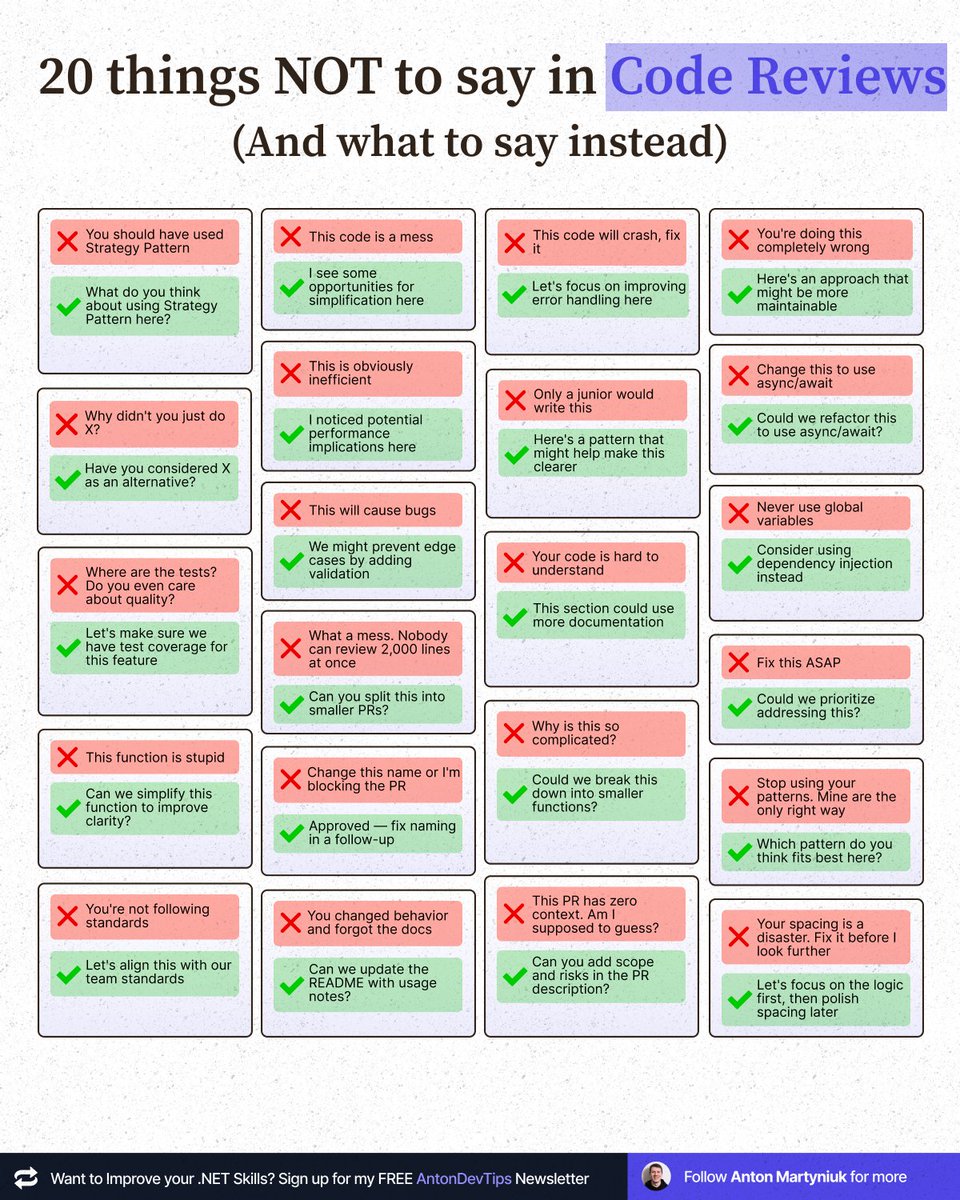

Most Senior devs tell you to create repositories for EF Core. But that's not the best way to code. As your .NET projects grow, handling data gets more and more complicated. Many teams start with the Repository Pattern, wrapping their EF Core queries inside. At first, this works fine. But as your project grows, your Repositories either don't do enough or try to do too much. Your code becomes harder to understand and modify as business requirements change. Each time you need a new filter or query, you add another method or even a new repository. Remember that EF Core's DbContext already implements the Repository and Unit of Work patterns This is clearly stated in the official Microsoft documentation on DbContext. You can also see this in the DbContext code summary in your IDE. When we create a repository over EF Core, we create an abstraction over an abstraction, leading to over-engineered solutions. How can you solve this issue? The answer is a 𝗦𝗽𝗲𝗰𝗶𝗳𝗶𝗰𝗮𝘁𝗶𝗼𝗻 pattern. The Specification Pattern is a way to describe what data you want from your database using small, reusable classes called "specifications". Each Specification represents a filter or a rule that can be applied to a query. This lets you build complex queries by combining simple, easy-to-understand classes. Recently, I shared with 13,000+ people: ➡️ Why Repositories Become a Bottleneck in Real Projects ➡️ What Is the Specification Pattern? ➡️ How to Implement Specifications in EF Core ➡️ Advanced Specifications Read the full article here: ↳ antondevtips.com/blog/specifica… 📌Subscribe to my weekly .NET newsletter, amazing content is coming in September — ♻️ Repost to help others learn about Specification Pattern ➕ Follow me ( @AntonMartyniuk ) for more #dotnet