
mmkz
3.1K posts

@KoKooffcial
AI/ML, Systems Engineering, Stochastic Calculus and All around Chuddhist


@cwsmith1729 They certainly do. Makes you wonder what he has in store for Ohio if somehow Vivek is tragically elected.

Taiwan vs Egypt in the 1950s. Taiwan was so poor then, most people couldn't afford cars and rode bikes instead. Kids often walked barefoot on the streets. Egypt actually had a functioning tram system and public transportation back then which was non-existent in Taiwan. But nowadays, people are so clueless as to how this switch was so recent they just assumed that Taiwan was always rich while Egypt was always poor. Not so.

One of the coolest stories I heard from David Reich about the interaction between genetics and human culture: The caste system was powerful enough to essentially 'freeze' Indian genetics for thousands of years, almost completely stopping the process of genetic mixture.


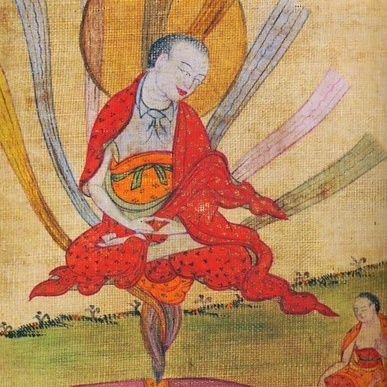
Buddha looked like this btw


Much of Hindu philosophy is aimed at addressing the "hard problem of consciousness": what *is* consciousness? Sure, you can write down all the physical laws underlying your mind etc but how does the subjective experience of consciousness arise from that? Who *are* you? Advaita Vedānta = Monism. You are the universe, observing yourself: and more specifically, you (consciousness) *are* the most fundamental reality, your sense that you, individually are conscious separate from all other beings and matter (ahaṃkāra) etc are only a result of the specific nature of how Brahman manifests itself (i.e. you can only observe your own memory, not other people's etc). This is quite promising and basically correct, but is a bit vague. In particular, it leaves open the question of what "how Brahman manifests itself" is. Advaita typically models Brahman as completely nirguṇa, and all specific facts about the physical universe and your individuality as completely illusory (Māyā), but this seems to just invert the question of "Why does consciousness exist?" to "Why do all the specific material attributes of the world exist?" Paramādvaita ("Kaśmīr Śaivism") = Pan-computationalism. If Brahman were totally nirguṇa and that was all there was to the world, it would be śūnya: none of our observed reality would exist. Sure, you can talk all you want about how the ultimate goal is to forget all that observed reality and just focus on Brahman, but clearly this observed reality is an actual phenomenon that needs to be explained: why is this the observed reality, rather than anything else? Śiva (=Brahman) is the universal consciousness, and Śakti (no longer mere Māyā) is that consciousness actively computing reality, i.e. the physical universe. One specific analogy given is that of the sea and its waves, i.e. Śiva is "pure" consciousness while Śakti is the specific patterns or information that correspond to the real world; though in other places it looks more like Śiva and Śakti are computation and physics respectively, and are both equivalent views of the same reality. [@Jakhar_ankit_ was the one to point out that it's specifically Paramādvaita that is computationalist, not really Advaita as a whole as I had thought.] Viśiṣṭādvaita = Panentheism + Exemplarism. Brahman is a multi-agent system comprised of all the individual ātmans, just like you are comprised of cells, or the economy is comprised of people. However we have a holistic rather than a reductionist view of the multi-agent system. Much like Paramādvaita, Viśiṣṭādvaita also rejects the notion that Brahman is nirguṇa, for similar reasons. However, its answer is to say that Brahman (here visualized as Viṣṇu) possesses only "good" attributes like infinite knowledge and strength and mercy, and all the bad attributes of individual souls are due to their incompleteness. One may compare this to the famous verses in the Bhagavad Gītā where Kṛṣṇa says "Among gods I am Indra, among mountains I am Meru, among birds I am Garuḍa" etc. This latter tenet is something I'm not convinced of. I would say that this exemplarism (as well as the resulting conclusion is that the goal is to have your ātman reach Vaikuṇṭha and be in eternal service of Brahman/Viṣṇu) is a borrowing from popular theism (which would later be formalized as Dvaita). [It should also be noted that the monism or panentheism of the Advaita schools should not be confused with panpsychism, where consciousness is viewed as an inherent microscopic property of matter, rather than linked to its interactions and dynamics. I would actually say panpsychism is equivalent to a dualistic philosophy, and is basically Jainism, but both would disagree.] ------- Advaita and its schools are definitely the correct approach to metaphysics in my view. However there is an alternative view, based on a simpler intuition about consciousness (think: dualism, Descartes, philosophical zombies). Sāṃkhya (Dualism). Human brains and bodies can run as perfect philosophical zombies, composed entirely of matter (Prakṛti). But consciousness exists (for we observe that it exists). Thus consciousness (Puruṣa) must be an entirely passive/static observer, enjoying the dance of Prakṛti but with no effect on it. This is similar to Descartes's dualism, except a bit less wrong because it doesn't randomly claim that philosophical zombies would be slightly less intelligent or agentic or whatever. Still, it is basically non-explanatory of consciousness, like asserting heat is a substance called phlogiston. Yoga (Sāṃkhya + God). Īśvara is a special, formless, Puruṣa who has never been tangled up with matter; a perfect reference point of pure consciousness to meditate on to also attain mokṣa. This is similar to the Buddhists' view of Buddha, except Buddha was not "eternal" like Īśvara but instead had to seek liberation himself. And the Buddhists do not actually have a model for what this liberated state is, since they do not believe in either Brahman or Puruṣa. In general I view their philosophy as comprised of incoherent and haphazard borrowings from Hinduism (as well as from Jainism or an earlier common śramaṇic base) with a bunch of wordceling put in between. Dvaita Vedānta (Classical theism). Brahman (usually seen as Viṣṇu or Śiva) is a completely separate creator god who designed the universe. ------- Apart from pondering consciousness, there are two other sources of darśanas: science and Vedic ritual. Which one is theistic, might surprise you. 1) Philosophy of science -> Nyāya-Vaiśeṣika. Nyāya is a school of epistemology and formal logic: what are the valid ways of knowing (pramāṇa)? What is valid logic and inference? What are the rules of debate? Vaiśeṣika asserts that the universe is comprised of atoms which form bonds and structures to comprise a zoo of the various substances seen in the world. If N-V "knew their place" and limited their claims to the material world, they would have no contradiction with Advaita or any of the other darśanas. However, they sought to explain consciousness with the same "atomistic" method, asserting that it is the result of the mixing of four substances (soul, mind, senses and the perceived object). Thus they did not see consciousness as fundamental: instead, the noumenal world was fundamental and consciousness was just a material property that emerged from certain "chemical interactions". N-V did not initially believe in/require Īśvara, but in medieval times became the strongest defenders of the idea. Their arguments (specifically that of Udayana) were: 1) Matter does not spontaneously arrange itself into structure, like clay does not spontaneously arrange itself into a clay pot. 2) Calculating karma for every soul in the world (and physical effects in general) is a complex task that requires an intelligent being. 3) Human knowledge must have been passed down from a "first teacher". Even if you learn things from observation etc, there must be some prior knowledge of how to even internalize this new information. One may note that all of these arguments have an "entropic" flavour, i.e. "the universe contains order, thus there must be an external source of energy/information into it". Dvaita also accepts the N-V view of Īśvara, but rejects its view of consciousness, and instead regards Īśvara as synonymous with Brahman. The Advaita (including Paramādvaita and Viśiṣṭādvaita) critique of this is not to reject this entropic argument (we are quite happy to say that Brahman is this "cause" of the world). Rather, they reject the proposition that Brahman is only the "efficient cause" (i.e. creator) of the world, and that the "material cause" (i.e. the raw material) is some completely separate "Prakṛti". 2) Exegesis of the Vedas -> Mīmāṃsā. In my post "The early development of Indian philosophy", I stated that there were two basic roots of Indian philosophy: intellectual speculation on the nature of consciousness (jñānakāṇḍa) and exegesis of Vedic ritual (karmakāṇḍa). One way to interpret the Vedas was a philosophical guide, often via analogies e.g. the famous "chariot analogy". This is Uttara-mīmāṃsā, which takes us back to jñānakāṇḍa/Vedānta. The other way to interpret it is as an explicit ritual manual. This is Pūrva-mīmāṃsā, which holds that (a) The authority of the Veda is *only* in prescribing ritual actions. Any other claim in the Veda is only an "auxillary" claim to make a broader point, and does not hold authority over observation and inference, the pramāṇas for the material world. (Note that Vedānta states the same.) (b) Ritual and its fruits are physical laws followed by the universe, and not administered by intelligent gods. [In fact, while jñānakāṇḍa motivates the development of philosopy, karmakāṇḍa was responsible for both philosophy and the Vedāṅga: auxillary disciplines such as linguistics, geometry and astronomy developed to better understand the Vedas and perform Vedic ritual, and thus Indian science itself.]


I recently spoke with New Scientist @newscientist, one of world’s major weekly science-and-technology magazines, to share how our work is revealing one of the most promising frontiers in human development, and may also be part of a bigger story about our collective potential and evolution. After decades of research on meditation, we still have so much further to go. The inner frontier runs deep. Many people wonder why we study advanced meditation, why we believe we’ve only begun to scratch the surface of its potential, and how such research can make a real difference beyond the Meditation Research Program at Harvard Medical School @harvardmed and Massachusetts General Hospital @MassGeneralNews. It’s true that our findings, including that meditative states like extended cessation and non-dual awareness are real and track meaningfully to measurable brain activity, are groundbreaking in their own right. But what may be even more radical and profound are their philosophical, scientific, and cultural implications. If the science of advanced meditation continues to explore the depths of the mind, alongside other bold frontiers of consciousness research, I believe the data will eventually speak for itself. We are learning, empirically, that the brain and mind can be rewired, reconfigured, healed, and transformed in ways that challenge what we thought possible. Some of these ideas about who we are, and what we might be capable of, include: — The “self” is a fluid, dynamic process, not a fixed entity. — The mind can be reset, similar to a computer rebooting to cleared settings. — Massive reductions in suffering can be learned. — Experiential distance between ourselves, others, and the world is profoundly malleable. And some of our most unhealthy desires and impulses may not be flaws hardwired into biology, but conditioned psychological patterns that can be seen through and transformed as we develop toward new ways of being. The possibilities this all hints at, what might be experienced if we realize these latent, powerful capacities, feel both hopeful and suggestive of a new beginning for what it may mean to be human. In a not-too-distant future, we may even have neuroscience-informed methods, perhaps biomarkers or brain stimulation, to accelerate meditative development and democratize access to deep transformation. Neuroscience alone may not have all the answers. But I hope this work continues to inspire more people, across disciplines, to safely explore how human experience can be radically good, extraordinarily plastic, and mind-blowingly beautiful. Personally, when studying a heretofore unstudied advanced meditative state, I feel we’re on the cusp of something incredible: to give more people a chance to stand in awe of their own awareness 💫 Thanks so much to Claudia Canavan @ClaudiaCanavan and New Scientist @newscientist for making this interview possible. The full interview is included in comments ⤵️